Lecture 17 C = Q Capacitance: V C = Q Q = 0 A Ed = d - - PowerPoint PPT Presentation

lecture 17
SMART_READER_LITE
LIVE PREVIEW

Lecture 17 C = Q Capacitance: V C = Q Q = 0 A Ed = d - - PowerPoint PPT Presentation

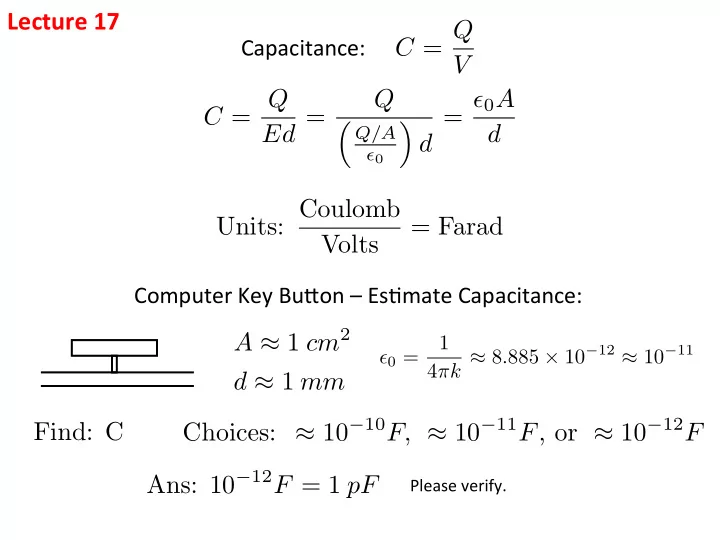
Lecture 17 C = Q Capacitance: V C = Q Q = 0 A Ed = d Q/A d 0 Units: Coulomb = Farad Volts Computer Key Bu2on Es6mate Capacitance: A 1 cm 2 1 4 k 8 . 885 10 12


slide-1
SLIDE 1

Lecture ¡17 ¡

Capacitance: ¡

C = Q V C = Q Ed = Q ⇣

Q/A ✏0

⌘ d = ✏0A d

Computer ¡Key ¡Bu2on ¡– ¡Es6mate ¡Capacitance: ¡

A ≈ 1 cm2 d ≈ 1 mm

✏0 = 1 4⇡k ≈ 8.885 × 10⁻¹² ≈ 10−11

Find: C Ans: 10−12F = 1 pF Units: Coulomb Volts = Farad Choices: ≈ 10−10F, ≈ 10−11F, or ≈ 10−12F

Please ¡verify. ¡

slide-2
SLIDE 2

Energy ¡stored ¡in ¡a ¡capacitor, ¡Q, ¡A, ¡D ¡

U = F extd = QE1plate

Q

d = Q ✓Q/A 2✏0 ◆ d = Q2 2 · 1

✏0A d

U = Q2 2C

Revisit: ¡

slide-3
SLIDE 3

Lec16-2 Attraction between two plates fig16.2a Given: a parallel plate system with plate charge Q and area A. Within the gap, Egap = (Q/A)/✏0 What is the electric force that the bottom plate exerts on the top plate? Choice F 1 QEgap 2 0.5QEgap Hint: In general, the force on exerted on q by a field E is given by “F = qE”. Here, “E” is the field due to all source charges except q, since self-force (i.e. q on q) is 0.

Fig(clicker) ¡17-­‑1 ¡

slide-4
SLIDE 4

E = Q/A ✏0 , Q = ✏0EA

Fig(clicker) ¡17-­‑1 ¡cont. ¡ When ¡there ¡is ¡E ¡there ¡is ¡electric ¡energy ¡

u = U Ad = ✏0E2 2 ∴ U = Q2 2C = (✏0EA)2 2 ·

1 ✏0A

d = d ✏0A = ⇣✏0 2 E2⌘ (Ad)

slide-5
SLIDE 5

Dielectric ¡Mediums ¡

E' Q E Q

E0 = E κ

Examples ¡of ¡κ ¡

κ ¡ Vacuum ¡ 1 ¡ Air ¡ 1.0006 ¡ Plas6c ¡ 5 ¡ Water ¡ 80 ¡ Semi-­‑conductor ¡ 300 ¡ Conductor ¡ infinity ¡

Microscopic ¡Picture: ¡

Epol Q

E0 = E − Epol = E κ

For ¡fixed ¡plate ¡charge ¡Q ¡

slide-6
SLIDE 6

E0 = E − Epol = E κ Q/A ✏0 − Qpol/A ✏0 = Q/A ✏0 , Q − Qpol = Q 

Dielectric ¡Mediums ¡con0nued... ¡

Qpol = Q  1 − 1 1 κ

  • 2 ¡limits: ¡ vacuum k = 1 ⇒ Qpol = Q

 1 − 1 1

  • = 0

metal k = ∞ ⇒ Qpol = Q  1 − 1 ∞

  • = Q

General ¡κ ¡and ¡Q ¡fixed: ¡ 1 < κ < ∞

E0 = E κ , V 0 = V κ C = Q V , C0 = Q V 0 = κC, U = Q2 2C , U 0 = Q2 2C0 U 0 = U κ

slide-7
SLIDE 7

Lec16-5 Capacitance in the presence of a dielectric medium The capacitance of a parallel plate capacitor in free space is given by C = Q/V = (Q)/( (Q/A)d

✏0

) = ✏0 A

d , where V is the potential difference

across the gap. When the gap is filled with a dielectric medium of dielectric constant , the electric field is reduced from the free space field E to E 0 = E/. Determine V 0 and C 0 — the potential difference and capacitance in the presence of the dielectric. Choice V’ C’ 1 V / C 2 V C 3 V / C/ 4 V C/

Fig(clicker) ¡17.2 ¡

slide-8
SLIDE 8

Lec16-6 Energy stored in a capacitor filled with a dielectric medium Given: a parallel plate capacitor with plate area A and gap width d. Determine the energy stored in the capacitor for a plate charge Q when there is a dielectric within the gap with dielectric constant κ. Hint: From Lecture 16-2, the energy stored in the capacitor in the absence of a dielectric is: U = Fd = ⇥ 1

2QEgap

⇤ d = Q 2 V = Q2 2C , where V = Ed and V = Q/C were used. Also C 0 = κC. Choice U’ 1 κU 2 U 3 U/κ

Fig(clicker) ¡17.3 ¡

slide-9
SLIDE 9

Hint ¡on ¡HW17-­‑3 ¡: ¡005 ¡

q1 = Q −Q q2 = 0

#1 #2

V 0

2f

V1f V1i κ Q0 Q00

Find: V1f V1i V1f V1i =

Q0/A ✏0 Q/A ✏0

= Q0 Q0 + Q00 = 1 1 + Q00

Q0

Hint: ¡

slide-10
SLIDE 10

Find: V at 0 V0 = V shell1 + V shell2 + V shell3

Where ¡charges ¡are ¡all ¡at ¡the ¡ surface ¡of ¡the ¡three ¡shells ¡

with charges: q1, q0

2,

q00

2

radii: R1, R2, R3

slide-11
SLIDE 11

Preview ¡of ¡Ch. ¡18: ¡Magne6c ¡Field ¡due ¡to ¡a ¡long ¡wire ¡

∆l

I

~ B

∆ ~ B = µ0 4⇡ I∆~ l × ˆ r r2