Learning Outcomes I understand the sources of capacitance in CMOS - - PowerPoint PPT Presentation

learning outcomes
SMART_READER_LITE
LIVE PREVIEW

Learning Outcomes I understand the sources of capacitance in CMOS - - PowerPoint PPT Presentation

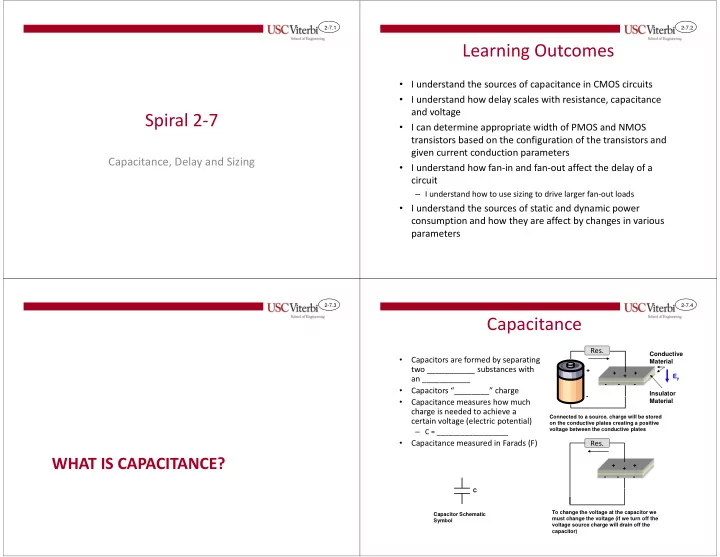
2-7.1 2-7.2 Learning Outcomes I understand the sources of capacitance in CMOS circuits I understand how delay scales with resistance, capacitance and voltage Spiral 2-7 I can determine appropriate width of PMOS and NMOS transistors


slide-1
SLIDE 1

2-7.1

Spiral 2-7

Capacitance, Delay and Sizing

2-7.2

Learning Outcomes

  • I understand the sources of capacitance in CMOS circuits
  • I understand how delay scales with resistance, capacitance

and voltage

  • I can determine appropriate width of PMOS and NMOS

transistors based on the configuration of the transistors and given current conduction parameters

  • I understand how fan-in and fan-out affect the delay of a

circuit

– I understand how to use sizing to drive larger fan-out loads

  • I understand the sources of static and dynamic power

consumption and how they are affect by changes in various parameters

2-7.3

WHAT IS CAPACITANCE?

2-7.4

Capacitance

  • Capacitors are formed by separating

two ___________ substances with an ___________

  • Capacitors “________” charge
  • Capacitance measures how much

charge is needed to achieve a certain voltage (electric potential)

– C = __________________

  • Capacitance measured in Farads (F)

Conductive Material Insulator Material +

  • +

+ +

  • Connected to a source, charge will be stored
  • n the conductive plates creating a positive

voltage between the conductive plates To change the voltage at the capacitor we must change the voltage (if we turn off the voltage source charge will drain off the capacitor) Capacitor Schematic Symbol C

+ + +

  • Ey

Res. Res.

slide-2
SLIDE 2

2-7.5

Charging/Discharging Capacitors

  • Charging a capacitor gets more “__________” as more charge is added
  • Eventually, no more charge can be added and the capacitor acts like an
  • pen circuit

Voltage of Capacitor Time

As more charge (voltage) builds up that charge repels like charge and makes it “harder” to add more (like pushing a spring)

+ + +

  • +

+ +

  • +

+ +

  • +

+ +

2-7.6

Capacitor I-V Relationship

  • Fact
  • , or
  • Also recall
  • Thus, substituting
  • __________
  • Current is linearly related (slope = C) to the

___________ in voltage (not the absolute voltage)

– No voltage _________ (constant voltage) means no ____________________

2-7.7

Measures of Capacitance

  • C =
  • – is the permittivity of the insulator substance

(intrinsic material property)

  • defined as 1 for a vacuum
  • Silicon dioxide (separates gate from silicon) = 3.9
  • Pure silicon = 11.68

– is the _________ of the conductive materials – is the ___________________ (or thickness of the capacitor)

+ + +

  • 2-7.8

RC CIRCUIT ANALYSIS

First-order RC circuit step response

slide-3
SLIDE 3

2-7.9

Resistance / Capacitance Analogy

Voltage Source = Water Pressure Resistance = Limit of water flow Capacitance = Total Water Needed

+ + +

Charge = Water Switching Time = Time to fill or drain the capacitor (“bucket”) of charge Thus, increase the voltage or decrease the resistance/capacitance.

2-7.10

Voltage, Resistance & Capacitance

  • Let's analyze a simple circuit

– Known as an RC circuit (resistor & capacitor in series) – Assume t < 0, _________________ – For t > 0, Vs = ___ (voltage source turns on) – Current through R must be same as current "through" C

  • ⇒ ____________

– Now let's solve for dVc/dt

  • ______________

– We can solve this differential equation

  • For Vc(0)=0 we have

_______________

2-7.11

Voltage, Resistance & Capacitance

  • Let's analyze a simple circuit

– Known as an RC circuit (resistor & capacitor in series) – Assume t < 0, Vs = Vdd then Vc=Vdd – For t > 0, Vs = 0 (voltage source = GND) – Current through R must be same as current "through" C

  • – Now let's solve for dVc/dt
  • – We can solve this differential equation
  • For Vc(0)=Vdd we have

__________

2-7.12

Time Constant

  • Notice the charging (discharging) time

is determined by product of R*C

  • We refer to this as the ___________, τ

– τ = RC

  • As the product of RC increases we get

___________ switching times

  • We can show that the time it takes to

charge/discharge a capacitor to a fraction of Vdd is given in the table below

Voltage Range Time 0 to 50% (tp = prop. delay) _____*RC 0 to 63% (τ) RC 10% to 90% (tr=rise time/delay) ____*RC

slide-4
SLIDE 4

2-7.13

DELAY

2-7.14

14

  • In order to examine the delay of a MOSFET, we have to

determine nature and amount of ______________ capacitance associated with MOS transistor

– Parasitic: Unintentional, ______________________ capacitors

– It's not that we want caps, we're ________________ due to the structure of the MOSFET.

  • The oxide layer separating gate and substrate is a more obvious

capacitor

  • However the _______________ around the source and drain

also form capacitors

MOSFET Parasitic Capacitance

Drain Source Gate

2-7.15

Transistor R and C values

  • Observation: Output of one transistor usually drives input of another

– Sources of resistance

  • ____________________________________
  • _____________ connecting __________________

– Sources of capacitance

  • ________________ of the next transistor
  • Other small capacitances

Metal Wire

Gate Drain Source Drain Source Gate

3V Source Charge must be conducted through this path and build up at the gate input to raise the voltage to the necessary value 2-7.16

Resistor and Capacitor Delay

  • Outputs connect to other inputs
  • To change the output voltage (really

the input of the next gate), we must conduct enough charge to raise or lower its present voltage

  • Resistance limits the amount of

charge that can be transferred per unit time

  • Capacitance determines how much

charge must be present to attain a certain voltage

  • Time it takes to attain a certain

voltage is proportional to R*C

Wire

+ + +

Desired Transition: 0V -> Vdd Switching Time ~ Resistance*Capacitance Wire from an output

  • f another gate
slide-5
SLIDE 5

2-7.17

Where RC Circuits Occur

  • Consider a CMOS gate driving others (__________)

– The output connects to the gate inputs of the loads (fan-

  • ut) and thus can be modeled as a capacitive load (CL)

2-7.18

Where RC Circuits Occur

  • Depending on the inverter input the PMOS or NMOS will be in

________________ mode and can be modeled as resistors

– Thus we have an RC circuit either charging or discharging the output (CL)

2-7.19

Defining Delays

  • We model

– The next gate(s) and other parasitic capacitances as a lumped capacitance – The PDN or PUN transistors as resistors (since they are operating in linear mode when the input is near VDD or GND)

  • tPLH and tPHL refer to the ___________ delay of a

circuit when the output changes from low to high (______) [tPLH] or high to low (________) [tPHL]

– !" # 0.69' !

()) *+ )),+

  • – "! # 0.69'.!

()) */ )),/ -

  • We say the delay of the gate is then:

– tPD≈ (tPLH + tPHL) / 2

  • Important: What reduces delay?

– ___________________________

Vin Vout Vin Vout

2-7.20

CMOS SIZING

slide-6
SLIDE 6

2-7.21

Sizing – PMOS is Slower than NMOS!

VDD IN OUT CL

  • Recall the equations for current through a transistor in linear mode

– |12| 3

4 5′ 7 !

2 9:2 |;| |

2| | 2|4

– Ohm's law says I = V/R so in the equation above 3

∝ 5′ 7 !

  • Problem _________ (KN ≈ _____KP)

– PMOS are ______ at conducting than NMOS – This will leave to imbalances in ______ (i.e. ______________) – To balance the delay when pulling up vs. pulling down we can play with _______

  • Solution: Make _________

by about a factor of 2 or 2.5

2-7.22

Sizing – Inverter

n p p n p p n n n p

W W W W W K W K R R L KW R 2 2 1 = ⇒ = ∝ ⇒ ∝

  • Assume
  • Find the ratio and Wp and Wn that balances the delay of output

during falling and rising transitions 2

n p

K K ≈

2-7.23

Sizing – Simple CMOS Gates

  • Goal: Make any gate have the same worst case resistance as

an inverter

  • The ratio of the {W/L}PUN/ {W/L}PDN should be about two (or

higher) to make up for slow PMOS

NAND NOR Important Notes: For parallel transistors consider only the case if 1 is on (Remember if R||R then Reff=R/2 which is a better case so we assume only one is

  • n)

Series transistors in series add lengths/ resistance All paths in a PxN should have same resistance

2-7.24

24

Sizing – Complex CMOS Gates

D A B C D A B C

PUN: make each path W/L = 2) PDN: make each path W/L = 1

slide-7
SLIDE 7

2-7.25

Compound Gate Example

A B Y C D D C B A

Y = D • (A + B + C)

PUN: make each path W/L = 2) PDN: make each path W/L = 1

2-7.26

Compound Gate Example

Y = AB+CD

PUN: make each path W/L = 2) PDN: make each path W/L = 1

2-7.27

FANIN & FANOUT

2-7.28

Fanout

  • Fanout refers the number of

gates an output connects to

  • As the fanout increases CL

________________ and means the delay _________

This inverter has a fanout (# of loads) = 1 This inverter has a fanout (# of loads) = 3

slide-8
SLIDE 8

2-7.29

Increasing Drive Strength

  • So far we’ve always modeled an idea inverter

for our transistor sizes

– Ideal inverter => NMOS: 1/1 and PMOS 2/1 or 3/1

  • We can counteract the increase in CL by

_____________ through increasing transistor ____________

– NMOS and PMOS widths increase by: ____________________

___ INV (Wn/Ln = 1) __ INV (Wn/Ln = 2) __ INV (Wn/Ln = 4)

2-7.30

Fan-in

  • Fan-in refers to the number of inputs

to a gate

  • Each input adds intrinsic, parasitic

___________

– tphl=0.69*Rn(___________________)

  • To discharge C2 requires going 2L (i.e. 2RN)
  • To discharge C3 requires 3L (i.e. 3RN)
  • This means delay grows quadratically

with fan-in but linearly with fanout

– tpd ~ ______________________

  • Important: Rarely want FI > ______

Fanin = 2 Fanin = 5

2-7.31

Mitigating Delay

  • May increase widths __________

– Bottom transistor has _______ width

  • Order transistors to allow the

latest arriving input control the transistor ________ to the output

– If Z is the latest arriving input we want to put it _______ to the

  • utput

2-7.32

INTERCONNECT DELAY

slide-9
SLIDE 9

2-7.33

Ideal vs. Realistic Wire

  • Ideal wire should have R=0 and little

capacitance

  • In real life it has some small R and C
  • R = ρL/A

– ρ = resistivity of material (some intrinsic property) – L = length or wire – A = cross-section area of the material

  • As technology scales (we build smaller

devices) _____ and ____ means resistance goes ___________

L

  • A

ρ = Intrinsic property of material

2-7.34

Modeling Interconnect Delay

  • Interconnect delay is starting to (already is) _______

switching delay

  • Important design considerations

– Long wire traces slow a signal down, thus global signals on a chip require special attention

Lumped Model (overestimates delay) Ideal wire Distributed Model (better estimate) A real wire can be modeled as…

2-7.35

Dealing With Interconnect

  • Clock, reset, and other signals must be routed carefully

and a whole tree of buffers inserted to decrease the delay

2-7.36

DYNAMIC POWER

slide-10
SLIDE 10

2-7.37

Power

  • Power consumption decomposed into:

– Static: Power constantly being dissipated (grows with # of transistors) – Dynamic: Power consumed for switching a bit (1 to 0)

  • PDYN = IDYN*VDD ≈ ½CTOTVDD

2f

– Recall, I = C dV/dt – VDD is the logic ‘1’ voltage, f = clock frequency

  • Dynamic power favors parallel processing vs. higher clock rates

– VDD value is tied to f, so a reduction/increase in f leads to similar change in Vdd – Implies power is proportional to f3 (a cubic savings in power if we can reduce f)

– Take a core and replicate it 4x => 4x performance and 4x power – Take a core and increase clock rate 4x => 4x performance and 64x power

  • Static power

– Leakage occurs no matter what the frequency is

2-7.38

Temperature

  • Temperature is related to power consumption

– Locations on the chip that burn more power will usually run hotter

  • Locations where bits toggle (register file, etc.) often will become quite hot

especially if toggling continues for a long period of time

– Too much heat can destroy a chip – Can use sensors to dynamically sense temperature

  • Techniques for controlling temperature

– External measures: Remove and spread the heat

  • Heat sinks, fans, even liquid cooled machines

– Architectural measures

  • Throttle performance (run at slower frequencies / lower voltages)
  • Global clock gating (pause..turn off the clock)
  • None…results can be catastrophic
  • Fun video to be played now!