
SLIDE 1
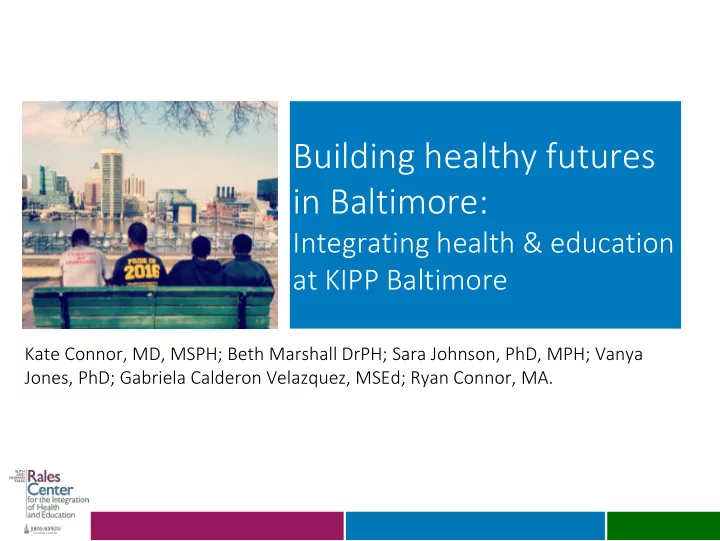
Building healthy futures in Baltimore:
Integrating health & education at KIPP Baltimore
Kate Connor, MD, MSPH; Beth Marshall DrPH; Sara Johnson, PhD, MPH; Vanya Jones, PhD; Gabriela Calderon Velazquez, MSEd; Ryan Connor, MA.
Building healthy futures in Baltimore: Integrating health & - - PowerPoint PPT Presentation
Building healthy futures in Baltimore: Integrating health & education at KIPP Baltimore Kate Connor, MD, MSPH; Beth Marshall DrPH; Sara Johnson, PhD, MPH; Vanya Jones, PhD; Gabriela Calderon Velazquez, MSEd; Ryan Connor, MA. Healt lth
Building healthy futures in Baltimore:
Integrating health & education at KIPP Baltimore
Kate Connor, MD, MSPH; Beth Marshall DrPH; Sara Johnson, PhD, MPH; Vanya Jones, PhD; Gabriela Calderon Velazquez, MSEd; Ryan Connor, MA.
Healt lth Disp isparit ities
Stress Poverty Trauma Nutrition No Access to Care Education Health Behaviors Poor Housing Toxins Inequities
Adapted fro rom: : Ito Iton, , A. . Calif lifornia Endowment
Educational l Disp isparit ities
Stress Poverty Trauma Nutrition School climate Teacher/curriculum Quality Health & Health Behaviors Poor Housing Toxins Inequities
The Rales Center’s vision is to be a national leader in developing, evaluating, and disseminating new school- based models that integrate health, educational, and developmental services for young people and their families.
K-4th 848 students 5th-8th
789 students
disadvantaged
conditions
screening
Neighborhood poverty levels, KIPP Baltimore students.
Our enhanced school health staffing model allows us to take a population health approach to comprehensive school health and wellness.
Pediatrician
Family Advocate Medical Assistant Wellness ONE Nurse Practitioner
Nurse Practitioner
School Nurses
Parent Engagement
htt ttps: ps://ww /www.cdc dc.gov/h /heal althyyou
th/ws /wscc/
supports KIPP’s effort to create a unique SEL programs based
– Restorative practices – Trauma informed schooling – Social justice – Joy
coached school leaders and teachers, evaluated SEL curricula, and created communities of practice focused on these areas.
10
School Health Services + School Based Health Center
– Acute, preventive, chronic disease management – Onsite lab, prescription delivery
Innovative Treatment of Chronic Conditions
Pediatric care Teacher wellness Wellness curriculum
The Rales Health Center has among the highest School Based Health Center enrollment rates in Maryland.
77%
nurses.
pediatrician and nurse practitioner.
In the first three years of the program, there were:
School Based Asthma Controller Directly Observed Therapy (DOT)
in at least one school-wide screening program for asthma, dental hygiene, fitness/obesity, or vision. That’s 8,505screenings!
pairs of eyeglasses were provided in-school 547 students participated in vision screening at school, last year. Students who failed received in-school
In one year, more than
student minutes
brought into classroom activities to get kids moving
Between years 1 & 3 …
Chronic absenteeism dropped by 50% among students with ADHD Chronic absenteeism dropped by 49% among students with asthma
Despite higher staffing costs, every $1.00 invested in the Rales Health Center returns more than $4.20 of social benefit
Rales Team
Wellness
Administration & Evaluation
Parent Engagement
More than one third of students are
42%
Asthma and ADHD prevalence among KIPP’s 1517 students
8% of students with ADHD 25% of students with asthma
and resources
implementation
Parent Engagement – Health Center Enrollment Cover letter
Con
tact ct Act Activi viti ties es
Modification to enrollment process: Please check ONE box (YES or N0) below regarding your family’s participation in the School Based Health Center: [ ]NO, I have read the attached information and DO NOT want to register my child with the SBHC.
1513 3 stu tudent dents
1117 ( (73%) %) consen ents ts returned eturned
Ma Maili ling ng 6% 6%
Orientation entation 19%
Outre treac ach h at school
ts 21% Class assroom
competition tition 26% 26%
Unkn Unknown wn 5% 5%
Person sonal al conta tact ct 24%
and resources
effectiveness
Physical Environment
Advocacy through data:
asthma related care