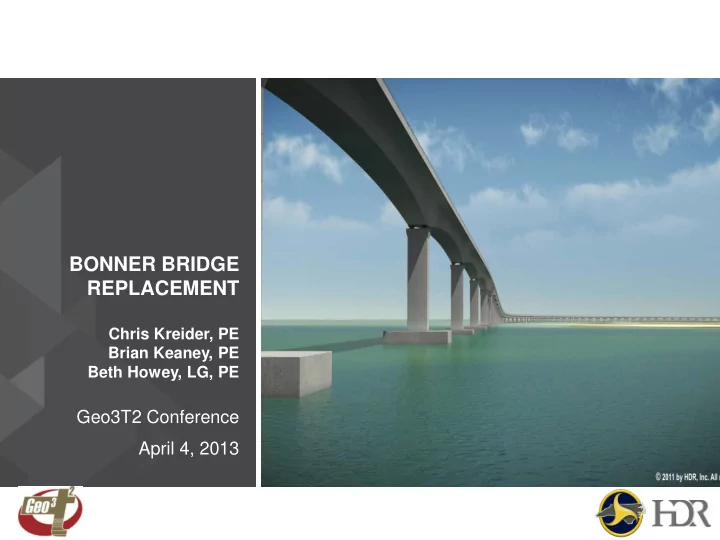
SLIDE 1
Geo3T2 Conference April 4, 2013
BONNER BRIDGE REPLACEMENT
Chris Kreider, PE Brian Keaney, PE Beth Howey, LG, PE
SLIDE 2
BONNER BRIDGE TIMELINE
SLIDE 3
October 1991 October 1990 June 1996 October 1993
SLIDE 4
Existing Bridge’s Navigation Span
SLIDE 5
This inlet didn’t exist before Irene struck in August of 2011
SLIDE 6
PROJECT WENT DESIGN BUILD ROUTE
► Design Build Team of PCL and HDR submitted proposal and
winning bid in July, 2011
► Winning Bid was $215,777,000.00
SLIDE 7
SUPPLEMENTAL BORINGS OBTAINED
SLIDE 8
SUBSURFACE CONDITIONS AT OREGON INLET
► Boring near each of the 83 Bents ► Colored profile based on soil type and added design scour line ► Provided soil parameters specific for each bent
SLIDE 9
SHIP IMPACT WAS A SIGNIFICANT CONCERN
► Bridge Closed
October 26, 1990
► Re-opened February
12, 1991
SLIDE 10
SCOUR WAS A HUGE CHALLENGE
► Design Scour to
Elevation -84
► Physical model scour
tests performed by OEI
► Conservative design
values
SLIDE 11
DIFFERENT SCOUR CONDITIONS MODELED
Soil at EL = 0.0 ft Long Term Scour 100-yr Scour ► Different scour
conditions were evaluated at each bent to determine the critical condition for various loading scenarios.
► FBMP program
utilized for each scour and loading condition.
SLIDE 12
TWO FOUNDATION ELEMENTS USED
► 36” Prestressed Concrete Square Piles ► 532 Piles Totaling 12 Miles in Length! ► Used under large footings constructed at the water
surface in navigation and transition zones
► Installed in battered configuration for increased bent
stability
► 6 to 30 piles under each footing ► Maximum Factored Axial Loads ranged from 638k to
1080k for the 36 inch piles
SLIDE 13
TWO FOUNDATION ELEMENTS USED
► 54” Prestressed Concrete Cylinder Piles ► 137 Cylinder Piles totaling 3.4 Miles in Length! ► Installed in approaches where scour and ship impact
are significantly less
► Piles extend all the way up to the bent caps ► 3 or 4 piles support each cap ► Maximum Factored Axial Loads for the 54” piles ranged
from 751k to 1490k
SLIDE 14
LOAD TEST PROGRAM PERFORMED IN NAVIGATION ZONE
► Near proposed Bent 24 ► Deepest scour area ► Deepest water depth
SLIDE 15
JETTING TO INSTALL PILES
► PCL developed
innovative jetting system
► Jet frame surrounds
pile
SLIDE 16
CLOSE UP OF JETTING PORTS
► Jet ports direct water
and air toward pile to limit disturbance to surrounding soil
► Important because 36”
square piles are only 7.5 feet apart
SLIDE 17
SLIDE 18
Jet in action with water and air
SLIDE 19 LARGE HAMMER REQUIRED!
► Delmag D-225
►
Ram Weight = 49.6 kips
►
Maximum Rated Energy = 565 kip- feet
►
Weighs 200 kips!
► After jetting to near
the final tip elevation, piles are driven to extend below potential disturbed zone beneath the tip
► Pile driving also helps
verify adequate resistance has been achieved
SLIDE 20
LOAD TEST IN PROGRESS
SLIDE 21
LARGE HAMMER REQUIRED!
► After jetting to near
the final tip elevation, piles are driven to extend below potential disturbed zone beneath the tip
► Pile driving also helps
verify adequate resistance has been achieved