The Failed Microfracture in a 41-Year-Old Weekend Warrior: What I - - PowerPoint PPT Presentation

the failed microfracture in a 41 year old weekend warrior
SMART_READER_LITE
LIVE PREVIEW

The Failed Microfracture in a 41-Year-Old Weekend Warrior: What I - - PowerPoint PPT Presentation

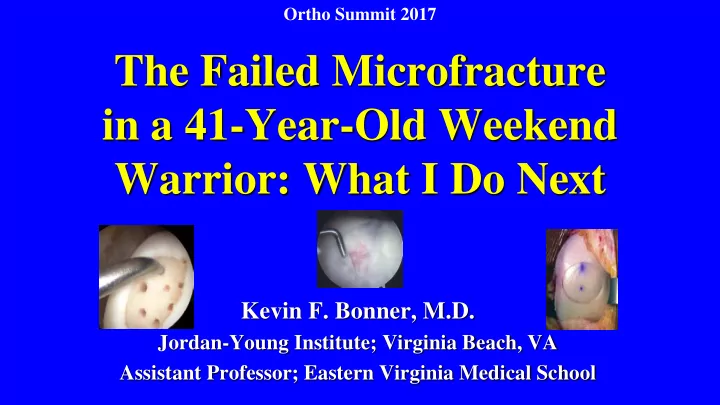
Ortho Summit 2017 The Failed Microfracture in a 41-Year-Old Weekend Warrior: What I Do Next Kevin F. Bonner, M.D. Jordan-Young Institute; Virginia Beach, VA Assistant Professor; Eastern Virginia Medical School Kevin F Bonner MD Disclosures


slide-1
SLIDE 1

The Failed Microfracture in a 41-Year-Old Weekend Warrior: What I Do Next

Kevin F. Bonner, M.D.

Jordan-Young Institute; Virginia Beach, VA Assistant Professor; Eastern Virginia Medical School

Ortho Summit 2017
slide-2
SLIDE 2

Kevin F Bonner MD Disclosures

1.Royalties : Zimmer / Biomet 2.Consulting : Smith & Nephew LifeNet Health Abyrx 3.Research and educational support : Depuy / Johnson & Johnson Zimmer / Biomet LifeNet Health

slide-3
SLIDE 3

Careful in a 41 Year-Old “Isolated Lesions” often the initial phenotype of DJD

  • Is it a train you cannot stop?

–Genetics

  • Is it a truly isolated lesion?
  • Need to address environment?
slide-4
SLIDE 4

41 YO Ex college basketball player: Prior microfracture

slide-5
SLIDE 5

Chondral Defects in the Knee:

Surgical Options

Lesion < 2 cm2 ? Primary Tx? Secondary Tx? Low Demand? High Demand? Low/High Demand

  • Arthrsocopic

Debridement

  • Marrow

Stimulating Technique (Microfracture, Abrasion, Drilling)

  • Arthrsocopic

Debridement

  • Marrow

Stimulating Technique (Microfracture, Abrasion, Drilling)

  • Osteochondral

Autograft

  • Autologous

Chondrocyte Implantation

  • Autologous

Chondrocyte Implantation

  • Osteochondral

Autograft

Lesion > 2 cm2 ? Primary Tx? Secondary Tx? Low Demand? High Demand? Low/High Demand

  • Autologous

Chondrocyte Implantation

  • Arthrsocopic

Debridement

  • Marrow

Stimulating Technique (Microfracture, Abrasion, Drilling)

  • Osteochondral

Autograft

  • Autologous

Chondrocyte Implantation

  • Osteochondral

Autograft

  • Autologous

Chondrocyte Implantation

  • Osteochondral

Allograft

  • Cole. Op Tech Orthopaedics 2001

Everyone develops their own personal, and likely ever-evolving, algorithm for cartilage defects

slide-6
SLIDE 6

Your Surgical Options for the Failed Microfracture

  • Osteochondral Autograft

Transfer

  • MACI
  • Fresh Osteochondral

Allograft

  • Newer options:
slide-7
SLIDE 7

In what cartilage religion were you raised?

Have an open mind

slide-8
SLIDE 8

Some may go to MACI next

  • MFX may increase failure rate of subsequent ACI

?

– Minas, AJSM 2009 – Pestka, AJSM 2012

  • Perhaps not:

– Riff, Cole et al. AAOS Annual Meeting; Las Vegas, NV 2015

Intra-lesional

  • steophyte
slide-9
SLIDE 9

JBJS 96-A (10); 2014

Survival: 78% @ 5 yrs 51% @ 10 yrs

No difference: ACI-C/ACI-P or MACI

4 yrs S/P Bilat ACI Pre-op TKA’s

slide-10
SLIDE 10

MACI for the PF Compartment

  • Good option for some

lesions not as amenable to OA grafts

  • Supported by the

literature

  • Insurance challenge
slide-11
SLIDE 11

However: Nothing as reliable as a viable osteochondral graft

Trochlea MFC

41 YO Ex college basketball player

slide-12
SLIDE 12

Osteochondral Autograft Transfer

  • Good option for smaller

symptomatic lesions: < 2.0 cm2

–Address subchondral issues –Relatively high return to activity –Durable

  • Potential Donor site morbidity
slide-13
SLIDE 13

Morbidity when graft transferred to

  • ther joints: Variable
  • Iwasaki. Am J Sports Med. 2007

0% (11 pts)

  • Reddy. Am J Sports Med. 2007

36% poor –Lysholm (11 pts)

  • Paul. JBJS-Am. 2009

10% mod or very unsatisfied (112 pts)

  • Kennedy. Cartilage. 2011

4% (72 pts)

  • Kim. Am J Sports Med. 2012

0% (52 pts)

slide-14
SLIDE 14

17-Year f/u in Athletic Population

  • 354 pts (ave 9.6 yr f/u)
  • 63% Mild / Mod arthritis

Good / Excellent Femoral 91% Tibial 86% Patellofemoral 74%

Harvest site pain: 5%

  • Hangody. Am J Sports Med 2010
slide-15
SLIDE 15
  • Arthroscopy. 2015 Apr;31(4)
  • 9 Level 1 & 2 studies (607 pts)
  • Appropriate for < 2 cm
  • Allows athletes to return at

high rate at 6 months

  • Deterioration at 2-4 yrs ?

Bentley JBJS-Br 2003, 2012 Ave 4.66 cm2

slide-16
SLIDE 16

Osteochondral Autografts

  • May be the best option for relatively small (<

2.0 cm2) symptomatic lesions in athletes

– Higher level of activity Krych et al. JBJS-AM 2012

  • Limited donor cartilage available
  • Donor site morbidity?
slide-17
SLIDE 17

Osteochondral Allografts

  • Typically used for >2.0 cm2
  • r subchondral pathology
  • Restore cartilage-bone

architecture

  • Results not effected by prior

MST

  • Logistical & supply issues
  • Cost / Infection /…..
slide-18
SLIDE 18

Outcomes of osteochondral allograft transplantation in the knee.

  • 19 studies - 644 knees (mean f/u 58

mos)

– Mean defect 6.3 cm2 – 46% concomitant procedures

  • 86% overall satisfaction rate

Chahl J, Gross AE, Cole BJ. Arthroscopy. 2013

slide-19
SLIDE 19

Return to athletic activity after

  • steochondral allograft

transplantation in the knee.

  • 43 athletes (2.5 yr ave f/u)
  • 88% limited return to sport
  • 79% full return to the

preinjury level

Krych AJ, et al. Am J Sports Med. 2012

slide-20
SLIDE 20

Return to an athletic lifestyle after osteochondral allograft transplantation of the knee.

Shaha, Cook, Rowles, Bottoni, Shaha, Tokish

  • 38 military pts
  • 4.8 cm
  • 42% unable to return to duty
  • 7% able to return to sports

Am J Sports Med 2013; Sep 41(9)

slide-21
SLIDE 21

Fresh Osteochondral Allografts: Patellofemoral (large grafts)

Trochlea: 89% extremely satisfied or satisfied (92% survival @ 10 yrs)

Cameron, Bugbee et al. Am J Sports Med. 2015

Patella: 29% considered failures

  • Of the 71% (20) with grafts in-situ:
  • 89% extremely satisfied or satisfied

Gracitelli, Bugbee et al. Am J Sports Med. 2015

slide-22
SLIDE 22
slide-23
SLIDE 23

Femoral Algorithm Autologous OAT

  • Up to 2 plugs
  • Large wide trochlea –donor site
  • Younger athletes: Needs one operation

with RTP within 6 months

  • Accepts risk of donor site morbidity

– “Robbing Peter to pay Paul”

  • This would be maybe my second choice
slide-24
SLIDE 24

Femoral Algorithm Viable OA Allograft

  • Most reliable option in a 41 YO

– And probably for most

  • My personal “go to procedure”
  • Quicker recovery than MACI
  • Accepts infection risk (minimal) & graft

failure

  • Can do plugs arthroscopically
slide-25
SLIDE 25

Personal thoughts & evolution on the treatment of articular cartilage lesions

  • Often long office visits
  • Reality is that they all don’t do well
  • Risk / benefit analysis discussion
  • Doing less than more initially OK
  • Nothing more reliable than a viable
  • steochondral graft

– Can be morbidity with donor sites

slide-26
SLIDE 26

Thank you