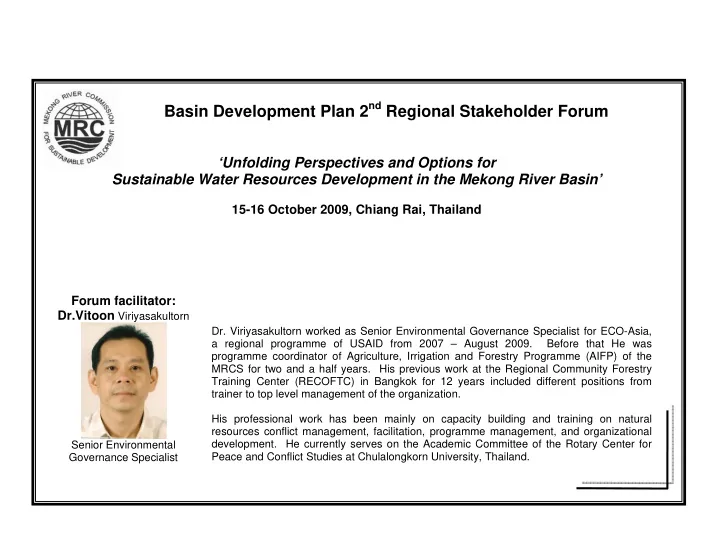
SLIDE 1 Basin Development Plan 2nd Regional Stakeholder Forum
‘Unfolding Perspectives and Options for Sustainable Water Resources Development in the Mekong River Basin’
15-16 October 2009, Chiang Rai, Thailand Forum facilitator: Dr.Vitoon Viriyasakultorn
Senior Environmental Governance Specialist
- Dr. Viriyasakultorn worked as Senior Environmental Governance Specialist for ECO-Asia,
a regional programme of USAID from 2007 – August 2009. Before that He was programme coordinator of Agriculture, Irrigation and Forestry Programme (AIFP) of the MRCS for two and a half years. His previous work at the Regional Community Forestry Training Center (RECOFTC) in Bangkok for 12 years included different positions from trainer to top level management of the organization. His professional work has been mainly on capacity building and training on natural resources conflict management, facilitation, programme management, and organizational
- development. He currently serves on the Academic Committee of the Rotary Center for
Peace and Conflict Studies at Chulalongkorn University, Thailand.
SLIDE 2 Ge Su ex (C co
lon ha ca pa Ph De Un Fac
Sessio
eoffrey Blate,
xperience in th Cambodia, Laos
ptions for forest ngstanding pas armonize conse
artners ranging f h.D. in tropical f egree from the niversity of Roch
Water Adviso cilitator of Sess
Cha
Ph.D., leads W s a tropical fores he Amazon, In s, Thailand, a e role of forests management. ssion for biodiv ervation with de regard, he has from local peop forest ecology f Yale School o hester.
n Dore
ion & Theme 1
Mekong R llenges an
John Dore Water Envir writer with engagemen to several b Governance Mekong Re special issu Controversy
Centre for WWF’s Climat st ecologist with ndonesia, and and Vietnam). s in internationa His interests en versity conserva evelopment goa developed pro le to governmen from the Botany
River Basi nd Opportu
is also Program ronment and Re particular inte nt and negotiatio
e in the Mekon gion: Hydropow ue of Water Alt y’
Seng
r Development O e Change init h 15 years of re most recently
al development ncompass both ation and a se als have been m
nt and academi y Department, U Environmental
n: Emerge unities
m Director of th esilience) resea erest in: region
Challenges for t ng Region (Silk wer, Livelihoods ternatives Journ Oriented Resea iatives in the esearch and pro y in mainland career has fo , and climate c basic and applie ense of urgenc motivating facto ng relationships c researchers. G University of Flo l Studies, and
ence of Kn
he research ne arch network, a nalism; transbo Recent writings he Mekong Reg kworm Mekong s, Governance ( nal focused on rch, Cambodia, Greater Meko
Southeast A
change adaptati ed research, bu cy in the need
with an array Geoff received
his B.S. from t
nowledge o
etwork M-POWE and a political e
include editing gion (White Lotu Press), Contes (Earthscan), NE n ‘WCD+10: Re Facilitator of T
D
Climate F
ent sia est ion ut a to his
his er’s the
ER (Mekong Pr economy and go multicultural, d and contributing us), Democratis sted Waterscap EGOTIATE (IUC evisiting the La heme 2
Change Coord Facilitator of The
pment
rogram on
eliberative g chapters sing Water pes in the CN), and a rge Dams
Blate
inator, WWF eme 3
SLIDE 3
Chief Techni MRC BDP P
ennaerts
cal Advisor Programme
Abstra
River Ba resource consider
expected This pre increasin resource countries
Title o
Meko trend
act: While mil
asin for their es are largely red to be in, or rging trends a d to modify the esentation will ng opportunitie es in the Meko s to a basin-w
ds and p
llions of poor food security undeveloped. r very close to and developm e flow regime o provide an ov es for the priv
wide IWRM ap
sentation:
er resou plans
people use t and livelihoo The hydrolog , it’s natural st ents at the g
verview of the ate sector in t clear and re-c pproach is now
:
urces dev
he natural res
ical regime of
global, basin a ng decades. emerging tren the developme confirmed com w important to
velopme
sources of the
the mainstrea the cumulativ and national l nds, existing p ent of water an mmitment by th
ent: eme
e Mekong nd related am can be ve impacts levels are plans, and nd related he riparian ccelerated
erging
SLIDE 4
Boungong
Department of Electricity Ministry of Mines and Energy, Laos PDR
Abstract: This presentation aims to share Gov of Laos’ perspectives on how
hydropower development can contribute to economic growth and poverty reduction in Laos and can be implemented in a sustainable manner. It emphasizes the importance
- f hydropower to achieve socio-economic development objectives in Laos. It shares the
updated information on hydropower development plans and the policies of the Laos Government to make sure that hydropower will contribute to poverty reduction. The Laos government perspectives on challenges and opportunities for sustainable hydropower development in the context of global and regional electricity demand, the sustainability of the fisheries and ecosystem and for equitable development are shared to invite Forum’ s participants ideas on the ways forward.
Title of the presentation:
Hydropower development for poverty reduction in Laos: opportunities and challenges
SLIDE 5 Abstract: Electricity markets in the Mekong region are profoundly
influenced by the quality of long-term official power system planning practices. This talk reviews several important planning practices: demand forecasting,
- ptions assessment, and risk assessment. The author emphasizes the
relevance of IRP (integrated electricity resource planning) as a proven best
- practice. IRP gives balanced treatment to demand-side and supply-side
- ptions are given balanced treatment, with the objective of investing in the
least-economic cost first. The time has come for Mekong electricity utilities to implement IRP principles. IRP can be designed as an integrated, participatory assessment, and in recent years a number of independent analysts have called for Thailand to initiate such a process. As an input to such a process, the author asked: how much electricity from power stations greater than 20 MW could be avoided if Thailand were to attain its ‘practically achievable potentials’ in clean domestic options: (1) energy efficiency; (2) renewable energy; (3) combined heat and power systems fired by natural gas. A detailed preliminary estimate of ‘clean domestic’ options Thailand can achieve by 2018, but not included in PDP 2007 Revision 1, sums to more than 7900 MW (approximately 33,000 GWh). The figures that Thailand will actually achieve depend on successful implementation of energy efficiency measures in commercial and industrial buildings, as well as on enhanced tariffs for renewable energy. Results depend on participation by the private sector, thoughtful incentives, and political commitment to more transparent and open planning.
Researcher, M-POWER
Title of the presentation:
Market opportunities for electricity supply in the Mekong region and alternative energy production options
- Dr. Tira Foran is a Research Fellow at Chiang Mai
University–Unit for Social and Environmental
- Research. He is interested in the policy and politics
- f transition to more sustainable energy systems in
developing Asia. Based in Thailand since 2001, Tira has recently worked on estimation of commercially achievable alternatives to central station power; policy instruments for energy efficiency and renewable energy; and improved mechanisms for stakeholder participation. Ph.D. (Geography) from University of Sydney, M.S. from University of California at Berkeley, A.B. from Harvard. Past work with the World Conservation Union (Thailand), The Nautilus Institute (California), and Environmental Defense (California).
SLIDE 6
Choulamany
Coordinator MRC Fisheries Programme
Abstract: The presentation highlights key characteristics of Mekong
fisheries, such as its diversity, its dependence on river flow, and importance of fish migrations, which all contribute to its extraordinary productivity and production, making it the world’s largest inland
- fisheries. Mekong fisheries are now affected by water development in
the basin, in particular the construction of dams. In fact, basin development and healthy fisheries are not contradictory, if fisheries were considered adequately in basin planning. In order to achieve this, additional research is necessary in fisheries ecology and valuation; integrated planning approaches are needed; and communication between stakeholders and sectors has to be improved. Importantly, negative impacts from basin development have to be assessed and, wherever possible, mitigated. The MRC Fisheries Programme has undertaken important activities in this direction, and first results are now available. They point out what is needed to maintain productive Mekong fisheries whilst developing the basin.
Title of the presentation:
Mekong fisheries and basin development planning
- Mr. Xaypladeth has been Deputy Director General of
the Department
Planning and International Cooperation in the agriculture and forestry sectors. He was actively involved in establishing the Living Aquatic Resource Research Center (LARReC) in Vientiane, serving as its founding director between 1999 and 2004. Mr. Xaypladeth has been active in developing numerous community fisheries programmes in the Lower Mekong Basin. He has also been actively involved in formulating national strategies for agricultural development, biodiversity, watershed-based development, wetland management and forestry in the ministry. As director of LARReC, Mr. Xaypladeth prepared the aquatic resources component
the National Biodiversity Strategy in 2000. He also authored the report “Traditional Use and Availability of Aquatic Biodiversity in Rice-Based Ecosystems” in 2005.
SLIDE 7 IW
Dr A Wat Scie scie rese Tow work asso and reha pos Sou Scie Res plan artic proc thes jour
Regional WMI Southeas Asia, La
Andrew D. Noble ter Management entist with a stro
earch Scientist w wnsville, far nort ked in both the
the potential abilitating degra itions (1982 - 19 uth Africa and P entist with the search (1989 - 19 ntation forestry. H cles and book
sis and is on the rnals.
ew Noble
Director st and Central ao PDR
e is Regional Di Institute (IWMI) a
ning IWMI in 200 with CSIRO Land th Queensland, wet and semi-a degradation incl role of clay aded soils. He 89) at the Unive roject Leader an Institute for 992) working in th He has over 108 chapters and o as supervised se editorial board o
Title o
Glob supp agric
irector of Interna and Principal Res in agronomy an 02, he was a Pri d and Water bas Australia, wher arid tropics on i luding soil acidific based materia has held Lec rsity of KwaZulu nd Principal Res Commercial Fo he area of comm peer reviewed jo
everal MSc and
Abs
syste secu comp There prom capit agric persp and availa using build to ha centu insec
bal food ply and d culture in
ational search d soil ncipal sed in re he ssues cation als in cturing Natal search
mercial
erence PhD ational
stract: Overa
ems, both larg
ponents that p e is an uniqu mote a shift to alizing on the cultural econom pective stemm the “breathing able to the GM g this period to more resilient andle the more ury – and mo curity.
sentation:
crisis, fu demand n LMB
all there is a e and small s require that rovide ecosyst ue opportunity
current conju mies; a new lo ming from inter g space” of 20 MS region befo
t communities, e extreme chan
:
uture pro and the
a need to tr cale, in order these system tem services. for the gove nable agricult unction of rapi
rnational awar 0-30 years th
t, implement a , the GMS reg nges predicted will alleviate c
role of i
ransform our to ensure lon ms have built rnments of th tural productio idly changing, gionally orient reness of clima at projections nges in climate and scale up m ion will be wel d for the secon current povert
irrigated
agricultural g-term food t into them he region to
responsive ed planning ate change; suggest is e occur. By measures to ll positioned d half of the ty and food
d
SLIDE 8
Natural Resources Planning Specialist Cambodian National Mekong Committee
Title of the presentation:
Changing land use in Cambodia, implication for poverty reduction and challenges with the current agricultural land concession
SLIDE 9 Title of the presentation:
Thailand water transfer and diversion scheme for irrigation development and poverty reduction
- opportunities and risks and lessons learned
- Ms. Chawee
Wongprasitporn
Royal Irrigation Department Thailand
SLIDE 10 Abstract: Irrigation is a means for improvement of agricultural
productivity, therefore has been considered to be one among important strategies of the government to reduce rural poverty. During the 1980s and 1990s large-scale water infrastructures lost their economic appeal and funding due to the opposition to dams, largely from the environmentalists. However, the advent of regional development of Mekong sub-region pushed by ADB saw the expansion of large-scale water infrastructures again. This presentation will consider irrigation development in the Northeast of Thailand under the context of regional development of Mekong sub-region. The Northeast of Thailand has been known as the poorest region, with poor quality of soil and therefore the lowest agricultural productivity. Irrigation has been at the center of development plan for decades. Growth in both agricultural sectors and industries of this region mounted the demand of water, resulting in ‘water deficit’ of the region. One of the strategies the government adopted is to import water from neighboring countries. The presentation will finally discuss the extent to which poor farmers of the Northeast will be benefit from irrigation projects, and try to identify what would be appropriate strategy for irrigation development in the future.
Prompakping
Faculty of Humanity, Khon Kaen University Thailand
Title of the presentation:
Lessons learned from the Greening Esarn Project
Buapun was awarded Ph.D. from Bath University in 2000. The title of his thesis is ‘Rural Transformation and Gender Relations in the Northeast of Thailand’. He is at present Associate Professor of Faculty of Humanity and Social Sciences, Khon Kaen University. In recent years, he was a member of the ESRC Research Group
- n Well-being in Developing Countries – WeD
and led a research project of this Research Group in the Northeast of Thailand. His interests
- f research are rural development, gender
relations, social capital and wellbeing. At present, he and his colleagues form a research group called ‘Wellbeing and Sustainable Development – WeSD’ at Khon Kaen University to continue and expand the research of the WeD Research
Group.
.
SLIDE 11
Helsinki University of Technology Finland
Title of the presentation:
Climate variability and change and impacts on the Mekong Basin
SLIDE 12 Abstract: Poverty in Cambodia is amongst the highest in the world.
Although considerably reduced over the last decade from a rate of around 45% to its present level of 35%, it is still substantial. Poverty is predominantly rural based, and given that the Mekong River Basin covers
- ver 85% of the country, not surprisingly most of population including the
poor lives in areas that are covered by Mekong River Basin which contains Tonle Sap. The poor in particular are heavily dependent on resources that are directly and indirectly provided by the lake and the Mekong Basin plain as well. Any change in the Mekong River’s flow regime therefore is expected to severely impact the livelihood of the poor as well as the larger population that depends on resources derived from the Mekong River Basin. The fish catch from the lake alone is close to a quarter of a million tones per year, accounting for the half of the total fish catch in Cambodia. Since 2001, through its Poverty Dynamic Study (PDS) which is funded by the WB, CDRI has conducted research on the dynamic of poverty in Cambodia, using samples from 9 villages in the country that represent different geographic conditions in there. Through 6 round of surveys conducted in 2001, 2005 and 2008, we have generated a panel data on various socio-economic factors and characteristics of around 1000 households. The information generated allows us to forecast possible impacts that changes in the Mekong River’s regime flow may have on the livelihood of the households directly affected and through that possible impact on the poor and poverty in the country.
Cambodia Development Research Institute (CDRI) Cambodia
Title of the presentation:
Tonle Sap and social vulnerability to potential changes in the Mekong’s flow regime
Hossein Jalilian (PhD, Reader in Economic Development, University of Bradford) is the research director at CDRI (Cambodia Development Resource Institute), Cambodia. He has considerable experience in research, consultancy and teaching in Africa and Asia; his research interest is in the area of macro economic modelling, growth and poverty.
- f around 1000 households. The information
generated allows us to forecast possible impacts that changes in the Mekong River’s regime flow may have on the livelihood of the households directly affected and through that possible impact on the poor and poverty in the country.
SLIDE 13 D
Dr. the Inst Doc Agr Ark crop
Asia San aro natu app live part auth area pov and
Can Tho Univ
Nguyen Van S Mekong De titute at Can Th ctorate degree riculture Econ kansas Universit p science at Ca Science in Ag an Institute of nh's research und themes ural resource proaches for inte lihood for food s ticularly in the hored and co-a as such as f verty reduction d food security.
n Van San
versity, Vietnam
Sanh is the Dep elta Developm ho University. H e in policy nomic Develo ty, after his Bac an Tho Univers gricultural Syst f Technology, background such as com e manageme egrated rural de security and po Mekong region authored literat flood control a and community
nh
m
Title o
Clim vuln Meko
puty Director of ment Research He obtained his in Rural and
from chelor degree in sity and Master tems from the
has revolved mmunity based ent, regional evelopment and verty reduction, . Dr. Sanh has ture relating to and mitigation, y development,
Abs
to clim proje millio subm Intrus rema the M could where This Meko livelih where key in borde strate
mate chan erabilitie
f h s d m n r e . d d l d , s
,
stract: Vietnam
mate change as ction, more tha
merged if sea lev sion of salt wate ining delta area Mekong Delta u d put the coffee e large areas co presentation illu
hoods are to clim e on-going strat n adaptation is t ers of provinces egies.
sentation
nge: und es and a ta
m ranks among s reported by th an one-third of and nearly hal vels rise by thre er and industria
p into the Cent e crop at risk, a
ustrates the po Viet Nam and mate change. T tegies have dem to look at the D s to ensure int
:
derstand adaptatio
the top five mo he World Bank the Viet Nam lf the country's e feet in the dec al pollution could climate change tral Highlands, w and to the Red ed near the cap
how vulnerab There are no sim monstrated both Delta as one sys egrated and we
ding of li
in 2007. In the Mekong Delta, s rice is grown cades to come. d contaminate m for Vietnam go where rising te d River Delta in pital, Hanoi.
ble the people mple answers to h success and f stem without ad ell coordinated
ikely imp ns in the
untries due worst case , where 17 n, could be much of the far beyond mperatures n the north, nge on the and their
ministrative adaptation
pacts, e
SLIDE 14 Session 2 – Cumulative Impact Assessment of Transboundary Economic, Environment and Social Implications of Water Resources Development
Robert Mather has a PhD from Cambridge University, awarded in 1992, for field work on primate ecology in Central Kalimantan, Indonesia. Robert joined WWF in 1993 to coordinate a large project for the Huay Kha Kaeng-Thung Yai Naresuan World Heritage site, in western Thailand, and subsequently established the WWF Thailand Office in 1995, taking it from a start- up operation to a nationally well-known and respected organisation with 60 talented staff by
- 2005. During this time Robert led projects working on conservation of elephants, tigers, and
marine turtles, as well as a number of environmental education programmes and protected areas management work. He also initiated a number of innovative partnerships with the private
- sector. Robert started to work on Mekong issues in 2001 and from 2005-2008 led WWF’s Living
Mekong Programme based out of Vientiane, Lao PDR. During this time the programme enjoyed rapid growth and a multimillion dollar annual budget, focused on environmental issues in hydropower development, road construction in headwaters and floodplain areas, conservation
- f priority sites throughout the basin from the Tibetan Plateau to the Delta, Mekong Dolphins,
Mekong Giant Catfish and the linkages between local livelihoods and sustainable management
- f wetlands. Robert joined IUCN in 2008 and is now responsible for IUCN’s programme in 3
countries – Laos, Cambodia and Vietnam, including initiatives such as the Mekong Region Water Dialogues supported by the Ministry of Foreign Affairs of Finland.
World Conservation Union – IUCN Facilitator of the session & parallel session 2.3
Chulalongkorn University, Bangkok, Thailand, Facilitator of parallel session 2.1
- Dr. Larry Hass, Chief Technical Advisor,
Initiative for Sustainable Hydropower, MRC, Facilitator of parallel session 2.2
Centre for Development Oriented Research, Cambodia, Facilitator of parallel session 2.4
SLIDE 15
Econo MRC BDP P
min Han
Programme
Abstra
is not fe
Basin’, w procedur Basin De meets pr how wat perspecti the resu scenarios scenario recognizi
assessm
Title o
Basi defin
decis
act: In a large a
easible to ‘force tion techniques. which would loo res of the sove evelopment Stra
ter related dev ive and mutuall ults of a comp s represent diffe would be form ing the synerg w of the propo ent of basin-wid
n-wide d nitions, a sults for sion ma
and complex ba e’ a rigid and . Nor is it feasib
reign riparian c ategy, which fo delines and con velopment can ly beneficial to prehensive ass erent levels of w mulated to repr gies and trade-
de development
sentation:
developm approac r basin-w king
asin as the Mek constraining ba ble to prepare a ration’ of water
- countries. But i
- cuses on how
- ncepts. The mos
proceed in a the LMB count sessment of b water resources resent different
, methodology t scenarios.
:
ment sce h to ass wide dis
kong basin, with asin developme an ‘IWRM Strate r related nationa t is feasible to development c st sensible optio way that is s tries, is through asin-wide deve development in combinations
y and process
enarios essmen cussion
six sovereign c ent plan, based egy for the Low al policies, stra prepare an IW can proceed in
sustainable from h a basin-wide d elopment scen n the Mekong B
presentation pr
nt and th ns and
countries, it d on basin wer Mekong ategies and WRM-based a way that uidance on m a basin dialogue of
velopment, resents an ulation and
ives, e use
SLIDE 16
Manager MRC Initiative for Sustainable Hydropower
Abstract: This MRC Strategic Environmental Assessment (SEA) seeks to
identify the potential opportunities and risks, as well as contribution of hydropower to regional development, by assessing alternative mainstream Mekong hydropower development strategies. In particular the SEA focuses
- n regional distribution of costs and benefits with respect to economic
development, social equity and environmental protection. There was strong debate in most workshops and workshop group activities were used to summarise and rank group consensus. Fisheries and agriculture were priority themes for all countries. Other themes which ranked highly in all countries included: Power & energy security, navigation, water quality, livelihoods and poverty reduction. Ten themes and key strategic issues were consolidated into a list of eight, based on the scoping consultations. For each theme a scope and methods paper has been drafted. These are key documents for the SEA as they outline the approach and substantive scope
- f the assessment. The theme papers involved intensive input from all
members of the team as well as MRCS.The SEA is an important first step to strengthen multi-stakeholder dialogue and capacity to undertake the formal prior notification, prior consultation agreement (PNPCA) process that proposed mainstream dams in the LMB will trigger. It will be the first time the formal MRC process is utilized for mainstream developments, when all the issues will be addressed by the 4 countries in the MRC platform. The SEA began in May 2009 and is scheduled to complete the final report and recommendations by mid-2010.
Title of the presentation: SEA of mainstream hydropower dams - objectives and scope as derived from stakeholder consultations
Voradeth Phonekeo joined the Mekong River Commission Secretariat as Project Manager for the Hydropower Programme on 28 April 2008. He holds a Master of Science in Hydropower Engineering from
- Moscow. Mr. Voradeth served the Government of Lao
PDR in the field of hydropower for more than 20 years and prior to joining the MRCS, he worked as IWRM National Planning Expert for Nam Ngum River Basin Development Project. In the beginning of his carrier he has been involved extensively in assembly and maintenance of hydro generators and hydro turbines for hydropower plants. He has been involved with feasibility studies of large hydropower projects such as Theun Hinboun, Nam Theun 2, and Nam Ngiep. He has also been an active participant in all stages of hydropower development and in many aspects such as power purchase negotiation, concession agreement, public consultation at all levels.
SLIDE 17 Abstract: The LMB countries have formulated and agreed on 9 basin-wide
development scenarios, some of which comprise sub-scenarios. First the scenarios will be assessed on a range of hydrological impact indicators. The results are then fed into the assessment of the transboundary economic, social and environmental impacts. This presentation will provide an overview of the 9 scenarios and the approach and methodology used for their hydrological assessment. Preliminary results indicate that subject to the assessment of risks and uncertainties, and from the single perspective of water availability, the four countries can now agree that the “LMB 20-Year Plan Scenario” reflects the quantity of water that could be ‘consumed’ by proposed developments in this scenario, without impacting on the present dry season flow. This does not necessarily mean that all of this development can proceed: the economic, social and environmental impacts must be determined and this will guide how much of this development will be ‘acceptable’.
Senior Modelling Specialist MRC BDP Programme
Title of the presentation: Hydrological assessment of basin-wide development scenarios-tools and results
SLIDE 18
Washington University USA
Title of the presentation:
Uncertainties to be addressed in the hydrological assessment of development scenarios
Jeffrey Richey is a Professor in the School of Oceanography and Adjunct Professor in the College of Forest Resources, Department of Civil and Environmental Engineering, and the Quaternary Research Center, University of Washington. He received his B.A. from Stanford University, MSPH from the University of North Carolina, and PhD from the University of California, Davis. His research involves the biogeochemistry and hydrology of large-scale river basins, and how to implement geo-information systems for analysis of complex basins. His long-term multi-national study of the Amazon has serves the dual purposes of gaining a broad mechanistic understanding of the fluvial system, and of establishing data baselines needed to assess anthropogenic perturbations. He has been extending this perspective to Southeast Asia/Mekong, South Asia, and to Africa. He has approximately 150 publications and conference presentations, was Vice-Chair of the IGBP LOICZ (Land Ocean Interactions in the Coastal Zone), is on the Scientific Steering Committee of the Amazon LBA program, and directs the Puget Sound Regional Synthesis Model program. He was awarded the Medalha Ademar Cervellini de Merito Academico, by the University of Sao Paulo. He has worked with the World Bank and GEF on projects of “dynamic information frameworks, in Brazil, China, Mozambique, Lake Victoria basin countries, and Bhutan, and is a member of the World Bank’s Hydrology Expert Facility.
SLIDE 19 Abstract: The main purpose of the economic assessment is to estimate the benefits
and costs of the various development scenarios in order to determine whether the proposed investments will be able to generate adequate net economic benefits in the
- future. The economic analyses will be undertaken on an incremental basis by
contrasting the annual net economic benefits in the “future with” and “future without” development situations projected over a given period. Net present values of the incremental net benefits will then be estimated for each development scenario. In order to take account of future uncertainties, sensitivity analysis will also be carried out. The equitable distribution of the economic benefits from water resources development is a key development objective. A distributional analysis will therefore be undertaken in
- rder to determine the likely allocation of the incremental net economic benefits
between the four LMB countries. In addition, employment created by the scenario interventions (e.g. hydropower, irrigation and flood mitigation) as well as jobs and livelihoods lost (e.g. fisheries) will be estimated for each LMB country and the overall basin economy.
Economist MRC BDP Programme
Title of the presentation:
Economic impact assessment of basin-wide development scenarios – methodology and process
SLIDE 20
Senior Fishe
ey Hall
ery Expert
Abstrac
a ‘guild’ fr the basin embankm accessible impacts o dams and availability arising fro
areas of e
Title o
Basin Asse
t: The presen
ramework to c to developme ents as barrie e spawning a
d (ii) water abs y measured in
ld fisheries by each type of fis
n-wide d essment
ntation outlines ent scenarios o characterize th ent pressures. ers to fish migr nd feeding ha n the flood zon stractions for ir n terms of flo ir fisheries cre irrigation proj sh habitat and
sentation:
developm Method
s the proposed
he vulnerability . The impact ration will be e
ne arising from rrigation, will b
eated above tr ects will be es their typical ar
ment sce
d methodology ds of fish. The y of different ty
estimated from g an empirica m: (i) water st be predicted fro d duration. Po ributary dams, stimated as th real fish yields.
enarios:
y to estimate t e assessment ypes of fish in ams and flood m potential cha al model, flow torage above
- m changes to
- tential gains
and (ii) an ex e product of t .
Fisherie
the likely employs nhabiting d control anges to change planned
in yield xpansion he ‘new’
es
SLIDE 21 Abstract: In this CED‘s presentation, it would be focused on the important and
the relevant of Sambor Hydro Dam study sites to its richest biodiversity area called Prey Lang which is the last evergreen forest in Southeast Asia on its economic value. 1- Current linkages of Sambor Planned hydro dam Area to Richest Biodiversity Prey Lang (in three communes of Sombor district of Kratie and one commune of Siem Bok district of Stung Treng Province , Cambodia)
- Sambor-Planned Hydro-Dam Area
- Richest Biodiversity Prey Lang- the evergreen forest along up-Mekong
2- Two possible approach practicing in Economic Assessment by the local in upstream of Mekong in Cambodia
- Through protecting in sustainable uses on their Non-timber forestry
products (NTFPs approach) for their community and family income.
- Through community action research of their wetlands biodiversity and
their income from those resources (action research approach).
Programme coordinator Community Economic Development (CED), Cambodia
Title of the presentation:
Other approach in economic assessment by the local in upstream of Mekong in Cambodia; A case study of Sambor hydropower dam study sites and its richest biodiversity area
I graduated in Bachelor of Law from Royal University of Law Economics (RULE) and Bachelor
Education from Human Resources University (HRU) in Cambodia. Currently, am studying for my Master Degree in Development Management at Norton
- University. Of course, after I had graduated, in
2006 I started working as a Project Officer with Working Group for Weapons Reduction (WGWR) in Community Security Project. In 2007 I worked as an Investigations Coordinator for Actions Pour Les Enfant (APLE) on child sexes which have been conducted by pedophiles. Currently I am working for Community Economic Development (CED) as A Programs Coordinator of NREM and Livelihoods in Northeast provinces of Cambodia.
SLIDE 22 M
Southa
Environmen MRC BDP P
mone lack
t Specialist Programme
Abstra
water re cause d different This pre assessm evaluate environm being m each M developm
Title o
Envi deve proc
act: The basi
esources deve different chan t environmenta esentation int ment of the s e the environm mental develo most relevant to ember State ment space th
ronment elopmen cess
n developmen lopment in the ges in hydro al impacts. roduces the
mental impacts
- pment objecti
- strategic dec
is the princip at each scena
sentation:
t impact t scenar
nt scenarios r e Mekong mai
proposed me e purpose of s of the differe ives previousl cision taking. pal means fo ario offers.
:
t assess rios – me
represent diffe instream and tions and cha ethodology to the environme nt scenarios in ly agreed bet The acceptab r determining
ment of ethodolo
erent levels o its tributaries, aracteristics, carry out en ental assessm n the context tween the cou bility of these i the magnitu
basin-w
which will and thus, nvironment ment is to
untries as mpacts to de of the
wide
SLIDE 23 Abstract: The presentation considers the issue of how to assess the
impacts of different forms of development on the environment and on people, both within the vicinity of where development takes place and further afield. The first part of the presentation considers some of the conceptual issues involved in understanding the relationship between prediction (of possible impacts), evaluation (of the significance of the impacts) and mitigation (steps to reduce or compensate for the impacts). It then gives an overview of an approach to considering these relationships in a structured way: Strategic Environmental Assessment (SEA). The origins and purpose of SEA approaches are
- utlined and a brief discussion on different types of SEA is provided.
The second part of the presentation is a summary of the approach to and findings from a major recent SEA in the Mekong Region, the SEA
- f the Hydropower Master Plan for Viet Nam. This SEA considered
the consequences of proposals for multiple hydropower development schemes within the context of the long-term planning of power supply and development of the country. An approach to provide more effective measures to reduce
mitigate both social and environmental impacts emerged from the study within the framework
- f the internalisation of such impacts in the economic assessment of
hydropower development.
Director Stockholm Environment Institute
Title of the presentation:
Strategic approach to assessment of development impacts on the people and environment
John Soussan is a Professor in the Stockholm Environment Institute and is Science Director of the SEI Asia Centre in Bangkok. His work focuses on the people-resource-policy relationships in developing countries, with in particular a focus on Asia, the region in which he has worked continually for the last 30
- years. A geographer by training, John has extensive
experience in the management of inter-disciplinary approaches in different aspects of sustainable development and has a track record of major projects funded by a range of organizations, including bilateral donors, multilateral development banks, UN agencies and environmental NGOs. John has worked in over 50 countries and has expertise in a range of environment and development issues including water resources, energy, strategic environmental assessment, community forestry, coastal zone development, livelihoods analysis, poverty reduction strategies and policy development.
SLIDE 24
Abstract: Tonle Sap is the big wetland area in Cambodia that
absorbs floodwater from Mekong River by 20%, and 60% of Tonle Sap water originate from Mekong River. The lake wet area is 13, 260 km² in the wet season, the size decrease to 2,300 km² in the dry season. In Tonle Sap, the flooded forest area for fish spawning and so on (197km²). This is the flood pulse in Tonle Sap. By the upstream development such Dams and Hydropower dam since 1950, there are nearly 6,000 dams build in lower Mekong. 23 dams are the big dam. This development has two main impacts to Tonle Sap: less flow in wet season and the long term flood in dry season. Building dam will block fish migration; decrease rainy season and increase flood in dry season. This changing will effect to floodplain, fish spawning, fish breeding, and fish habitat. Any upstream Mekong hydro development will alter the essential hydro-ecological processes upon which the Tonle Sap fishery depends. This fishery is critical to the livelihoods of over a million people in over 140 communities.
Ms.Thorn Riguen
Project Officer of Mekong Project Fisheries Action Coalition Team (FACT)
Title of the presentation:
The Impacts of Upstream Development to Wetland and Biodiversity resource in Tonle Sap
Thorn Riguen graduated BA of Socilolgy in 2006(Royal University of Phnom Penh-RUPP) and MA of Sociology/Anthropolgy; Major Rural Development (2008) from RUPP. Her experiences are freeland researcher for NGOs, Research company, and academy research such as KHANA, BBC, IRL, and etc. Presently, her is working in FACT since January, 2009
SLIDE 25
Janprasart,
Sociologist/Socio-economist MRC BDP Programme
Title of the presentation:
Social impact assessment of basin wide development scenarios
SLIDE 26
Research Fellow WorldFish Center
Title of the presentation:
Social implications of water resource development
Mark Dubois is Research Fellow and Project Leader for WorldFish engagement in the Wetlands Alliance at the World Fish Center, Greater Mekong Regional Office, Phnom Penh, Cambodia (email: m.dubois@cgiar.org). His research interests seek to bring together natural and social sciences in understanding complex systems in the context of rapid ecological, economic and social change. His current work focuses on participatory methodologies for constructing and communicating knowledge, political ecology, adaptive capacity development and exploring the relationship between human and ecosystem wellbeing. Mark has been working in the Mekong region since 1999.
SLIDE 27 Abstract: Large scale of water development projects will decrease
the level of access to natural resources, on which communities depend for their livelihoods. This will increase the level of impoverishment, undermine food security, especially among the ethnic minority and poor households and the loss of subsistence agriculturalists and thus the loss of culture. In order to promote more sustainable and peaceful ways of meeting people’s energy and water needs, first of all the importance of the Mekong river basin’s natural resources to people’s livelihoods and food security must be recognized and placed centrally in any basin development plan. Second, due to the potentially devastating impacts to regional fisheries and food security, the Mekong River’s mainstream should be placed
- ff-limits to dam development. Third, comprehensive options
assessment for meeting the region’s energy and water needs should be undertaken. Fourth, if dam projects are identified as the most appropriate option, affected people should give their agreement and indigenous people should give their free, prior and informed consent, as recognized by international law. Legally binding agreements for mitigation and compensation should be negotiated and affected communities should be guaranteed a share in the project’s benefits.
Country Director, Laos International Rivers South East Asia
Title of the presentation:
Large scale hydropower projects and their impacts on local communities in the Mekong River Basin
- Ms. Matsumoto works with International Rivers’
Southeast Asia team to focuses on monitoring the dam building industry in the Laos, and promoting better planning processes and technologies for sustainable use of water and energy resources. Before joining International Rivers in 2009, she was a policy
in the Environment and Social Development Department of the International Finance Corporation (IFC), one of the private arms of World Bank Group in Washington, DC. Prior to joining the IFC, Ms. Matsumoto was a Program Director of Friends
the Earth Japan (FoEJ), leading campaigns, developing advocacy strategies, and coordinating among local, national and international NGOs in order to reform the social and environmental policies and practices of Japan Bank for International Cooperation (JBIC), Japan International Cooperation Agency (JICA), and Nippon Export Investment Insurance (NEXI).
SLIDE 28
Anukularmphai
President, Thailand Water Resources Association
Dinner speech:
What is IWRM? From Rio to MRC Basin Development Planning – Repeating the same mistakes or moving towards sustainable transboundary basin management?
The Guest Speaker
Educated in Israel and the United States, Dr. Apichart Anukularmphai has over thirty years of experience in research, policy and institutional development, and management in the field of integrated water resources management and agricultural and rural development. He has served on a number of national, high-level policy making committees (e.g., National Water Resources Committee; National Rural Employment Generation Committee; Sub-committee for Co-ordination of Provincial and Central Plans for Rural Development; Committee for Co-ordination and Acceleration of Water Resource Development). He has extensive international experience in development cooperation, networking and institutional development, and has strong linkages with international research, development, and funding organizations; has demonstrated exceptional qualities for international and intercultural relations.
SLIDE 29 Abstract: Integrated Water Resources Management (IWRM) has gained worldwide recognition as an important approach to more
effective management of water resources locally, regionally and globally as evidenced by the Johannesburg Plan of Implementation (JPOI) which stated that “every country to develop IWRM plan by 2005”. However, there remains some confusion about what IWRM really is, is it a plan, a process, or an outcome? The JPOI statement in fact if interpreted narrowly may mislead countries into simply preparing IWRM plans as the end goal rather than putting IWRM into practice. IWRM as a process in water resources management is infinitely more important and meaningful than simply to have an IWRM plan, an experience shown in the case of Thailand. There is no fixed rule, procedure or template for the implementation of IWRM rather it depends much on the political, social and economic conditions
- f each country. It can be argued that implementing IWRM would need a road map or action program which would provide short-term
and long-term sets of activities and outputs. On the other hand, it is also of vital importance to have a coalition of key players or champions who can act as catalysts for change and who has the motivation and influence to engage the government and obtain its full endorsement and support in espousing IWRM. Finally, another critical factor for success is to be consistent in pursuing IWRM objectives and have patience in pursuing the same. IWRM when put into practice will bring about change in the water sector. It is these changes which make water resources management vastly different from the past notion of business as usual. It is critical to create changes through IWRM, i.e. the change of mindset of all involved in water resources management, the change in decision making process by stronger stakeholder participation, the change towards management rather than development, the change from separate responsibility to partnership, the change in the way we develop capacities for IWRM by also looking at institutional systems and mechanisms rather than pure training, among others. When we look at IWRM, it is these changes that should matter more than just IWRM plans as our key outputs. MRC remains a useful organization in bridging and promoting close cooperation of the four member countries in managing the Mekong River and its vast natural resources for the well being of the region’s population. To be even more effective, MRC needs to fully embrace IWRM principles, and integrate them in its operations. But beyond rhetorics, what can and should MRC do to be a genuine and effective champion of IWRM? What are its strengths and what opportunities should it open up to? What are its areas of weaknesses that it should address at the same time? MRC needs to continuously evolve in all aspects of its operations, it cannot be a dormant organization. Forefront is to change the mindset of looking at Mekong river as a resources base to be exploited only to accelerate economic growth of the region. Rather, to look at the Mekong as a sustainable resource for promoting quality of life and maintaining the ecological system for generations to come. To shift from simply sharing water to sharing benefits as well in a sustainable manner. The IWRM – based Basin Development Strategy for the Lower Mekong Basin seems to give more emphasis for having “an IWRM Plan”, but the challenge is how to implement IWRM as a process. Strengthening policy, strategic planning, implementation, and monitoring capacities for IWRM is crucial, and with the cross-border nature of the Mekong is something that MRC is in a very good position to address.
SLIDE 30 Session 3-Understanding the Distribution of benefits and costs, the potential winners and losers
Dr Andrew D. Noble is Regional Director of International Water Management Institute (IWMI) and Principal Research Scientist with a strong background in agronomy and soil
- science. Prior to joining IWMI in 2002, he was a Principal research Scientist with
CSIRO Land and Water based in Townsville, far north Queensland, Australia, where he worked in both the wet and semi-arid tropics on issues associated with land degradation including soil acidification and the potential role of clay based materials in rehabilitating degraded soils. He has held Lecturing positions (1982 - 1989) at the University of KwaZulu Natal South Africa and Project Leader and Principal Research Scientist with the Institute for Commercial Forestry Research (1989 - 1992) working in the area of commercial plantation forestry. He has over 108 peer reviewed journal articles and book chapters and over 100 conference proceedings. He has supervised several MSc and PhD thesis and is on the editorial board of several international journals.
Regional Director– IWMI Facilitator of the session 3
SLIDE 31
Senior Engineer, General Institute of Water Resources and Hydropower Planning and Design, China
Title of the presentation:
Contribution of the Lancang hydropower cascade to economic development and the downstream water regime - the perspective of the Chinese Government
SLIDE 32 Abstract: In this presentation we briefly show that capture fisheries in the
Mekong Basin are of major importance by global standards and crucial to food security basinwide. Fish production is much higher than cattle production in the region, and in Cambodia and Laos in particular, fish also outweigh pig and chicken production, meaning that there are currently no alternatives to offset possible losses in capture fisheries production. . We then emphasize measures that can minimize or mitigate the impact of dams
- n fish resources. These measures are multiple and cover dam location, spillway
design, clearance of vegetation in the dam reservoir, filling schedules, and reservoir management. The case of fish passes is also detailed, and it is concluded that although fish passes are possible mitigation options for smaller dams on tributaries, on the lower part of the Mekong there are no fish passes that can accommodate the size and intensity of mainstream fish migrations during the peak season. The last section of the presentation deals with alternative sources of fish production (aquaculture and stocking in reservoirs). We show that freshwater aquaculture is booming only in Vietnam, and that for the other riparian countries it does not seem likely to replace capture fisheries. Furthermore, in Vietnam the freshwater aquaculture sector targets foreign consumers and does not contribute much to local food security. We conclude that dam development in the Mekong is a potential threat to food security. There are multiple options for dam location and design, as well as for mitigation, but none of them will completely compensate for the potential loss of fish production, and the replacement of lost capture fisheries by aquaculture is very unlikely.
World Fish Centre
Title of the presentation:
Capture fisheries, dams, mitigations measures and alternative sources of fish production
Alan Brooks is the very recently appointed Director Greater Mekong for the WorldFish Center based in Phnom Penh Cambodia. Prior to that Alan served as Center’s Regional Director South Asia based in Bangladesh for 4 years. Alan joined DFID in 1998 to lead on an institutional strengthening fisheries project for 5 years and thereafter, led a consortium of private companies to oversee DfID’s entire rural livelihoods programme. A further 12 years Alan has worked on long term, private sector, research and development projects in Thailand, India, Zambia and Malawi. Alan holds a Masters degree from the University of Stirling, UK.
SLIDE 33 Abstract: There has been increasing demand from both riparian countries
and project developers for the provision of an integrated basin perspective against which ambitious national plans and proposed projects can be assessed to ensure an acceptable balance between economic, environmental and social outcomes, and mutual benefits to the countries. This has led to the preparation of an IWRM-based Basin Development Strategy by the four Lower Mekong Basin countries (LMB), supported by the MRC. The IWRM-based Basin Development Strategy will provide a clear and re- confirmed commitment by the countries to a basin wide IWRM approach to guide basin development in a sustainable way. The Strategy will define the ‘development space’ of the basin’s water and related resources within which the countries can plan and work, supported by strategic guidance and a package of IWRM guidelines that will assist policy makers and water managers in the use and management of the ‘development space’. Practical institutional mechanisms will be agreed to adapt the strategic guidance and processes in the Strategy into the various transboundary and national planning, decision-making and governance processes, which complement activities and processes now underway.
National Adviser for MRC BDP Programme
Title of the presentation:
From assessments to strategy for sustainable basin development and to implementation-Path being followed by MRC BDP
- Mr. Nguyen Hong Toan has more than 35
years of experience in the water sector including 10 years as Secretary General of the Viet Nam National Mekong Committee and the Member of the MRC Joint Committee for Viet Nam and 8 years working at the MRC
- Secretariat. His expertise is in the areas of
policy and institutional development, especially transboudary water governance. Holding a Master degree on water resources management from India, Mr. Toan also has extensive experience in hydraulic designs, environmental impact assessment and other water resources management related areas.
- Mr. Toan is currently Director of the Centre for
River Basin and Natural Resources Management and Member of the Secretariat
- f the Viet Nam Committee on Large Dams.
SLIDE 34 Professor
Director Department of Sociology & Anthropology, Chulalongkorn University
Title of the presentation:
Articulating the promises and impossibilities – Vision of the MRC Basin Development Planning and its draft IWRM Strategy
SLIDE 35
Session 4-Strengthen Partnership and Stakeholder Engagement
Richard Friend is a freelance consultant and researcher working in the Mekong Region. He specializes in natural resources management, sustainable livelihoods, participatory approaches and governance. Richard Friend
Consultant Facilitator of the session 4
SLIDE 36
Janprasart,
Sociologist/Socio-economist MRC BDP Programme
Title of the presentation:
BDP Stakeholder Participation and Communication Plan - the ambitions and lessons learned with the implementation to date
SLIDE 37 A Co
Mr.Than Thanas
A member of R
Northen Kon
noosak sarn
River Basin C) of Kok and g basins
Title o
BDP RBO natio
He is Lect
- 1. Thai ha
- 2. Farmer
- 3. IWRM i
- 4. Researc
- 5. Simple
- f the pres
process s, and th
turer of Rajabh bitat organic fa School Projec n Kok Basin ch on commun Photometer fo
sentation:
s at the s he coher basin p
hat Chiang Rai arm project ct nity water reso
sub-bas rence be lanning
i University an
in level, etween s
d followings ar ement
the role sub-basi
re his accomp
e of in,
lished:
SLIDE 38 Title of the presentation:
Preparation of the MRC Strategic Plan 2011-2015 –Process and expected involvement of stakeholders
Communication Officer MRC International Coordination and Communication Section
SLIDE 39 Joh res
netw gov reg deli pro con Cha Lot Me Con Hyd (Ea issu ‘WC Con
Water Advis
hn Dore is als earch network Water Environm work, and a vernance writer ionalism; trans iberative eng
ntributing chapte allenges for t us), Democratis kong Region ntested Watersc dropower, arthscan), NEGO ue of Water Alt CD+10: Revis ntroversy’
n Dore
sor, AusAID
so Program D M-POWER (Me ment and Resilie a political e r with particula sboundary and agement and nt writings inclu ers to several b he Mekong R sing Water Gov (Silkworm Me capes in the M Livelihoods, OTIATE (IUCN) ternatives Journ siting the L
Title o
Multi infor
Director of the ekong Program ence) research economy and ar interest in: d multicultural, d negotiation de editing and books – Social Region (White vernance in the ekong Press), ekong Region: Governance ), and a special nal focused on Large Dams
Abstract
which di representa focuses o examining decisions. MSPs are complex stakeholde focusing t part of a rewards, r
app
acto
i-stakeho rm and in
t: Multi-Stakeh
fferent stake atives, invited
g options an e an approach
ers in a new fo he MSP contr systematic a risks, rights and e rewards bein proach; e involuntary a ater-related righ e various wat
sentation:
nfluence
holder Platform eholders are and assisted knowledge a d iii) informi h for construc MSPs can b
ribution to wat nd semi-struc d responsibiliti ng sought from and voluntary w hts; ter-related res
atform - e decisio
ms (MSPs) are identified, to interact in a and perspectiv ing and sha ctive engagem e influential nication and d ter negotiation ctured approac
m a particular water-related ri sponsibilities
would it
e a part of gove and usually a deliberative ves, ii) gener aping negotiat ment and learn by bringing ecision finding ns is to use th
mple: project or dev isks;
t be able ng?
ernance in y through forum that rating and tions and ning about together
he 4Rs as s refers to velopment non-state
e to