SLIDE 1
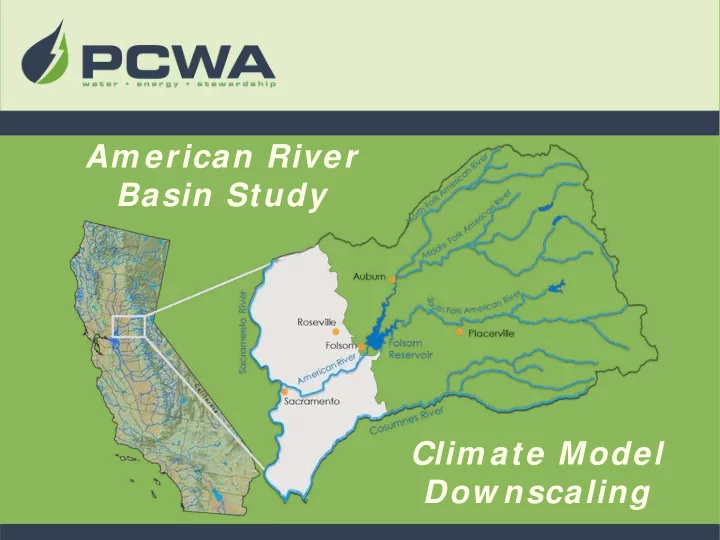
Am erican River Basin Study Clim ate Model Dow nscaling
SLIDE 2 American River Basin Study
ARBS Study Objectives
- Further refine the assessment of water supplies and demands for the
American River Basin
- Address regional supply-demand imbalance and infrastructure
deficiencies under the existing and future climate change conditions.
- Improve coordination of local and Federal water management.
- Align water management tools, strategies, and planning efforts of
Reclamation and water agencies in the basin.
- Identify water management strategies and actions which remain functional
across multiple future potential climate and socioeconomic conditions to 2100 AD.
SLIDE 3 Global Climate Projections Coupled Model Intercomparison Project – Phase 5 (CMIP5) Multi-Model Dataset
Models
scenarios
used for IPCC Fifth Assessment Report
projections of future climate conditions.
SLIDE 4 LOCA Multi-Model Dataset
- 32 Global Climate Models
- 2 long-term emissions
scenarios
publicly available through web-portal
CWC for long-term planning in California
Downscaled Climate Projections Spatial Downscaling Typical GCM LOCA
(~1.5° x ~1.5°) (1/16° x 1/16°)
SLIDE 5 Representative Concentration Pathways (RCP) Emsission Scenarios
Carbon Emissions per Year
(GtC/yr)
Methane Emissions per Year
(MtCH4/yr)
Nitrous Oxide Emissions per Year
(MtNO2/yr)
Atmospheric Carbon Dioxide Concentration
(parts per million)
SLIDE 6 Development of Climate Scenarios for ARBS Ensemble-Informed Hybrid-Delta Climate Scenarios
Ensemble of 64 GCM Projections Projection Selection for 5 Scenarios
W-W H-W H-D W-D CT
SLIDE 7 Hydrology Scenarios
- Climate scenarios used to force
VIC Hydrology Model
Hydrology Scenarios & CalSim Scenario Inputs CalSim Scenario Inputs
- Simulated runoff and potential ET
used to re-scale CalSim3 inputs to reflect climate scenarios
SLIDE 8
CalSim I I I Am erican River Operations Module
SLIDE 9 CalSim III Updates Complete representation of operations in the American River Basin
CalSim III Domain CalSim III Model Schematic
SLIDE 10 CalSim III Updates Complete representation of operations in the American River Basin
Project 184 Folsom Reservoir Upper American River Project Middle Fork Project American River Basin Representation in CalSim III
SLIDE 11 CalSim III Model Calibration
E ID - Pr
Uppe r Ame r ic an Rive r Pr
Middle F
k Pr
SLIDE 12
CLI MATE CHANGE PROJECTI ONS
SLIDE 13
ARBS Projection of Temperature Increases by Elevation
SLIDE 14
Supply: ARBS Projected Changes in Unimpaired Flow
Climate Scenarios
SLIDE 15
Demands: Increase in irrigation
SLIDE 16
Changes in Timing of Runoff Earlier runoff would increase the chance of spills from Folsom reservoir during flood season. Earlier runoff would reduce water supply available during summer and fall for M&I, ecosystem, hydropower, irrigation, recreation, etc.
SLIDE 17 Elevation > 5 ,0 0 0 feet
Under historical conditions, runoff occurs in late spring at elevations above 3,000 feet, peaking around May.
Elevation 3 ,0 0 0 to 5 ,0 0 0 feet Elevation < 3 ,0 0 0 feet
Changes in Timing of Snowmelt Under future conditions, runoff is expected earlier at elevations above 3,000 feet, with peak snowmelt 30-60 days earlier.
SLIDE 18
ADAPTATI ONS
SLIDE 19 We Can Adapt
Preparing for present-day droughts and preparing for a warming climate involve the same adaptations.
- 1. Improve Operational Flexibility
- Increase upstream storage
- Modified carryover storage targets and timing
- Develop groundwater bank
- Expand conjunctive use programs
- Relocate diversions to less sensitive locations
- Implement forecast based flood operations
- 2. Diversify Water Supplies
- Increase regional water reuse
- Implement stormwater capture
SLIDE 20 We Can Adapt (Continued)
- 3. Improve Demand Management
- Increase water use efficiency
- 4. Improve Resource Stewardship
- Improve Headwaters and Forest Health
- Improve Lower American River Ecosystem
- 5. Secure Institutional Agreements to Enable Flexibility
- Resolve water supply contracts
- Develop water marketing supporting tools and
management framework
SLIDE 21
QUESTI ONS?