B REAK - OUT D ISCUSSION RELATED TO L10N TOOLS M ARCH 16, 2012 - - PDF document

b reak out d iscussion related to l10n tools
SMART_READER_LITE
LIVE PREVIEW

B REAK - OUT D ISCUSSION RELATED TO L10N TOOLS M ARCH 16, 2012 - - PDF document

B REAK - OUT D ISCUSSION RELATED TO L10N TOOLS M ARCH 16, 2012 Participants Elena Rudeshko (moderator), ELEKS background : L10N of software products with software development and linguistic knowledge interested in : L10N process automation


slide-1
SLIDE 1

1

BREAK-OUT DISCUSSION RELATED TO L10N TOOLS

MARCH 16, 2012

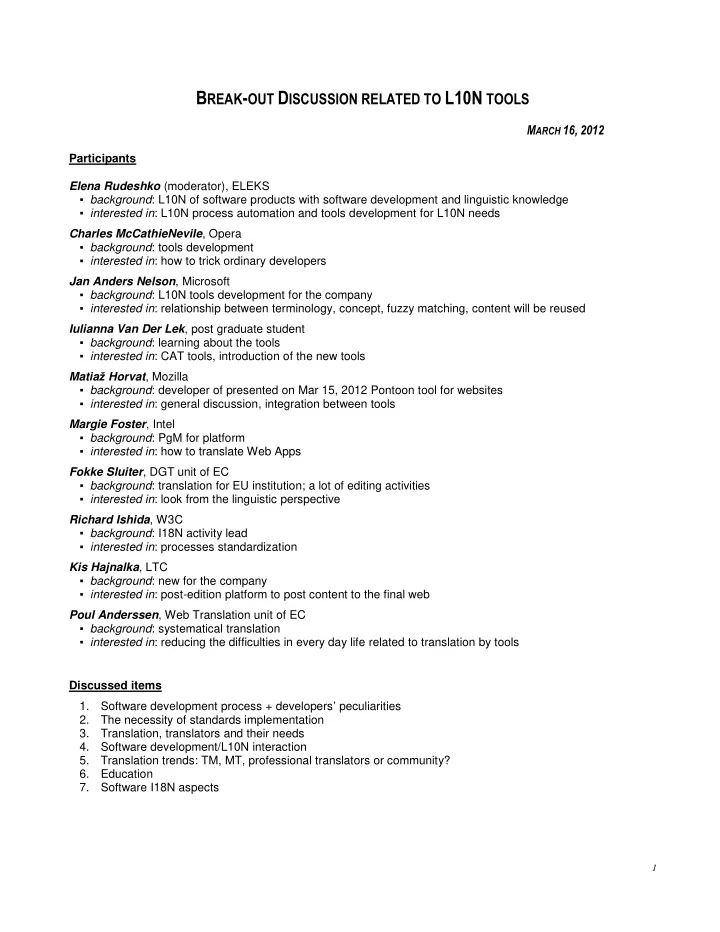
Participants Elena Rudeshko (moderator), ELEKS ▪ background: L10N of software products with software development and linguistic knowledge ▪ interested in: L10N process automation and tools development for L10N needs Charles McCathieNevile, Opera ▪ background: tools development ▪ interested in: how to trick ordinary developers Jan Anders Nelson, Microsoft ▪ background: L10N tools development for the company ▪ interested in: relationship between terminology, concept, fuzzy matching, content will be reused Iulianna Van Der Lek, post graduate student ▪ background: learning about the tools ▪ interested in: CAT tools, introduction of the new tools Matiaž Horvat, Mozilla ▪ background: developer of presented on Mar 15, 2012 Pontoon tool for websites ▪ interested in: general discussion, integration between tools Margie Foster, Intel ▪ background: PgM for platform ▪ interested in: how to translate Web Apps Fokke Sluiter, DGT unit of EC ▪ background: translation for EU institution; a lot of editing activities ▪ interested in: look from the linguistic perspective Richard Ishida, W3C ▪ background: I18N activity lead ▪ interested in: processes standardization Kis Hajnalka, LTC ▪ background: new for the company ▪ interested in: post-edition platform to post content to the final web Poul Anderssen, Web Translation unit of EC ▪ background: systematical translation ▪ interested in: reducing the difficulties in every day life related to translation by tools Discussed items

  • 1. Software development process + developers’ peculiarities
  • 2. The necessity of standards implementation
  • 3. Translation, translators and their needs
  • 4. Software development/L10N interaction
  • 5. Translation trends: TM, MT, professional translators or community?
  • 6. Education
  • 7. Software I18N aspects
slide-2
SLIDE 2

2

Participants input Charles: [1] ▪ developers think about themselves during SW development process ▪ translation tool of custom building; started to develop in Spanish ▪ works with Spanish speaking developers -> difficulty to find developer with good English [2] ▪ to have the same kit from one company is a death [3] ▪ ways to shift staff from one tool from another smoothly [4] ▪ start from scratch ▪ how to build the tool which helps to understand other issues? ▪ L10N is a problem for SW developers ▪ communities should have their own tools to talk to each other -- important for L10N process [5] ▪ should community replace prof. translators? ▪ perfect translation or good enough -> depends on the situation when it is used ▪ it's very expensive to have translators who copy-paste during their work Jan: [1] ▪ XLIFF 1.2 usage is strict ▪ vendors should pay their attention whether the tools rely on the needs of the process: ○ be free to invest in their internal tooling to innovate on their process efficiency ○ still be capable of a clean hand/off - hand/back cycle with developers ▪ each business unit in the company has their unique business needs -> they look for the layers where I18N engineering can be common and try to differentiate only where the businesses dictate [4] ▪ start talking with the stakeholders is important: ○ early interaction will surface and remove I18N defects before they can leak into the L10N work cycle and “explode” across the number of shipping languages requiring a lot more time to correct ▪ each business unit in the company has their unique business needs: ○ they look for the layers where I18N engineering can be common ○ and try to differentiate only where the businesses dictate ▪ internal tool development teams meet to determine the common engineering requirements to collaborate

  • n

▪ communication between different groups: “We need to converse” ▪ DEV tools: e.g. MS VS10 ships in 9 languages (http://msdn.microsoft.com/en-us/library/th647yhh.aspx ): ○ this is a critical mess for Chinese due to string writing skills of developers ○ strings need to be rewritten from skilled writers prior to translation to assure the best results ○ developers and their writers need the ability to focus on the app in their native languages [5] ▪ translation looks in the content -> the tool should optimize the difference -> we need to look at this ▪ Thai example: ○ 80% of visible UI have been translated -> excellent results for the market ○ visibility of UI strings is accomplished by instrumentation that users opt in to provide ▪ TM/MT/crowdsourcing feedback: ○ it is important to have trusted translators + MT usage ○ JP MT example: an increased expectation that the quality of translation gets better with time -> this evolves to an increased state where post MT human editing is needed ▪ healthy self-enforcing community -> it must be able to exist on its own or it will not be sustainable ▪ next steps: to move forward with HTML files, legacy, all old content [7] ▪ current implementation of WR Tenet == 2 years -> good results in the engineering system -> look forward to further improvements over future release cycles ▪ quality improvement: the focus was created by looking at historical top bug areas and targeting them ▪ items to implement I18N: QA management + recognition from top that I18N is a part of the production process + skilled people == permanent process control

slide-3
SLIDE 3

3

Richard: [2] ▪ standardization is required ▪ to build the tool to bring together known formats and the standards should be brought [3] ▪ nowadays translators should permanently learn [4] ▪ current tools need is to have interoperability between different formats Fokke: [3] ▪ monolingual English vs. languages with wide strings (e.g. Bulgarian, Greek) [4] ▪ constraints in the tools ▪ tools are not a problem, language is a problem ▪ L10N DEV tools: terminology is in English Iulianna: [3] ▪ cross language problem is present [6] ▪ there is a lack in the university education to supply L10N needs ▪ the number of studied CAT tools is limited ▪ all knowledge comes from work experience or desire of the person to investigate L10N and translation related processes ▪ there is a necessity to improve education process from L10N industry perspective Matiaž: [1] ▪ policy of using English in SW DEV companies in Slovenia ▪ a lot of English DEV terms are slavisized in the professional developers jargon [4] ▪ Pontoon is an attempt to improve translation of web site contents: ○ live website L10N tool ○ is still under development ○ only one developer is involved Margie: [7] ▪ I18N is still the secondary process from DEV perspective ▪ there is a number of defects which are postponed from release to release Elena: [1] ▪ it is a real problem to have a good English speaking developer on board in Ukraine, Russia: ○ technical staff usually has a problem with languages ○ they can read tech documentation in English, but no more ▪ local companies improve English knowledge of their staff by organizing internal English language courses ▪ the language inside professional developer’s community is a continuous mix of slavisized English tech terms [3] ▪ a lot of SW DEV related technical terminology is not translated and used in everyday life in English -> this caused a difficulty for tech translators ▪ problem with wide strings in APPs for Slavic languages in comparison with logical English [5] ▪ a common trend of transnational corporations is to have a good enough language rather than a perfect

  • ne:

○ e.g. Facebook and their local language communities ○ Thai Facebook has been fully translated without involvement of professional translators -> they prefer to have a good enough Thai [6] ▪ there is no any L10N/I18N related subjects in Ukrainian universities ▪ local companies trains their staff by themselves

slide-4
SLIDE 4

4

[7] ▪ I18N issues are usually a complexity during the work with the customer: ○ the chain is vendor -> customer’s L10N department -> customer’s DEV team and sometimes DEV teams are based in different locations ▪ standardization of I18N processes is required internally in the organization Kis: [3] ▪ the typical internal translation process is TM -> MT -> web-site -> post-editing Poul: [3] ▪ consistently using Trados for re-use the translation ▪ avoiding translation of XLS-files Common input: ▪ non-English speakers is still an issue ▪ we who involved in L10N industry can speak on more than one language ▪ if you build the culture you should start speak English ▪ culture is built on our workplaces everyday CONCLUSIONS

  • 1. L10N is a problem
  • 2. users are a problem
  • 3. lack of education and training is a problem
  • 4. exchange formats should be all aligned
  • 5. standard format to use
  • 6. new language -> to break the interchange -> to fix the interchange not the word
  • 7. software developers don't think about L10N and I18N needs starting from college