ATM Networking: Issues and Challenges Ahead LAN or WAN - - PowerPoint PPT Presentation

atm networking issues and challenges ahead
SMART_READER_LITE
LIVE PREVIEW

ATM Networking: Issues and Challenges Ahead LAN or WAN - - PowerPoint PPT Presentation

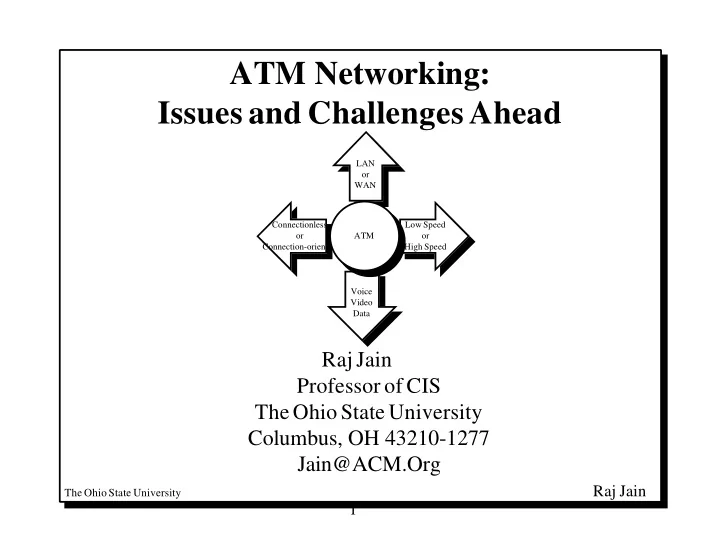
ATM Networking: Issues and Challenges Ahead LAN or WAN Connectionless Low Speed or ATM or Connection-oriented High Speed Voice Video Data Raj Jain Professor of CIS The Ohio State University Columbus, OH 43210-1277 Jain@ACM.Org


slide-1
SLIDE 1

Raj Jain

The Ohio State University

1

ATM Networking: Issues and Challenges Ahead

Raj Jain Professor of CIS The Ohio State University Columbus, OH 43210-1277 Jain@ACM.Org

Low Speed

  • r

High Speed Connectionless

  • r

Connection-oriented LAN

  • r

WAN Voice Video Data ATM

slide-2
SLIDE 2

Raj Jain

The Ohio State University

3

ATM Networks Overview Connectionless Traffic: IP Over ATM Requirements for Success Tariff, Scalability, Applications, Simplicity

Overview

slide-3
SLIDE 3

Raj Jain

The Ohio State University

5

Service Categories

CBR: Constant Bit Rate (Zero delay variation) VBR: Variable Bit Rate VBR-RT: VBR real time (Low delay variation) VBR-NRT: VBR non-real time ABR: Available Bit Rate (Source commits to control, Best effort to not loose cells) UBR: Unspecified Bit Rate (No commitment, No guarantee) CBR VBR ABR

slide-4
SLIDE 4

Raj Jain

The Ohio State University

6

Current Service Categories

Attribute CBR VBR-RT VBR-NRT ABR UBR CLR for CLP=0 Specified Specified Unspecified CLR for CLP=1 Optional Specified Unspecified CTD Specified Specified* Unspecified Unspecified CDV Specified Unspecified Unspecified Unspecified PCR Specified Specified N/A MCR N/A Specified N/A Controllable? No Yes No Application Circuit Switching Interactive Multimedia Multimedia Email Data Monitoring

CLP = Cell loss priority; 1 Cell can be dropped under overload CLR = Cell Loss Ratio CTD = Cell transfer Delay = End-to-end delay CDV = Cell Delay variation = Max-Min End-to-end delay PCR = Peak Cell Rate MCR = Minimum Cell Rate

slide-5
SLIDE 5

Raj Jain

The Ohio State University

7

Protocol Layers

IP Ethernet Twisted Pair TCP CLNS Token Ring Fiber TP4 IPX Coax Application Application Application UDP STP Network Datalink Physical Transport Application

slide-6
SLIDE 6

Raj Jain

The Ohio State University

8

LAN Emulation

IP Ethernet S/W Twisted Pair TCP CLNS Token Ring S/W Fiber TP4 IPX Coax Application Application Application UDP STP ATM LAN Emulation

slide-7
SLIDE 7

Raj Jain

The Ohio State University

9

IP Over ATM

IP Ethernet Twisted Pair TCP CLNS Token Ring Fiber TP4 IPX Coax Application Application Application UDP STP ATM

slide-8
SLIDE 8

Raj Jain

The Ohio State University

11

IP Over ATM

ATM similar to point-to-point WANs. Simpler than LAN emulation IP address:123.145.134.65 ATM address:…1-614-999-2345-… Issue: IP Address ⇔ ATM Address translation Address Resolution Protocol (ARP) Inverse ATM ARP: VC ⇒ IP Address Solution: Logical IP Subnet (LIS) Server Ref: RFC 1577 Router SW Router VC

slide-9
SLIDE 9

Raj Jain

The Ohio State University

12

ARP Over ATM

Only one ATM ARP server per subnet ⇒ No synchronization Clients are configured with server’s ATM address Clients setup a VC with the server Server sends an inverse ARP (What’s your IP Address?) Client responds with its IP Address Clients ask server by ARP request (What’s ATM address of 123.145.134.65?) Server replies with ATM address. NAKs if not in table. ARP requests are NOT broadcast to all LIS members No broadcast or multicast in LIS LIS Router Server LIS Server

slide-10
SLIDE 10

Raj Jain

The Ohio State University

13

New technologies are like new marriages Before After

Overview

Overview Overview Issues and Challanges Ahead

slide-11
SLIDE 11

Raj Jain

The Ohio State University

17

Networking Failures vs Successes

1980: Broadband (vs baseband) 1981: PBX (vs Ethernet) 1984: ISDN (vs Modems) 1986: MAP/TOP (vs Ethernet) 1988: OSI (vs TCP/IP) 1991: DQDB 1992: XTP (vs TCP)

slide-12
SLIDE 12

Raj Jain

The Ohio State University

18

Requirements for Success

Low Cost High Performance Killer Applications Timely completion Manageability Interoperability Coexistence with legacy LANs Existing infrastructure is more important than new technology

slide-13
SLIDE 13

Raj Jain

The Ohio State University

19

Challenge: Tariff

High-speed is important for LANs Low-cost is critical for WANs. Phone company’s goal: How to keep the voice business and get into data too? Customer’s goal: How to transmit the data cheaper? Tariff Today: 64 kbps voice line = $300/year 45 Mbps line (coast to coast) = $180 k-240 k/year ⇒ 155 Mbps line = $540 k - $720 k/year Tomorrow: 155 Mbps = $1k/month+ $28/G cells ⇒ $13k - $45k/year

slide-14
SLIDE 14

Raj Jain

The Ohio State University

20

Challenge: Simplicity

No equal competition ⇒ Complexity Ethernet vs Token ring war ⇒ improvements One size fits all ⇒ Complexity Too many options too soon. Should work for CBR and ABR LAN and WAN Private and Public Low speed and High speed Switches have to do connection setup, route determination, address translation, anycasting, multicasting, flow control, congestion control, ... Too few header bits. Bits used for dual purposes ⇒ Implementation complexity Many independent forums (ITU vs ATM Forum) ⇒ People energy divided

slide-15
SLIDE 15

Raj Jain

The Ohio State University

22

Summary

Available bit rate (ABR) service is important for data. IP over ATM is designed to KISS. Voice brings a lot of bucks for a little

  • bandwidth. Data requires a lot of

bandwidth for little bucks. Old companies will find it difficult to survive the tarriff wars. Solving all problems can lead to complexity and failure.

slide-16
SLIDE 16

Raj Jain

The Ohio State University

23

References

R, Handel, M. Huber, and S. Schroder, ATM Networks, Addison-Wesley, 1994. D.E. McDysan and D.L. Spohn, ATM: Theory and Applications, McGraw-Hill, 1994 L.G. Cuthbert and J-C Sapanel, ATM: The broadband Telecommunication Solution IEE 1993, London, 161 pp. David Benham, ATM in Local Area Networks, 11 April 1994, Hughes LAN Systems, (800)395-LANs, (415)966-7300. Communications of ACM, Special issue on ATM, February 1995 Presentation ATM Basics, ATM Forum, Fax on demand (415)- 688-4318, Document #5007, 8 pp. Computer based training (CBT) diskettes, ATM Forum

slide-17
SLIDE 17

Raj Jain

The Ohio State University

24

References

RFC 1577, “Classical IP and ARP over ATM’’ by M. Laubach, January 1994. RFC 1483, “Multiprotocol Encapsulation over ATM Adaptation Layer 5’’ by J. Heinanen, July 1993. User-Network Interface Specifications, V3.0, Prentice-Hall, September 10, 1993., (515)-284-6751 From ATM Forum, (415)-578-6860 B-ICI V1.1 DXI V1 DS1 Phy V1.0 52 Mb/s Category 3 UTP 155 Mb/s Category 5 UTP

slide-18
SLIDE 18

Raj Jain

The Ohio State University

25

Information Sources

ATM Forum (415)578-6860 info@atmforum.com http://www.atmforum.com Internet Engineering Task Force IP over ATM: atm-request@hpl.hp.com Routing over Large Clouds: rolc- request@nsco.netcom.com atommib-request@thumper.bellcore.com RFCs: mail-server@nisc.sri.com (Send Help in message) Draft RFC's: Internet-Drafts@cnri.reston.va.us Internet News: cell-relay-request@indiana.edu comp.dcom.cell-relay@indiana.edu International Telecommunications Union (ITU)

slide-19
SLIDE 19

Raj Jain

The Ohio State University

26

Recent Advances in Networking and Telecommunications Seminar Series 1995

Last Tuesday of the month (mostly), 3:45-5:15 PM at Ives 100 January 31: High Speed Networks: Trends and Issues February 21: ATM Networks: Introduction March 28: ATM Networks: Advanced Issues April 25: Multimedia Networks May 30: Multimedia Networks June 27: Wireless Networks July 25: Wireless Networks September 19: Congestion Control October 31: Signaling November 28: All-Optical Networks