
SLIDE 1
1
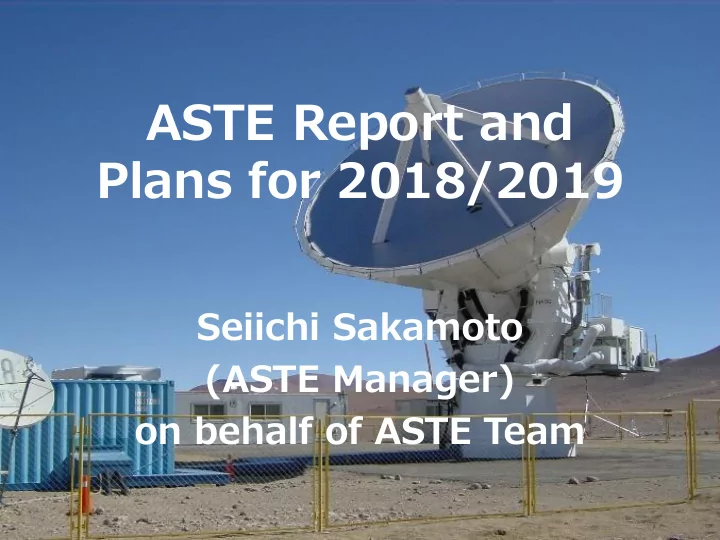
ASTE Report and Plans for 2018/2019
Seiichi Sakamoto (ASTE Manager)
- n behalf of ASTE Team
ASTE Report and Plans for 2018/2019 Seiichi Sakamoto (ASTE - - PowerPoint PPT Presentation
1 ASTE Report and Plans for 2018/2019 Seiichi Sakamoto (ASTE Manager) on behalf of ASTE Team 2 What is ASTE? ASTE Atacama Submillimeter Telescope Experiment 10-m submm telescope located at Pampla La Bola within Chajnantor
1
2
Pampla La Bola within Chajnantor area
– Surface accuracy: 19 um → 50 um? – Pointing accuracy: 2” rms – Scientific Observing Time: ~1000h/yr
– Gensets ×2 + fuel tanks (15 kL)×2 – Satellite Network (1 Mbps) – Weather Station, web cameras, etc.
– Strengthen EA ALMA proposals – Promote science with submm single dish – Promote astronomical instrumentation
ASTE ↓ ALMA
3
Understand and quantify the physical environments associated with star-formation processes, from large-scale molecular filaments (~10 pc = 1.5° at Orion) down to small-scale cores (~0.1 pc = 50" at Orion) including their kinematics (ΔV = 0.03 km/s over 60 km/s), through wide-field observations and deep (σ ~ 0.1 Msun for a 10σ detection) integration of nearby star forming regions in CO J=3-2, J=4-3, their isotopes, and the [CI] lines, as well as key carbon-chain molecules which are the proxy for the chemical evolution.
Probe the evolution of molecular clouds by mapping the distribution (~1 kpc = 21" at 10 Mpc) and kinematics (ΔV < 0.5 km/s over 1000 km/s) of the key total mass and dense gas tracers such as CO J=3-2, J=4-3 and [CI] in nearby (D < 10 Mpc) galaxies, including the Magellanic Clouds.
in the early universe
Probe the large scale distribution and the history of obscured massive star formation in the universe by observing the bright (S850 > 10 mJy) submillimeter galaxies at z = 3-7 in the [CII] line and the underlying continuum and deriving their precise redshifts (Δz = 0.01 at z = 4), at a rate of one galaxy per night.
platform for ALMA2 development
Use ASTE as a telescope to obtain pilot Band 9/10 data for future ALMA proposals (including ACA standalone) that request high resolution/sensitivity follow-up. ASTE shall be used for the platform for ALMA2 development.
4
ASTE Manager Seiichi Sakamoto* Maintenance and Development Group Lead: Shinichiro Asayama* Telescope Operation
RX Development
Science Operation Group Lead: Daisuke Iono* Science Operation
Computing
ASTE Deputy Manager Takeshi Kamazaki*
A-Project application for FY2019: 6.25 FTEs (incl 2 PD) + 1 FTE (EPO, safety, log, admin) as of 2018 December
5
⁻ During DESHIMA commissioning session, ASTE Az drive got stuck/locked on 2017 Nov 26 during DESHIMA commissioning campaign. ⁻ There is an issue on Az mechanism. Similar problem was found also for El mechanism. Spare parts are in preparation.
⁻ After stopping 4 months, fuel overflow (several×100 L) from the service tank of a genset was detected on 2018 Nov 23. ⁻ Contaminated soil was removed. ⁻ Leaky valves were replaced.
6
500 1000 1500 2000 2500 2012 2013 2014 2015 2016 2017 2018 2019 2012 2013 2014 2015 2016 2017 2018 2019a Total time [hours] 360 630 2020 2152 900 800 959
7
2012 2013 2014 2015 2016 2017 2018 2019a Total time [hours] 360 630 2020 2152 900 800 959
proposals Accepted East Asia 9 (228 h) Under evaluation Chile 2
Carryover from 2017 348 hours Carryover from 2018 216 hours 2019a EA: 203 hours CL: 96 hours (10%) Contingency 96 hours (10%) Total 959 hours
8
Trends in the number of publications.
→ Demo science data released in 2017 November (Izumi's talk)
9
Sample images of integrated intensity map (made by archived CASA fits data, 3 pixel gaussian smoothing)
10
Receiver Type Freq [GHz] HPBW [arcsec] Npix Npol DASH345 Heterodyne 324-372 22 1 2 Band 8 Heterodyne 385-500 17 1 2 Spectrometer Type BW [MHz] Δf [kHz] WHSF 3-bit 2048 ch FX 4096 2000 1.7 over 3500 km/s 2048 1000 0.86 over 1755 km/s 1024 500 0.43 over 878 km/s F-FX 64 31.25 0.027 over 55 km/s 32 15.625 0.013 over 27 km/s
11
10 20 30 40 50 60 320 330 340 350 360 370 380
SIS bias current with LO [uA] LO freq. [GHz]
P0S1_old FEM60 P1S1_old FEM60 P0S1_new FEM37 P1S1_new FEM60
all frequency range due to over-sized waveguide.
improvement of LO input power
12
12
13
14