9/11/2018 JOINT ESTATE PLANS What makes the good plans good and - - PDF document

9 11 2018
SMART_READER_LITE
LIVE PREVIEW

9/11/2018 JOINT ESTATE PLANS What makes the good plans good and - - PDF document

9/11/2018 JOINT ESTATE PLANS What makes the good plans good and the bad "plans" bad? PURPOSE OF PRESENTATION How to more effectively deal with spouses that come to your office to help with estate planning How to deal with the


slide-1
SLIDE 1

9/11/2018 1

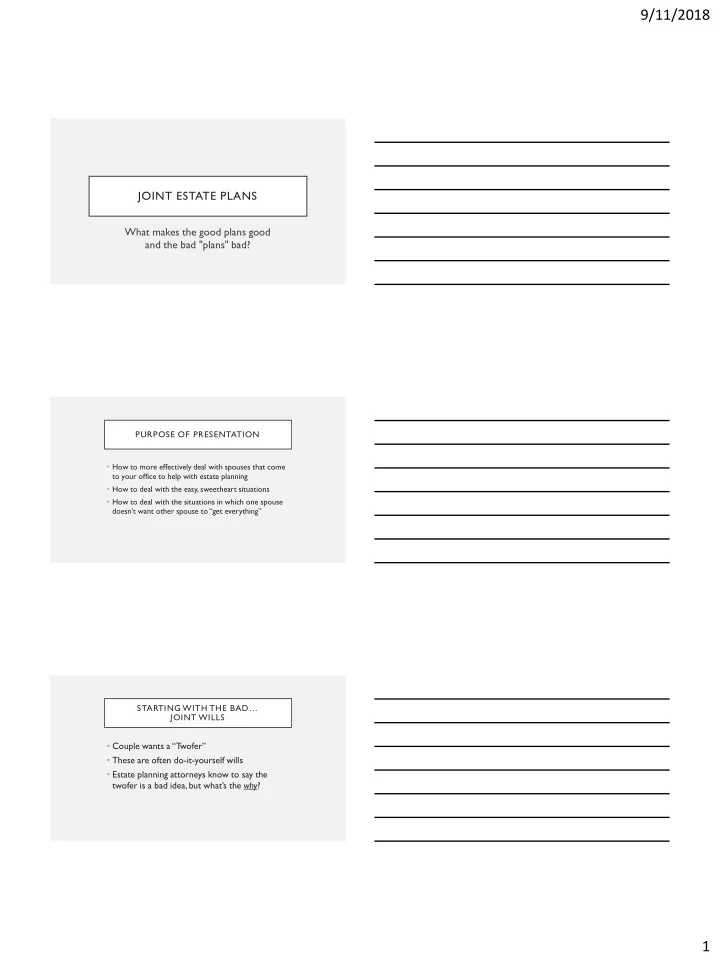
JOINT ESTATE PLANS

What makes the good plans good and the bad "plans" bad?

PURPOSE OF PRESENTATION

  • How to more effectively deal with spouses that come

to your office to help with estate planning

  • How to deal with the easy, sweetheart situations
  • How to deal with the situations in which one spouse

doesn’t want other spouse to “get everything” STARTING WITH THE BAD… JOINT WILLS

  • Couple wants a “T

wofer”

  • These are often do-it-yourself wills
  • Estate planning attorneys know to say the

twofer is a bad idea, but what’s the why?

slide-2
SLIDE 2

9/11/2018 2

THE BAD…. JOINT WILLS

  • Typical design: Spouse A dies, devising all to

Spouse B

  • When Spouse B dies, the same will probated

again (alternate beneficiaries as takers)

  • See any problems with that?

THE BAD… JOINT WILLS

  • Interpretation of the will is “testator’s intent.”
  • Whose intent? Spouse A? Spouse B?
  • What is the purpose that anyone is trying to

achieve? If you can't explain to a client what a joint will achieves that a will per spouse does not, then you shouldn't be suggesting (agreeing to draft?) one. THE BAD (WORSE?)…. CONTRACTUAL WILLS

  • Joint Wills vs. Contractual

Wills

slide-3
SLIDE 3

9/11/2018 3

CONTRACTUAL WILLS (TEC 254.004)

  • CONTRACTS CONCERNING WILLS OR DEVISES; JOINT OR RECIPROCAL WILLS. (a) A

contract executed or entered into on or after September 1, 1979, to make a will or devise, or not to revoke a will or devise, may be established only by:

  • (1) a written agreement that is binding and enforceable; or
  • (2) a will stating:
  • (A) that a contract exists; and
  • (B) the material provisions of the contract.
  • (b) The execution of a joint will or reciprocal wills does not constitute by itself

sufficient evidence of the existence of a contract.

THE BAD… CONTRACTUAL WILLS

  • Case law is sparse post enactment of TEC 254.004, but common law test may be required in

addition to 254.004

  • Judges likely have the same anti-contractual-wills lens you have
  • T

wo-prong common-law test:

  • (1) the property at issue must not be conveyed to the survivor as an absolute and

unconditional gift; and

  • (2) the balance remaining from the estate of the first to die and the estate of the last to

die is treated as a single estate and jointly disposed of by both testators in the secondary dispositive provisions of the will.

THE BAD… CONTRACTUAL WILLS

  • Can a spouse revoke a contractual will?
  • YES! Spouses can revoke the will
  • Breach of contract
  • Remedy is constructive trust
slide-4
SLIDE 4

9/11/2018 4

THE BAD… CONTRACTUAL WILLS

  • Contractual wills may be less of a no-no when:
  • It’s drafted to actually comply with TEC 254.004
  • Clients understand they have a contract to jointly dispose of combined estates
  • How about agreed-upon plan for blended families?
  • Clients have an aversion to “complicated” estate planning (trusts, etc.)

THE BAD…. CONTRACTUAL WILLS

  • Again, we start with: Can you answer why

clients should employ contractual wills?

  • What could go wrong?

THE BAD (BUT MAYBE BETTER?)… NO PLAN AT ALL

  • If the intent is to provide for spouse

and for other heirs, how well does the Estates Code do with intestate succession?

slide-5
SLIDE 5

9/11/2018 5

THE GOOD ABOUT NO ESTATE PLAN

  • Still provides for spouse
  • How many of you use spousal allowance?
  • Still provides for descendants
  • Less room for legal disputes (can’t file a will

contest, etc.) THE BAD ABOUT NO ESTATE PLAN

  • No control about distribution
  • Paternity disputes
  • Cost/timeline of determination of heirship
  • vs. will or trust

NOW FOR THE GOOD… SEPARATE WILLS

  • Separate wills are considered better, but how do we get around

the surviving spouse’s ability to change his/her will?

  • EX: Spouses execute separate wills, listing one another as

primary beneficiaries and an agreed-upon set of their descendants as alternate beneficiaries. Spouse A dies, leaving everything to Spouse B.

  • Then Spouse B can change her/his will to give everything to…
  • Cabana boy/tennis instructor
slide-6
SLIDE 6

9/11/2018 6

MAKING SEPARATE WILLS BETTER

  • Engagement agreement and

explanation letter with clients

  • Educate clients on non-probate

transfers

MAKING SEPARATE WILLS BETTER

  • What if spouse doesn’t want everything

(or anything) to go to surviving spouse at death?

  • Most important thing is to get it in

writing to address

WITH SEPARATE WILLS, SURVIVING SPOUSE STILL GETS BITES AT THE APPLE

  • Exempt property or Allowance in Lieu

Thereof (TEC 353.05 and 353.053, respectively)

  • “Family Allowance” of one-year’s

maintenance expense (TEC 353.102)

slide-7
SLIDE 7

9/11/2018 7

MAKING SEPARATE WILLS BETTER

  • Unorthodox solution by a local probate

judge we all know and love: Get acknowledgements from potential disputants

THE GOOD: SMART USE OF BENEFICIARY DESIGNATIONS

  • If each spouse wants his/her respective children to

receive some inheritance at death of Spouse A, can use a segregated account with JTROS and/or beneficiary designation with financial institution or will

  • Will want something in writing from non-donor spouse

due to Tex. Fam. Code Sec. 3.102…

TEXAS FAMILY CODE SECTION 3.102

  • (a) During marriage, each spouse has the sole management, control, and disposition of the

community property that the spouse would have owned if single,including:[…]

  • (b) If community property subject to the sole management, control, and disposition of one spouse

is mixed or combined with community property subject to the sole management, control, and disposition of the other spouse, then the mixed or combined community property is subject to the joint management, control, and disposition of the spouses, unless the spouses provide otherwise by power of attorney in writing or other agreement.

  • (c) Except as provided by Subsection (a), community property is subject to the joint

management, control, and disposition of the spouses unless the spouses provide

  • therwise by power of attorney in writing or other agreement
slide-8
SLIDE 8

9/11/2018 8

THE GOOD: SEPARATE WILLS WITH MARITAL AGREEMENT

  • Sec. 4.003, Texas Family Code - Premarital Agreement
  • Sec. 4.102 - Partition of Community to Separate
  • Sec. 4.103 - Income on Separate Property can be

Considered Separate Property by Agreement

THE GOOD: TRUSTS WHEN SWEETHEARTS

  • Trust with

“Renege” Provision (Thanks to Karen Gerstner and Amanda Gyeszly)

  • Designed to protect the ultimate beneficiaries if surviving spouse alters the
  • riginal, joint estate plan

RENEGE TRUST: PHASE1

  • At the first death, if Spouse

A kept to the plan by not employing general power

  • f appointment, then bypass and marital trusts funded
  • If Spouse

A reneged by utilizing general power of appointment, then trust provisions no longer obligate surviving spouse to keep to the plan

slide-9
SLIDE 9

9/11/2018 9

RENEGE TRUST: PHASE 2

  • When Spouse B dies, if she reneged, then the remaining assets in marital and

bypass trusts go to Spouse A’s descendants

  • If Spouse B kept to the plan, then all remaining assets split evenly among

Spouses’ descendants

THE GOOD: TRUSTS WHEN NOT SWEETHEART

  • If Spouse A wants to give property to his children after his death, he can use a

trust

  • Trust must be irrevocable. A revocable trust is “illusory” rather than real for

marital property purposes (Land v. Marshall, 426 SW.2d 841 (T

  • ex. 1968))
  • Settlor cannot retain beneficial interest, or surviving spouse would have

community claims

  • Must avoid Fraud on the Community issues
  • Even RLT appears to avoid surviving spouse claims for family allowance or

allowance in lieu of homestead exemption

USING AN ENTITY TO PREVENT COMMUNITY CLAIM

  • TBOC 152.056 – “A partnership is an entity distinct from

its partners.”

  • If Spouse A buys partnership interest with his separate

property, his partnership interest and the income and profits therefrom are not community

  • Make sure to avoid reimbursement claims. Spouse A

should not contribute “time, talent or labor” without compensation