Northumberland, Tyne and Wear Sustainability and Transformation - - PowerPoint PPT Presentation

northumberland tyne and wear sustainability and
SMART_READER_LITE
LIVE PREVIEW

Northumberland, Tyne and Wear Sustainability and Transformation - - PowerPoint PPT Presentation

Northumberland, Tyne and Wear Sustainability and Transformation Plan (NTW STP) The Northumberland Tyne and Wear STP footprint is a new collaboration covering a total population of 1.5 million residents across three Local Health Economies


slide-1
SLIDE 1

Northumberland, Tyne and Wear Sustainability and Transformation Plan (NTW STP)

1

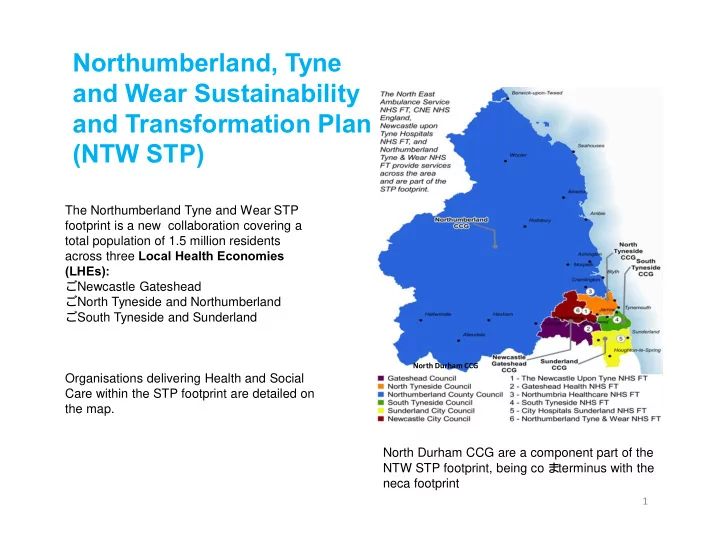
The Northumberland Tyne and Wear STP footprint is a new collaboration covering a total population of 1.5 million residents across three Local Health Economies (LHEs):

  • Newcastle Gateshead
  • North Tyneside and Northumberland
  • South Tyneside and Sunderland

Organisations delivering Health and Social Care within the STP footprint are detailed on the map. North Durham CCG are a component part of the NTW STP footprint, being co – terminus with the neca footprint

North Durham CCG

slide-2
SLIDE 2

What are Sustainability & Transformation Plans?

  • Part of the NHS planning requirements
  • Designed to support the delivery the NHS 5 year forward

view by 2020/21

  • Planned on a bigger spatial footprint
  • Focused on place and population not organisation

boundaries

  • 44 STPs nationally - transformation/evolution
  • Transformation and sustainability funding

will be dependent on the quality of the plan

  • Plan submission in June 2016 –

assessment and feedback in July 2016

slide-3
SLIDE 3

What does the STP need to address?

Health & wellbeing Care and quality The ‘three gaps’ Funding & efficiency

TRIPLE AIM

slide-4
SLIDE 4

Opportunity

  • Sustainability and Transformation Plans (STPs) are an opportunity

to develop a route map to an improved, more sustainable, health and care system by:

– Bringing organisations together to work much more closely, beyond organisation boundaries – Sharing of good practice and expertise – Identifying those areas where a single or small group of organisations would, or is, having difficulty transforming services – Identifying areas where the common agenda suggests we can do something

  • nce well rather than several times less effectively

– Alignment with the work of the neca Commission for Health and Social Care Integration

4

slide-5
SLIDE 5

Northumberland, Tyne and Wear STP

  • 5 CCG’

s, 6 Local Authorities, 7 Foundation Trusts (including NEAS and NTW), NHS England, Public Health England

  • Includes North Durham CCG –

co-terminus with the neca footprint

  • Key areas for transformation include:

– Acute hospital collaboration across clinical pathways – Reconfiguration of services between acute providers – Out of hospital collaboration – Radical upgrade in prevention and wellbeing – Development of accountable care systems – Financial stability

  • Areas for collaborative work including system enablers:

– IT, estates, workforce etc

  • Whole system focus –

commissioners and providers across health and social care

slide-6
SLIDE 6

Northumberland, Tyne and Wear STP Footprint

6

Sustainable and Transformation Plans – large planning footprint

‘Do once’ Workforce/Estates Digital Technology UEC network, Cancer Alliance, Networks, Specialised services, Devolution

Local Health Economies – layer of major transformation

Northumberland / North Tyneside Newcastle and Gateshead South Tyneside / Sunderland Individual CCGs – layer of local integration

Northumberland North Tyneside Newcastle and Gateshead South Tyneside Sunderland

Federations/Communities/Neighbourhoods North Durham CCG are a component part of the NTW STP footprint, being co-terminus with the neca footprint

slide-7
SLIDE 7
  • If we ‘

do nothing’ we will incur a £650 million gap across health by 2020, representing 23% of total NHS allocation

  • £650 million represents 40% of the total North East and

Cumbria £1.7 billion financial gap by 2021

  • Work to date with Local Authorities indicates our joint health

and social care financial gap could be as high as £960 million

  • Joint working continues to refine these figures with providers

including LA’ s to confirm details of provider/commissioning gaps

Systems efficiency and finance challenges

slide-8
SLIDE 8

Governance

slide-9
SLIDE 9

Next steps

  • The Plan is a point in time/work in progress
  • June 30th submission will form the basis for a

“conversation” with NHS England and NHS Improvement throughout July

  • It will inform decisions about the geographical targeting
  • f growth in the intervening years to 2020
  • No formal approval or consultation from boards at this

early stage

  • BUT need to assure NHS England and NHS

Improvement that the plans reflect a shared view from STP leadership team, based upon the needs of patients and taxpayers

  • Engage more formally with boards and partners

following the July conversations.