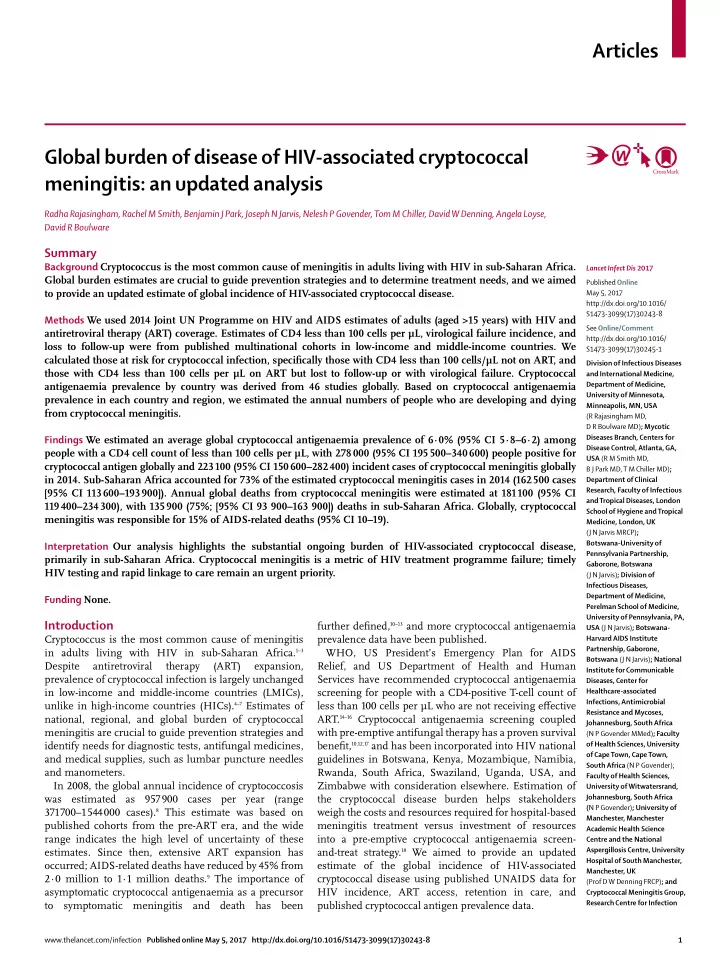
Articles Global burden of disease of HIV-associated cryptococcal - - PDF document

articles global burden of disease of hiv associated
SMART_READER_LITE
LIVE PREVIEW

Articles Global burden of disease of HIV-associated cryptococcal - - PDF document

Articles Global burden of disease of HIV-associated cryptococcal meningitis: an updated analysis Radha Rajasingham, Rachel M Smith, Benjamin J Park, Joseph N Jarvis, Nelesh P Govender, Tom M Chiller, David W Denning, Angela Loyse, David R


slide-1
SLIDE 1

www.thelancet.com/infection Published online May 5, 2017 http://dx.doi.org/10.1016/S1473-3099(17)30243-8 1

Articles

Lancet Infect Dis 2017 Published Online May 5, 2017 http://dx.doi.org/10.1016/ S1473-3099(17)30243-8 See Online/Comment http://dx.doi.org/10.1016/ S1473-3099(17)30245-1 Division of Infectious Diseases and International Medicine, Department of Medicine, University of Minnesota, Minneapolis, MN, USA (R Rajasingham MD, D R Boulware MD); Mycotic Diseases Branch, Centers for Disease Control, Atlanta, GA, USA (R M Smith MD, B J Park MD, T M Chiller MD); Department of Clinical Research, Faculty of Infectious and Tropical Diseases, London School of Hygiene and Tropical Medicine, London, UK (J N Jarvis MRCP); Botswana-University of Pennsylvania Partnership, Gaborone, Botswana (J N Jarvis); Division of Infectious Diseases, Department of Medicine, Perelman School of Medicine, University of Pennsylvania, PA, USA (J N Jarvis); Botswana- Harvard AIDS Institute Partnership, Gaborone, Botswana (J N Jarvis); National Institute for Communicable Diseases, Center for Healthcare-associated Infections, Antimicrobial Resistance and Mycoses, Johannesburg, South Africa (N P Govender MMed); Faculty

  • f Health Sciences, University
  • f Cape Town, Cape Town,

South Africa (N P Govender); Faculty of Health Sciences, University of Witwatersrand, Johannesburg, South Africa (N P Govender); University of Manchester, Manchester Academic Health Science Centre and the National Aspergillosis Centre, University Hospital of South Manchester, Manchester, UK (Prof D W Denning FRCP); and Cryptococcal Meningitis Group, Research Centre for Infection

Global burden of disease of HIV-associated cryptococcal meningitis: an updated analysis

Radha Rajasingham, Rachel M Smith, Benjamin J Park, Joseph N Jarvis, Nelesh P Govender, Tom M Chiller, David W Denning, Angela Loyse, David R Boulware

Summary

Background Cryptococcus is the most common cause of meningitis in adults living with HIV in sub-Saharan Africa. Global burden estimates are crucial to guide prevention strategies and to determine treatment needs, and we aimed to provide an updated estimate of global incidence of HIV-associated cryptococcal disease. Methods We used 2014 Joint UN Programme on HIV and AIDS estimates of adults (aged >15 years) with HIV and antiretroviral therapy (ART) coverage. Estimates of CD4 less than 100 cells per µL, virological failure incidence, and loss to follow-up were from published multinational cohorts in low-income and middle-income countries. We calculated those at risk for cryptococcal infection, specifically those with CD4 less than 100 cells/µL not on ART, and those with CD4 less than 100 cells per µL on ART but lost to follow-up or with virological failure. Cryptococcal antigenaemia prevalence by country was derived from 46 studies globally. Based on cryptococcal antigenaemia prevalence in each country and region, we estimated the annual numbers of people who are developing and dying from cryptococcal meningitis. Findings We estimated an average global cryptococcal antigenaemia prevalence of 6·0% (95% CI 5·8–6·2) among people with a CD4 cell count of less than 100 cells per µL, with 278 000 (95% CI 195 500–340 600) people positive for cryptococcal antigen globally and 223 100 (95% CI 150 600–282 400) incident cases of cryptococcal meningitis globally in 2014. Sub-Saharan Africa accounted for 73% of the estimated cryptococcal meningitis cases in 2014 (162 500 cases [95% CI 113 600–193 900]). Annual global deaths from cryptococcal meningitis were estimated at 181 100 (95% CI 119 400–234 300), with 135 900 (75%; [95% CI 93 900–163 900]) deaths in sub-Saharan Africa. Globally, cryptococcal meningitis was responsible for 15% of AIDS-related deaths (95% CI 10–19). Interpretation Our analysis highlights the substantial ongoing burden of HIV-associated cryptococcal disease, primarily in sub-Saharan Africa. Cryptococcal meningitis is a metric of HIV treatment programme failure; timely HIV testing and rapid linkage to care remain an urgent priority. Funding None.

Introduction

Cryptococcus is the most common cause of meningitis in adults living with HIV in sub-Saharan Africa.1–3 Despite antiretroviral therapy (ART) expansion, prevalence of cryptococcal infection is largely unchanged in low-income and middle-income countries (LMICs), unlike in high-income countries (HICs).4–7 Estimates of national, regional, and global burden of cryptococcal meningitis are crucial to guide prevention strategies and identify needs for diagnostic tests, antifungal medicines, and medical supplies, such as lumbar puncture needles and manometers. In 2008, the global annual incidence of cryptococcosis was estimated as 957 900 cases per year (range 371 700–1 544 000 cases).8 This estimate was based on published cohorts from the pre-ART era, and the wide range indicates the high level of uncertainty of these

  • estimates. Since then, extensive ART expansion has
  • ccurred; AIDS-related deaths have reduced by 45% from

2·0 million to 1·1 million deaths.9 The importance of asymptomatic cryptococcal antigenaemia as a precursor to symptomatic meningitis and death has been further defjned,10–13 and more cryptococcal antigenaemia prevalence data have been published. WHO, US President’s Emergency Plan for AIDS Relief, and US Department of Health and Human Services have recommended cryptococcal antigenaemia screening for people with a CD4-positive T-cell count of less than 100 cells per μL who are not receiving efgective ART.14–16 Cryptococcal antigenaemia screening coupled with pre-emptive antifungal therapy has a proven survival benefjt,10,12,17 and has been incorporated into HIV national guidelines in Botswana, Kenya, Mozambique, Namibia, Rwanda, South Africa, Swaziland, Uganda, USA, and Zimbabwe with consideration elsewhere. Estimation of the cryptococcal disease burden helps stakeholders weigh the costs and resources required for hospital-based meningitis treatment versus investment of resources into a pre-emptive cryptococcal antigenaemia screen- and-treat strategy.18 We aimed to provide an updated estimate of the global incidence of HIV-associated cryptococcal disease using published UNAIDS data for HIV incidence, ART access, retention in care, and published cryptococcal antigen prevalence data.

slide-2
SLIDE 2

Articles

2 www.thelancet.com/infection Published online May 5, 2017 http://dx.doi.org/10.1016/S1473-3099(17)30243-8

and Immunity, Division of Clinical Sciences, St George’s University of London, London, UK (A Loyse MD [Res]) Correspondence to: Dr Radha Rajasingham, Division

  • f Infectious Diseases and

International Medicine, Department of Medicine, University of Minnesota, Minneapolis, MN 55455, USA radha@umn.edu

Methods

Global estimates of HIV infection We used UNAIDS 2014 country-level estimates of global incidence and cases of HIV infection (table 1); specifjcally published estimates of adults (aged >15 years) living with HIV, adults receiving ART, percentage

  • f adults receiving ART among those eligible per WHO

2010 guidelines (CD4 <350 cells per µL) via UNAIDS 2014 spectrum estimates,24 UNAIDS GAP report,9 and WHO Global Health Observatory database.46 Each UNAIDS and WHO estimate was originally published with a low and high estimate range as a measure of

  • uncertainty. Using the estimates of those with a CD4

cell count of less than 350 cells per µL on ART, and those eligible for ART, we calculated the ART gap (people who were not receiving ART but CD4 cell counts of <350 cells per µL). We used UNAIDS and WHO reports for estimates of the number of people with CD4 cell counts of less than 100 cells per µL,19 CD4 cell counts of 100–200 cells per µL, virological failure,26 and loss to follow-up (table 1, appendix pp 2–6).26 For each point estimate, a 95% CI was obtained. To further account for bias and limitations of the primary literature, the 95% CI was widened by adding or subtracting 1·5 times the difgerence between the right and left limits, respectively. Thus, the uncertainty ranges described in the Methods and in table 1 are conservatively wider than 95% CI from the published literature. Estimate of people at risk for cryptococcal disease We defjned the total number of people at risk for cryptococcosis by country and region as: adults with a CD4 cell count of less than 100 cells per µL not on ART and adults with a CD4 cell count of less than 100 cells per µL on ART but either lost to follow-up or with virological failure. Those who start ART but do not have virological failure, and are negative for cryptococcal antigenaemia, have no risk of developing cryptococcal

  • infection. The estimate of adults with a CD4 count of

100 cells per µL or less was 22·5% (range 19–26) among those with a CD4 cell count of less than 350 cells per µL in LMICs.19,20 In HICs, 18·5% (range 16–21) of those with a CD4 cell count of less than 350 cells per µL were estimated to have a CD4 cell count of less than 100 cells per µL.19,20 Thus, we estimated the number of patients with a CD4 count of less than 100 cells per µL on ART from the ART percentage coverage (ART percentage coverage × ART eligible [CD4 <350 cells per µL] × proportion with CD4 <100 cells per µL, accounting for uncertainty around those estimates; appendix pp 2, 3). Based on a UNAIDS systematic review,26 we assumed 16% (range 12–20) of people initiating ART retained in care had virological failure at 12 months. After completion

  • f 1 year on ART, we assumed the virological failure

incidence to be a third of that in the fjrst year at 5·3% (95% CI 4·0–6·6).26–29 This Article cites observational data from Canada, the USA, and the UK with similar frequencies of viral suppression at 12 months.47–49 Research in context Evidence before this study Cryptococcus is the most common cause of meningitis in adults in sub-Saharan Africa due to the burden of HIV infection. We searched PubMed with the terms “cryptococcal meningitis” and “burden” on Feb 8, 2017, with no restrictions on language or date. The only study to estimate the global burden of cryptococcal infection was published in 2008. The global annual incidence of cryptococcosis was estimated as 957 900 cases per year (range 371 700–1 544 000). This estimate was based on published cohorts primarily from the pre-antiretroviral therapy (ART) era, and the wide ranges indicate the high level of uncertainty of these

  • estimates. This 2008 study used only three incidence publications

to derive sub-Saharan African estimates. Since then, extensive ART expansion has occurred; AIDS-related deaths have reduced by 39%. The importance of asymptomatic cryptococcal antigenaemia as a precursor to symptomatic meningitis and death has been further defjned, and more cryptococcal antigenaemia prevalence data have been published. Since the initial estimate of global burden of cryptococcal meningitis in 2008, small, retrospective studies describing the national burden of cryptococcal meningitis have been published in South Africa, Brazil, Ecuador, Nigeria, Tanzania, Kenya, Vietnam, Thailand, and USA. These studies used epidemiological, country-wide data from the local government, WHO, international and local reports, along with unreported data. Added value of this study This updated global estimate of cryptococcal infection is the fjrst in 8 years. The landscape of HIV infection has changed greatly since the initial estimate of global burden. We provide an updated estimate of the global incidence of HIV-associated cryptococcal disease with published UNAIDS data for HIV incidence, ART access, retention in the care cascade and published cryptococcal antigenaemia prevalence data. Cryptococcal antigenaemia prevalence data have not been previously used to estimate incidence of cryptococcal meningitis. Implications of all the available evidence We estimated an average global cryptococcal antigen prevalence

  • f 6% among HIV-infected people with a CD4 cell count of less

than 100 cells per µL. Annually, 278 000 people have cryptococcal antigenaemia, with 73% of meningitis cases

  • ccurring in sub-Saharan Africa. Cryptococcal meningitis causes

15% of AIDS-related deaths globally, yet remains neglected by numerous stakeholders. This study summarises the global scale

  • f disease and highlights the need to implement cryptococcal

prevention efgorts.

See Online for appendix

slide-3
SLIDE 3

Articles

www.thelancet.com/infection Published online May 5, 2017 http://dx.doi.org/10.1016/S1473-3099(17)30243-8 3

Retention in care is based on country level estimates from UNAIDS,24 and where data were missing, we used continental mean estimates. Cryptococcal antigenaemia prevalence We estimated the total number of people with cryptococcal antigenaemia using blood cryptococcal antigenaemia prevalence studies from 1989 to 2016, either in the published literature, or abstracts presented at conferences, among outpatient populations for 17 African countries, fjve Asian countries, fjve Latin American countries, the USA, and the UK (fjgure 1). Cryptococcal antigenaemia prevalence studies of solely inpatient populations were excluded because prevalence is higher in those presenting to the hospital and not representative of the asymptomatic outpatient population that is ideal for cryptococcal antigenaemia screening. For countries with available data, cryptococcal antigenaemia prevalence among people with a CD4 cell count of less than 100 cells per µL was used for that specifjc country along with the associated 95% CI by Fisher’s exact test (appendix pp 4, 10). For countries without cryptococcal antigenaemia prevalence data, we used the pooled, weighted continental mean

  • estimate. Thereafter, we estimated the number of

people with prevalent cryptococcal antigenaemia by country and region by multiplying people at risk for cryptococcal disease by the cryptococcal antigenaemia prevalence of the country and region (described earlier and in table 1). People positive for cryptococcal antigenaemia who develop cryptococcal meningitis Not all patients positive for cryptococcal antigenaemia develop cryptococcal meningitis. Estimates of adults who are positive for cryptococcal antigenaemia who go on to develop symptomatic cryptococcal meningitis were from published cohort studies.10–12,30–32 We estimated that 70% (range 56–84%) of people positive for cryptococcal antigenaemia would progress to develop cryptococcal disease or died without diagnosis, unless treated with ART or pre-emptive fmuconazole (appendix p 6). Without ART or pre-emptive fmuconazole therapy, we assumed 95% (uncertainty interval 90–100) progression in all regions (opinion of authors) with a 5% competing risk of death from other causes or comorbid conditions.10,11,45,50,51 People negative for cryptococcal antigenaemia who are at risk for cryptococcal infection The cryptococcal meningitis incidence in people with a CD4 cell count of less than 200 cells per µL who were initially negative for cryptococcal antigenaemia in blood before initiating ART is 5·14 per 100 person-years.30 This value is estimated from the only publication available for estimating incidence of cryptococcal meningitis before initiation of ART in Uganda, and for this estimation, we assumed an incidence range of 2·6–9·0 cryptococcal events per 100 person-years. In high-income countries, we assumed the risk of development of cryptococcal meningitis was 50% lower due to more intensive virological monitoring and additional second-line ART

Estimate (uncertainty interval) Adults living with HIV19 31·8 million (30·1–33·7) Adults with CD4 <350 cells per µL19 19·5 million (18·5–20·7) CD4 <100 cells per µL of those CD4 <350 cells per µL Low-income and middle-income countries19–23 22·5% (19–26) High-income countries19–23 18·5% (16–21) CD4 100–200 cells per µL of those CD4 <350 cells per µL Low-income and middle-income countries19–23 27·5% (24–31) High-income countries 31·5% (29–34) Adults receiving ART19 11·3 million (10·4–12·7) New initiation of ART19,24 2·3 million (1·8–2·8) Retention in care (year 1)*25 Country-specifjc, regional estimate, weighted pooled average; total LTFU estimated at 1·1 million in 2014 Virological failure Virological failure (year 1)25,26 16% (12–20) Virological failure (year >2)*27–29 5·33% (4·0–6·6) At risk for cryptococcal infection CD4 <100 cells per µL not on ART CD4 <100 cells per µL on ART but LTFU or virological failure CD4 100–200 cells per µL not on ART, LTFU, or virological failure CD4 100–200 cells per µL no ART, LTFU, or virological failure10,30 25% of those with CD4 <100 cells per µL not on ART, or LTFU, or virological failure CRAG prevalence For countries with multiple sources Weighted average of all sources and computed 95% CIs (fjgure 1) For countries without sources Regional weighted average (computed 95% CI) CRAG-negative progression to CRAG-positive (without efgective ART) CD4 <200 cells per μL Low-income and middle-income countries30 5·14 events per 100 person-years (2·6–9·0) High-income country30 2·57 events per 100 person-years (1·3–4·5) CRAG positive who develop cryptococcal meningitis In care without pre-emptive treatment10–12,31,32 70% (56–84) Not in care10–12,31,32 95% (90–100) Deaths from cryptococcal meningitis (1 year mortality) Low-income country33–39 70% (59–81) Middle-income country34,40–42 40% (34–46) North America43,44 20% (12·5–27·5) Europe 30% (25–35) Death not in care (all regions)45 1·5 times higher For more information see appendix. ART=antiretroviral therapy. LTFU=lost to follow-up. CRAG=cryptococcal antigenaemia. *Retention-in-care and virological failure in more than 2 years were assumed to be 33% of their year 1 value.. Table 1: Model inputs and assumptions

slide-4
SLIDE 4

Articles

4 www.thelancet.com/infection Published online May 5, 2017 http://dx.doi.org/10.1016/S1473-3099(17)30243-8

  • ptions. For people with CD4 less than 200 cells per µL,

initially prevalent cryptococcal antigenaemia-negative status and not receiving ART, we assumed a competing risk of starting ART or death of 50% (ie, 500 of 1000 person-years). Annual incidence of cryptococcal meningitis Annual incidence of cryptococcal meningitis includes the estimation of those people positive for cryptococcal antigenaemia who developed symptomatic meningitis, both in care and newly initiating ART with unmasking

Cryptococcal antigen prevalence 24 22 20 18 16 14 12 10 8 6 4 2 Malawi, Bedell; 2012 Nigeria (SW, N) Ezeanolue; 2016 Malawi, Chipungu; 2015 Ghana, Mamoojee; 2011 South Africa (Western Cape), Vallabhaneni; 2016 Brazil (Para State), Costa; 2013 South Africa (Soweto), Govender; 2015 USA (multisite), McKenney; 2014 Peru (Lima), Linares; 2012 Uganda (Masaka), Parkes-Ratanshi; 2011 Benin, Ogouyemi-Hounto; 2016 Vietnam (multisite), Smith; 2013 Namiba, Sawadogo; 2014 Rwanda, Swinne; 1992 South Africa (Cape Town), Longley; 2016 Tanzania (Ifakara), Letang; 2015 Uganda (Mbarara), Tassie; 2003 Zambia-Tanzania, Mfinanga; 2015 Tanzania (Moshi), Rugemalila; 2013 Guinea, MSF; 2014 UK (London), Patel; 2013 Lesotho, MSF; 2014 Uganda (Tororo), Liechty; 2007 Mozambique, MSF; 2014 Nigeria (SE), Ezeanolue; 2016 Argentina, Negroni; 1995 South Africa (Cape Town), Jarvis; 2009 All low-income and middle-income countries Uganda (Kiboga), Pac; 2015 Colombia, Escandón; 2013 Indonesia, Ganiem; 2014 Zimbabwe (Gutu,Buhera), MSF; 2014 Kenya, Kendi; 2011 India (Pune), Kadam; 2017 Uganda (Kampala), Meya; 2010 Uganda (multisite), Morawski; 2016 Nigeria (Lagos), Oladele; 2016 Cambodia, Micol; 2007 Thailand, Kwan; 2012 Ethiopia (Addis), Alemu; 2013 Kenya (multisite), Meyer; 2013 DR Congo, Desmet; 1989 Nigeria, Osazuwa; 2012 Kenya (Kibera), MSF; 2014 Thailand (Bangkok), Pongsai; 2010 Nigeria, Chukwuanukwu; 2013 DR Congo, MSF; 2014 Ethiopia (Oromia region), Beyene; 2013 Styudy location, author; year Figure 1: Cryptococcal antigenaemia prevalence studies of HIV-infected outpatient populations from 1989 to 2016 Error bars are 95% CI, the vertical dotted line represents the mean cryptococcal antigenaemia prevalence for all studies combined. Estimates of USA and UK were not included in fjnal summary estimate of low-income and middle-income countries. Studies of populations in hospital were not included (appendix p 11). All references for the studies in this fjgure are in the appendix. MSF=Médecins Sans Frontieres. N=north. SE=southeast. SW=southwest.

slide-5
SLIDE 5

Articles

www.thelancet.com/infection Published online May 5, 2017 http://dx.doi.org/10.1016/S1473-3099(17)30243-8 5

disease and those not in care or not on ART with AIDS progression. Cryptococcal meningitis deaths We estimated 1 year mortality in low-income countries (LICs) as 70% (uncertainty interval 59–81) after cryptococcal meningitis for those in care and 100% for those not in care (appendix p 5).31,49,52–56 For middle-income countries, we presumed 1 year mortality of 40% (uncertainty interval 34–46), based on summary statistics of outcomes of those receiving amphotericin B and fmuconazole, and 60% for those not originally in care (ie, not receiving ART).40,41 In Europe (including eastern Europe and Russia), we estimated 1 year mortality to be 30% for those in care and 45% for those not in care (opinion of authors). In North America, we estimated 1 year mortality to be 20% for those in care and 30% for those not in care.43 Uncertainty analysis To account for parameter uncertainty in the primary data, we used probability distributions to describe a range for each point estimate of interest. We varied each value in our model simultaneously, sampled from a priori defjned probability distributions. The outputs from this uncertainty analysis generated CIs for each

  • parameter. Full details of each parameter and distribution

are available in the appendix (p 6). We used empirical data, when available, to defjne distributions (appendix p 6). We used standard β distributions for binomial data, and normal distribution for continuous estimates. Using Microsoft Excel 2013, we randomly selected a value for each parameter within the appropriate distribution, and used the combination of these values to estimate the number of people positive for cryptococcal antigenaemia, annual incidence of cryptococcal meningitis, and number of deaths from cryptococcal meningitis for each region. Using 50 000 iterations, we obtained empirical distributions corresponding to posterior distributions calculated by Monte Carlo simulations. These distributions were used to generate a point estimate (posterior mean) and Monte Carlo CIs from the lower 2·5% and higher 97·5% for the estimates of cryptococcal antigenaemia, meningitis, and fatality from cryptococcal disease. Given the limited high-quality source data, we broadened our estimates of uncertainty of the primary data by widening our CIs to use 99·7% CI with three standard deviations above and below the weighted averages of included studies. Role of the funding source There was no funding source for this study. The corresponding author had full access to all the data in the study and had fjnal responsibility for the decision to submit for publication.

Results

In December, 2013, 31·8 million (range 30·1–33·7) adults were living with HIV globally, with 21·7 million (20·7–23·0) living in sub-Saharan Africa. Globally, 19·5 million adults were eligible for ART (CD4 <350 cells per µL) according to

Cryptococcal infection annual incidence <500 501–1000 1001–2500 2501–5000 5001–10 000 10 001–15 000 15 001–25 000 >25 000 Figure 2: Annual incidence of cryptococcal infection by country The annual number of people positive with cryptococcal antigenaemia estimated at 278 000 (95% CI 195 500–340 600) globally in 2014. We estimated 223 100 annual incident cases of cryptococcal meningitis in 2014..

slide-6
SLIDE 6

Articles

6 www.thelancet.com/infection Published online May 5, 2017 http://dx.doi.org/10.1016/S1473-3099(17)30243-8

WHO 2010 guidelines, with 11·3 million actually receiving

  • ART. Globally, 8·2 million people had a CD4 count of less

than 350 cells per µL but not receiving ART, with 5·2 million

  • f these individuals in sub-Saharan Africa. We estimated

4·3 million adults have a CD4 count of less than 100 cells per µL globally, and of these, 1·8 million (42%) were not on ART. This group is at particularly high risk for

  • pportunistic infections, including cryptococcosis. In 2013,

there were an estimated 1·4 million (range 1·1–1·6) AIDS- related deaths globally, per UNAIDS estimates. We estimated an average global cryptococcal antigenaemia prevalence of 6·0% (95% CI 5·8–6·2) in people with a CD4 count of less than 100 cells per µL, corresponding to 278 000 (95% CI 195 500–340 600) people globally in 2014 (fjgure 2). Annually, we estimated that there are 223 100 (95% CI 150 600–282 400) cases

  • f cryptococcal meningitis globally, with 73% of

cases (162 500 [95% CI 113 600–193 900]) occurring in sub-Saharan Africa (table 2; appendix p 9). The region with the second highest incidence was Asia and Pacifjc (19% of total), with an annual incidence of 43 200 (95% CI 25 300–64 700) cases of cryptococcal meningitis (table 2). Annual fatalities from cryptococcal meningitis are estimated at 181 100 (95% CI 119 400–234 300) deaths globally, with 135 900 (75%; 95% CI 93 900–163 900) deaths occurring in sub-Saharan Africa (table 2). Table 3 highlights countries with the highest annual incidence of cryptococcal meningitis. Globally, cryptococcal meningitis results in 15% of AIDS- related mortality (95% CI 10–19). The appendix provides country-level listing of data for all parameters considered in the model.

Discussion

We estimated the global incidence of cryptococcal meningitis to be substantial at 223 100 cases annually (95% CI 150 600–282 400), resulting in 181 100 (95% CI 119 400–234 300) annual deaths in 2014. Sub-Saharan Africa continues to have the greatest burden of this disease. We estimated cryptococcal meningitis causes 15% (95% CI 10–19) of AIDS-related deaths globally. Although the absolute number of cryptococcal deaths has decreased since the previous 2008 estimate,8 the proportion of AIDS- related mortality remains similar. Our estimates, and

  • thers, imply that cryptococcosis remains the second most

common cause of AIDS-related mortality, only narrowly behind tuberculosis.58–63 These updated accurate disease estimates enable appropriate ordering of essential antifungals, diagnostics, and medical supplies. Importantly, prevention of cryptococcal disease has shown survival benefjt and is cost-saving to health-care systems when coupled with enhanced ART adherence.18,41,52,64 The cost of cryptococcal antigenaemia screening programmes needs to be appreciated in the context of the treatment costs for patients with cryptococcal meningitis in LMICs. For example, the per patient cost of cryptococcal meningitis treatment in Uganda with amphotericin B and fmuconazole is US$400 for 2 weeks.41 Consolidation and maintenance therapy with fmuconazole for 1 year costs $60 per meningitis survivor ($0·15 per 200 mg fmuconazole) in LMICs.53 Thus, with an annual estimated incidence of 12 200 meningitis cases in Uganda, $5·6 million would be required for initial meningitis diagnosis and treatment. Conversely, if cryptococcal antigenaemia screening costs $4·0054 plus $24·60 for the WHO-recommended pre-emptive treatment regimen,9 screening the 110 500 people at risk for cryptococcal disease in Uganda with a CD4 count of less than 100 cells per µL and pre- emptively treating the 15 500 people positive for cryptococcal antigenaemia would cost $822 600, which is 15% of the cost of meningitis treatment with more than 40% better long-term survival.33 Compared with previous 2008 estimates,8 our 2014 estimates are lower, because the HIV and AIDS

Annual incidence

  • f cryptococcal

meningitis Number at risk (CD4 <100 cells per µL) Cost of screening all at risk (US$)* HIV budget to screen all at risk (%)57 Nigeria 27 100 325 900 $1 303 437 0·23% South Africa 21 400 382 400 $1 529 685 0·09% Mozambique 18 600 184 300 $737 228 0·28% India 18 300 209 900 $839 502 0·06% Uganda 12 200 110 500 $441 933 0·08% Ethiopia 9600 60 600 $242 561 0·06% Kenya 9000 84 700 $329 138 0·08% Tanzania 8400 117 200 $468 959 0·15% DR Congo 8400 51 200 $204 889 0·24% Zimbabwe 8100 92 400 $369 621 ·· Indonesia 6600 58 900 $235 564 0·27% Zambia 5000 66 200 $264 611 0·10% *Based on presumed cost of cryptococcal antigenaemia lateral fmow assay test of US$3 per test delivered price for resource-limited areas, with an additional $0·50 added for laboratory labour, and $0·50 for profjt and overhead costs. Although not every person at risk will present to care, this gives an estimate of the magnitude of budgetary resources necessary to start screening. Further information about each estimate is available in the appendix. Table 3: Countries with the highest incidence of cryptococcal meningitis Total cryptococcal antigenaemia positive (uncertainty interval) Annual burden of cryptococcal meningitis (uncertainty interval) Deaths from cryptococcal meningitis (uncertainty interval) Sub-Saharan Africa 204 300 (148 400–237 800) 162 500 (113 600–193 900) 135 900 (93 900–163 900) Asia and Pacifjc 52 300 (32 900–74 100) 43 200 (25 300–64 700) 39 700 (20 600–59 700) Caribbean 1800 (1300–2200) 1400 (1000–1800) 700 (500–900) Latin America 7000 (3600–11 100) 5300 (2600–8900) 2400 (1100–4400) North America 3700 (3000–4600) 3000 (2300–3700) 700 (500–1000) North Africa and Middle East 3600 (2600–5000) 3300 (2400–4500) 1900 (1300–2700) Europe 5200 (4000–6500) 4400 (3400–5600) 1800 (1300–2400) Global 278 000 (195 500–341 000) 223 100 (150 600–282 400) 181 100 (119 400–234 300) Table 2: Burden of cryptococcal infection by region

slide-7
SLIDE 7

Articles

www.thelancet.com/infection Published online May 5, 2017 http://dx.doi.org/10.1016/S1473-3099(17)30243-8 7

landscape has changed with rapid ART expansion and a 45% decrease in AIDS-related mortality from 2005 to 2013 in sub-Saharan Africa.9 We also used a difgerent method

  • f cryptococcal antigenaemia prevalence, as cryptococcal

antigenaemia positive status is a known predictor of progression to cryptococcal meningitis. Country-specifjc cryptococcal antigenaemia prevalence data were less available previously. Additionally, we compared our estimates with the few published estimates of the national incidence of HIV- associated cryptococcal meningitis. Our model estimated that there are 2945 US cases of cryptococcal meningitis

  • annually. In the USA, an estimated 3400 recognised

cryptococcal meningitis admissions to hospital were identifjed by the International Classifjcation of Diseases (9th edition) hospital billing codes, of which two-thirds were HIV-related.43 In South Africa during 2015, the national reporting laboratory-confjrmed 6174 cryptococcal meningitis cases and an additional 4295 people were positive for cryptococcal antigenaemia without documented meningitis.5 W e estimated that there were 21 400 cryptococcal cases in South Africa for 2014. This discrepancy probably refmects a proportion of people living with AIDS not in care, undiagnosed, and lost to follow-up who do not receive a reported laboratory- confjrmed diagnosis. An estimated 554 990 South Africans are living with AIDS,5 and the median CD4 count in ART-naive people entering care was 150 cells per µL in 2015.55 We estimated 382 400 South Africans with a CD4 count of less than 100 cells per µL would be at risk for cryptococcal disease. In 2015, the South African National Health Laboratory Service processed 360 000 specimens with CD4 counts of less than 100 cells per µL (about 10% of nationwide total) of which around 80% are estimated to be from unique individuals.55 One limitation of this estimate is our use of UNAIDS 2014 data,24 when 2016 data are available.65 The most recent fjgures were not used because the 2014 UNAIDS estimates have published numbers of people with a CD4 count of less than 350 cells per µL by country. We used these numbers to estimate a CD4 count of less than 100 cells per μL and thereby estimated the population at risk for cryptococcal infection. UNAIDS no longer publishes the number of people with CD4 counts of less than 350 cells per µL by country; thus, a 2016 estimate would require us to project this number with a CD4 count of less than 100 cells per µL based on the proportion

  • f people who are HIV infected, thereby adding more

uncertainty to our estimates. At the time of this publication, 2016 data were also missing in several important country estimates such as Nigeria and Ethiopia. Further limitations of our analysis are related to the absence of UNAIDS country data for HICs. A second limitation is that many countries do not have any cryptococcal antigenaemia prevalence data available so estimates were extrapolated from countries in the region with cryptococcal antigenaemia data available. There is also substantial heterogeneity in studies reporting cryptococcal antigenaemia prevalence. Solely inpatient cryptococcal antigenaemia prevalence studies were excluded; however, some studies included symptomatic and asymptomatic people, which might overestimate point estimates for cryptococcal antigenaemia prevalence and yet underestimate the progression to symptomatic meningitis, if already symptomatic. Cryptococcal antigenaemia prevalence studies used difgerent testing methods (latex agglutination vs lateral fmow assay) with lower sensitivities for detection with latex agglutination. There are relatively few studies that have assessed progression of asymptomatic cryptococcal antigenaemia to symptomatic meningitis or death.10–12,31,32 Our estimate

  • f asymptomatic cryptococcal antigenaemia progression

to symptomatic meningitis was based on a weighted average of mixed studies in which most people were not treated with antifungals at all.11 Thus, progression to meningitis or death might be an underestimate and will vary with access to timely ART. To account for bias and limitations of the primary data, we did a probabilistic sensitivity analysis that generated Monte Carlo CIs according to the probability distribution of possible

  • utcomes. Furthermore, our estimates of meningitis

incidence and death are based on point-prevalence data

  • ver the past 10 years. These estimates do not refmect

averages of historical trends nor are they based on dynamic disease models to predict future disease incidence. However, cryptococcal antigenaemia prevalence data have been relatively constant by country

  • ver time.10,13,56 Notably, AIDS-related mortality due to

cryptococcosis has remained stable from previous estimates.8 However, with improvements in ART access and retention in care, estimates of incidence of cryptococcal meningitis should correspondingly decrease

  • ver time.

Despite global improvement in access to ART, the number of HIV-infected people with a CD4 count of less than 100 cells per µL is still substantial at about 20–25%

  • f those presenting to care.66 Thus, the annual number

with cryptococcal infection is high at 278 000 globally. Cryptococcal meningitis is an excellent metric of HIV treatment programme failure. In 2016, no person with HIV should develop cryptococcal disease, yet due to challenges with late diagnosis, linkage to care, ART access, retention in care, and virological failure on ART,20,66,67 the often fjnal event in a failed cascade of HIV care is the development of cryptococcal meningitis. Until linkage to comprehensive HIV care can be improved, cryptococcal screening programmes are a worthy investment that identify populations at high risk for

  • death. To reduce AIDS-related deaths, it is crucial to

ensure that people with CD4 counts of less than 100 cells per µL are screened for cryptococcal antigenaemia, pre-emptively treated (if cryptococcal antigenaemia positive), and initiated on ART. In the

slide-8
SLIDE 8

Articles

8 www.thelancet.com/infection Published online May 5, 2017 http://dx.doi.org/10.1016/S1473-3099(17)30243-8

absence of initial CD4 testing, all people should be cryptococcal antigen screened. Our analysis highlights the ongoing substantial burden

  • f HIV-associated cryptococcal disease, primarily in sub-

Saharan Africa but also in Asia and the Pacifjc. Timely HIV testing and rapid linkage to care is an urgent

  • priority. Cryptococcal antigenaemia screening and pre-

emptive fmuconazole treatment should be part of a routine package of enhanced care for people presenting late with AIDS at time of entering into HIV care.

Contributors RR searched the literature. RR, DRB, BJP, and RMS designed the study. RR and DRB collected data. RR, DRB, RMS, BJP, JNJ, NPG, TMC, DWD, and AL analysed data. RR, DRB, RMS, BJP, JNJ, NPG, TMC, DWD, and AL interpreted data. RR and DRB wrote the Article. Declaration of interests DWD and family hold founder shares in F2G Ltd, in Novocyt. DWD acts

  • r has recently acted as a consultant to Astellas, Sigma Tau, Basilea,

Scynexis, Cidara, Biosergen, Quintilles, Pulmatrix, and Pulmocide. DWD has been paid for talks on behalf of Astellas, Dynamiker, Gilead, Merck, and Pfjzer. DWD is a long-standing member of the Infectious Disease Society of America Aspergillosis Guidelines group, the European Society for Clinical Microbiology and Infectious Diseases Aspergillosis Guidelines group, and the British Society for Medical Mycology Standards of Care committee. DWD has a patent in assays for fungal infection licensed. NPG received grants from National Institutes

  • f Health (NIH), another from MSD, personal fees from Fujifjlm

Pharma and Astellas, grants from Centers for Disease Control and the National Health Laboratory Service Research Trust, outside of this

  • Article. DRB received grants from NIH and UK Medial Research

Council, during the conduct of the study. JNJ received grants from Gilead Sciences Europe, outside of the Article. All other authors declare no competing interests. Acknowledgments RR, DRB, and NPG are supported by the National Institutes of Neurologic Diseases and Stroke or National Institute of Allergy and Infectious Diseases, or both (ie, R01NS086312, U01AI125003, and R01AI118511) and RR by the National Center for Advancing Translational Sciences of the National Institutes of Health (UL1TR000114). The content is solely the responsibility of the authors and does not necessarily represent the offjcial views of the Centers for Disease Control and Prevention. References 1 Durski KN, Kuntz KM, Yasukawa K, Virnig BA, Meya DB, Boulware DR. Cost-efgective diagnostic checklists for meningitis in resource-limited settings. J Acquir Immune Defic Syndr 2013; 63: e101–08. 2 Jarvis JN, Meintjes G, Williams A, Brown Y, Crede T, Harrison TS. Adult meningitis in a setting of high HIV and TB prevalence: fjndings from 4961 suspected cases. BMC Infect Dis 2010; 10: 67 . 3 Siddiqi OK, Ghebremichael M, Dang X, et al. Molecular diagnosis

  • f central nervous system opportunistic infections in HIV-infected

Zambian adults. Clin Infect Dis 2014; 58: 1771–77 . 4 Jarvis JN, Boulle A, Loyse A, et al. High ongoing burden of cryptococcal disease in Africa despite antiretroviral roll out. AIDS 2009; 23: 1182–23. 5 National Institute for Communicable Diseases. GERMS-South Africa Annual Report 2015. http://www.nicd.ac. za/?page=publications&id=196 (accessed Oct 25, 2016). 6 Mirza SA, Phelan M, Rimland D, et al. The changing epidemiology

  • f cryptococcosis: an update from population-based active

surveillance in 2 large metropolitan areas, 1992–2000. Clin Infect Dis 2003; 36: 789–94. 7 Wall EC, Everett DB, Mukaka M, et al. Bacterial meningitis in Malawian adults, adolescents, and children during the era of antiretroviral scale-up and Haemophilus infmuenzae type b vaccination, 2000–2012. Clin Infect Dis 2014; 58: e137–45. 8 Park BJ, Wannemuehler KA, Marston BJ, Govender N, Pappas PG, Chiller TM. Estimation of the current global burden of cryptococcal meningitis among persons living with HIV/AIDS. AIDS 2009; 23: 525–30. 9

  • UNAIDS. Gap report, fact sheet. 2014. http://www.unaids.org/en/

resources/campaigns/2014gapreport (Dec 21, 2014). 10 Meya DB, Manabe YC, Castelnuovo B, et al. Cost-efgectiveness of serum cryptococcal antigen screening to prevent deaths among HIV-infected persons with a CD4+ cell count < or = 100 cells/microL who start HIV therapy in resource-limited settings. Clin Infect Dis 2010; 51: 448–55. 11 Jarvis JN, Lawn SD, Vogt M, Bangani N, Wood R, Harrison TS. Screening for cryptococcal antigenemia in patients accessing an antiretroviral treatment program in South Africa. Clin Infect Dis 2009; 48: 856–62. 12 Letang E, Muller MC, Ntamatungiro AJ, et al. Cryptococcal antigenemia in immunocompromised HIV patients in rural Tanzania: a preventable cause of early mortality. Open Forum Infect Dis 2015; 2: ofv046. 13 McKenney J, Bauman S, Neary B, et al. Prevalence, correlates, and

  • utcomes of cryptococcal antigen positivity among patients with

AIDS, United States, 1986–2012. Clin Infect Dis 2015; 60: 959–65. 14

  • WHO. Rapid advice: diagnosis, prevention and management of

cryptococcal disease in HIV-infected adults, adolescents and

  • children. http://www.who.int/hiv/pub/cryptococcal_disease2011

(accessed Nov 1, 2015). 15

  • PEPFAR. The President‘s Emergency Plan for AIDS Relief: FY 2013

technical considerations. http://www.pepfar.gov/documents/

  • rganization/199147

.pdf (accessed Oct 25, 2016). 16 Masur H, Brooks JT, Benson CA, Holmes KK, Pau AK, Kaplan JE. Prevention and treatment of opportunistic infections in HIV-infected adults and adolescents: updated guidelines from the Centers for Disease Control and Prevention, National Institutes of Health, and HIV Medicine Association of the Infectious Diseases Society of America. Clin Infect Dis 2014; 58: 1308–11. 17 Mfjnanga S, Chanda D, Kivuyo SL, et al. Cryptococcal meningitis screening and community-based early adherence support in people with advanced HIV infection starting antiretroviral therapy in Tanzania and Zambia: an open-label, randomised controlled trial. Lancet 2015; 385: 2173–82. 18 Jarvis JN, Harrison TS, Lawn SD, Meintjes G, Wood R, Cleary S. Cost efgectiveness of cryptococcal antigen screening as a strategy to prevent HIV-associated cryptococcal meningitis in South Africa. PLOS One 2013; 8: e69288. 19

  • UNAIDS. Access to antiretroviral therapy in Africa:

status report on progress towards the 2015 targets. 2013 Geneva. http://www.unaids.org/en/resources/documents/2013 (accessed Oct 25, 2016). 20 Avila D, Althofg KN, Mugglin C, et al. Immunodefjciency at the start

  • f combination antiretroviral therapy in low-, middle-, and

high-income countries. J Acquir Immune Defic Syndr 2014; 65: e8–16. 21 Mocroft A, Lundgren J, Antinori A, for the Late presenters working group in COHERE in EuroCoord. Late presentation for HIV care across Europe: update from the Collaboration of Observational HIV Epidemiological Research Europe (COHERE) study, 2010 to 2013. Euro Surveill 2015; 20: 47 . 22 European Centre for Disease Prevention and Control, WHO Regional Offjce for Europe. HIV/AIDS Surveillance in Europe, 2014. http://ecdc.europa.eu/en/healthtopics/aids/surveillance-reports/ Pages/surveillance-reports.aspx (accessed Dec 1, 2015). 23 Centers for Disease Control and Prevention. Monitoring selected national HIV prevention and care objectives by using HIV surveillance data—United States and 6 dependent areas—2013. HIV Surveill Suppl Rep 2015; 20: 2. 24

  • UNAIDS. Spectrum. http://www.unaids.org/en/dataanalysis/

datatools/spectrumepp (accessed Nov 1, 2015). 25 UNAIDS 2015: AIDS by the numbers. http://www.unaids.org/en/ resources/documents/2015/AIDS_by_the_numbers_2015 (accessed Nov 25, 2016). 26 McMahon JH, Elliott JH, Bertagnolio S, Kubiak R, Jordan MR. Viral suppression after 12 months of antiretroviral therapy in low- and middle-income countries: a systematic review. Bull World Health Organ 2013; 91: 377–85.

slide-9
SLIDE 9

Articles

www.thelancet.com/infection Published online May 5, 2017 http://dx.doi.org/10.1016/S1473-3099(17)30243-8 9 27 Castelnuovo B, Kiragga A, Mubiru F, Kambugu A, Kamya M, Reynolds

  • SJ. First-line antiretroviral therapy durability in a 10-year cohort of naive

adults started on treatment in Uganda. J Int AIDS Soc 2016; 19: 20773. 28 Castelnuovo B, Kiragga A, Musaazi J, et al. Outcomes in a cohort of patients started on antiretroviral treatment and followed up for a decade in an urban clinic in Uganda. PLOS One 2015; 10: e0142722. 29 Sanne IM, Westreich D, Macphail AP, Rubel D, Majuba P, Van Rie A. Long term outcomes of antiretroviral therapy in a large HIV /AIDS care clinic in urban South Africa: a prospective cohort

  • study. J Int AIDS Soc 2009; 12: 38.

30 Parkes-Ratanshi R, Wakeham K, Levin J, et al. Primary prophylaxis

  • f cryptococcal disease with fmuconazole in HIV-positive Ugandan

adults: a double-blind, randomised, placebo-controlled trial. Lancet Infect Dis 2011; 11: 933–41. 31 Govender N, Roy M, Mendes J, Zulu T, Chiller T, Karstaedt A. Evaluation of screening and treatment of cryptococcal antigenaemia among HIV-infected persons in Soweto, South Africa. HIV Med 2015; 16: 468–76. 32 Pongsai P, Atamasirikul K, Sungkanuparph S. The role of serum cryptococcal antigen screening for the early diagnosis of cryptococcosis in HIV-infected patients with difgerent ranges of CD4 cell counts. J Infect 2010; 60: 474–77 . 33 Butler EK, Boulware DR, Bohjanen PR, Meya DB. Long term 5-year survival of persons with cryptococcal meningitis or asymptomatic subclinical antigenemia in Uganda. PLOS One 2012; 7: e51291. 34 Jarvis JN, Bicanic T, Loyse A, et al. Determinants of mortality in a combined cohort of 501 patients with HIV-associated Cryptococcal meningitis: implications for improving outcomes. Clin Infect Dis 2014; 58: 736–45. 35 Gaskell KM, Rothe C, Gnanadurai R, et al. A prospective study of mortality from cryptococcal meningitis following treatment induction with 1200 mg oral fmuconazole in Blantyre, Malawi. PLOS One 2014; 9: e110285. 36 Lessells RJ, Mutevedzi PC, Heller T, Newell ML. Poor long-term

  • utcomes for cryptococcal meningitis in rural South Africa.

South African Med J 2011; 101: 251–52. 37 Baldassarre R, Mdodo R, Omonge E, et al. Mortality after clinical management of aids-associated cryptococcal meningitis in Kenya. East African Med J 2014; 91: 145–51. 38 Rothe C, Sloan DJ, Goodson P, et al. A prospective longitudinal study of the clinical outcomes from cryptococcal meningitis following treatment induction with 800 mg oral fmuconazole in Blantyre, Malawi. PLOS One 2013; 8: e67311. 39 Kendi C, Penner J, Koech J, et al. Predictors of outcome in routine care for cryptococcal meningitis in Western Kenya: lessons for HIV

  • utpatient care in resource-limited settings. Postgrad Med J 2013;

89: 73–77 . 40 Rajasingham R, Rolfes MA, Birkenkamp KE, Meya DB, Boulware DR. Cryptococcal meningitis treatment strategies in resource-limited settings: a cost-efgectiveness analysis. PLoS Med 2012; 9: e1001316. 41 Vidal JE, Penalva de Oliveira AC, Dauar RF, Boulware DR. Strategies to reduce mortality and morbidity due to AIDS-related cryptococcal meningitis in Latin America. Braz J Infect Dis 2013; 17: 353–62. 42 Jongwutiwes U, Kiertiburanakul S, Sungkanuparph S. Impact of antiretroviral therapy on the relapse of cryptococcosis and survival

  • f HIV-infected patients with cryptococcal infection. Curr HIV Res

2007; 5: 355–60. 43 Pyrgos V, Seitz AE, Steiner CA, Prevots DR, Williamson PR. Epidemiology of cryptococcal meningitis in the US: 1997–2009. PLOS One 2013; 8: e56269. 44 Lortholary O, Poizat G, Zeller V, et al. Long-term outcome of AIDS-associated cryptococcosis in the era of combination antiretroviral therapy. AIDS 2006; 20: 2183–91. 45 Mwaba P, Mwansa J, Chintu C, et al. Clinical presentation, natural history, and cumulative death rates of 230 adults with primary cryptococcal meningitis in Zambian AIDS patients treated under local conditions. Postgrad Med J 2001; 77: 769–73. 46

  • WHO. Global Health Observatory (GHO) data 2015. http://www.

who.int/gho/en (accessed Nov 1, 2015). 47 Bansi L, Sabin C, Gilson R, et al. Virological response to initial antiretroviral regimens containing abacavir or tenofovir. J Infect Dis 2009; 200: 710–14. 48 Uy J, Armon C, Buchacz K, Wood K, Brooks JT. Initiation of HAART at higher CD4 cell counts is associated with a lower frequency of antiretroviral drug resistance mutations at virologic

  • failure. J Acquir Immune Defic Syndr 2009; 51: 450–53.

49 Moore DM, Mermin J, Awor A, Yip B, Hogg RS, Montaner JS. Performance of immunologic responses in predicting viral load suppression: implications for monitoring patients in resource-limited

  • settings. J Acquir Immune Defic Syndr 2006; 43: 436–39.

50 Mayanja-Kizza H, Oishi K, Mitarai S, et al. Combination therapy with fmuconazole and fmucytosine for cryptococcal meningitis in Ugandan patients with AIDS. Clin Infect Dis 1998; 26: 1362–66. 51 Letang E, Muller MC, Ntamatungiro AJ, et al. Cryptococcal antigenemia in immunocompromised HIV patients in rural Tanzania: a preventable cause of early mortality. Open Forum Infect Dis 2015; 2: ofv046. 52 Mfjnanga S, Chanda D, Kivuyo SL, et al. Cryptococcal meningitis screening and community-based early adherence support in people with advanced HIV infection starting antiretroviral therapy in Tanzania and Zambia: an open-label, randomised controlled trial. Lancet 2015; 385: 2173–82. 53 Joint Medical Store. Product catalogue. http://www.jms.co.ug/sites/ default/fjles/resources/Current%20Price%20Catalogue.pdf (accessed Oct 25, 2016). 54 Rajasingham R, Meya DB, Boulware DR. Integrating cryptococcal antigen screening and pre-emptive treatment into routine HIV care. J Acquir Immune Defic Syndr 2012; 59: e85–91. 55 National Health Laboratory Service. National Health Laboratory Services annual report 2015/2016. http://www.nhls.ac. za/?page=annual_report&id=45 (accessed Oct 15, 2016). 56 Morawski BM, Boulware DR, Nalintya E, et al. Pre-ART cryptococcal antigen titer associated with preemptive fmuconazole failure. Conference on Retroviruses and Opportunistic Infections; Boston, MA; Feb 22–25, 2016. Abstract 159. 57 Lozano R, Naghavi M, Foreman K, et al. Global and regional mortality from 235 causes of death for 20 age groups in 1990 and 2010: a systematic analysis for the Global Burden of Disease Study 2010. Lancet 2012; 380: 2095–128. 58 Castelnuovo B, Manabe YC, Kiragga A, Kamya M, Easterbrook P, Kambugu A. Cause-specifjc mortality and the contribution of immune reconstitution infmammatory syndrome in the fjrst 3 years after antiretroviral therapy initiation in an urban African cohort. Clin Infect Dis 2009; 49: 965–72. 59 French N, Gray K, Watera C, et al. Cryptococcal infection in a cohort

  • f HIV-1-infected Ugandan adults. AIDS 2002; 16: 1031–38.

60 Liechty CA, Solberg P, Were W, et al. Asymptomatic serum cryptococcal antigenemia and early mortality during antiretroviral therapy in rural Uganda. Trop Med Int Health 2007; 12: 929–35. 61 Lawn SD, Bekker LG, Myer L, Orrell C, Wood R. Cryptococcocal immune reconstitution disease: a major cause of early mortality in a South African antiretroviral programme. AIDS 2005; 19: 2050–52. 62 Lawn SD, Harries AD, Anglaret X, Myer L, Wood R. Early mortality among adults accessing antiretroviral treatment programmes in sub-Saharan Africa. AIDS 2008; 22: 1897–908. 63 Rajasingham R, Boulware DR. Reconsidering cryptococcal antigen screening in the US among persons with CD4 <100 cells/mcL. Clin Infect Dis 2012; 55: 1742–44. 64 UNAIDS 2016 Prevention Gap Report. http://www.unaids.org/en/ resources/documents/2016/prevention-gap (accessed Feb 1, 2017). 65 Siedner MJ, Ng CK, Bassett IV, Katz IT, Bangsberg DR, Tsai AC. Trends in CD4 count at presentation to care and treatment initiation in sub-Saharan Africa, 2002–2013: a meta-analysis. Clin Infect Dis 2015; 60: 1120–27 . 66 Lahuerta M, Wu Y, Hofgman S, et al. Advanced HIV disease at entry into HIV care and initiation of antiretroviral therapy during 2006–2011: fjndings from four sub-saharan African countries. Clin Infect Dis 2014; 58: 432–41. 67 Resch S, Ryckman T, Hecht R. Funding AIDS programmes in the era of shared responsibility: an analysis of domestic spending in 12 low-income and middle-income countries. Lancet Glob Health 2015; 3: e52–61.