Malaria elimination will require New tools Science and politics of - - PDF document

malaria elimination will require new tools
SMART_READER_LITE
LIVE PREVIEW

Malaria elimination will require New tools Science and politics of - - PDF document

1/17/2017 Malaria elimination will require New tools Science and politics of malaria elimination in the Greater Mekong Subregion New partnerships Chris Plowe MD MPH FASTMH Frank M. Calia MD Professor of Medicine Founding Director,


slide-1
SLIDE 1

1/17/2017 1 Science and politics of malaria elimination in the Greater Mekong Subregion

Chris Plowe MD MPH FASTMH Frank M. Calia MD Professor of Medicine Founding Director, Institute for Global Health Past President, American Society of Tropical Medicine & Hygiene ~~~ Joint International Tropical Medicine Meeting ~~~ Bangkok 7 December 2016

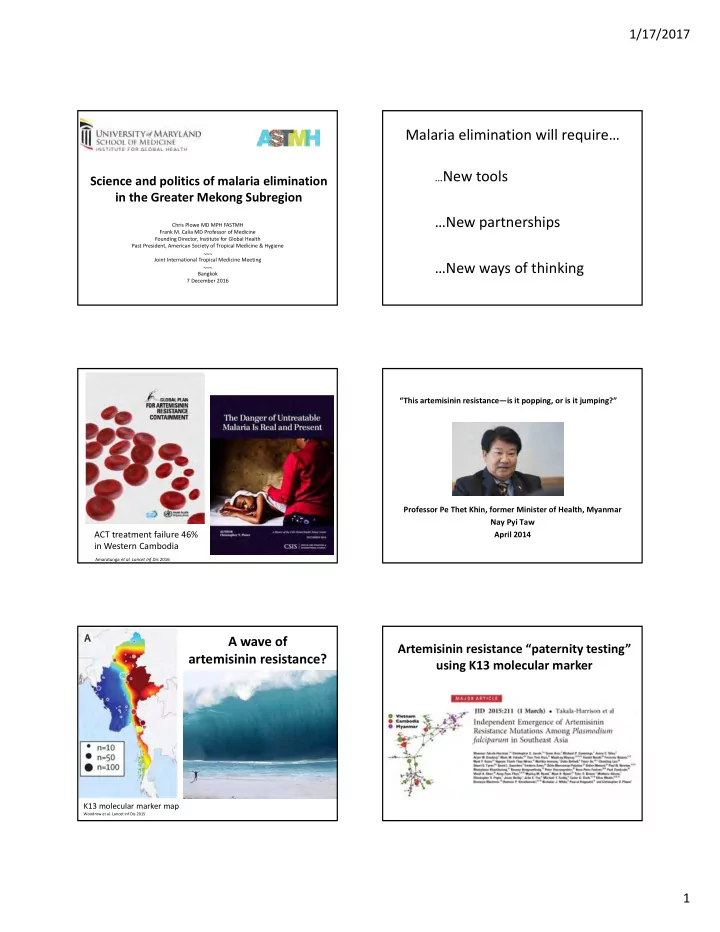
Malaria elimination will require…

…New tools

…New partnerships …New ways of thinking

Amaratunga et al. Lancet Inf Dis 2016

ACT treatment failure 46% in Western Cambodia

“This artemisinin resistance—is it popping, or is it jumping?” Professor Pe Thet Khin, former Minister of Health, Myanmar Nay Pyi Taw April 2014 K13 molecular marker map

Woodrow et al. Lancet Inf Dis 2015

A wave of artemisinin resistance?

Artemisinin resistance “paternity testing” using K13 molecular marker

slide-2
SLIDE 2

1/17/2017 2

K13 migration: Implications

  • Many different K13 mutations arose

independently on many different genetic backgrounds

  • Several resistance mutations have

spread between countries in the Greater Mekong Subregion (GMS)

  • Based on this result, 2015 WHO

recommendation:

– Containment is not possible – Falciparum elimination is imperative for the GMS

Need better tools to stratify and forecast malaria risk

  • Myanmar National

Malaria Control Program seeks to “microstratify” malaria risk at village level

  • Local transmission vs.

importation?

  • Sources vs. sinks of

transmission?

WHO recommendations:

Mass drug administration (MDA) for GMS …but not screen‐and‐treat (need better diagnostic tests)

http://www.who.int/malaria/publications/atoz/role‐of‐mda‐for‐malaria.pdf

usPCR PCR RDT

Parasites/mL 16 1000 100K

Limits of detection

  • P. falciparum and
  • P. vivax in human

blood samples

Mapping the subclinical malaria reservoir

  • Field scalable: No sample processing, no cold chain x 14 days
  • High throughput pipeline in Yangon: >20,000 samples since 2015
  • Concordant with high volume PCR from frozen venous blood
  • Now achieving same lower limit of detection from dried blood spots

– Better, cheaper, faster

  • Ultrasensitive low‐volume Reverse Transcriptase PCR

– Sensitivity: 16 parasites/mL & can detect both Pf & Pv simultaneously 0.3mL finger prick blood in cap tube

+

Mix with DNA‐ RNA shield Transport to lab Extract DNA/RNA Ultrasensitive qPCR Adams et al. Malaria Journal 2015 Zainabadi et al. in preparation

slide-3
SLIDE 3

1/17/2017 3 >30,000 samples analyzed in 2016

Department of Medical Research, Myanmar Ministry of Health

Serology Antibodies to diverse malaria antigens

  • Extremely high throughput

– Thousands of antibody assays on a single microarray the size of a microscope slide

  • Cost of equipment

decreasing ten‐fold

Serology for malaria surveillance

Array Cam microarray reader

slide-4
SLIDE 4

1/17/2017 4

Rangoon University medical students 1987

Burma 1988

Rangoon University medical students 1988 Rangoon University medical students 1989

Myanmar 2011

slide-5
SLIDE 5

1/17/2017 5

Building political will and ownership through capacity strengthening in the lab and the field First ever NIH grant in Myanmar

Malaria as a catalyst for social change

Gates Foundation Partners Meeting Nay Pyi Taw, Myanmar December 2014

Washington DC August 2015

Nay Pyi Taw 2016

Peace Health Science Science

slide-6
SLIDE 6

1/17/2017 6

Thanks to

Shannon Takala‐Harrison Chris Jacob Jason Bailey Andrew Pike Alexa Machikis Sonia Agarwal Andrea Berry Mark Travassos Matthew Adams Shay Roemmich Christina Shehata Cheron Jones Nicole Eddington Johnson Gillian Mbambo Biraj Shrestha Sudhaunshu Joshi Kayvan Zainabadi Myaing Nyunt Institute for Genome Sciences University of Maryland Joana Silva Amol Shetty Tim O’Connor Department of Geographical Sciences University of Maryland College Park Demian Rybock Kathleen Stewart Tatiana Loboda Department of Medical Research Myanmar Ministry of Health Zayar Han Hnin Hnin Wai Lwin Kay Thwe Han Myat Phone Kyaw Kyaw Zin Thant Defence Services Military Academy Myanmar Ministry of Defence Khine Zaw Oo Ye Myat Kyaw Tin Maung Hlaing National Institute of Parasitic Diseases Chinese CDC Huang Fang Xiao‐Nong Zhou Global Malaria Program World Health Organization Pascal Ringwald Community Partners International Si Thura Phyo Maung Maung Aye Aye Khaing Roche Innovation Technology John Tan ARC3 Collaborators ARCE Collaborators TRAC Collaborators