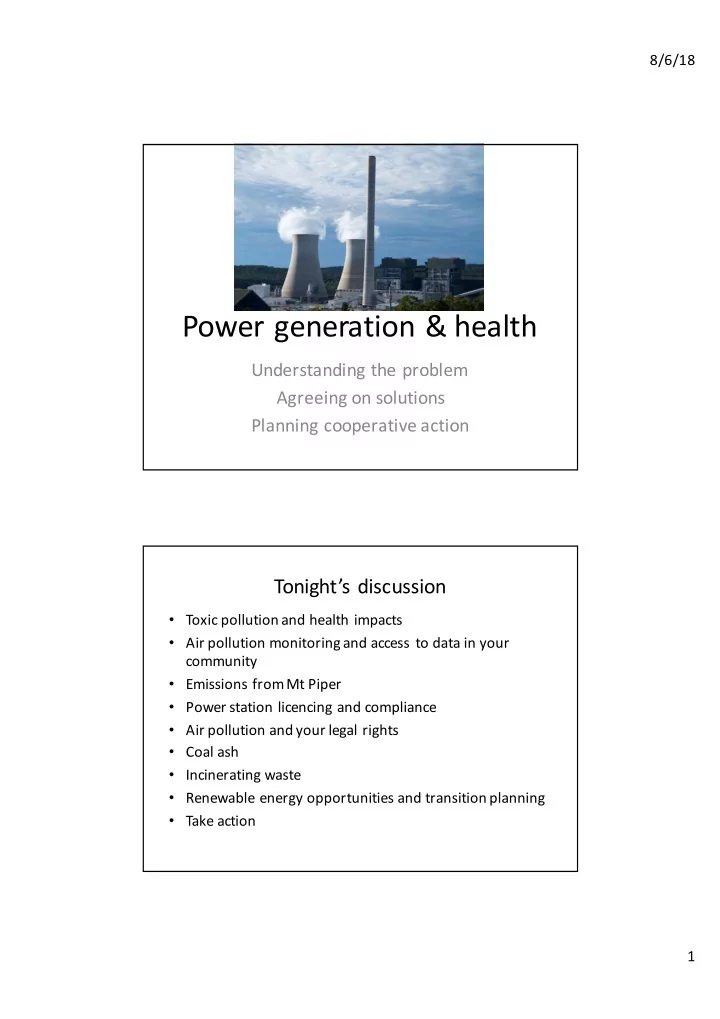
SLIDE 2 8/6/18 2
2014-15 2015-16 2016-17 Ammonia (total) 920 1,400 Arsenic & compounds 9 7 73 Beryllium & compounds 4 1 4 Boron & compounds 23,000 33,001 Cadmium & compounds 6 2 6 Carbon monoxide 820,000 550,000 809,100 Chlorine & compounds 190 55 Chromium (III) compounds 43 13 43 Chromium (VI) compounds 2 1 2 Cobalt & compounds Copper & compounds 16 3 19 Cumene (1-methylethylbenzene) 12 Fluoride compounds 210,000 71,000 270,000 Hydrochloric acid 2,000,000 1,300,000 1,900,000 Lead & compounds 44 7 26 Manganese & compounds 95 29 102 Mercury & compounds 42 19 29 Nickel & compounds 77 27 131 Oxides of Nitrogen 24,000,000 18,000,000 22,021,000 Particulate Matter 10.0 um 258,000 43,000 153,000 Particulate Matter 2.5 um 130,000 10,000 59,400 Polycyclic aromatic hydrocarbons (B[a]Peq) 33 22 33 Sulfur dioxide 36,000,000 23,000,000 32,000,015 Sulfuric acid 370,000 240,000 330,000 T
T
- tal Volatile Organic Compounds
99,062 66,097 100,200 Xylenes (individual or mixed isomers) 64 Zinc and compounds 130 48 153 T
63,888,673 43,303,331 57,677,812
T
- xic emissions from Mt Piper: National Pollutant Inventory 2016-17
Health impacts
- Fine particle pollution (PM2.5) causes premature death
- Sulfur dioxide contributes to asthma, infant birth weight,
cardiovascular and repiratory illness, hospital admissions
- Oxides of nitrogen effect lung function, asthma and
allergies even at low levels
- Mercury has toxic effects on the nervous, digestive and
immune systems, and on lungs, kidneys, skin and eyes
- Coal ash contains arsenic, lead, mercury, cadmium,
chromium and other toxic pollutants.