Cell- -associated HIV transmission: associated HIV transmission: - - PowerPoint PPT Presentation

cell associated hiv transmission associated hiv
SMART_READER_LITE
LIVE PREVIEW

Cell- -associated HIV transmission: associated HIV transmission: - - PowerPoint PPT Presentation

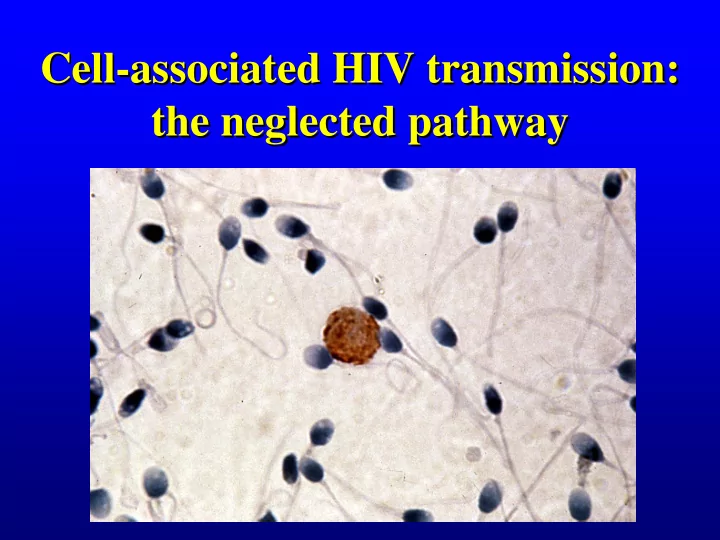
Cell- -associated HIV transmission: associated HIV transmission: Cell the neglected pathway the neglected pathway Trojan Horse Leukocytes Trojan Horse Leukocytes in AIDS Transmission in AIDS Transmission Anderson DJ, Yunis Yunis EJ. NEJM


slide-1
SLIDE 1

Cell Cell-

  • associated HIV transmission:

associated HIV transmission: the neglected pathway the neglected pathway

slide-2
SLIDE 2

Trojan Horse Leukocytes Trojan Horse Leukocytes in AIDS Transmission in AIDS Transmission

Anderson DJ, Anderson DJ, Yunis Yunis EJ. NEJM 1983

  • EJ. NEJM 1983
  • T cells and macrophages

T cells and macrophages in in semen could transmit HIV semen could transmit HIV

  • Intracellular virus is

Intracellular virus is protected from antibodies protected from antibodies and antimicrobial proteins and antimicrobial proteins

  • Cell

Cell-

  • to

to-

  • cell HIV transfer is

cell HIV transfer is highly efficient highly efficient

slide-3
SLIDE 3

3. 4. 6. 5. 1. 2.

Dendritic cell/ Langerhans cell Resident leukocyte HIV virions Resident macrophage Infected leukocyte/ macrophage

Columnar Epithelium Columnar Epithelium Stratified Stratified Squamous Squamous Epithelium Epithelium

slide-4
SLIDE 4

Questions:

  • What are the infectious cells in semen?
  • How long do they survive?
  • Does CA-HIV have a distinctive genotype?
  • What are the molecular events that can be

targeted by HIV prevention strategies?

  • What are the best in vitro and animal

models to study CA-HIV transmission?

  • Can CA-HIV transmission be blocked with

antibodies, microbicides, ARVs?

slide-5
SLIDE 5

In Vitro Tissue Models of Cell- Associated HIV Transmission

  • Microscopic studies
  • Transcytosis assays
  • Explant assays
slide-6
SLIDE 6

Adhesion of leukocytes to Adhesion of leukocytes to epithelial cells epithelial cells

D Phillips 1997

slide-7
SLIDE 7

Directional HIV shedding towards Directional HIV shedding towards epithelial surface epithelial surface

Phillips 1997

slide-8
SLIDE 8

Macrophage beginning to Macrophage beginning to infiltrate infiltrate endocervical endocervical explant explant

slide-9
SLIDE 9

Macrophages attached to surface Macrophages attached to surface

  • f VEC tissue
  • f VEC tissue

30 min

slide-10
SLIDE 10

Macrophages infiltrating VEC Macrophages infiltrating VEC stratified stratified squamous squamous epithelium epithelium

1 hr

slide-11
SLIDE 11

Macrophages have crossed the Macrophages have crossed the epithelium and are located in the epithelium and are located in the lamina lamina propria propria

4 hrs

slide-12
SLIDE 12

JPEG graph of infiltrating JPEG graph of infiltrating cells cells

slide-13
SLIDE 13

TNF-a treated VEC tissue is more permeable to macrophage infiltration

PBS treated control 0.1ug/mL TNF 1ug/mL TNF 10ug/mL TNF

slide-14
SLIDE 14

Total U937 Infiltration of EpiVaginal Tissue

20 40 60 80 100 120 PBS total TNF 0.1ug total TNF 1ug total TNF 10ug total number of cells <50um 50-100um 100-200um 200um+

Quantitation of infiltrating cells in TNF-a treated VEC tissue

slide-15
SLIDE 15

Evidence for cell Evidence for cell-

  • associated HIV

associated HIV transmission: in vitro models transmission: in vitro models

  • HIV

HIV-

  • infected leukocytes are more efficient than

infected leukocytes are more efficient than free virus at transmitting HIV across polarized free virus at transmitting HIV across polarized epithelial epithelial monolayers monolayers via via transcytosis transcytosis

(Tan et al 1993; (Tan et al 1993; Chancey Chancey et al 2006; et al 2006; Bomsel Bomsel 1997;VanHerrewege 1997;VanHerrewege 2007) 2007)

  • Both infected cells and free virus infect

Both infected cells and free virus infect subepithelial subepithelial cells in the cervical cells in the cervical explant explant model model

(Collins et al 2000) (Collins et al 2000)

slide-16
SLIDE 16

Recent In Vitro Studies

  • SIV-infected PBMCs crossed the mucosal

epithelium of rectal explant tissues and infected target cells.

Kolodkin-Gal D. et al. J Virol 2013

  • HIV-infected PBMCs crossed themucosal

epithelium of human urethral explant tissues and infected subepithelial macrophages

  • Ganor Y et al Mucosal Immunology 2013
slide-17
SLIDE 17

Summary of Cell Summary of Cell-

  • Associated HIV

Associated HIV Transmission Models Transmission Models

Cervicovaginal Rectal Urethral Polarized Epithelial Monolayers + + Tissue Explants + + + Organotypic Cultures +