The Journal of Neuroscience Directional Preferences Differ in - - PDF document

the journal of neuroscience
SMART_READER_LITE
LIVE PREVIEW

The Journal of Neuroscience Directional Preferences Differ in - - PDF document

9/29/2011 Retinal Ganglion Cells with Distinct The Journal of Neuroscience Directional Preferences Differ in Molecular Identity, Structure, and Central Published by the Society for Neuroscience Projections First issue: 1981 Jeremy N.


slide-1
SLIDE 1

9/29/2011 1 Retinal Ganglion Cells with Distinct Directional Preferences Differ in Molecular Identity, Structure, and Central Projections

Jeremy N. Kay, Irina De la Huerta, In-Jung Kim, Yifeng Zhang, Masahito Yamagata, Monica W. Chu, Markus Meister, and Joshua R. Sanes

The Journal of Neuroscience 31 (21), 7753–7762 Date published: May 25, 2011 Presented by: Michelle Lee

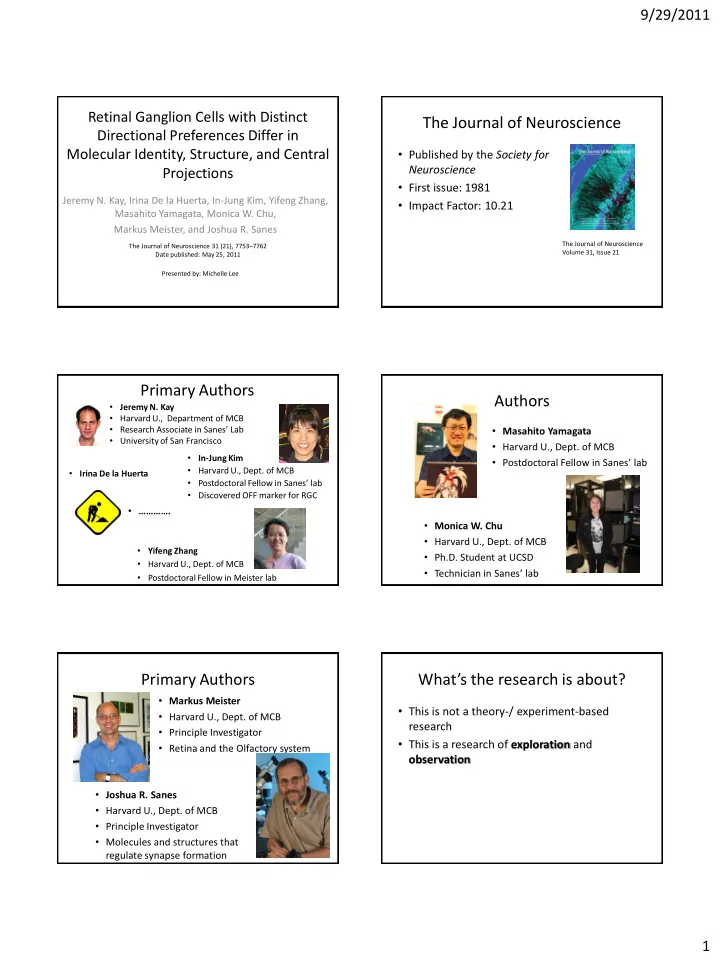
The Journal of Neuroscience

  • Published by the Society for

Neuroscience

  • First issue: 1981
  • Impact Factor: 10.21

The Journal of Neuroscience Volume 31, Issue 21

Primary Authors

  • Irina De la Huerta
  • Jeremy N. Kay
  • Harvard U., Department of MCB
  • Research Associate in Sanes’ Lab
  • University of San Francisco
  • ………….
  • In-Jung Kim
  • Harvard U., Dept. of MCB
  • Postdoctoral Fellow in Sanes’ lab
  • Discovered OFF marker for RGC
  • Yifeng Zhang
  • Harvard U., Dept. of MCB
  • Postdoctoral Fellow in Meister lab

Authors

  • Monica W. Chu
  • Harvard U., Dept. of MCB
  • Ph.D. Student at UCSD
  • Technician in Sanes’ lab
  • Masahito Yamagata
  • Harvard U., Dept. of MCB
  • Postdoctoral Fellow in Sanes’ lab

Primary Authors

  • Joshua R. Sanes
  • Harvard U., Dept. of MCB
  • Principle Investigator
  • Molecules and structures that

regulate synapse formation

  • Markus Meister
  • Harvard U., Dept. of MCB
  • Principle Investigator
  • Retina and the Olfactory system

What’s the research is about?

  • This is not a theory-/ experiment-based

research

  • This is a research of exploration and
  • bservation
slide-2
SLIDE 2

9/29/2011 2

What’s the research is about?

  • Exploring Retinal Ganglion Cells with

Directional Preferences in:

– Molecular Identity (genes! surface markers!) – Structure (dendritic asymmetry!) – Central Projections (where do axons project to?)

  • The 4 directions:

– Dorsal – Ventral – Nasal – Temporal

Background information

  • A light-sensitive tissue lining the inner surface of the

eye

Retina Background information Retina

Light!

  • 3 layers of neurons
  • 2 layers of

synapses

Background information Retina Background information Retinal Ganglion Cells

  • Signaling to brain- large diameter axons
  • On/ Off center cells
  • VERY diverse structures and sizes

So… What have been done so far?

  • Since Cajal…

– Dendritic morphology – Cell body and dendritic tree size – Arborized sub-layer in …

  • 5 main types; 60-100 subtypes
  • Directional Preferences (1964!)
slide-3
SLIDE 3

9/29/2011 3

  • oDSGC
  • On-Off direction-selective retinal ganglion cells
  • Bistratified: bipolar & amacrine cell input
  • DIRECTIONAL SELECTIVITY: 4 directions
  • It’s ASSUMED that there are 4 subtypes of
  • oDSGCs
  • They “know” they are different

What we don’t know yet…

  • Detailed differences between the 4 subtypes!

Methods

  • Transgenic technology
  • Electrophysiology
  • Histology

Transgenic technology

  • Purpose: to mark different lines of ooDSGC

that might have different directional preferences

  • Use markers that only express in certain lines
  • f RGCs

– BD-RGCs: Fstl4: (ventral) – W9-RGCs: Thy: (nasal) – Cdh6-expressing RGCs: Cdh6: ( dorsal & ventral) – DRD4-RGCs: DRD4:(nasal)

D: Cdh6 V: BD/Cdh6 N: DRD4/ W9 T: ?

Transgenic technology Transgenic technology

X

Courtesy of Dr. Hopkins

slide-4
SLIDE 4

9/29/2011 4

Transgenic technology

Specific marker Gene Fstl4/ Thy/ cdh6/ DRD4… No fluorescence because of the STOP sequence CreER + the specific marker integrated into cells that ALSO have the marker sequence Tamoxifen turns CreER on: CreER cut off STOP: YFP expresses!

Transgenic technology

Green fluorescent label: DRD4 Red Fluorescent label: BD

Electrophysiology

  • Measure directional preference
  • Isolate retinas out
  • Cells recorded with cell-attached patch

microelectrodes

  • Light stimuli delivered in different directions
  • Spikes recorded with light moving through

different directions

So again… What is this CRAZY thing for?

Green fluorescent label: DRD4 Red Fluorescent label: BD

Electrophysiology

Because we need to know which cell to look at!

BD-RGC BD-RGC W9-RGC Cdh6 D: Cdh6 V: BD/Cdh6 N: DRD4/ W9 T: ?

Histology- In situ Hybridization

  • Purpose: Mark out WHERE and WHICH gene is

expressing in a whole tissue

slide-5
SLIDE 5

9/29/2011 5

  • Use RNA/ DNA probes
  • Probes Hybridize with mRNA (precursor of

Protein)

  • Antibodies that carries fluorescent dye reveal

hybridized molecules

Histology- In situ Hybridization How were the genes selected?

  • Microarray shows lots of genes to choose

from

  • Products are cell surface or secreted proteins:

might be involved in development or function

  • f ooDSGCs

– Cdh6, Col25c1, Mmp17, CART

Histology- Lucifer Yellow Staining

  • http://webvision.med.utah.edu/movies/electr
  • de.mov

Results

  • Molecular identity
  • Dendritic/ cell body structures
  • Axonal projections

D: Cdh6 V: BD/Cdh6 N: DRD4/ W9 T: ?

Molecular identity

D: Cdh6 V: BD/Cdh6 N: DRD4/ W9 T: ?

Molecular identity

In situ marks out the target gene expression: Cdh6 In situ marks out the target gene expression: Cdh6 GFP marks out target RGC line: BD GFP marks out target RGC line: DRD4 2 markers merged! Confirm of gene expression on this cell line  2 markers did not merge  no expression

  • n DRD4

D: Cdh6 V: BD/Cdh6 N: DRD4/ W9 T: ?

slide-6
SLIDE 6

9/29/2011 6

Molecular identity

+ + + + +

D: Cdh6 V: BD/Cdh6 N: DRD4/ W9 T: ?

Molecular identity

Key point here: the development is experience-independent!

7 days after birth 14 days after birth

Molecular identity- CART

  • CART: specific marker for ooDSGC!

Merged markers!

Molecular identity- CART

  • Morphologically matched!

– Bistratified, ON/OFF,

Dendritic/ cell body structures Dendritic/ cell body structures

  • W9/DRD4 cells: Morphology does not

correlate with their preferred direction

  • D: Cdh6

V: BD/Cdh6 N: DRD4/ W9 T: ?

slide-7
SLIDE 7

9/29/2011 7

Dendritic/ cell body structures

  • BD cells: Morphology DOES correlate with

their preferred direction

  • D: Cdh6

V: BD/Cdh6 N: DRD4/ W9 T: ?

Dendritic/ cell body structures

  • Perhaps dendrite directions play a role in

directional selectivity?

  • Maybe… BUT…

Axonal projections Axonal projections

  • ooDSGC projections

V.S. RGC

– Absent from many retinal targets – Arbors are confined to the upper portion in SC – Nearly NO ipsilateral porjections

Axonal projections

  • Differences in targets among ooDSGC subsets

– Only vertical GC (BD and Cdh6) project to the MTN and NOT – DRD4-RGCs do not project to MTN and NOT

D: Cdh6 V: BD/Cdh6 N: DRD4/ W9 T: ?

Last slide, I promise!

D: Cdh6 V: BD/Cdh6 N: DRD4/ W9 T: ?