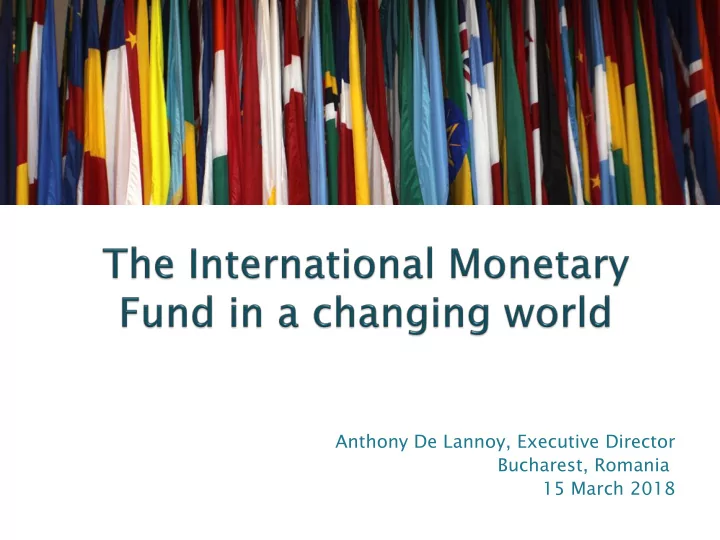
Anthony De Lannoy, Executive Director Bucharest, Romania 15 March - - PowerPoint PPT Presentation

anthony de lannoy executive director bucharest romania 15
SMART_READER_LITE
LIVE PREVIEW

Anthony De Lannoy, Executive Director Bucharest, Romania 15 March - - PowerPoint PPT Presentation

Anthony De Lannoy, Executive Director Bucharest, Romania 15 March 2018 Introduction I. IMF governance II. III. The Dutch-Belgian Constituency IV. European representation V. Tasks VI. The IMF in Romania VII. The IMF in a changing world VIII.


slide-1
SLIDE 1

Anthony De Lannoy, Executive Director Bucharest, Romania 15 March 2018

slide-2
SLIDE 2

I.

Introduction

II.

IMF governance

  • III. The Dutch-Belgian Constituency
  • IV. European representation
  • V. Tasks
  • VI. The IMF in Romania
  • VII. The IMF in a changing world
  • VIII. Challenges for the future
slide-3
SLIDE 3
  • I. Introd

roduc uctio tion

Established in Bretton Woods, New Hampshire, in 1944

Members: from 44 44 member states in 1945 to 189 189 member states in 2018; only the UN has more member states (193): ⁻ Andorra, Cuba, Liechtenstein, Monaco, and North Korea are not a member of the IMF ⁻ Kosovo is a member of the IMF, but not of the UN IMF World Bank

International monetary cooperation LT economic development and poverty reduction Provides loans and helps countries design policy programs to solve balance

  • f payments problems

Projects, sector reforms (health, education…) ST/MT loans funded through quota contributions/bilateral loans LT loans funded through member country contributions/bond issuance

slide-4
SLIDE 4

II. . IMF F governa vernanc nce e - quota ta

A country’s quota (capital contribution) is based on the country’s relative position in the world economy

The current quota formula is a weighted average of GDP (50%), openn nness ss (30%), econom

  • mic

c vari riab abil ility ity (15%), and internat rnation ional al reserv rves (5%). GDP is measured through a blend of GDP, based on market exchange rates (60%) and on PPP exchange rates (40%). The formula also includes a compression factor which somewhat improves the position of small(er) countries

A country’s quota determines:

The maximum amount of financial resources the member is obliged to provide to the IMF (25% reserve currency, 75% own currency)

The voting power and thus the relative power of the member within the institution

Access to financing; a distinction is made between normal access and exceptional access

slide-5
SLIDE 5

II. . IMF governa vernanc nce e - overview rview

Board of Gover ernors

  • rs

▪ One Governor from each member state ▪ Annual Meetings IMFC International Monetary and Financial Committee ▪ 24 Governors ▪ Spring and Annual Meetings

advise ises

Executive tive Board ▪ 24 Executive Directors ▪ Conducts day-to-day business ▪ Meets several times a week Managem ement ent & Staff +/-2700

Crucial aspect of the IMF’s governance: nearly all decisions are taken by consens nsus us (legally: simple or special 70%/85% majority)

slide-6
SLIDE 6

8 single country Chairs 16 Constituencies

II. . IMF F governa vernanc nce e – Execut cutive ive Board

USA 16.53% Japan 6.16%

24 Executive Directors

China 6.09% Germany 5.32% UK 4.04% France 4.04% Russia 2.59% Saudi Arabia 2.02%

slide-7
SLIDE 7

III II. . The Dutch ch-Be Belgia lgian n Constit tituency uency

0.05% 1.30% 0.08% 0.21% 0.17% 0.09% 0.07% 0.41% 0.29% 0.06% 0.06% 0.04% 1.77% 0.39% 0.43%

slide-8
SLIDE 8

III II. . The Dutch ch-Be Belgia lgian n Constit tituency uency

Until October 31, 2012, Belgium and the Netherlands led two separate constituencies. On November 1, 2012, Belgium and Luxembourg moved to the Dutch Constituency to establish the Dutch-Belgian Constituency

The establishment of the Dutch-Belgian Constituency in 2012 was the result of the 2010 quota and governance reforms

Goal: reduce the number of European seats in the Executive Board

slide-9
SLIDE 9
  • IV. Europe
  • pean

an representation esentation

IMF members freely choose a constituency:

⁻ 28 EU member states are spread across 9 chairs ⁻ 18 Euro Area member states are spread across 8 chairs ▪

Nor the EU, nor the Euro Area are members of the IMF. The ECB has an observer on the Executive Board and the IMFC. The European Commission only has observer status at the IMFC

The European Commission’s long term aim is a single Euro Area chair in the IMF, and thus to have a more unified and coherent external representation of the Euro Area

slide-10
SLIDE 10
  • V. Tasks - survei

veilla llanc nce e

Surveillance covers macroeconomic policies, financial sector stability, risks and vulnerabilities, as well as institutional and structural issues Global Regi giona

  • nal

l Bilatera ral

slide-11
SLIDE 11
  • V. Tasks – ca

capacity city deve velopm lopmen ent t

Capacity development consists of technical assistance and training

slide-12
SLIDE 12
  • V. Tasks - lending

ing

The IMF provides loans to countries that have trouble meeting their international payments and cannot otherwise find sufficient financing on affordable terms

Balance ce of pa payments nts problem: international payments require reserve currency (USD, EUR, JPY, GBP…). Countries run out of reserves e.g. because of a sharp drop in export receipts (fall in commodity prices), speculative attacks against a fixed exchange rate, loss of access to capital markets because of high debt levels…

Stabiliza zati tion

  • n: IMF financial assistance is designed to help countries

restore macroeconomic stability by rebuilding their international reserves, stabilizing their currencies, and staying current on international payments

slide-13
SLIDE 13
  • V. Tasks - lending

ing

Condit ditiona ionali lity ty: conditions linked to an IMF loan are focused and country-specific in order to address the underlying causes of the crisis that forced the member to request an IMF loan

Disbu burs rsem ement ent of resources urces: once an IMF program is approved, the loan is released in phased installments as the program is effectively carried out

Precau aution tionar ary y credit it lines ines: : to members with strong fundamentals and a strong track record of policy implementation (e.g. Flexible Credit Line, Precautionary and Liquidity Line)

Non-fin financial cial: the IMF can help countries design an economic program that delivers clear signals to donors and/or the markets on the basis of the IMF’s endorsement of the strength of the country’s policies

slide-14
SLIDE 14
  • V. Tasks - lending

ing

Concess cession

  • nal

l financing ncing: an IMF loan can be either on non- concessional terms or on concessional terms. Low-income countries can obtain concessional financing under the Poverty Reduction and Growth Trust (PRGT), which allows them to lend at substantially reduced interest rates. To help low-income countries cope with the global crisis, zero interest are currently charged on all concessional lending

Debt relief ief: the IMF has provided substantial debt relief to low- income countries under the Heavily Indebted Poor Countries (HIPC) Initiative and the Multilateral Debt Relief Initiative (MDRI); to date, 36 countries, of which 30 in Africa, have benefited from US$76 billion in debt-service relief over time

slide-15
SLIDE 15
  • V. Tasks - lending

ing

Reac accu cumul ulation tion of debt in low-in inco come me count ntri ries es:

15 20 30 40 50 60 70 80 90 2010 2011 2012 2013 2014 2015 2016 Fuel exporters Other commodity exporters Diversified exporters Post-HIPCs countries Post-HIPCs countries in difficulty 1/

Evolution of Public Debt

(simple averages, percent of GDP)

Source: IMF WEO database. 1/ Post-HIPC countries downgraded to debt distress or high risk of debt distress in past 3 years, including those expected to be downgraded based on IMF staff assessment.

slide-16
SLIDE 16
  • V. Tasks - lending

ing

Non-co conce ncessiona

  • nal

Conce cessiona

  • nal

Stand-By By Arrangem ement ent (SBA) A)

Typically 1-2yrs

Standby by Credit t Facility (SCF)

Short-term/potential BoP needs

Extend ended ed Fund Facility (EFF)

Medium/longer term BoP problems

Extend ended ed Credit t Facility (ECF)

Main tool for medium-term support

Flexible Credit t Line (FCL)

Precautionary, very strong fundamentals/policies

Precauti tion

  • nary

ry and Liquidi dity ty Line (PLL) L)

Precautionary, sound fundamentals/policies

Rapid Financing g Instrum rument ent (RFI)

Emergency assistance, limited access/conditionality

Rapid Credit t Facility (RCF)

Emergency assistance, limited access/conditionality

Policy Coordi dinati tion

  • n Instrum

rumen ent

Non-financial, for signaling purposes

Policy Support

  • rt Instru

trument ent (PSI)

Non-financial, for signaling purposes

slide-17
SLIDE 17

Lend nding ing during ng the crisis: spectacular increase in lending compared to the period <2009

  • V. Tasks - lending

ing

In miljarden SDR

173 336 mSDR FCC 246 200 mSDR 112 850 mSDR FCC 209 400 mSDR

slide-18
SLIDE 18

Largest t borrowers: the regional composition of the members with the largest non-concessional programs changed substantially during the global financial crisis

  • V. Tasks - lending

ing

02/200 008 05/201 011 10/201 017 Turkey ey

6 662 mSDR

Greece

26 432 mSDR

Ukraine

12 348 mSDR

Iraq

475 mSDR

Portu tuga gal

23 742 mSDR

Egypt

8 597 mSDR

Peru

172 mSDR

Ireland

19 466 mSDR

Iraq

3 831 mSDR

Gabon

77 mSDR

Ukraine

10 000 mSDR

Tunisi sia

2 046 mSDR

FYR Macedon

  • nia

52 mSDR

Pakist stan

7 236 mSDR

Jamaica

1 195 mSDR

slide-19
SLIDE 19

Reserv erve e currency rency: most, if not all, international payments require internationally accepted currencies (e.g. USD, EUR, JPY, GBP)

Balan lance ce of Payments yments deficit icit: the Balance of Payments is always balanced. When more reserve currency leave the country than enter, the international reserves of the central bank decline. This may lead to a crisis and a sharp devaluation of the currency

Euro

  • Area: why did a member of the Euro

Area suffer a Balance of Payments problem, despite the euro being a reserve currency?

  • V. Tasks - lending

ing

slide-20
SLIDE 20

Lend nding ing: Romania entered into several IMF-supported programs

  • ver the years; the last two programs were precautionary and

Romania never drew on them

Romania IMF-supported programs (SDR thousand)

  • VI. The IMF

F in Romani ania

slide-21
SLIDE 21

Surve veillance llance: on May 22, 2017 the Executive Board of the IMF concluded the 2017 Article IV consultation with Romania

The 2018 annual check up on the Romanian economy is underway and will conclude in Bucharest on March 16, 2018

  • VI. The IMF

F in Romani ania

slide-22
SLIDE 22

▪ Public

ic perception tion: the IMF may not always be popular, especially in program countries (conditionality), it is nevertheless needed. People often confuse the firefighter with the fire

▪ Cataly

lytic tic role: countries and/or other international/regional institutions willing to help a country with a Balance of Payments need regularly require that there is an IMF program in place first. An IMF program also helps regaining market access at affordable terms

▪ Change: as the world changes, the IMF also changes, both its

governance and in the way it operates

VII.

  • I. The IMF

F in a ch changing nging world

slide-23
SLIDE 23

VII.

  • I. The IMF in a chang

ngin ing g wor

  • rld

ld - govern vernance ance

Governance nance:

⁻ The 2010 quota and governance were an important step

forward

⁻ The 2010 quota and governance reforms only came into effect

in February 2016 after the US ratified the proposals (85% majority required)

⁻ the reforms resulted in a shift of more than 6% of quota shares

to dynamic emerging market and developing countries, while protecting the quota shares and voting power of the poorest members

slide-24
SLIDE 24

VII.

  • I. The IMF in a chang

ngin ing g wor

  • rld

ld - govern vernance ance

Before re the 2010 10 refor

  • rms

After r the 2010 0 refor

  • rms

ms

  • 1. US (16.75%)
  • 1. US (16.53%)
  • 2. Japan (6.23%)
  • 2. Japan (6.16%)
  • 3. Germany (5.81%)
  • 3. China (6.09%)
  • 4. UK (4.29%)
  • 4. Germany (5.32%)
  • 5. France (4.29%)
  • 5. UK (4.04%)
  • 6. China (3.81%)
  • 6. France (4.04%)
  • 7. Italy (3.16%)
  • 7. Italy (3.02%)
  • 8. Saudi Arabia (2.80%)
  • 8. India (2.64%)
  • 9. Canada (2.56%)
  • 9. Russia (2.59%)
  • 10. Russia (2.39%)
  • 10. Brazil (2.22%)
slide-25
SLIDE 25

Tasks ks: the IMF learned lessons from previous programs and crises:

⁻ Better

ter count untry y owners ershi hip: it is crucial that the authorities own an IMF program, share and support its contents and goals

⁻ More trans

nspa paren ency cy and accoun

  • untab

abili ility ty: most Board documents are made public, and the IMF has increased its outreach towards CSOs, academics, private market participants, labor unions…

⁻ More tailo

ilored red policy icy advis ise: programs cannot be one-size-fits-all, but need to be country-specific

⁻ Broader

ader scope: programs now take into account macro-social issues, gender issues (e.g. labor market participation), the effects

  • f inequality…

VII.

  • I. The IMF

F in a ch changing nging world d - tasks

slide-26
SLIDE 26

VII.

  • I. The IMF

F in a ch changing nging world d - tasks

The Managing Director’s April 2017 Global Policy Agenda: A More Inclusive and Resilient Global Economy

slide-27
SLIDE 27

Going forward the IMF has identified a number of important challenges for the world economy

Climate te chang nge:

⁻ Temperature increases will trigger large falls in GDP per capita

across many countries around the world

⁻ Natural disasters have a negative impact on fiscal balances/debt

ratios (e.g. high costs related to hurricanes in the Caribbean)

⁻ “The Fund has a role to play in helping its members address those

challenges of climate change for which fiscal and macroeconomic policies are an important component of the appropriate policy response” Managing Director Christine Lagarde

VIII.

  • II. Challen

enge ges s for the future ure

slide-28
SLIDE 28

Market t dominance nce of high-tech tech companies ies:

⁻ Size: revenues of large corporations are comparable in size to

countries’ GDP

⁻ Dominance

ance: companies like Amazon, Facebook, Google, Netflix acquire rivals before these companies can reach a critical mass (winner takes all model)

⁻ Competi

titi tion

  • n: should an online platform with monopoly power be

regulated, comparable to other network sectors like e.g. electricity? Which (inter)national competition authority will enforce the rules?

⁻ Propert

rty y rights ts: should data property rights be redefined to provide individuals more control over their data?

VIII.

  • II. Challen

enge ges s for the future ure

slide-29
SLIDE 29

The econom nomic c impact of n new techno chnolo logies ies:

⁻ AI

AI: will lead to a massive expansion in data access and use (currently +/-80% of the world’s data is not searchable). There are important applications in economics: e.g. transparency/trust in financial services, AML procedures, regulation and compliance…

⁻ Blockc

kcha hain in: transaction costs will decrease substantially, e.g. in the transportation sector, in real estate transactions…

⁻ Labor market: will new technologies lead to massive job losses or

shifts in jobs to other sectors? What are the implications for education models and for low-skilled workers?

⁻ Go

Gover ernm nmen ent reven enues ues/tax /tax sy syste stems ms: How to define “physical presence”, source, and destination? Should automation and digitization be taxed (versus labor)? Should peer-to-peer transactions be taxed, and if so, how?

VIII.

  • II. Challen

enge ges s for the future ure

slide-30
SLIDE 30

Cyber se security curity and the sy syste stemic c impact t of cyber r incidents dents:

⁻ Scena

nario rios: there are various possible scenarios of cyber incidents with systemic impact (critical services disruption, data integrity issue, confidentiality breach…)

⁻ Cooperat

ratio ion: national cyber security preparedness varies across countries; cyber defense efforts are too decentralized and international/regional cooperation is lacking

⁻ Public

c good: de potential systemic impact of a cyber incident, e.g. in the financial sector, is too large for cyber security to be left to private sector weaknesses

⁻ Standa

dards rds: should minimal cyber security standards be developed in critical sectors? Which authority will enforce them?

VIII.

  • II. Challen

enge ges s for the future ure

slide-31
SLIDE 31