Smoking at Time of Delivery (SATOD) 2016/17 England North East - - PowerPoint PPT Presentation

smoking at time of delivery satod
SMART_READER_LITE
LIVE PREVIEW

Smoking at Time of Delivery (SATOD) 2016/17 England North East - - PowerPoint PPT Presentation

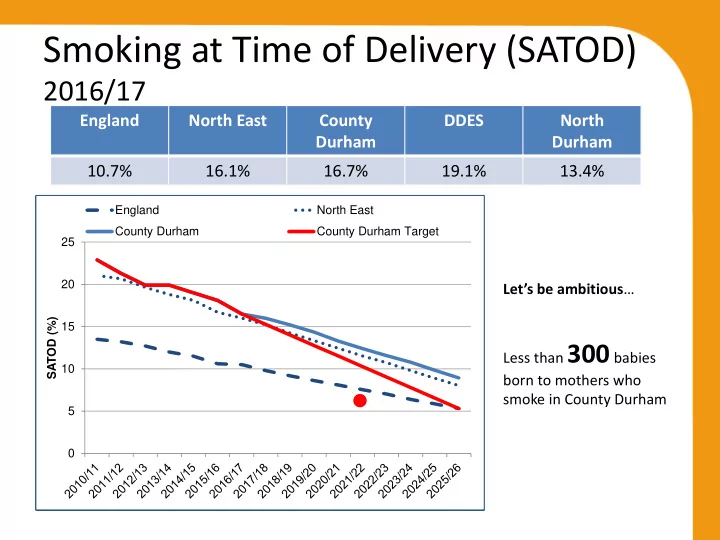
Smoking at Time of Delivery (SATOD) 2016/17 England North East County DDES North Durham Durham 10.7% 16.1% 16.7% 19.1% 13.4% England North East England England North East North East County Durham England North East County


slide-1
SLIDE 1

Smoking at Time of Delivery (SATOD)

2016/17

England North East County Durham DDES North Durham 10.7% 16.1% 16.7% 19.1% 13.4%

5 10 15 20 25 2010/11 2011/12 2012/13 2013/14 2014/15 2015/16 2016/17 SATOD (%) England North East County Durham 5 10 15 20 25 SATOD (%) England North East County Durham 5 10 15 20 25 SATOD (%) England North East County Durham 5 10 15 20 25 SATOD (%) England North East County Durham County Durham Target

2016/17

900 babies born to

mothers who smoke. If County Durham had the same % SATOD as England there would be around

340 less babies born to

smoking mothers. 2025/26

460 babies born to

mothers who smoke. If County Durham had the same % SATOD as England there would be around

180 less babies born to

smoking mothers. Let’s be ambitious… Less than 300 babies born to mothers who smoke in County Durham

slide-2
SLIDE 2

SATOD by MSOA and deprivation

3 year pooled 2014/15 – 2016/17

5 10 15 20 25 30 35 40 10 20 30 40 50 60 % SATOD Deprivation Score (ID2015) Least deprived Most deprived

There are 66 MSOAs (middle super output areas) in County Durham with an average population of around 7,200.

slide-3
SLIDE 3

SATOD by MSOA North Durham

3 year pooled 2014/15 – 2016/17

5 10 15 20 25 30 % SATOD North Durham North Durham +/- 20%

30% most deprived Not deprived

slide-4
SLIDE 4

SATOD by MSOA DDES

3 year pooled 2014/15 – 2016/17

5 10 15 20 25 30 35 40 % SATOD DDES DDES +/- 20%

30% most deprived Not deprived

slide-5
SLIDE 5
slide-6
SLIDE 6

Smoking in Pregnancy incentive scheme DDES

Specific goals:

  • To support pregnant smokers to set a quit date and achieve a CO

validated 4-week quit,

  • To remain smokefree throughout the pregnancy and for 3-months

post-partum. Key elements:

  • Enhanced cessation support
  • A financial incentive/ reward for achieving and maintaining

smokefree status

  • Support from a Significant Other (SOS)
  • Taping. D, Bauld. L. Purves, D. et al, (2015) Financial incentives for smoking cessation in pregnancy: randomised controlled trial. BMJ 2015;350:h134 doi:

10.1136/bmj.h134

slide-7
SLIDE 7

Criteria

Women are recruited via health professional referral based on the following criteria:

  • Teen pregnancy
  • Living in an area of deprivation/high smoking

prevalence

  • Living with a smoker/s
  • Smoked throughout previous pregnancy
  • Judgement of the relevant health care

professional

slide-8
SLIDE 8

Outcomes

  • 122 women to go through the programme
  • based on the success of previous

evaluation data, it is expected that 69% (n=84) women are quit at 4 weeks, and

  • 71% (n=59) would still be quit at delivery
slide-9
SLIDE 9

Recruitment as of Q2 (April –Sept)

Target 122: Recruited 92

  • 36% (n=33) have identified a significant other.
  • 64% (n=58) are participating in the scheme

unsupported by a significant other

  • 40% of women unsupported by a significant other live

with a smoker. Within this cohort 47% were lost to follow-up or did not quit

  • 14% (n=13) of those participating in the scheme are

teenagers

  • 46% (n=42) are age 25yrs or above
slide-10
SLIDE 10

Continued…

  • 8% (n=44) participants have identified themselves as

never having worked or having been unemployed for

  • ver a year
  • 35% (n=32)as routine and manual workers
  • Overall just under 84% are routine manual have never

worked or are long-term unemployed – These women would be classified as the most vulnerable

slide-11
SLIDE 11

Great success once women engage with the Stop Smoking Service

Number referred to SSS Number setting a quit date Number quit Number quit with Midwife BI Total quit

920 211 117 66 183

2016/17

slide-12
SLIDE 12

Q1 2016-17 Q1 2017-18 Total pregnancy referrals 217 331 Midwife referrals 193 309 Attended appointment 81 (37%) 136 (41%) Set a quit date 58 (72%) 59 Quit at 4 weeks 35 (60%) 40 (68%) CO validated quits 30 (86%) 34 (85%)

DDES North Durham DDES North Durham Set a quit date 33 23 41 18 Quit at 4 weeks 19 (58%) 16 (70%) 29 (73%) 11 (61%) CO validated quits 15 (79%) 15 (94%) 27 (93%) 7 (64%)

Q1 2016-17 Q1 2017-18

Quarter 1 service results

slide-13
SLIDE 13

Quarter 2 service results

Q2 2016-17 Q2 2017-18

slide-14
SLIDE 14

Healthwatch – Maternity Report

  • Healthwatch County

Durham (HWCD) undertook engagement and research

  • n to help ND and DDES

CCGs understand experiences of smoking during pregnancy

  • Key Performance Indicator

(KPIs) for maternity services

– Women smoking at time of delivery (per 100 maternities)

slide-15
SLIDE 15

Engagement and Research Undertaken

The approach was split into two areas of work:

  • 1. Gathered the views and experiences of mothers

in County Durham in relation to their smoking behaviour whilst pregnant.

  • 2. Contact demographically similar CCG areas

where they are higher achieving in relation to the performance indicator with a view to identify positive initiatives or/and best practice.

slide-16
SLIDE 16

Key Themes / Feedback

  • Early intervention is key
  • Women do generally understand the risks to

themselves and their babies

  • 97% of women surveyed felt had the information

provided to them on the effects of smoking on their unborn baby was helpful and easy to understand.

  • 67% felt they were given support they needed to

stop smoking, however of those referred to the stop smoking scheme, 50% did not attend appointments and 40% did not want to go.

slide-17
SLIDE 17

Recommendations from HWCD for consideration

  • Methods adopted by similar CCGs – early intervention and

access to nicotine replacement therapy from the initial booking appointment

  • Carbon monoxide level testing to be carried out at all

booking appointments and where there is a raised level is raised, an immediate referral made by midwife to the stop smoking services by telephone.

  • Stop smoking support is maintained postnatally, at a time

when smoking is likely to re-commence.

  • A ‘buddying’ network with non smoking family members and

friends who can offer support

  • Enhanced support packages for higher deprivation and

rural communities