Smoking - IVF Smoking and ectopic pregnancy -smo ex-smo +smo - - PDF document

smoking ivf
SMART_READER_LITE
LIVE PREVIEW

Smoking - IVF Smoking and ectopic pregnancy -smo ex-smo +smo - - PDF document

Lifestyle and infertility Lifestyle and infertility Age, smoking, caffeine, alcohol Some definitions and male fertility How big is the problem? Age and fertility Smoking jvind Lidegaard Alcohol Dept. Obstetrics &


slide-1
SLIDE 1

1

Lifestyle and infertility

Age, smoking, caffeine, alcohol and male fertility

Øjvind Lidegaard

  • Dept. Obstetrics & Gynaecology

Herlev University Hospital

Lifestyle and infertility

  • Some definitions
  • How big is the problem?
  • Age and fertility
  • Smoking
  • Alcohol
  • Caffeine
  • Male fertility

NFS 2005

Li/05

Some definitions

  • Infertility:

–No pregnancy after one year attempt

  • Fecundity:

–The capability to become pregnant and deliver

  • Fecundability:

–Pregnancy chance per cycle (mean: 20%)

  • Fecundability ratio:
  • Pregnancy chance among exposed

compared with non exposed

Lifestyle and infertility

  • Some definitions
  • How big is the problem?
  • Age and fertility
  • Smoking
  • Alcohol
  • Caffeine
  • Male fertility

NFS 2005

Li/05

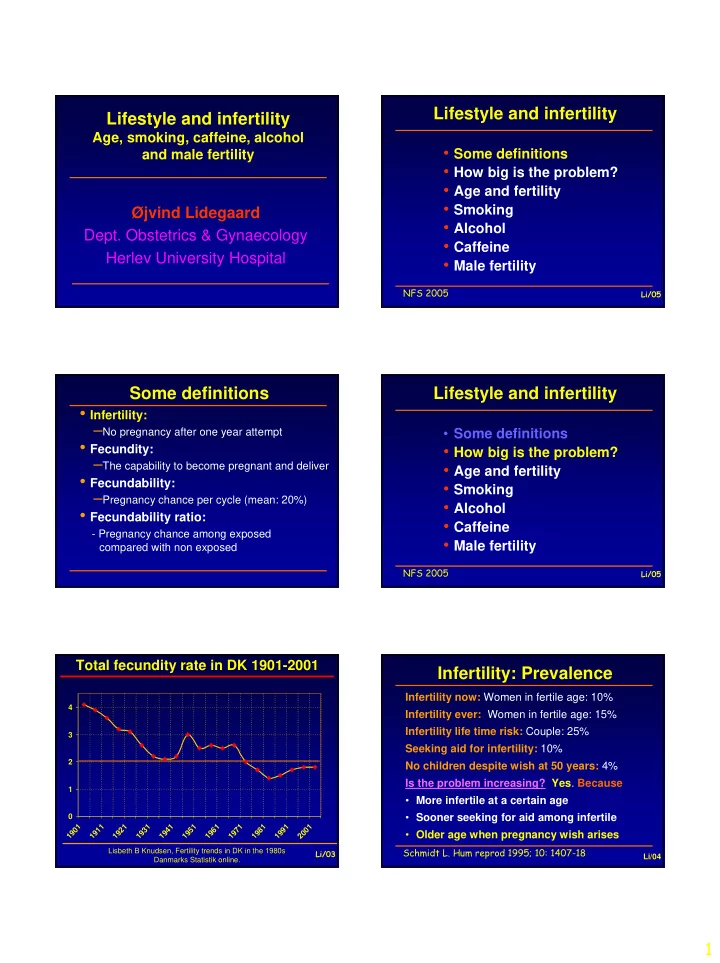
Total fecundity rate in DK 1901-2001

Lisbeth B Knudsen, Fertility trends in DK in the 1980s Danmarks Statistik online. Li/03 1 2 3 4 1 9 1 1 9 1 1 1 9 2 1 1 9 3 1 1 9 4 1 1 9 5 1 1 9 6 1 1 9 7 1 1 9 8 1 1 9 9 1 2 1

Infertility: Prevalence

Infertility now: Women in fertile age: 10% Infertility ever: Women in fertile age: 15% Infertility life time risk: Couple: 25% Seeking aid for infertility: 10% No children despite wish at 50 years: 4% Is the problem increasing? Yes. Because

  • More infertile at a certain age
  • Sooner seeking for aid among infertile
  • Older age when pregnancy wish arises

Schmidt L. Hum reprod 1995; 10: 1407-18

Li/04

slide-2
SLIDE 2

2

Lifestyle and infertility

  • Some definitions
  • How big is the problem?
  • Age and fertility
  • Smoking
  • Alcohol
  • Caffeine
  • Male fertility

NFS 2005

Li/05

Age at first birth Denmark 1970-2002

Knudsen LB. Fertility trends in DK in the 1980s og DK's Statistik

Increase: 1 year/6 years

Li/04

23,4 24,1 25,2 26,8 27,7 28,5

23 24 25 26 27 28 29 1970 1977 1983 1991 1998 2002

What is a woman, and what can you expect from her?

North & South Dakota to where the Hutterites immigrated at end of 19th century. Approx. 215 persons immigrated about 1870. In 1960 they were 5.450

  • No contraception allowed
  • Children have high priority
  • Socially comparable with other couples.
  • Let’s look at 544 couple, all married and all

with at least one child to quantify womans fertility

Fecundity according to age

28 34 24 17 12 6 0,5

5 10 15 20 25 30 35 18 20 25 30 35 40 45

Couples: 544 Children: 3,846 Post-partum Amennorrhea: 10 months Children/woman: 10,8

Larsen U et al. Social Biology 2000; 47: 34-50

Live births per cycle

Donor IUI. Pregnancies/100 cycles

5 10 15 20 25 30 35 <22 23 24 25 26 27 28 29 30 31 32 33 34 35 36 37 38 39 40 41 42 43 44 >44 Per cent Li/02 Botchan A et al. Hum Reprod 2001; 16: 2298-2304

6,139 IUI-D cycles 1,001 treated women All during 18 years

Why does fertility decrease by age?

  • Egg’s get older
  • Increased risk of

spontaneous abortion

slide-3
SLIDE 3

3

Spontaneous fetal loss after living pregnancy week 12-24 (CH).

7,8 50 3,9 2,9 3,4 3,2

0,7 0,8 0,8 1 2,1 13,8

10 20 30 40 50

<20 20-24 25-29 30-34 35-39 40-45

2 4 6 8 10 12 14

Per cent OR

Li/02

2,534 spontaneously pregnant women, all with US verified live pregnancy. Hoesli et al. Am J Med Genet 2001; 100: 106-9

Age and fertility: Conclusion

  • The dramatic increase in age at first

delivery through last three decades has increased the risk of infertility substan- tially

  • This development is expected to

continue over the next decades

  • Age at first pregnancy wish is probably

the most important life style factor in effect

Lifestyle and infertility

  • Some definitions
  • How big is the problem?
  • Age and fertility
  • Smoking
  • Alcohol
  • Caffeine
  • Male fertility

NFS 2005

Li/05

Naughty girls

2,8 3,5 5,5 8,8 2,2 2,3 3,3 3,6 2 4 6 8 10

<1 1-2 3-5 >5

Cig/day 2 2,4 2,8 3,2 3,6 4 Drinks/week

Bolumar et al. Am J Epidemiology 1997; 145: 324-34.

Cups per day

3,187 women 25-44 years old European Multicentre Study on Infertility and subfecundity ↑64% ↑214%

Li/04

Smoking in DK in 1987, 1994 & 2000

Women, N=8,494 41 46 47 25 29 43 39 27 27 34 36 24

5 10 15 20 25 30 35 40 45 50

16-24 25-44 45-66 67+

1987 1994 2000 Sundhed og Sygelighed i DK 2000. SIF 2002

Li/203

Fertility and smoking

Risk of waiting time >9,4 months 1 0,9 1 1,4 1,7 0,5 1 1,5 2 . .

Bolumar et al. Am J Epidemiology 1996; 143: 578-87. European multicenter study on infertility and subfecundity

Relative risk Women Men 0 1-10 >10 No Yes

Li/01

slide-4
SLIDE 4

4 Smoking and ectopic pregnancy

Am J Obstet Gynecol 1998; 178: 393-8

1 1,6 1,7 2,3 3,5 0,5 1 1,5 2 2,5 3 3,5 1-5 6-10 11-20 >20

Odds ratio Case-control study, USA 1988-90 196 cases, 237 controls. Adjusted for age, parity, infertility, and vaginal douching.

Li/01

Smoking - IVF

  • smo ex-smo +smo

No 499 351 111 37 Ø2/FSU U 82 71 60 Oocytes 13.5 13.6 12.6

  • Fertilis. rate

54% 54% 50% Embryos 8.0 8.2 6.6

  • Embr. transf

3.6 3.5 3.6

  • Implant. rate 16

16 6.7

Li/01 Voorhis et al. Obstet Gynecol 1996; 8: 785-91

IVF and smoking: Århus 2000-03

  • Observational cohort study at Skejby
  • Couples undergoing IVF or ICSI from

January 2000 through December 2003

  • Confounders included: Coffee, alcohol,

BMI, length of infertility, previous pregn, cause of infertility

  • Outcomes: oocytes retrieved, fertilisation

rate, clinical pregnancy rate week 7 (US)

Rikke Krogh, Kesmodel & Ingerslev. Paper in preparation.Li/05

IVF and smoking: Results

OR (95% CI) Oocytes Fertilisa- Pregnan- N=777 retrieved tion rate cy rate Female

  • smoking

1 1 1 + smoking 1.0 (0.7-1.5) 1.2 (0.8-1.7) 1.0 (0.7-1.4) Male

  • smoking

1 1 1 + smoking 1.0 (0.7-1.5) 1.0 (0.7-1.4) 1.2 (0.8-1.7) Conclusion: No effect of smoking on IVF

Rikke Krogh, Kesmodel & Ingerslev. Paper in preparation.Li/05

Smoking: Selection bias

Li/05

Smoking women Pregnancy attempt (home) Organic cause

Smoking: Selection bias

Li/05

Smoking women Pregnancy attempt (home)

Infertile

Organic cause Organic cause

Smoking women

slide-5
SLIDE 5

5

Smoking: Selection bias

Infertile GP Organic cause Smoking women

Smoking: Selection bias

Infertile GP Infertile, IVF clinic Organic cause Organic cause

Endometriosis, high BMI, PCO+-S, tubal occlusion, myomas, polypes etc.

Smoking women

Smoking women

Smokers (%) according to length of infertility (months)

Li/05

25 30 35 40 0-12 13-24 25-36 37-48 49-60 61+

% smokers Length of infertility

Smoking: Selection bias

Diagnosis % smokers All women (n=1,441) 32% Anovulation 18% Endometriosis 20% Other 25% Idiopatic 28% Male factor 32% Tubal factor (22%) 44%

Rikke Krogh, Kesmodel & Ingerslev. Paper in preparation.

Li/05

Smoking and fertility

Shiverick et al: Placenta, 1999; 20: 265-72 Impeded ciliary function: E2-production ↓ ↓ progesterone in granulosa cells Pick-up function ↓ Implantation rate ↓ Impeded placental function, low E2, hCG Abortion rate ↑

Ud/Li/2001

Lifestyle and infertility

  • Some definitions
  • How big is the problem?
  • Age and fertility
  • Smoking
  • Alcohol
  • Caffeine
  • Male fertility

NFS 2005

Li/05

slide-6
SLIDE 6

6

Alcohol and fertility

Does small amounts of alcohol have an impact on natural fertility?

  • Only few studies
  • Danish prospective study 1992-94 with 430

couples, 20-35 years, trying to become pregnant for the first time

  • Alcohol intake was recorded in detail

through 6 cycles

  • Control for smoking, BMI, and semen count

Jensen et al. BMJ 1998; 317: 505-10

Fertility and alcohol

Fecundability odds, 95% CI

1 0,61 0,55 0,34 0,34 0,91 1 1,02 0,76 0,83 0,2 0,4 0,6 0,8 1 1,2 1,4 1,6

0 1-5 5-10 11-15 >15 0 1-5 6-10 11-15 >15 Jensen TK et al. BMJ 1998; 317: 505-10. Drinks per week Odds for pregnancy Women Men

Alcohol and time to pregnancy

Cross sectional study DK 1997-2000 including 39,612 pregnant women (Danish birth cohort). 29,933 planned pregnancies included. Included: 60% of invited = 1/3 of all pregnant. Asked about alcohol habits before pregnancy, which was correlated to time to pregnancy. Included confounders: Smoking (in pregnancy), BMI, parity and age. Outcome measure: Subfecundity odds ratio

Li/02

Juhl M et al. Human reprod 2002; 16: 2705-9.

Waiting time to pregnancy in months and drinks per week

0% 20% 40% 60% 80% 100%

<0,5 0,5-2 2,5-7 7,5-14 >14

Drinks per week

>12 6-12 3-5 0-2

Li/02

Confounders: Age, Smoking, BMI, parity

Subfecundity OR and drinks per week

1,48 1 0,94 0,86 0,92

0,8 0,9 1 1,1 1,2 1,3 1,4 1,5 0,5-2 2,5-7 7,5-14 >14 Li/02 Juhl M, et al. Human Reprod 2002; 16: 2705-9

Risk of waiting time >12 months

Time to pregnancy, age, alcohol & smoking

1,2 1 1,1 1,7 1,2 1,2 1,9 1,6 1,6 2,8 2,4 3,4

0,5 1 1,5 2 2,5 3 3,5

0,5-14 >14

No smo + smo 30-34 >34

Li/02

Risk of increase in waiting time

slide-7
SLIDE 7

7

Alcohol and pregnancy

  • The birth cohort of Århus, 1989-96 with

25.000 pregnant women and their deliveries demonstrates that 5 drinks per week as compared with no alcohol =>

  • 2,5 x increased risk of stillbirth
  • 3 x increased risk of abortion w 7-12
  • Increased risk of premature birth
  • Increased risk of low birth weight

Kesmodel U. Am J Epidemiol 2002; 155: 305-12 Kesmodel U. Alcohol Alcohol 2002; 37: 87-92

Li/03

Alcohol and fertility

Clinical recommendation: Women who attempt pregnancy should reduce their alcohol intake to less than five drinks per week.

Lifestyle and infertility

  • Some definitions
  • How big is the problem?
  • Age and fertility
  • Smoking
  • Alcohol
  • Caffeine
  • Male fertility

NFS 2005

Li/05

Caffeine

Caffeine is found in

  • 1 cup of coffee

= 100 mg

  • 1 cup of tee

= 50 mg

  • ½ litre cola

= 50 mg

  • 30 g chocolade

= 10 mg

  • 1 cup of cacao

= 5 mg

  • Caffeine passes all biological

membranes incl. the placenta barrier

Li/01

Jensen et al. BMJ; 1998: 505-10

i

Fertility and coffee

Fecundability odds, 95% CI

1 1 1 1,45

0,5 1 1,5 2

  • 1

2

  • 3

4

  • 5

> 5 Bolúmar et al. Am J Epidemiol 1997; 145: 324-34 Cups of coffee per day Odds for waiting >9.5 months to pregnancy

European multicentre study, 3,187 women 25-44 years. Adjusted for age, smoking, parity, and alcohol Li/01

Caffeine and fertility: Conclusion

  • Less then five cups of coffee per day

has no influence on fertility

  • Women attempting to be pregnant

should drink less than five cups of coffee per day

Li/05

slide-8
SLIDE 8

8

Lifestyle and infertility

  • Some definitions
  • How big is the problem?
  • Age and fertility
  • Smoking
  • Alcohol
  • Caffeine
  • Male fertility

NFS 2005

Li/05

Sperm count by time

61 papers 14,947 men Carlsen et

  • al. BMJ

1992; 305: 609-13 Li/05

Sperm count and fecundity

  • 430 couples with first pregnancy wish
  • Followed through 6 menstrual cycles
  • Delivering a sperm sample at enrolment
  • Information about smoking habits, age of

woman, occupation of women, urogenital disorders, BMI, and woman’s smoking habits

  • Outcome: pregnancy chance per cycle

Bonde JPE et al. Lancet 1998; 352: 1172-7.

Li/05

Sperm count and fecundity

Li/05

Bonde et al. Lancet 1998; 352: 1172-7. 0,3 1 0,96 0,59 0,83

0,2 0,4 0,6 0,8 1 0-9 10-19 20-39 40-80 >80

Million per ml

1 = 18% per cycle

Sperm count in Danish men

  • 1.868 men, 18-22 years old, median 19 years
  • Military session, 1996-2001
  • Delivering a sperm sample
  • Abstinence for 48 hours
  • Median sperm count: 46 mio/ml (41-51)
  • Sperm count <40 mio/ml: 44% (-17%)
  • Sperm count <20 mio/ml: 22% (-41%)

Jørgensen et al. Månedsskr Prakt Lægegern 2003; 81: 169-75

Sperm count in Nordic-Baltic area

Norway Denm Finland Estonia Particip. 240 300 324 104 Period 1998 97-99 98-00 97-99 Sperm count in mio/ml (median) All 41 41 54 57 Clean 42 45 53 63 West-east gradient

Jørgensen et al: Hum Reprod 2002; 8: 2199-2208

Li/05

slide-9
SLIDE 9

9 Testicular cancer: west-east gradient

Li/05

Adami et al. Int J Cancer 1994; 59: 33-38. 4,6 3,6 6,3 8,8 7 4,4 3,7 4,2 3 2,3 1 1,6 2,3 1,5 0,9 1 2 3 4 5 6 7 8 9 50-54 60-64 70-74 85-89 Denmark Norway Sweden Finland Estonia Year Incidence per 100,000 years, age standardised

Testicular cancer according to age

Li/05

Adami et al. Int J Cancer 1994; 59: 33-38.

5 10 15 20 25 0-19 20-24 25-29 30-34 35-39 40-44 45-49 50-84 Denmark Norway Sweden Finland Estonia

Incidence per 100,000 years 1985-89

Testicular dysgenesis syndrome

Environmental factors incl Disrupted Imparied Semen endocrine Sertoli germ cell quality disruptors cell funct different. Testicular cancer Hypo- Deceased Andro- spadias Genetic Leydig gen in- defects cell suffi- Testicular function ciency maldescend

Testicular dysgenesis syndrome

Skakkebæk et al. Hum Reprod 2001; 16: 972-8.

Li/05

Testicular dysgenesis syndrome

Environmental factors incl Disrupted Imparied Semen endocrine Sertoli germ cell quality disruptors cell funct different. Testicular cancer Hypo- Deceased Andro- spadias Genetic Leydig gen in- defects cell suffi- Testicular function ciency maldescend

Testicular dysgenesis syndrome

Skakkebæk et al. Hum Reprod 2001; 16: 972-8.

Li/05

Male gonadogenesis

Hypothalamus Estrogen like substances Hypophysis FSH and LH TDF-protein Sertoli cells Leydig cells Spermatogonia Testosterone

Jensen CB & Paludan-Müller P. Økotoksikologi. Nucleus 1997 Li/05

Male fertility

  • Pregnant women are exposed to endo-

crine disrupters affecting the fertility of their male offspring lifelong.

  • The most urgent task concerning

infertility is to identify the environmental factors, responsible for the decreasing sperm count in men

  • The west-east gradient in the Baltic

area is a good starting point for this research

Li/05