Obstetrical Outcomes after IVF Heather Huddleston, MD Learning - - PowerPoint PPT Presentation

obstetrical outcomes after ivf
SMART_READER_LITE
LIVE PREVIEW

Obstetrical Outcomes after IVF Heather Huddleston, MD Learning - - PowerPoint PPT Presentation

6/15/2017 I have no disclosures. Obstetrical Outcomes after IVF Heather Huddleston, MD Learning Objectives IVF: Modern Reproduction in the US Epidemiology of IVF 12 % of couples have sought medical Review IVF obstetrical outcome


slide-1
SLIDE 1

6/15/2017 1

Obstetrical Outcomes after IVF

Heather Huddleston, MD

  • I have no disclosures.

Learning Objectives

  • Epidemiology of IVF
  • Review IVF obstetrical outcome data
  • Review studies aiming to tease apart

underlying factors

  • Discuss possible contributions from age,

vanishing twins, treatment, diagnosis

  • Focus on singletons

IVF: Modern Reproduction in the US

12 % of couples have sought medical assistance to achieve conception: Medical advice: 29% Infertility testing: 27% Ovulation drugs: 20% Artificial insemination: 7.4% IVF: 3.1 %

slide-2
SLIDE 2

6/15/2017 2

Demographic Trends

40-44 35-39

Prevalence of IVF

  • 2012: Treatment with ART resulted in 51,267 live

births and 65,160 live born infants

  • 1.6% of all U.S. births.
  • The number of births from IVF doubled between

2000 and 2013.

  • Since the inception of IVF 35 years ago, 5 million

babies born with half of them within the past six years.

IVF Births Have Dramatically Increased

IVF Usage World Wide

Unites States:

  • Relatively low

utilization per unit of population

  • Relatively high

multiple rate

  • Countries with

lower multiple rates generally have government coverage

slide-3
SLIDE 3

6/15/2017 3

Contributing Factors

  • Demographic changes in childbearing
  • Obesity
  • Environmental?

The use of IVF technology is likely to grow

  • Social trends toward later child bearing
  • Increasing acceptance of alternative family

structures

  • Egg freezing
  • Preimplantation genetic screening

The increased utilization of IVF raises concern about range of perinatal outcomes, including preterm birth, low birth weight, SGA neonatal death.

What are the implications for perinatal outcomes?

The Multiple Problem

Kulkarni et al NEJM 2013

  • Multiples are major factor

contributing to perinatal morbidity from IVF

  • Overall, there continues to be

improvements in multiple rates from IVF

  • Medically assisted conception is

a larger contributor to twin births compared to IVF

slide-4
SLIDE 4

6/15/2017 4

Short Story

Obstetrical and perinatal outcomes for singletons are worse across the board when compared to fertile controls

IVF

SUMMARY OF EXISTING DATA

17 Studies with Matched Controls Singletons

  • RR 3.27 for very preterm birth
  • RR 2.04 preterm birth
  • RR 3.0 for low birth weight
  • RR 1.54 SGA
  • RR 1.68 for perinatal mortality

TWINS:

  • No significant differences
  • Protective for perinatal mortality 0.58 (.44, .77)

Helmerhorst BMJ 2004

The Longer and More Complicated Story

Obstetrical and perinatal outcomes are worse across the board

IVF

  • Danish National Birth Cohort: 55,906

singleton live births from women who reported waiting time to pregnancy (TTP)

  • Findings: TTP >1 year was associated

with increased risk of all outcomes studies irrespective of treatment

  • OR for preterm birth 1.5 (1.2,1.8) for

pimiparas and1.9 (1.5, 2.4) for multiparas

Teasing Apart the Mechanism of Poor Perinatal Outcomes

Basso et al BMJ 2005

slide-5
SLIDE 5

6/15/2017 5

  • ART pregnancies were compared with spontaneously conceived

pregnancies with TTP of 2 years or more

  • No significant differences

Caesarean sections (OR 1.21, 95% CI 0.89-1.64), preterm births (OR 1.28, 95% CI 0.81-2.03), small for gestational age (SGA) birthweight (OR 0.95, 95% CI 0.65-1.39), need of neonatal intensive care (OR 1.28, 95% CI 0.88-1.88

  • Compared with pregnancies of women with TTP 0-6 months, ART

pregnancies had significantly increased risks of preterm or very preterm birth, low birthweight and need of neonatal intensive care. Raatikainen et al Human Reproduction, 2012

  • Until recently, only data addressing this question

came from european studies

  • The use of IVF technology differs between U.S.

and Europe: Thinner patients Overall greater utilization Fewer embryos transferred

Limitations

Massachusetts Outcomes Study of Assisted Reproductive Technologies(MOSART)

  • Goal: To compare on

population basis the birth outcomes of women treated with ART to women with indicators of subfertility but without ART and fertile women

Massachusetts Outcomes Study

  • f Assisted Reproductive

Technologies (MOSART)

Linkage of:

  • ART data from the Society for Assisted Reproductive Technology Clinic

Outcome Reporting System (SART CORS) for all cycles in MA (where utilization is high due to insurance coverage)

  • Massachusetts vital records and administrative data in the Pregnancy to

Early Life Longitudinal (PELL) data system. Created a subfertility measure

  • combination of information from birth certificate checkboxes,
  • diagnosis codes of infertility during hospitalizations
  • prior use of ART which allowed for identification of women with indicators of

subfertility

  • did not receive ART treatment for the index delivery
slide-6
SLIDE 6

6/15/2017 6 Massachusetts Outcomes Study

  • f Assisted Reproductive

Technologies(MOSART)

All Massachusetts births 2004-2008 ART: 11,271 live births Fertile: 316,748 live births Subfertile: 6,905 live births Outcomes: pre-term birth, low birthweight, SGA and perinatal death modeled for singletons and twins Covariates: age, race, marital status, maternal education, payer, smoking, prental care, parity, chronic hypertension, infant gender.

Pre - Term Birth

SINGLETON AOR (95% CI) P value AOR (95% CI) P value

Fertile 1.00 (Reference) – 0.80 (0.72–0.89) <.01 Subfertile, no ART 1.24 (1.12–1.38) <.01 1.00 (Reference) – ART 1.53 (1.40–1.67) <.01 1.23 (1.08–1.41) <.01

TWINS AOR (95% CI) P value AOR (95% CI) P value

Fertile 1.00 (Reference) – 0.74 (0.31–1.76) .50 Subfertile, no ART 1.35 (0.57–3.20) .50 1.00 (Reference) – ART 0.89 (0.68–1.18) .43 0.66 (0.23–1.90) .45

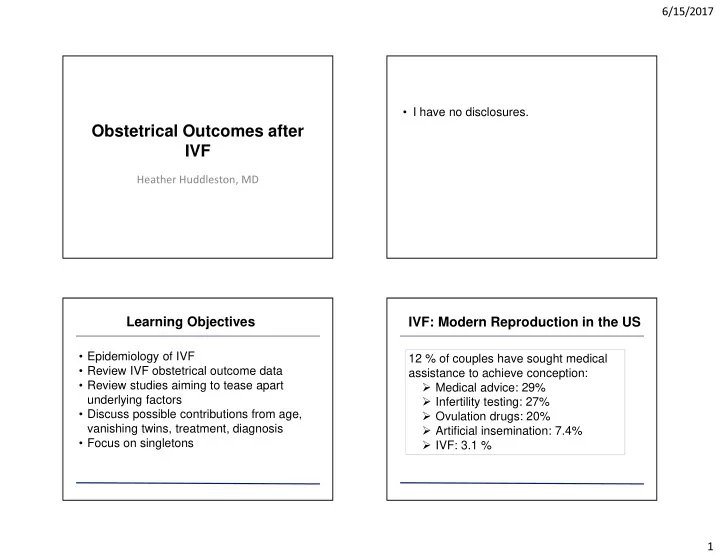
Declercq et al Fertility and Sterility, Volume 103, Issue 4, 2015, 888–895 Figure 1. Gestational age distribution, by fertility groups, singletons, and twins. Solid black: fertile twin; dashed blue: subfertile twin; dashed red: assisted reproductive technology (ART) twin; solid purple: fertile singleton; solid teal: subfertile single... ) Declercq et al Fertility and Sterility, Volume 103, Issue 4, 2015, 888–895

Low Birth Weight

SINGLETON AOR (95% CI) P value AOR (95% CI) P value

Fertile 1.00 (Reference) – 0.83 (0.74–0.94) <.01 Subfertile, no ART 1.20 (1.06–1.36) <.01 1.00 (Reference) – ART 1.51 (1.37–1.67) <.01 1.26 (1.08–1.47) <.01

TWINS AOR (95% CI) P value AOR (95% CI) P value

Fertile 1.00 (Reference) – 0.99 (0.83–1.18) .92 Subfertile, no ART 1.01 (0.85–1.20) .92 1.00 (Reference) – ART1 0.98 (0.89–1.09) .77 0.98 (0.82–1.17) .79 Declercq et al Fertility and Sterility, Volume 103, Issue 4, 2015,
slide-7
SLIDE 7

6/15/2017 7

SGA

SINGLETON AOR CI P value AOR Ref as Subfertile P value

Fertile 1.00 (Reference) – 1.05 (0.94–1.17) .39 Subfertile, no ART 0.95 (0.85–1.06) .39 1.00 (Reference) – ART 1.05 (0.96–1.16) .31 1.10 (0.96–1.27) .18

AOR CI P value AOR Ref as Subfertile P value

Fertile 1.00 (Reference) – 1.25 (1.02–1.52) .03 Subfertile, no ART 0.80 (0.66–0.98) .03 1.00 (Reference) – ART 0.85 (0.75–0.96) <.01 1.06 (0.86–1.30) .60

Declercq et al Fertility and Sterility, Volume 103, Issue 4, 2015,

Perinatal Death

SINGLETON AOR 95% CI P value AOR 95% CI P value

Fertile 1.00 (Reference) – 1.05 (0.94–1.17) .39 Subfertile, no ART 0.95 (0.85–1.06) .39 1.00 REF ART 1.05 (0.96–1.16) .31 1.10 (0.96–1.27) .18

TWINS AOR 95% CI P value AOR 95% CI P value

Fertile 1.00 (Reference) – 1.25 (1.02–1.52) .03 Subfertile, no ART 0.80 (0.66–0.98) .03 1.00 (Reference) – ART 0.85 (0.75–0.96) <.01 1.06 (0.86–1.30) .60

Declercq et al Fertility and Sterility, 2015

Summary of MOSART Data

  • For most outcomes, the general trend appears to be an increased risk
  • f adverse outcomes with IVF, but also with subfertility.
  • Differences more pronounced with singletons.
  • The increased risk with IVF may have contributions from population

factors and the technology (additive).

  • Or, the step-wise increased risk with IVF may reflect a more severe

sub-fertile population.

  • Caveats:

Subfertility under-estimated? Generalize?: Mass has highest utilization of any state.

Effect of Fertility Diagnosis on

Pregnancy Outcomes After IVF

Luke et al J Assist Reprod Genet PIH linked to diminished

  • varian reserve only

GDM associated with Ovulation Disorders

slide-8
SLIDE 8

6/15/2017 8

Effects of Specific Treatments

Specific IVF treatment effects have found to contribute to excess perinatal morbidity:

  • Plurality at birth
  • Plurality at conception (Vanishing Twin)
  • Number of embryos transferred
  • Egg Donor (higher risk of hypertension and cesarean)
  • Thawed versus Fresh

Luke et al American Journal of Obstetrics and Gynecology 2017

Effects of Specific Treatments: Fresh versus Frozen

  • Embryos transferred in a frozen cycle are transferred into a

more physiologic environment

  • Reports indicate that frozen transfers result in comparable
  • r lower risks for low birthweight, SGA and preterm birth
  • Compared to spontaneous conceptions, frozen cycles result

in LGA, pregnancy induced hypertension and accreta

Luke et al American Journal of Obstetrics and Gynecology 2017

What About Other Outcomes: Birth Defects

  • Congenital anomalies are

between 3-5% of all infants soon after birth

  • IVF is associated with a 30-

40% increased risk of major

  • Principal anomalies include a

range of GI, Cardiovascular and musculoskeletal defects and specifically septal heart defects, cleft lip, esophageal atresia and anorectal atresia

  • Couples who take longer than

12 months to conceive also exhibit an increased risk of anomalies (hazard ratio [HR] 1.20, 95% CI 1.07–1.35).

  • Compared to (HR 1.39, 95% CI

1.23–1.57) for treated subfertile.

Luke et al American Journal of Obstetrics and Gynecology 2017

Conclusions

  • Patients proceeding with IVF should be counseled about

perinatal outcomes associated with their diagnosis and treatment.

  • Patients who conceive without IVF but with a history of

subfertility should be similarly counseled.

  • There are multiple factors contributing to more adverse
  • utcomes in IVF, including, but not limited to the

underlying fertility condition

  • Whether patients who proceed with IVF without

infertility face increased risks is not known.

  • Reducing twins and triplets is still the most critical factor

in reducing the morbidity from IVF