
Problem solving and search
Chapter 3
Chapter 3 1Outline
♦ Problem-solving agents ♦ Problem types ♦ Problem formulation ♦ Example problems ♦ Basic search algorithms
Chapter 3 2Problem-solving agents
Restricted form of general agent:
function Simple-Problem-Solving-Agent(percept) returns an action static: seq, an action sequence, initially empty state, some description of the current world state goal, a goal, initially null problem, a problem formulation state ← Update-State(state, percept) if seq is empty then goal ← Formulate-Goal(state) problem ← Formulate-Problem(state, goal) seq ← Search(problem) action ← First(seq) seq ← Rest(seq) return action
Note: this is offline problem solving; solution executed “eyes closed.” Online problem solving involves acting without complete knowledge.
Chapter 3 3Example: Romania
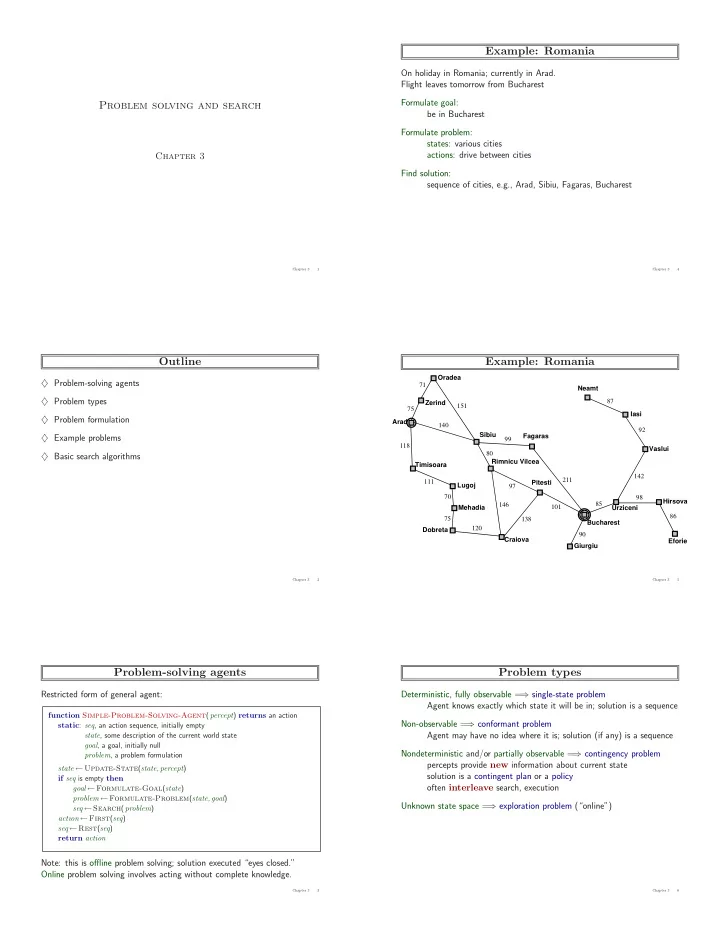
On holiday in Romania; currently in Arad. Flight leaves tomorrow from Bucharest Formulate goal: be in Bucharest Formulate problem: states: various cities actions: drive between cities Find solution: sequence of cities, e.g., Arad, Sibiu, Fagaras, Bucharest
Chapter 3 4Example: Romania
Giurgiu Urziceni Hirsova Eforie Neamt Oradea Zerind Arad Timisoara Lugoj Mehadia Dobreta Craiova Sibiu Fagaras Pitesti Vaslui Iasi Rimnicu Vilcea Bucharest 71 75 118 111 70 75 120 151 140 99 80 97 101 211 138 146 85 90 98 142 92 87 86
Chapter 3 5Problem types
Deterministic, fully observable = ⇒ single-state problem Agent knows exactly which state it will be in; solution is a sequence Non-observable = ⇒ conformant problem Agent may have no idea where it is; solution (if any) is a sequence Nondeterministic and/or partially observable = ⇒ contingency problem percepts provide new information about current state solution is a contingent plan or a policy
- ften interleave search, execution
Unknown state space = ⇒ exploration problem (“online”)
Chapter 3 6