Alternative technologies: introduction Rationale: leveraging the - - PowerPoint PPT Presentation

alternative technologies introduction
SMART_READER_LITE
LIVE PREVIEW

Alternative technologies: introduction Rationale: leveraging the - - PowerPoint PPT Presentation

Contents Alternative technologies: introduction Rationale: leveraging the human visual system Display hardware in this laboratory: iDome, stereoscopic screen, tiled display Paul Bourke Filming: Fisheye camera/lens, LadyBug


slide-1
SLIDE 1

Alternative technologies: introduction

Paul Bourke

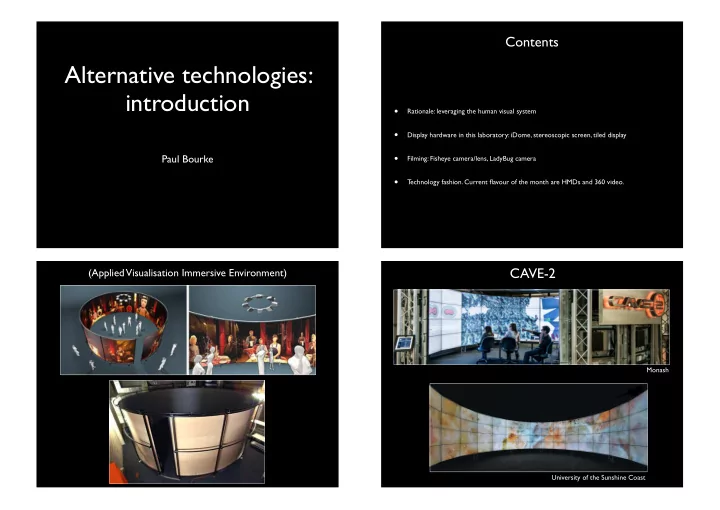
Contents

  • Rationale: leveraging the human visual system
  • Display hardware in this laboratory: iDome, stereoscopic screen, tiled display
  • Filming: Fisheye camera/lens, LadyBug camera
  • Technology fashion. Current flavour of the month are HMDs and 360 video.

(Applied Visualisation Immersive Environment)

CAVE-2

Monash University of the Sunshine Coast

slide-2
SLIDE 2

Rationale

  • Information is (largely) conveyed to the human brain through our eyes.
  • Makes sense that there should be experiential advantages if one uses the capabilities of the

human visual system.

  • Three capabilities not normally fully engaged when watching a standard display are
  • 1. Stereopsis.

For example, the sense of depth when watching 3D movies.

  • 2. Peripheral vision.

Our eyes detect motion out to almost 180 degrees. Engaging peripheral vision is largely credited to a sense of “being there”. Known as “removing the frame” when comparing to flat rectangular screens.

  • 3. Visual acuity.

Human visual system is about 1 arc minute. This is equivalent to a full HD panel, 1m wide about 3m away.

Display hardware in this laboratory

  • Three display technologies available.
  • iDome: engages peripheral vision.
  • 180 degrees horizontally and from +90 degrees to -45 degrees below the horizon.
  • If you are interested in this medium then recommend a visit to the SciTech dome.
  • Stereoscopic projector.
  • 1400x1050 pixel resolution.
  • Can be driven with either active stereo or side-by-side stereo.
  • Tiled display.
  • Each panel is full HD so about 6000 pixels by 2000 pixels.
  • While there are bezils (frames of a window) tiling panels is currently the only way to get high

pixel counts at a large physical scale, and higher brightness than projectors.

  • This display is 3x2 but you’ve seen larger arrays in shopping centers, airports, etc.
  • How does one capture video for these displays?

Filming - Stereoscopic

  • Requires two cameras or video cameras.
  • Ideally achieve human eye separation of 65mm.
  • Due to the interest in stereoscopic production over the last 6 years, most

VFX and compositing software now has support.

  • Very difficult to produce good quality stereoscopic content, even the large production houses
  • ften get it wrong.
slide-3
SLIDE 3

A rich history

  • Stereoscopic 3D filming is not new. First known

film was in 1922, stereoscopic photography dates back to the 1850s.

  • In the mid 1950s pretty much every movie house

was producing stereoscopic movies as red-blue anaglyph.

  • iMax started producing stereoscopic 3D in the mid

1980s.

  • People like myself in the data visualisation process

have been using stereoscopic displays our whole life.

  • The latest popularity from 2010-2015 saw the

development of 3D capable TVs and home cinema.

Fairall Camera rig (1922) Frank Hurley, 1905 Left eye Right eye

slide-4
SLIDE 4

Filming - iDome

  • Two options
  • Camera with a fisheye lens.
  • 360 video camera
  • We have the LadyBug-3 camera, captures 360 degrees horizontally and about 150 degrees

vertically.

  • When capturing 360 one can then navigate within the video.
  • No longer does the director “direct’, the viewer is able to freely explore.
  • Some interesting challenges for storytelling.
  • My use of the LadyBug has predominantly been to record cultural practices.
slide-5
SLIDE 5

A rich history

  • 360 filming was an active area of film making back in the 1960s.
  • Indeed the camera here used folded optics which is an improvement on almost all the camera

rigs being built today.

Circlorama camera #2 (Disney)

slide-6
SLIDE 6

Hamburg 1957

Technology fashions

  • From 2010-2015 most technology writers were predicting stereoscopic 3D was going to be
  • ubiquitous. Didn’t happen. The new television in the stores from the major suppliers for the

2016/2017 Christmas season were no longer 3D capable. This allows one to tell compelling stories using a technology still seen as novel.

  • In the background there has been a steady rise in recording and display resolution. 4K

television and cameras are the norm, and there are 8K versions appearing in the market. I can understand 4K but unsure what the driver is for 8K?

  • The current flavour of the month are head mounted displays: GearVR,

Vive, and a whole range

  • f others.

Will they become ubiquitous?

  • Augmented reality?

Stands much more chance of widespread use but some significant technology barriers.

360 video - 2 cameras

  • There are a huge range of products in the market place for capturing 360 video.
  • Most accessible are two lens rigs.
  • Rely on a fisheye lens capturing greater than 180 degrees.
slide-7
SLIDE 7

360 video - multiple cameras

slide-8
SLIDE 8

360 video - multiple cameras 360 video - stereoscopic

  • This is generally achieved by having lots of cameras.
  • All of these multiple cameras have a fundamental parallax issue which means they cannot be

perfectly stitched and blended.

  • There is a solution involving folded optics, some bespoke rigs have been built.

360 video

slide-9
SLIDE 9

360 video

  • By no means a solved problem.
  • The current multiple camera solutions have fundamental parallax issues.
  • The folded light path cameras are not yet readily available.
  • But there is (currently) a huge appetite for 360 video content for the head mounted display

market.

  • Supported on

YouTube, Vimeo and others.

  • Currently people are still dealing with the technology, huge opportunity

for complelling stories to be told.