
SLIDE 1
Aerodynamic optimization
- f Chalmers Formula
Student Vehicle.
STAR Global Conference 2014,Vienna
Tzanakis Athanasios
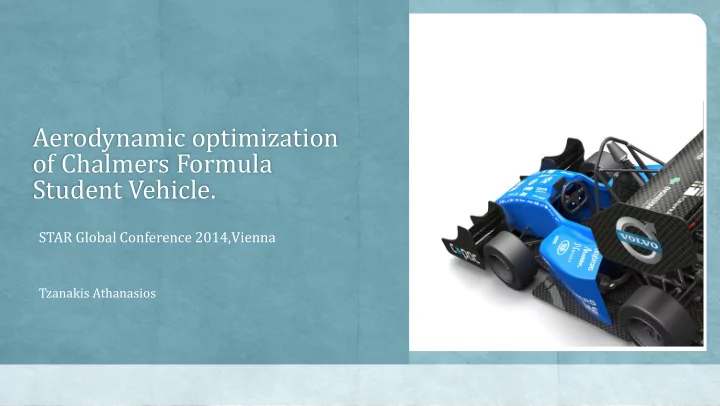
Aerodynamic optimization of Chalmers Formula Student Vehicle. STAR - - PowerPoint PPT Presentation
Aerodynamic optimization of Chalmers Formula Student Vehicle. STAR Global Conference 2014,Vienna Tzanakis Athanasios Presentation Layout Problem description. Approaching the optimum solution. Goals definition. Simulations
STAR Global Conference 2014,Vienna
Tzanakis Athanasios
The average speed of a Formula Student vehicle is approximately 56kph. What is the contribution of aerodynamics in vehicles performance in such a low speed?
Ideas Mathematical calculations Design 2D Simulations 3D Simulations
62 64 66 68 70 72 74 76
NO AERO AERO
Lap’s Time (s)
160 kg 180 kg 200 kg 220 kg
Design Targets Downforce 500-550 N at 56 km/h Drag 200-250 N Down force/Drag ratio 2.75 Mass flow over radiator 0.42 kg/s Weight 16 kg
Front wing Rear wing Sidepods Diffuser
Surface mesh
Volume mesh
Solver
Post Processing
Models Realizable k-ε, Standard wall function Steady State Segregated Free flow velocity 15.6m/s Floor boundary condition 15.6 m/s Wheels MRF zone Coefficient of inertial resistance in radiator (184.3 kg/m3 , 184.3 ×10² kg/m3, 184.3 ×10² kg/m3) Coefficient of porous resistance in radiator (222.6 kg/m3s, 222.6 ×10² kg/m3s, 222.6 ×10² kg/m3s) Iterations 1000
Wings set up Diffuser
Mass Flow
radiator Brake cooling
Not well balanced vehicle.
170 175 180 185 190 195 200 205 210 215 220 225 Two-element wing Three element wing Three element wing 2nd conf.
Local Downforce (N) Total Drag (N)
50 100 150 200 250 Three element wing Three element wing 2nd conf.
Local Downforce (N) Total Drag (N)
50 100 150 200 250 Endplate concept 1 Endplate concept 2 Endplate concept 3 Newtons
Rear Endplates
Local Downforce (N) Total Drag (N)
Case Carbon H35 Total Weight Deflection 0.3mm - 3 Ribs(13x15mm) 0.863 0.26411 1.12711 7.6985 0,3mm - No Rib(12x15mm) 0.863 0.276 1.139 9.0616 0.3mm - 3 Ribs(13x17,5mm) 0.863 0.284 1.147 7.1847 0.3mm - 3 Ribs(16x15mm) 0.863 0.2947 1.1577 7.45 0.3mm - 3 Ribs(13x20mm) 0.863 0.3083 1.1713 6.8529 0.3mm - 3 Ribs Bigger Rear 0.863 0.322 1.185 6.9075 0.3mm - 3 Ribs(20x15mm) 0.863 0.334 1.197 7.334 0,33mm - 1 Rib(12x15mm) 0.863 0.371 1.234 9.0215 0.3mm - 3 Ribs+Nomex 0.94 0.3083 1.2483 6.83
FEM by Elanghovan Natesen natesan@student.chalmers.se
Efficiency increased by 26%
Not interaction between flap and diffuser.
FEM by Elanghovan Natesen natesan@student.chalmers.se
Gap for radiator cooling.
Massflow: 0.3 kg/s Massflow: 0.46 kg/s
Overheated disk brakes effected vehicle stability and braking distance.
Many different geometries in limited area so Star-CCM+ surface wrapper was directly applied.
135 140 145 150 155 Neutral Short duct Long duct W/m2-K
Heat transfer coef.
Local heat transfer coefficient
Initial Final
Test Angle(deg) Velocity(m/s) Mx(Nm) My(Nm) Mz(Nm) Fx(N) Fy(N) Fz(N) Yaw 15.6 5.73
2.57 222 2.47
Yaw 5 15.6
227.7 45.6
Roll 1.2 15.6
7.75 220
Design Targets Goals Final objectives Downforce 500-550 N at 56 km/h 462 N at 56 km/h Drag 200-250 N 234 Down force/Drag ratio 2.75 1.97 Mass flow for radiator 0.42 kg/s 0.46 Weight 16 kg 10kg
Rendering by Bjorn Schlingmann Bjoern.schlingmann@gmail.com
Rendering by Bjorn Schlingmann Bjoern.schlingmann@gmail.com
Rendering by Bjorn Schlingmann Bjoern.schlingmann@gmail.com