Tips and Suggestions from Ecomodder.com for Better Aerodynamic - - PDF document

tips and suggestions from ecomodder com for better
SMART_READER_LITE
LIVE PREVIEW

Tips and Suggestions from Ecomodder.com for Better Aerodynamic - - PDF document

Tips and Suggestions from Ecomodder.com for Better Aerodynamic Efficiency Roof Racks (deletion) A lot of vehicles (SUVs, crossovers, wagons and minivans particularly) come with roof racks that are rarely if ever used by their owners. The


slide-1
SLIDE 1

Tips and Suggestions from Ecomodder.com for Better Aerodynamic Efficiency

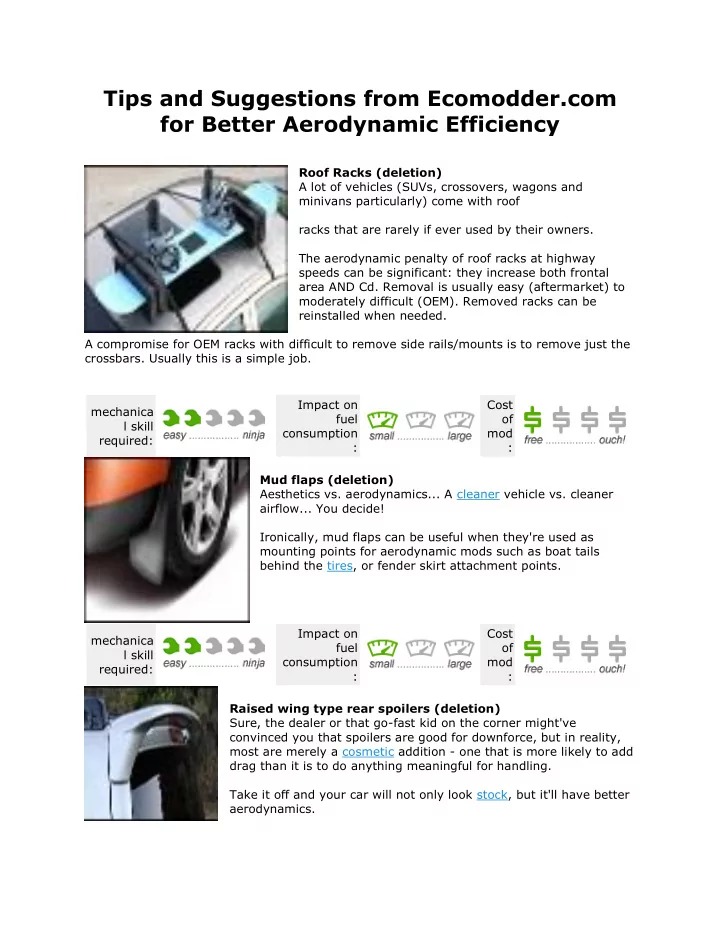
Roof Racks (deletion) A lot of vehicles (SUVs, crossovers, wagons and minivans particularly) come with roof racks that are rarely if ever used by their owners. The aerodynamic penalty of roof racks at highway speeds can be significant: they increase both frontal area AND Cd. Removal is usually easy (aftermarket) to moderately difficult (OEM). Removed racks can be reinstalled when needed. A compromise for OEM racks with difficult to remove side rails/mounts is to remove just the

  • crossbars. Usually this is a simple job.

mechanica l skill required: Impact on fuel consumption : Cost

  • f

mod : Mud flaps (deletion) Aesthetics vs. aerodynamics... A cleaner vehicle vs. cleaner airflow... You decide! Ironically, mud flaps can be useful when they're used as mounting points for aerodynamic mods such as boat tails behind the tires, or fender skirt attachment points. mechanica l skill required: Impact on fuel consumption : Cost

  • f

mod : Raised wing type rear spoilers (deletion) Sure, the dealer or that go-fast kid on the corner might've convinced you that spoilers are good for downforce, but in reality, most are merely a cosmetic addition - one that is more likely to add drag than it is to do anything meaningful for handling. Take it off and your car will not only look stock, but it'll have better aerodynamics.

slide-2
SLIDE 2

It isn't always obvious whether a particular spoiler style is an aero help or hindrance. mechanica l skill required: Impact on fuel consumption : Cost

  • f

mod : Side mirror/s (delete) Side mirrors are absent from most high efficiency concept vehicles for a reason: they increase both frontal area and Cd. Many jurisdictions do not require a passenger side mirror, so that is most often the one deleted. Some will replace the outside mirrors with smaller mirrors, or more aerodynamically shaped mirrors from similar models. Others replace the outside mirror with convex, in-car mirrors

  • r extra width rear view mirrors. Cameras and LCD screens

are a favourite of the concept car circuit, though a somewhat costly option. mechanica l skill required: Impact on fuel consumption : Cost

  • f

mod : Radio antenna (relocation/deletion) Radio antennas aren't the biggest things in the world, but they do stick

  • ut in the way, and you definitely won't find traditional "whip" style

antennas on high-efficiency concept & production cars. You can either remove it or relocate it to a more aerodynamically friendly location. mechanica l skill required: Impact on fuel consumption : Cost

  • f

mod : Shave badges, door handles, rain gutters, etc. Yes, this falls into the "splitting hairs" category. Shaving your door handles and smoothing out all the lines on your car isn't likely to boost your fuel economy a whole ton. However, if you're really motivated to create at the lowest drag form possible, this is what you'll need to do.

slide-3
SLIDE 3

mechanica l skill required: Impact on fuel consumption : Cost

  • f

mod : Windshield wiper (deletion) The effect of front wipers on airflow varies from vehicle to vehicle. Some people use RainX and remove their wipers completely, which is a bit risky and not advisable. Others, however, simply remove the blades and store them in their car. When rain threatens, you can easily throw the blades back on. If you're worried about airflow over the wipers, this is probably your best option. Another hair-splitting option is to replace your blades with a lower profile style. mechanica l skill required: Impact on fuel consumption : Cost

  • f

mod : Aerodynamic mods - fabrication ... Smooth wheel covers Moon caps or moon eyes, as they are often known, cut down on aero drag, and can even look pretty cool. The amount of drag reduction varies between different vehicle and wheel styles. They can be made DIY style with things like pizza pans,

  • r bought at various online retailers.

Some modders will also use clear tape over OEM hubcaps or wheels, though this is obviously less permanent. mechanica l skill required: Impact on fuel consumption : Cost

  • f

mod :

slide-4
SLIDE 4

Upgrade headlights from "bucket" or pop-up style to aero assemblies Some older headlight assemblies (particularly those with the sealed beam bulbs), have a bucket- style scoop design. Often these can be swapped

  • ut for different style headlights, or modified to cut

down on aero drag. Some car models came with both bucket and aero style assemblies, so swapping is a plug 'n' play

  • affair. One EcoModder member even removed his significantly less aero pop-up style sealed

beams with a lower profile flush fitting assembly from another vehicle. mechanica l skill required: Impact on fuel consumption : Cost

  • f

mod : Swap/fabricate a more aerodynamic front bumper cover Some different trim levels of the same vehicle model have more aerodynamic bumper styles than

  • thers. If your car has the possibility of swapping

between multiple different bumper styles, consider the one that is more aerodynamic. Another option is fabrication/modification of your existing bumper. mechanica l skill required: Impact on fuel consumption : Cost

  • f

mod : Lexan/plastic covers over "bucket" style headlights As mentioned in one of the previous tips, many cars come with unaerodynamic headlight

  • assemblies. If no swap is easily available, clear

covers can be made. These covers clean up the aero while leaving light from the headlights unfiltered. mechanica l skill required: Impact on fuel consumption : Cost

  • f

mod :

slide-5
SLIDE 5

Grill block (partial/full) Grill blocks have two purposes. The first is it cut down on aerodynamic drag by limiting the amount of air that enters the engine bay. The second is to allow the engine/transaxle (fwd vehicles) to warm up more quickly and retain more heat in the colder months by reducing excessive airflow through the engine compartment in colder months. Grill blocks come in many forms, though most often they are made to be flush with the outside of the bumper for greatest benefit. Simply inserting a piece of cardboard in front of the radiator does not provide the same aerodynamic benefit. While grill openings are usually oversized for "worst case" applications (towing a trailer through Death Valley with the A/C on), obviously care must be taken to monitor coolant

  • temperature. If your cooling fan runs more after installing a block, you've gone too far. So,

pay attention to your temp gauge and making your grill block easy to remove. mechanica l skill required: Impact on fuel consumption : Cost

  • f

mod : Tire spats, or fully contoured deflectors Properly designed tire spats or contoured deflectors direct flow around tires in such a way that drag is reduced without increasing outward flow enough to increase wake. mechanica l skill required: Impact on fuel consumption : Cost

  • f

mod : Boat-tailing behind tires Just as entire vehicle rear ends can benefit from boat tailing, so can individual wheels/tires. The 2nd generation Toyota Prius has tapered bodywork (in the bumper cover) behind its rear tires that serve this purpose.

slide-6
SLIDE 6

mechanica l skill required: Impact on fuel consumption : Cost

  • f

mod : Belly pan / under tray The underside of your car is one of its most aerodynamically dirty areas. Most vehicles will benefit by fitting a smooth undertray - something manufacturers are doing more and more where they want to squeeze the most efficiency from any particular model (eg. Jetta diesel vs. gas; Camry hybrid vs. non- hybrid). Sheet aluminum or corrugated plastic will do the trick. Just make sure that you don't put any flammable materials near hot exhaust pipes. mechanica l skill required: Impact on fuel consumption : Cost

  • f

mod : Rear wheel skirts Wheel arches & wheels can be a significant area

  • f turbulence depending on the OEM design.

Covering the back wheels to smooth airflow at the rear of the vehicle can make a measurable difference in fuel consumption. This mod is seen on production cars like the 1st generation Honda Insight, GM EV1, and many

  • ther efficient concept cars. It's often one of the first attempted by ecomodders because it

is rather easy to do. echanical skill required: Impact on fuel consumption: Cost

  • f

mod: Front wheel skirts Front wheel skirts have many of the same benefits as rear wheel skirts, but are a lot harder to make because the front wheels have to steer! Front skirts have appeared on a few high MPG concept cars, and a few EcoModder members have tackled the project, but this mod is not for the faint of heart.

slide-7
SLIDE 7

mechanica l skill required: Impact on fuel consumption : Cost

  • f

mod : Soften / radius aft edge of front wheel arches Radiusing the aft edge of wheel well arches allows air exiting the wheel well to more easily stay attached to/reattach to the side of the body. While modifying the metalwork itself would be difficult, the mod could also be accomplished by adding & shaping material on the inside of the arch. Examples of this design approach can be seen on the first generation Honda Insight, GM EV1 and Corvette, VW 1L concept, and Solectria Sunrise prototype EV (pictured). mechanica l skill required: Impact on fuel consumption : Cost

  • f

mod : Front wheel arch gap fillers This mod could be considered a partial wheel/fender skirt, which in combination with a smooth wheel cover may provide some of the benefits of a full skirt. Manufacturers of high efficiency cars that do not use wheel skirts typically try to minimize the tire/wheel arch gap to assist airflow, in addition to using a wheel offset which has the outside wheel/tire surface close to the side plane of the

  • vehicle. Examples are the 2nd generation Prius, GM Volt, Audi

A2. mechanica l skill required: Impact on fuel consumption : Cost

  • f

mod : Sealed panel gaps All those little gaps may not seem like much, but they add up. That's why all the bonneville race cars come sealed up like a coffin, and automakers are starting to pay attention to these areas on production cars. There are many solutions here, including the use of clear tape, color matching silicone filler, or foam weatherstripping. Others will adjust body panels to minimize gaps. mechanica l skill required: Impact on fuel consumption : Cost

  • f

mod :

slide-8
SLIDE 8

Partial Kammback One of the biggest aerodynamic problems with the majority of bluff body vehicles (most hatchbacks, vans, wagons) is the amount of pressure drag / size of the trailing wake. In other words, the rear of the vehicle is where the big gains are to be made. That said, a hatchback configuration isn't automatically an aerodynamic death

  • sentence. Several of the most slippery

production cars in recent years (1st gen Insight, 2nd gen Prius, Audi A2) have used "Kammback" shapes, where the roofline tapers downward, following a particular shape (a "chopped" teardrop). It's possible to retrofit this shape onto existing vehicles and gain a measurable improvement in fuel economy. mechanica l skill required: Impact on fuel consumption : Cost

  • f

mod : Full boat tail Taking the partial Kammback to its logical conclusion, this mod dramatically reduces rear pressure drag and minimizes trailing wake. Of all aero mods, a full boat tail will probably have the single largest effect on reducing fuel consumption, though it is obviously more difficult to construct (and will result in more heads turned than anything other mod!). mechanica l skill required: Impact on fuel consumption : Cost

  • f

mod : Frontal area reduction This mod involves any radical modification that reduces frontal area (aside from simple removal of a mirror, roof racks, etc., or lowering). This may include chopped tops, or

  • ther reforming of the body.
slide-9
SLIDE 9

mechanica l skill required: Impact on fuel consumption : Cost

  • f

mod : Decrease hood to windshield angle Another radical modification requiring much fabrication. Decreasing the angle between the hood and windshield reduces the amount of pressure build-up at its base and can help maintain laminar flow at the windshield/roof transition. mechanica l skill required: Impact on fuel consumption : Cost

  • f

mod : Front air dam Extending a dam to the level of the lowest underbody component (possibly lower depending

  • n the vehicle) diverts air away from (around) the

most aerodynamically "dirty" area of most vehicles. Adding air dams (particularly on trucks & SUV's) is a common tactic used by auto makers looking for quick aero-fixes to improve efficiency. mechanica l skill required: Impact on fuel consumption : Cost

  • f

mod : Rear corner airflow trip feature Airflow along the side of a vehicle tends to follow the curvature of the tail lights and bumper part way around to the rear of the car, which can cause more drag than a sharp corner "crease" that promotes clean separation at the trailing edge. GM designers integrated such a crease at the rear of the Chevy Volt "production" concept, a feature that could be retrofitted onto existing vehicles.

slide-10
SLIDE 10

mechanica l skill required: Impact on fuel consumption : Cost

  • f

mod : Ride height reduction Lowering a vehicle is a common tactic employed by auto manufacturers to improve efficiency in production and concept vehicles. While not a guaranteed improvement (much depends on the initial vehicle design - particularly the underbody), reduced ride height has multiple aerodynamic benefits, including:

  • improved fineness ratio (length/height)
  • slightly reduced frontal area (tires and possibly suspension components)
  • reduced tire/wheel arch gaps

Lowering may also reduce body roll, and improve handling enough to permit comfortable/safe cornering at higher speeds, thus saving fuel. mechanica l skill required: Impact on fuel consumption : Cost

  • f

mod : Pickup truck aeroshell/fastback bed cover Pickup trucks have high coefficients of drag. Fortunately, they're also ideal platforms for adding this highly effective aerodynamic modification. A number of EcoModders have undertaken this task, recording highway fuel economy improvements of between 13-20% compared to an uncovered bed. They can be built in such a way as to retain the usability of the bed as well. mechanica l skill required: Impact on fuel consumption : Cost

  • f

mod :

slide-11
SLIDE 11

Pickup truck tonneau cover (partial or full) Not quite as effective as a full aeroshell, a tonneau cover can still provide a measurable fuel economy benefit vs. an open bed. A tonneau is however much easier to install or fabricate. Perhaps somewhat counter-intuitive, a partial tonneau can be more effective at drag reduction than a full cover. mechanica l skill required: Impact on fuel consumption : Cost

  • f

mod :