Advanced Concept for the Advanced Concept for the Detection of - - PowerPoint PPT Presentation

advanced concept for the advanced concept for the
SMART_READER_LITE
LIVE PREVIEW

Advanced Concept for the Advanced Concept for the Detection of - - PowerPoint PPT Presentation

Advanced Concept for the Advanced Concept for the Detection of Weather Detection of Weather Hazards on Mars Hazards on Mars Aimee Covert Aimee Covert (aacovert@umich.edu) (aacovert@umich.edu) Nilton O. Renno Nilton O. Renno University of


slide-1
SLIDE 1

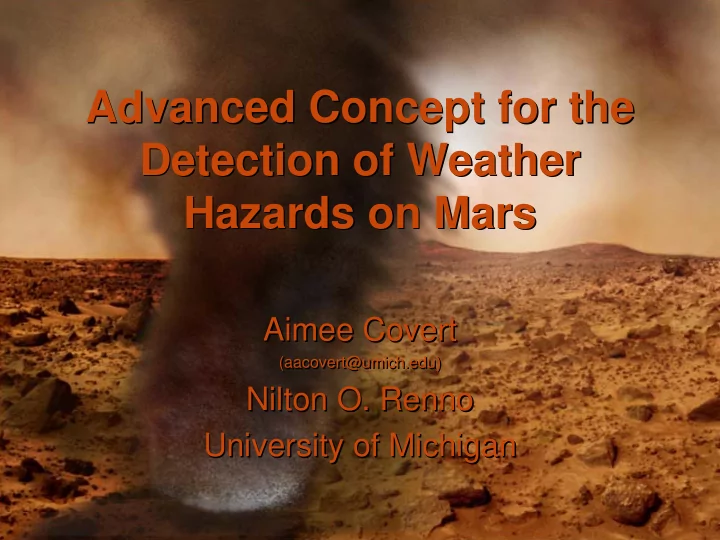
Advanced Concept for the Detection of Weather Hazards on Mars Advanced Concept for the Detection of Weather Hazards on Mars

Aimee Covert

(aacovert@umich.edu)

Nilton O. Renno University of Michigan Aimee Covert

(aacovert@umich.edu)
Nilton O. Renno University of Michigan

slide-2
SLIDE 2

NIAC Annual Meeting March 7, 2006

Introduction

  • Study electric behavior of weather-

related dust events

– Dust devils and dust storms

  • Terrestrial
  • Martian

– Field experiments – Laboratory simulations of dust devils

slide-3
SLIDE 3

NIAC Annual Meeting March 7, 2006

QuickTime™ and a Sorenson Video 3 decompressor are needed to see this picture.

slide-4
SLIDE 4

NIAC Annual Meeting March 7, 2006

Outline

  • Research Goals
  • Electric Theory of Dust Events
  • Experiments

– Lab Results – Field Results

  • Plans for the Future
  • Conclusions
slide-5
SLIDE 5

NIAC Annual Meeting March 7, 2006

Weather Hazards on Mars

  • Dust events pose a significant hazard to

future missions to Mars

– High winds, high dust content could negatively affect manned missions – Electric activity could negatively effect robotic landers and manned missions – Electric fields can ionize the air and cause potentially hazardous chemical reactions

slide-6
SLIDE 6

NIAC Annual Meeting March 7, 2006

Research Goals

  • To find an effective method for detecting weather

hazards on Mars (dust events) at any time of the day or during periods of low visibility

– To study microdischarges between colliding dust particles in the laboratory – To study microdischarges in terrestrial dust devils – To design an instrument to remotely fingerprint Martian dust events based on their microdischarges

slide-7
SLIDE 7

Electric Theory of Dust Events

slide-8
SLIDE 8

NIAC Annual Meeting March 7, 2006

Microdischarges in Dust Events

  • Asymmetric rubbing occurs between

colliding particles

– Causes a net transfer of electrons from larger to smaller particles – Smaller particles become negatively charged – Large particles become positively charged

  • Microdischarges occur when the particles

separate from each other, after a collision

slide-9
SLIDE 9

NIAC Annual Meeting March 7, 2006

Non-thermal Microwave Emissions

  • Microdischarges produce non-thermal microwave

radiation [Renno et al., 2004]

– Non-thermal emissions can be used to remotely fingerprint dust events

  • To distinguish thermal from non-thermal

emissions we look at the probability distribution function of the amplitude of the emissions (pdf)

– Gaussian: thermal – Non-gaussian: non-thermal

slide-10
SLIDE 10

NIAC Annual Meeting March 7, 2006

Bulk Electric Fields

[Kok and Renno 2006]

  • Charge separation occurs

when small particles rise in updrafts

– The larger particles stay near the ground

  • Charge separation produces

large electric fields in terrestrial dust devils and dust storms

– Fields in excess of 10 kV/m on Earth [Renno et al., 2004]

slide-11
SLIDE 11

NIAC Annual Meeting March 7, 2006

Applications to Mars

  • Martian dust events are significantly larger and

dustier than terrestrial dust events.

– There is evidence that microdischarges and large electric fields occur in these dust events [Renno et al., 2003, 2004] – Lower atmospheric pressure makes electric breakdown easier on Mars – Higher dust content and larger storms result in more collisions and therefore more microdischarges

slide-12
SLIDE 12

Experiments

slide-13
SLIDE 13

NIAC Annual Meeting March 7, 2006

Laboratory Setup

slide-14
SLIDE 14

NIAC Annual Meeting March 7, 2006

Particles of Interest

Martian Soil Composition

At Viking 1 Landing Site

  • Experiments with various

materials

– Representatitve of the Martian regolith

  • Silicon
  • Iron
  • Aluminum
  • Potassium
  • Magnesium

– Particles of a range of sizes representing those likely to be found in Martian dust events

[http://resources.yesican-science.ca]

slide-15
SLIDE 15

NIAC Annual Meeting March 7, 2006

Experimental Setup

  • Materials classified

by size:

– Large particles (~1 mm diameter) – Small particles (~1 to 10 µm) – Mixed particles (half large particles, half small by volume)

slide-16
SLIDE 16

NIAC Annual Meeting March 7, 2006

Experimental Setup

  • Used three

materials:

– Aluminum – Basalt – Hematite (Fe2O3)

  • Experiments

conducted at various pressures

– Ranging from 0.1 to 1 Bar

QuickTime™ and a H.264 decompressor are needed to see this picture.

slide-17
SLIDE 17

NIAC Annual Meeting March 7, 2006

Lab Experiments

  • Lab experiments conducted using two

different radiometers

– First provides time series of emission amplitude

  • Look for peaks in the data to identify microdischarges
  • Sensitive to emission frequencies around 10 GHz

– Second provides a probability distribution function (pdf) of electric field amplitude at small time intervals

  • Look for non-gaussian distribution to indicate the

presence of non-thermal radiation

  • Sensitive to frequencies around 10 GHz
slide-18
SLIDE 18

NIAC Annual Meeting March 7, 2006

Sensor of Setup 1

slide-19
SLIDE 19

NIAC Annual Meeting March 7, 2006

Setup 1 Lab Results

  • Observed

microdischarges

  • Only detected significant

emissions in experiments with aluminum particles

  • We might need to look at
  • ther frequencies or use

more sensitive instruments to detect emissions from other particles

slide-20
SLIDE 20

NIAC Annual Meeting March 7, 2006

Equipment of Setup 2

slide-21
SLIDE 21

NIAC Annual Meeting March 7, 2006

Setup 2 Lab Results

  • Positive results with

aluminum particles

– Consistent with results from setup 1

  • pdf significantly different

from control (blackbody pdf)

  • Did not detect emissions

in experiments with basalt or hematite

  • Did not detect emissions

in experiments with only small particles

PDF of electric field ( Large alum inum particles)

200 400 600 800 1000 1200

  • 70 -60 -50 -40 -30 -20 -10

10 20 30 40 50 60 70

Bins

Blackbody 1 atm

slide-22
SLIDE 22

NIAC Annual Meeting March 7, 2006

Kurtosis of the Emissions

Large aluminum particles 0.29 Bar Large aluminum particles 1 Bar

  • Kurtosis ~3 indicates gaussian distribution.
slide-23
SLIDE 23

NIAC Annual Meeting March 7, 2006

Field Experiments

  • Searched for

microdischarges in terrestrial dust devils

  • Conducted in

Summer 2005 near Eloy, AZ

  • Used radiometer

from setup 1

– Recoded time series

  • f the amplitude
slide-24
SLIDE 24

NIAC Annual Meeting March 7, 2006

Field Results

  • Microwave Emissions from a dust devil on June 11th 2005 at

2:15pm and a corresponding image of it.

slide-25
SLIDE 25

NIAC Annual Meeting March 7, 2006

More Field Results

2:28 p.m. MST on June 9, 2005 12:02 p.m. MST on June 11, 2005

slide-26
SLIDE 26

NIAC Annual Meeting March 7, 2006

Plans for the Future

  • Field Goals

– Develop a more portable data collection system – Distinguish non-thermal from thermal emissions – Correlate emission amplitude with weather data at a fixed location

  • Laboratory Goals

– Conduct experiments with additional materials – Try different methods to detect emissions with hematite and basalt – Calculate pdf of non-thermal emissions by removing background noise

slide-27
SLIDE 27

NIAC Annual Meeting March 7, 2006

Conclusions

  • Have shown that emissions from colliding particles is

non-thermal

  • Identified a flight qualified instrument that can

distinguish non-thermal from thermal emissions

  • Additional lab experiments with different materials are

necessary

  • Additional field measurements using different data

collection procedures are necessary

  • Optimal frequencies must be identified
  • Recommend an instrument to measure electric fields to

be placed on Mars landers

slide-28
SLIDE 28

NIAC Annual Meeting March 7, 2006

Acknowledgements

  • Dr. Nilton O. Renno, University of Michigan
  • Dr. Chris Ruf, University of Michigan
  • Collaborators Kevin Reed and Catalina

Oaida, University of Michigan

slide-29
SLIDE 29

NIAC Annual Meeting March 7, 2006

slide-30
SLIDE 30

NIAC Annual Meeting March 7, 2006

Addressing Problems with Results

  • Why didn’t we detect emissions with basalt

and hematite?

– Sampling rate may not be fast enough – May need to use a sensor with a different frequency

  • In experiments with aluminum we detected

changes in pdf for all but small particles

– Small particles tend to coat the inside of the bell jar, which may interfere with detection of emissions

slide-31
SLIDE 31

NIAC Annual Meeting March 7, 2006

Why 10 GHz?

  • Very sensitive
  • Developed for satellite dishes
  • Inexpensive
slide-32
SLIDE 32

NIAC Annual Meeting March 7, 2006

Effects of fan?

200 400 600 800 1000 1200

  • 70
  • 60
  • 50
  • 40 -30
  • 20
  • 10

10 20 30 40 50 60 70 Fan on Fan off

  • No visible difference in pdf of electric field amplitude
  • No change in kurtosis
slide-33
SLIDE 33

NIAC Annual Meeting March 7, 2006

Charge Transfer by Asymmetric Rubbing

  • Solid matter has more empty energy levels than electrons

in high energy states.

  • During asymmetric rubbing:

– There is a net transfer of electrons to the smaller body because it slides more over the other. – The smaller body becomes negatively charged and the larger becomes positively charged.

  • - - - - - - - - - - - - - - - - - - - -
  • + +

+ + + + + + + + + + + + + +