
SLIDE 1
Achieving Food Security in SSA through Food Value Chains Food Value Chains
8th of June IFPRI, Washington
IFPRI Policy Seminar
8th of June 2015
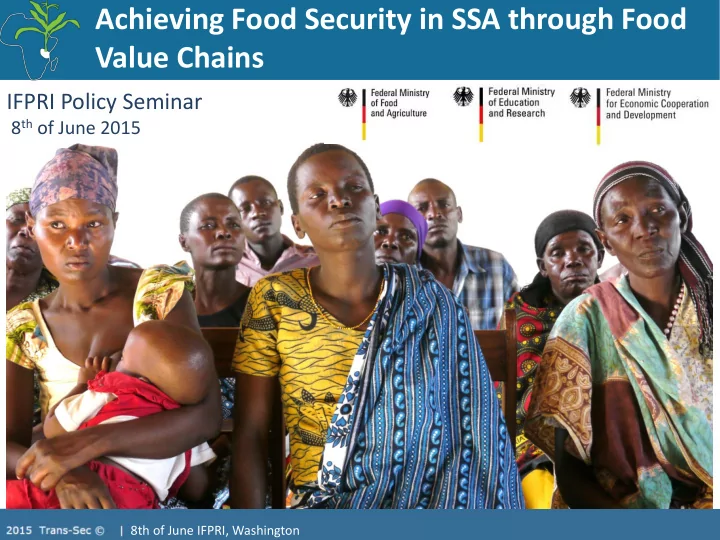
Achieving Food Security in SSA through Food Value Chains Food Value - - PowerPoint PPT Presentation
Achieving Food Security in SSA through Food Value Chains Food Value Chains IFPRI Policy Seminar 8 th of June 2015 8th of June IFPRI, Washington GlobE Global Food Security of the German Ministries BMBF and BMZ GlobE Global Food Security
8th of June IFPRI, Washington
8th of June 2015
08/06/2015 2
Initiative of the
cooperation with the
Total budget: approx. 50 M Euro
Global Food Security of the German Ministries BMBF and BMZ
08/06/2015 3
Global Food Security of the German Ministries BMBF and BMZ
08/06/2015 4
Agricultural production / nutrition / health German-African research networks which focus on the food system Soil / water / material flows Identifying and solving central problems related to food systems Reducing of losses along the value chain Developing regionally adapted research solutions Rural and gender-specific structures / local solutions Research capacities in Germany and in Africa Plants / plant breeding Biomass / bioenergy Animals in the system
Global Food Security of the German Ministries BMBF and BMZ
5
Name Countries Focus
Trans-SEC Tanzania Entire FVC Urban Food+
Burkina Faso, Ghana, Mali, Cameroon
Urban agriculture Wetlands
Kenya, Uganda, Rwanda, Tanzania
Wetlands Hortinlea
Kenya, Tanzania, Ethiopia
Vegetables Biomass Web
Ghana, Nigeria, Ethiopia
Biomass Reload
Ethiopia, Uganda, Kenya
Post-harvest losses
Global Food Security of the German Ministries BMBF and BMZ
6
Nutrition Research of the BMEL
08/06/2015
8 M Euro, total Budget 5 Years, total period
7
physical and economic access to sufficient, safe and nutritious food to meet their dietary needs and food preferences for an active and healthy life (FAO),
National Bureau of Statistics and ICF Macro, 2010. Tanzania Demographic and Health Survey 2009–10. National Bureau of Statistics Tanzania. 8
9
10
waste management, nutrient cycling How manage resources sustainably? water harvesting, erosion prevention How produce crops more efficiently ? inter-cropping, fertiliser How add value though processing? less energy, efficient PH processing and storage How add value / income through markets? certification, better market integration How improve consumption patterns / diets? nutrition education Natural Resources Crop Production Processing Markets Consumption
e.g.:
11
08/06/2015
12
08/06/2015
13
New projects in Trans-SEC case studies New institutes within consortium = asd
= Funding involved (total 12 M Euro)
STAR Project Unmanned Are Jan Dempehof Michigan University USA
08/06/2015
2006 2015 2018 2020
2013
From national up- scaling cases to Smart Up-Scaling Centres
14
Resilient Agro- landscapes to Climate Change in Tanzania Coordinator: ZALF 1,3 M GIZ Biofuel evaluation for Tanzanian Technological Efficiency using Renewables – integrated Strategies Coordinator: ZALF 1,1 M GIZ Strategies for Adapting to Climate Change in Rural Sub-Saharan Africa: Targeting the Most Vulnerable Coordinator: IFPRI 1,3 M GIZ Up-Scaling of Good Agricultural Practices Coordinator: ZALF 0,2 M BMELF/GIZ Innovating pro-poor strategies to safeguard Food Security using technology and knowledge transfer Scaling-Up Nutrition: Implementing Potentials of nutrition-sensitive and diversified agriculture
08/06/2015
Identification/Testing of successful upgrading strategies along FVC to site-specific, sustainable setting Dissemination/ Implementation for national outreach, policy, extension, research
Region1 Morogoro Region2 Dodoma Research Policy Extension Region Cross-country Approach
National Up-scaling Centre Up-Scaling Centre-Network
Sub-humid region: Maize, Sesame, pigeon pea
Ilakala/Changarawe
Semi-arid region: Millet, Sunflower, groundnut
Ilolo & Idifu
Improvement of food situation for the most- vulnerable rural poor
1000 HH 1000 HH 1000 HH 1000 HH
15
16
components in the CSS
prioritizing based on inventory and within given capacities
900 HH in 4 CSS, 2 control villages
ante IA
17
Natural Resources Crop Production Markets Income Generation Consumption Processing Waste Management Bioenergy
crops, surplus cereals, and livestock products)
18
Natural Resources Crop Production
Features: 1st year baby plots Idifu 73 households Ilolo 53 households Changarave 43 HH Ilakala 52
recommend (monetary amount equal to 2-4 chicken/ha) Sub-humid region:
Maize, Sesame, pigeon pea Ilakala/Changarawe Semi-arid region: Millet, Sunflower, groundnut Ilolo & Idifu
Sunflowers, rice, millet, Sorghum, maize all all
19
Processing Waste Management Bioenergy
Features: Pyroliser (Maize cob charcoal production) Maize shelling Crude oil pressing sunflower oil 500 stoves per village Low costs (2-3 Euro/stove) Training for trainers Nurseries (2000 trees, 4 species)
20
Markets Income Generation
crops, surplus cereals, and livestock products)
Features:
regional markets -> Two entire villages (1000 HH each)
IRRI super bag 2 Euro + „vihenge“ traditional storage (loam container) -> In all villages (30 1st y and 250 HH per village)
demonstration site for out-scaling
system for all mobile users.
21
Consumption
Features:
per village per year with subsequent outscaling acitivities)
plot
08/06/2015
Natural Resources Crop Production Processing Markets Consumption
mother and baby plots crude oil
22
08/06/2015 23
24
10 20 30 40 50 60 Burkina Faso Kenya Mali Uganda Tanzania Average Percent Subsidies Extension Marketing & regulation R&D irrigation
25
cashew nuts, etc)
thru a centralized & government controlled body
26
27
28
10 20 30 40 50 60 70 US$/capita ( real price) Upper middle income Lower middle income Low income Tanzania
Source: UNCTAD
08/06/2015
29