Direct Mail Advertising and Sales Tax Challenges: Navigating - - PowerPoint PPT Presentation

direct mail advertising and sales tax challenges
SMART_READER_LITE
LIVE PREVIEW

Direct Mail Advertising and Sales Tax Challenges: Navigating - - PowerPoint PPT Presentation

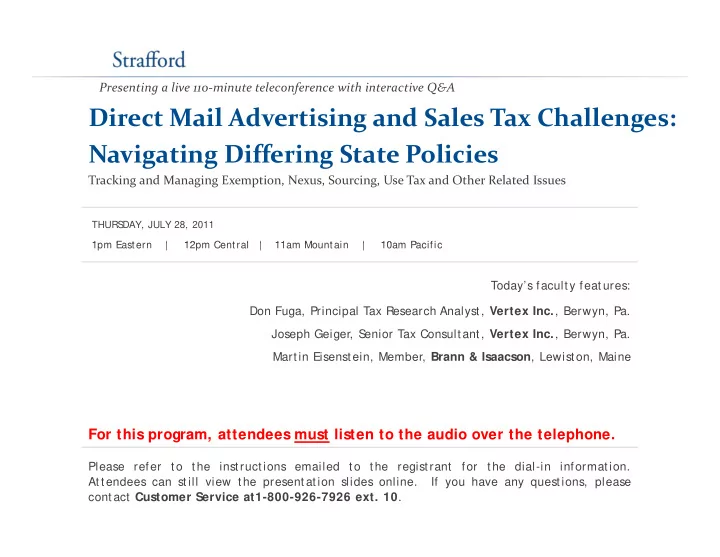
Presenting a live 110 minute teleconference with interactive Q&A Direct Mail Advertising and Sales Tax Challenges: Navigating Differing State Policies Tracking and Managing Exemption, Nexus, Sourcing, Use Tax and Other Related Issues


slide-1
SLIDE 1

Presenting a live 110‐minute teleconference with interactive Q&A

Direct Mail Advertising and Sales Tax Challenges: Navigating Differing State Policies

Tracking and Managing Exemption, Nexus, Sourcing, Use Tax and Other Related Issues

1pm Eastern | 12pm Central | 11am Mountain | 10am Pacific THURSDAY, JULY 28, 2011

Today’s faculty features:

1pm Eastern | 12pm Central | 11am Mountain | 10am Pacific

Don Fuga Principal Tax Research Analyst Vertex Inc. Berwyn Pa Don Fuga, Principal Tax Research Analyst, Vertex Inc., Berwyn, Pa. Joseph Geiger, S enior Tax Consultant, Vertex Inc., Berwyn, Pa. Martin Eisenstein, Member, Brann & Isaacson, Lewiston, Maine

For this program, attendees must listen to the audio over the telephone.

Please refer to the instructions emailed to the registrant for the dial-in information. Attendees can still view the presentation slides online. If you have any questions, please contact Customer Service at1-800-926-7926 ext. 10.

slide-2
SLIDE 2

Conference Materials

If you have not printed the conference materials for this program, please complete the following steps:

  • Click on the + sign next to “ Conference Materials” in the middle of the left-

hand column on your screen hand column on your screen.

  • Click on the tab labeled “ Handouts” that appears, and there you will see a

PDF of the slides for today's program.

  • Double click on the PDF and a separate page will open.

Double click on the PDF and a separate page will open.

  • Print the slides by clicking on the printer icon.
slide-3
SLIDE 3

Continuing Education Credits

FOR LIVE EVENT ONLY

Attendees must listen to the audio over the telephone. Attendees can still view the presentation slides online but there is no online audio for this program. Attendees must stay on the line for at least 100 minutes in order to qualify for a full 2 credits of CPE. Attendance is monitored as required by NAS BA. Please refer to the instructions emailed to the registrant for additional

  • information. If you have any questions, please contact Customer Service

at 1-800-926-7926 ext. 10. at 1 800 926 7926 ext. 10.

slide-4
SLIDE 4

Tips for Optimal Quality

S d Q lit S

  • und Qualit y

For this program, you must listen via the telephone by dialing 1-866-258-2056 and entering your PIN when prompted. There will be no sound over the web connection. co ect o . If you dialed in and have any difficulties during the call, press *0 for assistance. Y

  • u may also send us a chat or e-mail sound@

straffordpub.com immediately so we can address the problem. Viewing Qualit y To maximize your screen, press the F11 key on your keyboard. To exit full screen, press the F11 key again press the F11 key again.

slide-5
SLIDE 5

Direct Mail Advertising and Sales Tax Ch ll N i ti Diff i St t Challenges: Navigating Differing State Policies Seminar

July 28, 2011 Joseph Geiger, Vertex Inc. joseph.geiger@ vertexinc.com Don Fuga, Vertex Inc. don.fuga@ vertexinc.com Martin Eisenstein, Brann & Isaacson meisenstein@ brannlaw.com

slide-6
SLIDE 6

Today’s Program

Introductory Concepts [Don Fuga] S lide 7 – S lide 14 Examples Of S pecific S tate Treatments [Joseph Geiger] S lide 15 – S lide 31 Nexus Issues [Mart in Eisenst ein] S lide 32 – S lide 41 Printer's Liability To Charge Tax [Mart in Eisenst ein] S lide 42 – S lide 51 How S S TP Treats Certificates Printers May Need [Don Fuga] S lide 52 – S lide 53

slide-7
SLIDE 7

INTRODUCTORY CONCEPTS

Don Fuga, Vertex Inc.

INTRODUCTORY CONCEPTS

slide-8
SLIDE 8

Definition SSUTA Agreement

  • “Direct mail” means printed material delivered or distributed by U.S.

mail or other delivery service to a mass audience or to addressees on y a mailing list provided by the purchaser or at the direction of the purchaser, when the cost of the items are not billed directly to the

  • recipients. “Direct mail” includes tangible personal property supplied

directly or indirectly by the purchaser to the direct mail seller for inclusion in the package containing the printed material. “Direct mail” does not include multiple items of printed material delivered to a single dd address.

8

slide-9
SLIDE 9

Definition Qualifiers That Broaden Scope

  • Included in the definition is the term “advertising materials,” examples
  • f which include the following:
  • Video and audio tapes
  • Pens
  • Key rings
  • Key rings
  • Computer disks
  • Coffee mugs

9

slide-10
SLIDE 10

Definition Qualifiers That Limit Scope

  • Examples of qualifiers that limit scope include the following:
  • Method of delivery limited to the U.S. Postal Service
  • Specify only limited printed materials (e g

include or exclude Specify only limited printed materials (e.g., include or exclude catalogs)

  • Exclude advertising materials
  • Limit printed matter content to price and item
  • Limit printed matter content to price and item
  • Limit to free publications published on a regular basis
  • Exclude multiple items of printed matter
  • Limit exemption to cooperatives

10

slide-11
SLIDE 11

Examples Of Printed Material That Qualify

  • The following items are generally considered to qualify but some may

be excluded in certain jurisdictions: M il d t l

  • Mail order catalogs
  • Advertising circulars
  • Coupons
  • Advertising folders
  • Printed envelopes
  • Electoral literature

Electoral literature

  • Newspaper inserts
  • One-time license fee for a mailing list

11

slide-12
SLIDE 12

Examples Of Items That May Not Qualify

  • The following items are generally not considered to qualify, but some

may in certain jurisdictions:

  • Advertising materials (unless allowed by definition)

g ( y )

  • Stockholder reports
  • Personalized information
  • Legally required mailings
  • Legally required mailings
  • Privacy notices
  • Informal informational literature that is not in the form of

d ti i advertising

12

slide-13
SLIDE 13

Typical Tax Issues For Taxpayers

  • Does the advertising printed matter or materials qualify for an

exemption and if so, in which jurisdictions?

  • Is postage exempt and if so, in which jurisdictions?

p g p j

  • Does the printer have the ability to charge the appropriate tax where

applicable?

  • Does my IT system have the ability to accrue the correct use tax when

Does my IT system have the ability to accrue the correct use tax when the printer fails to charge the appropriate tax?

  • What is the correct exemption certificate to issue the printer, where

applicable? applicable?

  • Are there storage issues with direct mail advertising literature or

materials?

  • Are my records adequate to sustain exempt transactions?
  • Are my records adequate to sustain exempt transactions?

13

slide-14
SLIDE 14

Typical Tax Issues For Printers

  • Does my IT system have the ability to charge the appropriate tax?
  • Does the mailing list received from my customer contain information

Does the mailing list received from my customer contain information needed to comply with sourcing rules?

  • What exemption certificates are acceptable?
  • What exemption certificates are acceptable?
  • Are there storage issues with direct mail literature?

14

slide-15
SLIDE 15

EXAMPLES OF SPECIFIC STATE

Joseph Geiger, Vertex Inc.

EXAMPLES OF SPECIFIC STATE TREATMENTS

slide-16
SLIDE 16

Defining Direct Mail Advertising

  • “Direct mail advertising” includes catalogs, letters, circulars, brochures,

and pamphlets that consist of printed sales messages if the advertising p p p g g material is printed to the purchaser’s special order; delivered by the seller, the seller’s agent or a mailing house acting as the purchaser’s agent, via mail or common carrier; and received by any other person who becomes the owner of the material at no cost to the recipient.

16

slide-17
SLIDE 17

Taxability Of Direct Mail Advertising

  • Direct mail advertising is taxable in most states.
  • Direct mail advertising is generally not taxable in the following states:
  • CA

MO

  • MO
  • NY
  • OH
  • PA

17

slide-18
SLIDE 18

California

  • An exemption exists for the gross receipts from the sale of, and the

storage, use, or other consumption in California of catalogs, letters, g , , p g , , circulars, brochures, and pamphlets that consist substantially of printed sales messages for goods and services and are printed to the special

  • rder of the purchaser and mailed or delivered by the seller, the seller's

agent, or a mailing house, acting as an agent for the purchaser, through the U.S. Postal Service or by common carrier to any other person at no cost to that person who becomes the owner of such i t d l (S 6379 5 R & T C d ) printed sales messages. (Sec. 6379.5, Rev. & Tax Code)

18

slide-19
SLIDE 19

Florida

  • Exempt are free circulated publications the content of which is

Exempt are free, circulated publications, the content of which is primarily advertising, that are published on a regular basis and distributed through the mail. (Fla. Stat. Sec. 212.08(7)(w))

19

slide-20
SLIDE 20

Iowa

  • Envelopes used to contain advertising materials are exempt. (Rule

701-18.41 (422, 423))

20

slide-21
SLIDE 21

Kentucky

  • Effective July 1, 2011, commercial printers or mailers engaged in

business in Kentucky are not required to collect use tax on sales of printing, "advertising and promotional direct mail," or "other direct mail" printed outside Kentucky and delivered outside Kentucky to the U.S. Postal Service for mass mailing to third-party Kentucky residents who are not purchasers of the mail if the commercial printers or mailers (1) i t i d l t d t th l t i t th K t k maintain records related to those sales to assist the Kentucky Department of Revenue in the collection of use tax, and (2) file sales and use tax reports if requested to do so by the department. (KRS Sec. 139 365(1)) If a commercial printer or mailer meets these two criteria 139.365(1)) If a commercial printer or mailer meets these two criteria, the purchaser of the printing or mail is solely responsible for reporting and paying use tax. (KRS Sec. 139.365(2))

21

slide-22
SLIDE 22

Louisiana

  • Catalog distribution exemption: No sales or use tax shall be imposed

Catalog distribution exemption: No sales or use tax shall be imposed by the state or any political subdivision on the value of catalogs distributed, or intended for distribution in the state, without charge to the recipient. (La. Rev. Stat. Sec. 47:305.49) p ( )

22

slide-23
SLIDE 23

Maryland

  • Charges for printing direct marketing materials are taxable. Tax

applies to the total charge without deduction for separately itemized charges for property or services required to bring the printed matter to charges for property or services required to bring the printed matter to its completed state. (Sec. 11-101(m), Tax Gen. Art.; Reg. 03.06.01.11(A))

  • Sales of direct mail advertising literature and mail order catalogues

that will be distributed outside the state are exempt. Sales of computerized mailing lists are also exempt to the extent used for the computerized mailing lists are also exempt to the extent used for the purpose of providing addresses to which direct mail advertising literature and mail order catalogues will be distributed outside the state. (Sec 11-215(d)(1) Tax Gen Art ) (Sec. 11 215(d)(1), Tax Gen. Art.)

23

slide-24
SLIDE 24

Minnesota

  • Non-taxable advertising is creative promotional services that meet

three criteria: (1) there is no functional use of the medium except to carry the message, (2) the agency must be involved in the creation of advertising, and (3) the agency must have a direct relationship with the

  • advertiser. When the three nontaxable advertising criteria are met,

direct mail advertising materials are among a group of items, used to t d ti th t ll id d t b t bl promote or advertise, that are usually considered to be nontaxable advertising services.

  • Charges for delivery and distribution of direct mail are exempt from

Mi t l d t if th t l t t d (S Minnesota sales and use tax if they are separately stated. (Sec. 297A.68(36), Min. Stat.) Separately stated fees for preparing direct mail for delivery or distribution are also exempt. (Revenue Notice No. 07 07 Minnesota Department of Revenue April 30 2007) 07-07, Minnesota Department of Revenue, April 30, 2007)

24

slide-25
SLIDE 25

Missouri

  • In general, if a sale of advertising involves the transfer of tangible

personal property, it is a sale of tangible personal property subject to tax unless it is preliminary art or the sale is made by an exempt

  • business. If the sale is made by an exempt business, the transaction is

the sale of a service and is not subject to tax when the true object of the sale is the advertising. When the true object of a sale by an exempt b i i t ibl l t it i bj t t t (12 CSR 10 business is tangible personal property, it is subject to tax. (12 CSR 10- 103.610(1))

25

slide-26
SLIDE 26

New York

  • Printed advertising materials mailed or shipped to customers or

prospective customers of the purchaser of the such materials are exempt from tax. The printed promotional materials can be mailed or p p p shipped directly by the purchaser of the materials using a common carrier, the U.S. Postal Service or a like delivery service, or the mailing

  • r shipping can be arranged by a third party (such as a printer/mailer)
  • n behalf of the purchaser. There must be no charge to the purchaser's

ultimate recipient for the printed advertising materials. Finally, the purchaser of the materials is expected to provide a properly completed F ST 121 2 C tifi t f E ti f P h f P ti l Form ST-121.2, Certificate of Exemption for Purchases of Promotional Materials, to the seller of the materials. (N. Y. Tax Law Sec. 1115(n)(4))

26

slide-27
SLIDE 27

Ohio

  • Exempt are sales where the purpose of the consumer is to use or

consume the things transferred in making retail sales Examples of consume the things transferred in making retail sales. Examples of such items are newspaper inserts, catalogues, coupons, flyers, gift certificates, or other advertising material that prices and describes tangible personal property offered for retail sale. (Rev. Code Ann. Sec. g p p p y ( 5739.02(B)(35))

27

slide-28
SLIDE 28

Pennsylvania

  • Exempt are advertising literature or materials that are distributed

directly to intended recipients through the United States Postal Service. Advertising literature or material is defined as tangible personal property that is intended to promote business interest, create goodwill

  • r engage the attention or interest of a recipient. Included in this term

is printed matter, brochures, calendars, price lists, investment t fi i l d t l t l t l prospectuses, financial and corporate annual reports, electoral literature or materials, envelopes, address labels, reply envelopes, and application forms. (Reg. Sec. 31.29)

  • Advertising literature or materials that are distributed in a manner other

than by the United States Postal Service are taxable.

28

slide-29
SLIDE 29

Wisconsin

  • A Wisconsin sales and use tax exemption was created in 2007

Wisconsin Act 20 (effective April 1, 2009) for the gross receipts from ( p , ) g p the sale of and the storage, use, or other consumption of catalogs, and the envelopes in which the catalogs are mailed, that are designed to advertise and promote the sale of merchandise or to advertise the services of individual business firms. (Wis. Stat. 77.54(25m))

29

slide-30
SLIDE 30

West Virginia

  • Exempt are sales of advertisements of goods and services in

Exempt are sales of advertisements of goods and services in preprinted advertising circulars; provided, that pre-printed advertising circulars shall include the purchase of direct-mailing advertising services, but does not include wholesale, and retail catalogs through , , g g which tangible personal property, and services may be directly ordered. (Reg. Sec. 110-9.9(2)(4))

30

slide-31
SLIDE 31

Summary

  • State exemptions and qualifying conditions cover a broad spectrum.
  • Types of advertising materials (catalogs, envelopes, etc.)
  • Method of distribution (U S Postal Service)
  • Method of distribution (U.S. Postal Service)
  • Manner in which charges are stated on invoices

31

slide-32
SLIDE 32

NEXUS ISSUES

Martin Eisenstein, Brann & Isaacson

slide-33
SLIDE 33

N I G l Nexus Issues: General

  • Quill (504 U.S

. 298 (1992)) sets the constitutional standard. Q ill i th t t il h h i l

  • Quill requires that a retailer have a physical

presence.

  • Through its own employees properties or
  • Through its own employees, properties or

facilities

  • Attribution nexus: Agent/ representative
  • Attribution nexus: Agent/ representative.

33

slide-34
SLIDE 34

N I G l (C ) Nexus Issues: General (Cont.)

  • Quill states (quoting Bellas Hess):

Q (q g )

  • There is a “ sharp dist inct ion …

bet ween mail-order sellers wit h ret ail out let s, solicit ors, or propert y wit hin a st at e and t hose who do more t han communicat e wit h cust omers in t he st at e by who do more t han communicat e wit h cust omers in t he st at e by and or common carrier as a part of general int erst at e business.” (505 U.S . at 307) (emphasis added) d f i

  • Few court cases regard presence of inventory
  • Advance Magazine Publishers, Inc. v. Huddlest on, Chancery Court, 20th

Judicial District (Tennessee), ¶ 400-560, (Aug. 20, 1997) – Presence of i f i d bli h f hi inventory of paper at printer does not establish franchise tax nexus.

  • But. see statement in Quill that Quill did not have nexus because it did

not own tangible personal property; also see AOL v. Johnson (Tenn. Ct. App 2002) (Presence of modems in state creates nexus )

  • App. 2002) (Presence of modems in state creates nexus.)

34

slide-35
SLIDE 35

N I li i T M il Nexus Implications To Mailer

  • S

torage of paper

  • S

torage of paper

  • Most large promotional materials mailers contract with

paper brokers or directly with mills to purchase paper and cause paper to be supplied to the printer or printers.

  • Paper must be stored at the printer for short or longer

periods periods.

  • S

torage of paper creates a high nexus risk in the state of the printer, but an argument can be made otherwise.

  • S

ee previous slide

  • Does the activity “ make a market” in the state for the out-of-state

mailer? (see Tyler Pipe Indust ries, Inc. v. WA. S t at e Dept . of Revenue 483 U S 232 (1987) 483 U.S . 232 (1987)

35

slide-36
SLIDE 36

l l ( ) Nexus Implications To Mailer (Cont.)

  • Solutions
  • Transfer of title to printer
  • Accomplished with bill of sale and invoice price from
  • Accomplished with bill of sale and invoice price from

printer; includes cost of paper (avoid up-charge or paper management fee)

  • Need accounting for paper

Need accounting for paper

  • But, note potential issue for materials distributed in

Indiana: S ee Amerit ech Publ’ g, Inc. v Ind. Dep’t of S t at e Revenue (API I), No. 49T10-0305-TA-26, slip op. (Ind. Tax Ct . ( ) p p ( Oct 19, 2006) and AOL , LLC v Ind. Dep’t of S t at e Revenue,

  • No. 49T10-0903-TA-7, slip op. (Ind. Tax Ct . Dec. 29, 2010)
  • S

ince catalogs/ promo materials are purchased, they will be taxable, as opposed to non-taxability of printing services.

36

slide-37
SLIDE 37

l l ( ) Nexus Implications To Mailer (Cont.)

S l ti t P i t i t t ith f h b

  • S
  • lutions re: paper storage: Print in states with safe harbors

STATE STATUTE – REGULATION ‐ CODE

Connecticut CGA § 12‐407(15)(b) § ( )( ) Florida FL ST § 212.0596(2), 212.06(2)(d) Technical Assistance Advisement, No. 06A‐03 Georgia OCGA § 48‐8‐2, 48‐7‐1 g , Illinois 35 ILCS § 105/2(1), 35 ILCS § 5/205(f) Indiana IN Code § 6‐2.5‐3‐1, 6‐2.5‐8‐8.5, 6‐3‐2‐2.3 Kentucky KRS § 139.340(2), 139.470(13) Maine 36 MRSA § 1754‐B(1)(G)(5) Minnesota MN ST § 297A.66 (Subdivision 3)(b)

37

slide-38
SLIDE 38

l l ( ) Nexus Implications To Mailer (Cont.)

S l ti t P i t i t t ith f h b

  • S
  • lutions re: paper storage: Print in states with safe harbors

STATE STATUTE – REGULATION ‐ CODE

Ohio ORC § 5741.17, 5733.09(D), 5747.30b § , ( ), Oklahoma 68 OS § 1376 Pennsylvania 72 PS § 7201 y South Carolina SC Code § 12‐36‐75, § 12‐6‐555 Utah UT Code § 59‐7‐102(2) Virginia VA Code § 58.1‐401(7), 58.1‐612(D) West Virginia TAA 96‐003 Wisconsin WSA § 77.51(13h), 71.23(3)

38

slide-39
SLIDE 39

l l ( ) Nexus Implications To Mailer (Cont.)

  • Possible limitations on safe harbors
  • Maine and Minnesota do not specifically permit storage of paper

at printer.

  • S

torage of catalogs is not necessarily exempt.

  • Don’ t take title to catalogs or mailings until sent by

interstate commerce, and not when invoiced by printer

  • Visits by personnel of mailer to state may not be protected in

Florida, Kentucky, Maine and Minnesota, because the safe harbor provisions in the statutes don’ t address whether visits create nexus create nexus.

  • Constitutional argument: Infrequent visits to state don’ t create
  • nexus. (S

ee Dept of Rev. v. S hare Int ernat ional, Inc. 676 S

  • .2d. 1362 (Fla.

1996), Appeal of Int ercard, Inc., 14 P .3d 1111 (Kan. 2000) but see Orvis Co., Inc. 1996), Appeal of Int ercard, Inc., 14 P .3d 1111 (Kan. 2000) but see Orvis Co., Inc.

  • v. Tax App. Tribunal of New Y
  • rk 654 N.E.2d 954 (N.Y

. 1995)

39

slide-40
SLIDE 40

l l ( ) Nexus Implications To Mailer (Cont.)

  • Potential issues
  • Potential issues
  • Work done in more than one state, of which one state has a safe

harbor and the other state does not. Example: One facility prints pages 1 25 and facility in another state prints the remaining pages pages 1-25, and facility in another state prints the remaining pages.

  • Make sure that contract specifies that a printing facility in safe

state is responsible for printing j ob, including mailing of materials.

  • Useful tips
  • Include anti-agency clauses in contracts
  • Don’ t store catalogs or promotional materials with printers unless
  • Don’ t store catalogs or promotional materials with printers unless,

based on review of statute, it is safe to do so

  • Contract with printer should specify states where printing takes

l place

40

slide-41
SLIDE 41

h l l Other Nexus Implications To Mailer

  • Basic principle: Mailing promotional materials from outside of state into a

state does not create nexus in the destination state.

  • But, distributing promotional materials in a state may create nexus.
  • Example: Catalogs at trade shows or kiosks?

Example: Catalogs at trade shows or kiosks?

  • Example: Coupons
  • Tax authorities could argue that the person distributing is an agent or

representative soliciting sales in the state i e the person is helping to make representative soliciting sales in the state, i.e. the person is helping to make a market in the state for the advertiser.

  • (S

ee Borders Online, LLC v. Cal. Board of Equalizat ion, 129 Cal.App. 4th 1129 (Cal.

  • App. 2005) and the Appeal of S

cholast ic Book Clubs, Inc., 920 P2d 947 (Kan. 1996)

  • Electronic catalogs
  • New California statute passed June 28, 2011 (Act ABX1-28 to amend Ca. Rev.

and Tax. Code § 6203) and Tax. Code § 6203)

  • If not commission-based, then it does not create nexus.

41

slide-42
SLIDE 42

PRINTER’S LIABILITY TO

Martin Eisenstein, Brann & Isaacson

CHARGE TAX

slide-43
SLIDE 43

Lack Of Nexus Of Mailer: Is Tax Due From The Printer?

  • The problem
  • Printers frequently have nexus with

many states other than where printing many states other than where printing takes place.

  • Is a printer required to collect tax on

promotional materials mailed/ sent to a state where the mailer does not have nexus?

  • For a state other than one in which

materials are printed; i.e., a use tax tax

43

slide-44
SLIDE 44

Lack Of Nexus Of Mailer: Is Use Tax Due?

  • Constitutional argument against use tax in destination states

because of lack of substantial nexus with transaction under Complet e Aut o Transit four prong test: Complet e Aut o Transit , Inc.

  • v. Brady, 430 U.S

. 274 (1977); also D.H. Holmes Company, Lt d. v. McNamara, 486 U.S . 24 (1988) based on nexus aplenty of the purchaser of catalogs p g

  • Most state laws impose use tax on purchaser and require the seller

to collect.

  • Argument is that since tax cannot be imposed on the purchaser,

the printer has nothing to collect.

44

slide-45
SLIDE 45

Lack Of Nexus Of Mailer: Is Use Tax Due? (Cont.)

  • S
  • ect. 313 of S

S TA would indicate that printer is required to obtain a certificate

  • f exemption approved by destination

state.

  • Does the lack of nexus constitute an

adequate basis for an exemption adequate basis for an exemption certificate?

  • Most state laws provide an

exemption or exclusion from tax if it is unconstitutional.

45

slide-46
SLIDE 46

Lack Of Nexus of Mailer: Is Use Tax Due? (Cont.)

  • Most printers permit a no-nexus

letter or certificate.

46

slide-47
SLIDE 47

Lack Of Nexus of Mailer: Is Sales Tax Due?

  • Is the situation different for catalogs shipped

g pp within the state where the printer’s facility is located?

  • Arguably a difference, since this is a sales tax

Arguably a difference, since this is a sales tax

  • The state has a substantial nexus with the

transaction.

  • But, if sales tax under the statute is imposed
  • n the purchaser and not the seller, then the

argument is that like the use tax, a sales tax h ld t b i d th h i it should not be imposed on the purchaser since it does not have nexus with the state.

  • Conclusion: It is critical for printers and mailers to

determine kind of tax at issue (sales or use) and the incidence of the tax.

47

slide-48
SLIDE 48

T bili Of P /Shi i Taxability Of Postage/Shipping

STATE SALES TAX ON SHIPPING COSTS Alabama Excluded if (1) shipped by common carrier and (2) charges are billed separately and paid by the purchaser Arizona Excluded if charges are separately stated Arkansas Taxable California Excluded for “separately stated” charges if shipping directly to the purchaser by common carrier, USPS, or independent contractor Colorado Excluded if charges are both (1) separable from the sales transaction, and (2) stated separately on a written invoice or contract Connecticut Taxable District of Columbia Excluded if charges are separately stated and delivery occurs after the sale Florida Excluded if charges are (1) separately stated and (2) may “be avoided Florida by a decision or action solely on the part of the purchaser” Georgia Taxable Hawaii Taxable Idaho Excluded if charges are separately stated d bl Indiana Taxable

48

slide-49
SLIDE 49

Taxability Of Postage/Shipping (Cont.)

STATE SALES TAX ON SHIPPING COSTS Iowa Excluded if charges are separately contracted for and separately stated Kansas Taxable Kentucky Taxable Louisiana Excluded if charges are separately stated and delivery occurs after the sale Maine Excluded if (1) shipment is made direct to the purchaser, (2) charges are separately stated, (3) the transportation occurs by means of common carrier, contract carrier or USPS Maryland Excluded if separately stated Massachusetts Excluded if charges (1) reflect the costs of preparing and delivering goods to a location designated by the purchaser, (2) are separately Massachusetts stated on the bill, (3) are set in good faith and reasonably reflect the actual costs incurred by the vendor Michigan Taxable Minnesota Taxable

49

slide-50
SLIDE 50

Taxability Of Postage/Shipping (Cont.)

STATE SALES TAX ON SHIPPING COSTS Missouri Excluded if the charges are (1) separately stated and (2) not required to pay the delivery service price as part of the sale price (i.e., shipping service is optional) Nebraska Taxable Nevada Excluded if the charges are separately stated New Jersey Taxable New Mexico Taxable N Y k T bl New York Taxable North Carolina Taxable Michigan Taxable Minnesota Taxable Ohi T bl Ohio Taxable Oklahoma Excluded if separately stated on invoice Pennsylvania Taxable Rhode Island Taxable S th C li T bl South Carolina Taxable

50

slide-51
SLIDE 51

Taxability of Postage/Shipping (Cont.)

STATE SALES TAX ON SHIPPING COSTS South Dakota Taxable Tennessee Taxable Texas Taxable Utah Excluded if charges are separately stated Vermont Taxable Virginia Excluded if charges are separately stated Washington Taxable W Vi i i T bl West Virginia Taxable Wisconsin Taxable Wyoming Excluded if interstate delivery

51

slide-52
SLIDE 52

HOW SSTP TREATS

Don Fuga, Vertex Inc.

HOW SSTP TREATS CERTIFICATES PRINTERS MAY NEED

slide-53
SLIDE 53

SSUTA Certificate

  • The Streamlined Sales Tax Certificate of Exemption Form F0008 in
  • Sect. 5, line K provides a place to identify an exemption for direct mail.

An identification number is required. Form F0003 Certificate of Exemption, Multi-State Supplemental, needs to be completed for exempt direct mail transactions covering more than one jurisdiction. A reason for the exemption and an identification number are required. On th l t l f d t d 5/11/2011 it i t d th t th SSUTA the supplemental form updated 5/11/2011, it is noted that the SSUTA direct mail provisions do not apply to Tennessee and Wyoming. The latter are the only two states mentioned.

53