SSA Form & SSA-form: x 17-4 Each name is defined exactly - - PDF document

ssa form
SMART_READER_LITE
LIVE PREVIEW

SSA Form & SSA-form: x 17-4 Each name is defined exactly - - PDF document

What is SSA? SSA Form & SSA-form: x 17-4 Each name is defined exactly once. Dead Code Elimination Each use refers to exactly one name. Introduction x a+b Using SSA x y-z Whats hard? Straight-line code is


slide-1
SLIDE 1

SSA Form & Dead Code Elimination Using SSA

Advanced Compiler Techniques 2005 Erik Stenman Virtutech

2

Advanced Compiler Techniques http://lamp.epfl.ch/teaching/advancedCompiler/

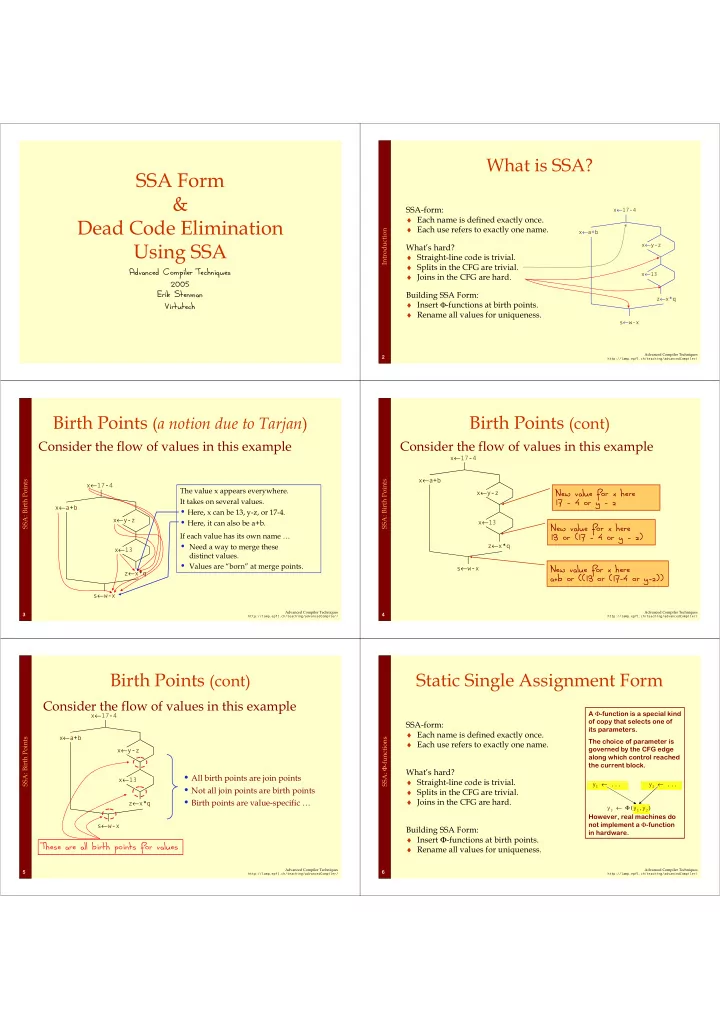
What is SSA?

SSA-form: ♦ Each name is defined exactly once. ♦ Each use refers to exactly one name. What’s hard? ♦ Straight-line code is trivial. ♦ Splits in the CFG are trivial. ♦ Joins in the CFG are hard. Building SSA Form: ♦ Insert Φ-functions at birth points. ♦ Rename all values for uniqueness.

x←17-4 x←a+b x←y-z x←13 z←x*q s←w-x

Introduction

3

Advanced Compiler Techniques http://lamp.epfl.ch/teaching/advancedCompiler/

Birth Points (a notion due to Tarjan)

Consider the flow of values in this example

The value x appears everywhere. It takes on several values.

  • Here, x can be 13, y-z, or 17-4.
  • Here, it can also be a+b.

If each value has its own name …

  • Need a way to merge these

distinct values.

  • Values are “born” at merge points.

x←17-4 x←a+b x←y-z x←13 z←x*q s←w-x SSA: Birth Points

4

Advanced Compiler Techniques http://lamp.epfl.ch/teaching/advancedCompiler/

Consider the flow of values in this example

New value for x here 17 - 4 or y - z New value for x here 13 or (17 - 4 or y - z) New value for x here a+b or ((13 or (17-4 or y-z))

Birth Points (cont)

x←17-4 x←a+b x←y-z x←13 z←x*q s←w-x SSA: Birth Points

5

Advanced Compiler Techniques http://lamp.epfl.ch/teaching/advancedCompiler/

Consider the flow of values in this example

x←17-4 x←a+b x←y-z x←13 z←x*q s←w-x

These are all birth points for values

  • All birth points are join points
  • Not all join points are birth points
  • Birth points are value-specific …

Birth Points (cont)

SSA: Birth Points

6

Advanced Compiler Techniques http://lamp.epfl.ch/teaching/advancedCompiler/

Static Single Assignment Form

SSA-form: ♦ Each name is defined exactly once. ♦ Each use refers to exactly one name. What’s hard? ♦ Straight-line code is trivial. ♦ Splits in the CFG are trivial. ♦ Joins in the CFG are hard. Building SSA Form: ♦ Insert Φ-functions at birth points. ♦ Rename all values for uniqueness.

A Φ-function is a special kind

  • f copy that selects one of

its parameters. The choice of parameter is governed by the CFG edge along which control reached the current block. However, real machines do not implement a Φ-function in hardware.

y1 ← ... y2 ← ... y3 ← Φ(y1,y2)

SSA: Φ-functions

slide-2
SLIDE 2

7

Advanced Compiler Techniques http://lamp.epfl.ch/teaching/advancedCompiler/

SSA Construction Algorithm

(High-level sketch)

1.Insert Φ-functions. 2.Rename values. … that’s all ...

… of course, there is some bookkeeping to be done ...

SSA: Construction

8

Advanced Compiler Techniques http://lamp.epfl.ch/teaching/advancedCompiler/

SSA Construction Algorithm

(Less high-level)

1.Insert Φ-functions at every join for every name. 2.Solve reaching definitions. 3.Rename each use to the def that reaches it. (will be unique)

SSA: Construction

9

Advanced Compiler Techniques http://lamp.epfl.ch/teaching/advancedCompiler/

Reaching Definitions

The equations REACHES(N0 ) = Ø REACHES(N) = ∪P∈ preds(N) DEFOUT(P) ∪ (REACHES(P) ∩ SURVIVED(P)) ♦ REACHES(N) is the set of definitions that reach block N ♦ DEFOUT(N) is the set of definitions in N that reach the end of N ♦ SURVIVED(N) is the set of definitions not obscured by a new def in N Computing REACHES(N) ♦ Use any data-flow method (i.e., the iterative method) ♦ This particular problem has a very-fast solution (Zadeck)

F.K. Zadeck, “Incremental data-flow analysis in a structured program editor,” Proceedings of the SIGPLAN 84 Conf. on Compiler Construction, June, 1984, pages 132-143.

Domain is |DEFINITIONS

DEFINITIONS|, same as

number of operations SSA: Construction – Reaching Definitions

10

Advanced Compiler Techniques http://lamp.epfl.ch/teaching/advancedCompiler/

SSA Construction Algorithm

(Less high-level)

  • 1. Insert Φ-functions at every join for every name.
  • 2. Solve reaching definitions.
  • 3. Rename each use to the def that reaches it.

(will be unique) What’s wrong with this approach? ♦ Too many Φ-functions. (precision) ♦ Too many Φ-functions. (space) ♦ Too many Φ-functions. (time) ♦ Need to relate edges to Φ-functions parameters. (bookkeeping) To do better, we need a more complex approach.

Builds maximal SSA SSA: Construction – Problems

11

Advanced Compiler Techniques http://lamp.epfl.ch/teaching/advancedCompiler/

SSA Construction Algorithm

(Less high-level)

  • 1. Insert Φ-functions

a.) calculate dominance frontiers b.) find global names

for each name, build a list of blocks that define it

c.) insert Φ-functions

∀ global name n ∀ block B in which n is defined ∀ blockD in B’s dominance frontier insert a Φ-function for n in D add D to n’s list of defining blocks

{

Creates the iterated dominance frontier This adds to the worklist ! Use a checklist to avoid putting blocks on the worklist twice; keep another checklist to avoid inserting the same Φ-function twice. Compute list of blocks where each name is assigned & use as a worklist Moderately complex SSA: Construction – Algorithm, Step 1

12

Advanced Compiler Techniques http://lamp.epfl.ch/teaching/advancedCompiler/

SSA Construction Algorithm

(Less high-level)

  • 2. Rename variables in a pre-order walk over dominator tree

(use an array of stacks, one stack per global name)

Staring with the root block, B a.) generate unique names for each Φ-function

and push them on the appropriate stacks

b.) rewrite each operation in the block

  • i. Rewrite uses of global names with the current version

(from the stack)

  • ii. Rewrite definition by inventing & pushing new name

c.) fill in Φ-function parameters of successor blocks d.) recurse on B ’s children in the dominator tree e.) <on exit from block B > pop names generated in B from stacks

1 counter per name for subscripts Need the end-of- block name for this path Reset the state SSA: Construction – Algorithm, Step 2

slide-3
SLIDE 3

13

Advanced Compiler Techniques http://lamp.epfl.ch/teaching/advancedCompiler/

Aside on Terminology: Dominators

Definitions

X dominates Y if and only if every path from the entry of the control-flow graph to the node for Y includes X

♦ By definition, X dominates X ♦ We associate a set of dominators (Dom) with each node ♦ |Dom(x)| ≥ 1 Immediate dominators ♦ For any node X, there must be aY in Dom(X) closest to X ♦ We call this Y the immediate dominator of X ♦ As a matter of notation, we write this as IDom(X)

Terminology: Dominators

14

Advanced Compiler Techniques http://lamp.epfl.ch/teaching/advancedCompiler/

Dominators (cont)

Dominators have many uses in program analysis & transformation: ♦ Finding loops. ♦ Building SSA form. ♦ Making code motion decisions. A B C G F E D

Dominator tree

Block Dom IDom A A – B A,B A C A,C A D A,C,D C E A,C,E C F A,C,F C G A,G A

Dominator sets

m0 ← a + b n0 ← a + b A p0 ← c + d r0 ← c + d B r2 ← φ(r0,r1) y0 ← a + b z0 ← c + d G q0 ← a + b r1 ← c + d C e0 ← b + 18 s0 ← a + b u0 ← e + f D e1 ← a + 17 t0 ← c + d u1 ← e + f E e3 ← φ(e0,e1) u2 ← φ(u0,u1) v0 ← a + b w0 ← c + d x0 ← e + f F

Let’s look at how to compute dominators…

Dominators

15

Advanced Compiler Techniques http://lamp.epfl.ch/teaching/advancedCompiler/

SSA Construction Algorithm (Low-level detail)

Computing Dominance ♦ First step in Φ-function insertion computes dominance. ♦ A node N dominates M iff N is on every path from N0 to M

♦ Every node dominates itself ♦ N ’s immediate dominator is its closest dominator, IDOM(N)†

DOM(N0) = {N0 } DOM(N) = {N} ∪ (∩P∈ preds(N) DOM(P)) Computing DOM ♦ These equations form a rapid data-flow framework ♦ Iterative algorithm will solve them in d(G) + 3 passes

♦ Each pass does |N| unions & |E| intersections, ♦ E is O(N 2) ⇒ O(N 2) work †IDOM(N ) ≠ N, unless N is N0 , by convention.

Initially, DOM(n) = N, ∀ n≠n0 d(G) is the loop-connectedness of the graph w.r.t a DFST

  • Maximal number of back edges in an acyclic path.
  • Several studies suggest that, in practice, d(G) is small. ( <3)
  • For most CFGs, d(G) is independent of the specific DFST.

SSA: Construction –1.a Compute Dominance Frontiers

16

Advanced Compiler Techniques http://lamp.epfl.ch/teaching/advancedCompiler/

Example

B1 B2 B3 B4 B5 B6 B7 B0 Control Flow Graph Progress of iterative solution for DOM Results of iterative solution for DOM & IDOM

Iter- ation 0 1 2 3 4 5 6 7 N N N N N N N 1 0 0,1 0,1,2 0,1,3 0,1,3,4 0,1,3,5 0,1,3,6 0,1,7 2 0 0,1 0,1,2 0,1,3 0,1,3,4 0,1,3,5 0,1,3,6 0,1,7 DOM(n ) 1 2 3 4 5 6 7 DOM 0 0,1 0,1,2 0,1,3 0,1,3,4 0,1,3,5 0,1,3,6 0,1,7 IDOM 0 1 1 3 3 3 1

SSA: Construction –1.a Compute Dominance Frontiers

17

Advanced Compiler Techniques http://lamp.epfl.ch/teaching/advancedCompiler/

Example

Dominance Tree B1 B2 B3 B4 B5 B6 B7 B0 Progress of iterative solution for DOM Results of iterative solution for DOM & IDOM

Iter- ation 0 1 2 3 4 5 6 7 N N N N N N N 1 0 0,1 0,1,2 0,1,3 0,1,3,4 0,1,3,5 0,1,3,6 0,1,7 2 0 0,1 0,1,2 0,1,3 0,1,3,4 0,1,3,5 0,1,3,6 0,1,7 DOM(n ) 1 2 3 4 5 6 7 DOM 0 0,1 0,1,2 0,1,3 0,1,3,4 0,1,3,5 0,1,3,6 0,1,7 IDOM 0 1 1 3 3 3 1

SSA: Construction –1.a Compute Dominance Frontiers

18

Advanced Compiler Techniques http://lamp.epfl.ch/teaching/advancedCompiler/

B1 B2 B3 B4 B5 B6 B7 B0

Example

Dominance Frontiers

Dominance Frontiers & Φ-Function Insertion

  • A definition at N forces a Φ-function at M iff

N ∉ DOM(M) but N ∈ DOM(P) for some P ∈ preds(M)

  • DF(N ) is the fringe just beyond the region that N

dominates.

1 2 3 4 5 6 7 DOM 0 0,1 0,1,2 0,1,3 0,1,3,4 0,1,3,5 0,1,3,6 0,1,7 DF – – 7 7 6 6 7 1

  • ← in B1 forces a Φ-function in DF(B1) = Ø

(halt ) x← ...

x← Φ(...)

  • DF(B4) is {B6}, so ← in B4 forces a Φ-function in B6

x← Φ(...)

  • ← in B6 forces a Φ-function in DF(B6) = {B7}

x← Φ(...)

  • ← in B7 forces a Φ-function in DF(B7) = {B1}

For each assignment, we insert the Φ-functions SSA: Construction –1.c insert Φ-functions

slide-4
SLIDE 4

19

Advanced Compiler Techniques http://lamp.epfl.ch/teaching/advancedCompiler/

Example

Computing Dominance Frontiers

  • Only join points are in DF(N ) for some N
  • Leads to a simple, intuitive algorithm for computing

dominance frontiers For each join point M (i.e., |preds(M)| > 1) For each CFG predecessor of M Run up to IDOM(M) in the dominator tree, adding M to DF(N) for each N between M and IDOM(M)

  • For some applications, we need post-dominance, the

post-dominator tree, and reverse dominance frontiers, RDF(N)

> Just dominance on the reverse CFG > Reverse the edges & add unique exit node

  • We will use these in dead code elimination

1 2 3 4 5 6 7 DOM 0 0,1 0,1,2 0,1,3 0,1,3,4 0,1,3,5 0,1,3,6 0,1,7 DF – – 7 7 6 6 7 1

B1 B2 B3 B4 B5 B6 B7 B0 Dominance Frontiers SSA: Construction –1.a Compute Dominance Frontiers

20

Advanced Compiler Techniques http://lamp.epfl.ch/teaching/advancedCompiler/

SSA Construction Algorithm (Reminder)

  • 1. Insert Φ-functions at every join for every name

a.) calculate dominance frontiers b.) find global names

for each name, build a list of blocks that define it

c.) insert Φ-functions

∀ global name n ∀ block B in which n is defined ∀ blockD in B’s dominance frontier insert a Φ-function for n in D add D to n’s list of defining blocks

Needs a little more detail SSA: Construction –1.b find global names

21

Advanced Compiler Techniques http://lamp.epfl.ch/teaching/advancedCompiler/

SSA Construction Algorithm

Finding global names

♦ Different between two forms of SSA ♦ Minimal uses all names ♦ Semi-pruned SSA uses names that are live on entry to some block

♦ Shrinks name space & number of Φ-functions ♦ Pays for itself in compile-time speed

♦ For each “global name”, need a list of blocks where it is defined

♦ Drives Φ-function insertion ♦

B defines x implies a Φ-function for x in every C ∈ DF(B)

Pruned SSA adds a test to see if x is live at insertion point

Otherwise, we do not need a Φ-function SSA: Construction –1.b find global names With all the Φ-functions

  • Lots of new ops
  • Renaming is next

Assume a, b, c, & d defined before B0

Example

Excluding local names avoids Φ’s for y & z

a ← Φ(a,a) b ← Φ(b,b) c ← Φ(c,c) d ← Φ(d,d) y ← a+b z ← c+d i ← i+1 B7 i > 100 i ← ••• B0 b ← ••• c ← ••• d ← ••• B2 a ← Φ(a,a) b ← Φ(b,b) c ← Φ(c,c) d ← Φ(d,d) i ← Φ(i,i) a ← ••• c ← ••• B1 a ← ••• d ← ••• B3 d ← ••• B4 c ← ••• B5 d ← Φ(d,d) c ← Φ(c,c) b ← ••• B6 i > 100 23

Advanced Compiler Techniques http://lamp.epfl.ch/teaching/advancedCompiler/

SSA Construction Algorithm

(Less high-level)

  • 2. Rename variables in a pre-order walk over dominator tree

(use an array of stacks, one stack per global name)

Staring with the root block, B a.) generate unique names for each Φ-function

and push them on the appropriate stacks

b.) rewrite each operation in the block

  • i. Rewrite uses of global names with the current version

(from the stack)

  • ii. Rewrite definition by inventing & pushing new name

c.) fill in Φ-function parameters of successor blocks d.) recurse on B’s children in the dominator tree e.) <on exit from block B > pop names generated in B from stacks

SSA: Construction –2 Rename variables

24

Advanced Compiler Techniques http://lamp.epfl.ch/teaching/advancedCompiler/

SSA Construction Algorithm

(Less high-level)

NewName(v) i ← counter[v] counter[v] ← counter[v] + 1 push vi onto stack[v] return return vi Rename( B ) for each Φ-function in B, x ← Φ(…) (…) rename x as NewName( x) for each operation “x←y op

  • p z” in B

rewrite y as top(stack[y]) rewrite z as top(stack[z]) rewrite x as NewName( x) for each successor of B in the CFG rewrite appropriate Φ parameters for each successor S of B in dom. tree Rename(S) for each operation “x←y op

  • p z” in B

pop(stack[x])

Adding all the details ...

for each global name i counter[i] ← 0 stack[i] ← Ø call Rename( B0 ) SSA: Construction –2 Rename variables

slide-5
SLIDE 5

25

Advanced Compiler Techniques http://lamp.epfl.ch/teaching/advancedCompiler/

Counters Stacks 1 1 1 1 a

a0 b0 c0 d0

Before processing B0

b c d i Assume a, b, c, & d defined before B0 i has not been defined

a ← Φ(a,a) b ← Φ(b,b) c ← Φ(c,c) d ← Φ(d,d) y ← a+b z ← c+d i ← i+1 B7 i > 100 i ← ••• B0 b ← ••• c ← ••• d ← ••• B2 a ← Φ(a,a) b ← Φ(b,b) c ← Φ(c,c) d ← Φ(d,d) i ← Φ(i,i) a ← ••• c ← ••• B1 a ← ••• d ← ••• B3 d ← ••• B4 c ← ••• B5 d ← Φ(d,d) c ← Φ(c,c) b ← ••• B6 i > 100

Example

SSA: Construction –2 Rename variables

26

Advanced Compiler Techniques http://lamp.epfl.ch/teaching/advancedCompiler/

Counters Stacks 1 1 1 1 1 a

a0 b0 c0 d0

b c d i

a ← Φ(a,a) b ← Φ(b,b) c ← Φ(c,c) d ← Φ(d,d) y ← a+b z ← c+d i ← i+1 B7 i > 100 i0 ← ••• B0 b ← ••• c ← ••• d ← ••• B2 a ← Φ(a0,a) b ← Φ(b0,b) c ← Φ(c0,c) d ← Φ(d0,d) i ← Φ(i0,i) a ← ••• c ← ••• B1 a ← ••• d ← ••• B3 d ← ••• B4 c ← ••• B5 d ← Φ(d,d) c ← Φ(c,c) b ← ••• B6 i > 100

Example

End of B0

i0

SSA: Construction –2 Rename variables

27

Advanced Compiler Techniques http://lamp.epfl.ch/teaching/advancedCompiler/

Counters Stacks 3 2 3 2 2 a

a0 b0 c0 d0

b c d i

a ← Φ(a,a) b ← Φ(b,b) c ← Φ(c,c) d ← Φ(d,d) y ← a+b z ← c+d i ← i+1 B7 i > 100 i0 ← ••• B0 b ← ••• c ← ••• d ← ••• B2 a1 ← Φ(a0,a) b1 ← Φ(b0,b) c1 ← Φ(c0,c) d1 ← Φ(d0,d) i1 ← Φ(i0,i) a2 ← ••• c2 ← ••• B1 a ← ••• d ← ••• B3 d ← ••• B4 c ← ••• B5 d ← Φ(d,d) c ← Φ(c,c) b ← ••• B6 i > 100

Example

End of B1

i0 a1 b1 c1 d1 i1 a2 c2

SSA: Construction –2 Rename variables

28

Advanced Compiler Techniques http://lamp.epfl.ch/teaching/advancedCompiler/

Counters Stacks 3 3 4 3 2 a

a0 b0 c0 d0

b c d i

a ← Φ(a2,a) b ← Φ(b2,b) c ← Φ(c3,c) d ← Φ(d2,d) y ← a+b z ← c+d i ← i+1 B7 i > 100 i0 ← ••• B0 b2 ← ••• c3 ← ••• d2 ← ••• B2 a1 ← Φ(a0,a) b1 ← Φ(b0,b) c1 ← Φ(c0,c) d1 ← Φ(d0,d) i1 ← Φ(i0,i) a2 ← ••• c2 ← ••• B1 a ← ••• d ← ••• B3 d ← ••• B4 c ← ••• B5 d ← Φ(d,d) c ← Φ(c,c) b ← ••• B6 i > 100

Example

End of B2

i0 a1 b1 c1 d1 i1 a2 c2 b2 d2 c3

SSA: Construction –2 Rename variables

29

Advanced Compiler Techniques http://lamp.epfl.ch/teaching/advancedCompiler/

Counters Stacks 3 3 4 3 2 a

a0 b0 c0 d0

b c d i

a ← Φ(a2,a) b ← Φ(b2,b) c ← Φ(c3,c) d ← Φ(d2,d) y ← a+b z ← c+d i ← i+1 B7 i > 100 i0 ← ••• B0 b2 ← ••• c3 ← ••• d2 ← ••• B2 a1 ← Φ(a0,a) b1 ← Φ(b0,b) c1 ← Φ(c0,c) d1 ← Φ(d0,d) i1 ← Φ(i0,i) a2 ← ••• c2 ← ••• B1 a ← ••• d ← ••• B3 d ← ••• B4 c ← ••• B5 d ← Φ(d,d) c ← Φ(c,c) b ← ••• B6 i > 100

Example

Before starting B3

i0 a1 b1 c1 d1 i1 a2 c2

SSA: Construction –2 Rename variables

30

Advanced Compiler Techniques http://lamp.epfl.ch/teaching/advancedCompiler/

Counters Stacks 4 3 4 4 2 a

a0 b0 c0 d0

b c d i

a ← Φ(a2,a) b ← Φ(b2,b) c ← Φ(c3,c) d ← Φ(d2,d) y ← a+b z ← c+d i ← i+1 B7 i > 100 i0 ← ••• B0 b2 ← ••• c3 ← ••• d2 ← ••• B2 a1 ← Φ(a0,a) b1 ← Φ(b0,b) c1 ← Φ(c0,c) d1 ← Φ(d0,d) i1 ← Φ(i0,i) a2 ← ••• c2 ← ••• B1 a3 ← ••• d3 ← ••• B3 d ← ••• B4 c ← ••• B5 d ← Φ(d,d) c ← Φ(c,c) b ← ••• B6 i > 100

Example

End of B3

i0 a1 b1 c1 d1 i1 a2 c2 a3 d3

SSA: Construction –2 Rename variables

slide-6
SLIDE 6

31

Advanced Compiler Techniques http://lamp.epfl.ch/teaching/advancedCompiler/

Counters Stacks 4 3 4 5 2 a

a0 b0 c0 d0

b c d i

a ← Φ(a2,a) b ← Φ(b2,b) c ← Φ(c3,c) d ← Φ(d2,d) y ← a+b z ← c+d i ← i+1 B7 i > 100 i0 ← ••• B0 b2 ← ••• c3 ← ••• d2 ← ••• B2 a1 ← Φ(a0,a) b1 ← Φ(b0,b) c1 ← Φ(c0,c) d1 ← Φ(d0,d) i1 ← Φ(i0,i) a2 ← ••• c2 ← ••• B1 a3 ← ••• d3 ← ••• B3 d4 ← ••• B4 c ← ••• B5 d ← Φ(d4,d) c ← Φ(c2,c) b ← ••• B6 i > 100

Example

End of B4

i0 a1 b1 c1 d1 i1 a2 c2 a3 d3 d4

SSA: Construction –2 Rename variables

32

Advanced Compiler Techniques http://lamp.epfl.ch/teaching/advancedCompiler/

Counters Stacks 4 3 5 5 2 a

a0 b0 c0 d0

b c d i

a ← Φ(a2,a) b ← Φ(b2,b) c ← Φ(c3,c) d ← Φ(d2,d) y ← a+b z ← c+d i ← i+1 B7 i > 100 i0 ← ••• B0 b2 ← ••• c3 ← ••• d2 ← ••• B2 a1 ← Φ(a0,a) b1 ← Φ(b0,b) c1 ← Φ(c0,c) d1 ← Φ(d0,d) i1 ← Φ(i0,i) a2 ← ••• c2 ← ••• B1 a3 ← ••• d3 ← ••• B3 d4 ← ••• B4 c4 ← ••• B5 d ← Φ(d4,d3) c ← Φ(c2,c4) b ← ••• B6 i > 100

Example

End of B5

i0 a1 b1 c1 d1 i1 a2 c2 a3 d3 c4

SSA: Construction –2 Rename variables

33

Advanced Compiler Techniques http://lamp.epfl.ch/teaching/advancedCompiler/

Counters Stacks 4 4 6 6 2 a

a0 b0 c0 d0

b c d i

a ← Φ(a2,a3) b ← Φ(b2,b3) c ← Φ(c3,c5) d ← Φ(d2,d5) y ← a+b z ← c+d i ← i+1 B7 i > 100 i0 ← ••• B0 b2 ← ••• c3 ← ••• d2 ← ••• B2 a1 ← Φ(a0,a) b1 ← Φ(b0,b) c1 ← Φ(c0,c) d1 ← Φ(d0,d) i1 ← Φ(i0,i) a2 ← ••• c2 ← ••• B1 a3 ← ••• d3 ← ••• B3 d4 ← ••• B4 c4 ← ••• B5 d5 ← Φ(d4,d3) c5 ← Φ(c2,c4) b3 ← ••• B6 i > 100

Example

End of B6

i0 a1 b1 c1 d1 i1 a2 c2 a3 d3 c5 d5 b3

SSA: Construction –2 Rename variables

34

Advanced Compiler Techniques http://lamp.epfl.ch/teaching/advancedCompiler/

Counters Stacks 4 4 6 6 2 a

a0 b0 c0 d0

b c d i

a ← Φ(a2,a3) b ← Φ(b2,b3) c ← Φ(c3,c5) d ← Φ(d2,d5) y ← a+b z ← c+d i ← i+1 B7 i > 100 i0 ← ••• B0 b2 ← ••• c3 ← ••• d2 ← ••• B2 a1 ← Φ(a0,a) b1 ← Φ(b0,b) c1 ← Φ(c0,c) d1 ← Φ(d0,d) i1 ← Φ(i0,i) a2 ← ••• c2 ← ••• B1 a3 ← ••• d3 ← ••• B3 d4 ← ••• B4 c4 ← ••• B5 d5 ← Φ(d4,d3) c5 ← Φ(c2,c4) b3 ← ••• B6 i > 100

Example

Before B7

i0 a1 b1 c1 d1 i1 a2 c2

SSA: Construction –2 Rename variables

35

Advanced Compiler Techniques http://lamp.epfl.ch/teaching/advancedCompiler/

Counters Stacks 5 5 7 7 3 a

a0 b0 c0 d0

b c d i

a4 ← Φ(a2,a3) b4 ← Φ(b2,b3) c6 ← Φ(c3,c5) d6 ← Φ(d2,d5) y ← a4+b4 z ← c6+d6 i2 ← i1+1 B7 i > 100 i0 ← ••• B0 b2 ← ••• c3 ← ••• d2 ← ••• B2 a1 ← Φ(a0,a4) b1 ← Φ(b0,b4) c1 ← Φ(c0,c6) d1 ← Φ(d0,d6) i1 ← Φ(i0,i2) a2 ← ••• c2 ← ••• B1 a3 ← ••• d3 ← ••• B3 d4 ← ••• B4 c4 ← ••• B5 d5 ← Φ(d4,d3) c5 ← Φ(c2,c4) b3 ← ••• B6 i > 100

Example

End of B7

i0 a1 b1 c1 d1 i1 a2 c2 a4 b4 c6 d6 i2

SSA: Construction –2 Rename variables

36

Advanced Compiler Techniques http://lamp.epfl.ch/teaching/advancedCompiler/

Counters Stacks

a4 ← Φ(a2,a3) b4 ← Φ(b2,b3) c6 ← Φ(c3,c5) d6 ← Φ(d2,d5) y ← a4+b4 z ← c6+d6 i2 ← i1+1 B7 i > 100 i0 ← ••• B0 b2 ← ••• c3 ← ••• d2 ← ••• B2 a1 ← Φ(a0,a4) b1 ← Φ(b0,b4) c1 ← Φ(c0,c6) d1 ← Φ(d0,d6) i1 ← Φ(i0,i2) a2 ← ••• c2 ← ••• B1 a3 ← ••• d3 ← ••• B3 d4 ← ••• B4 c4 ← ••• B5 d5 ← Φ(d4,d3) c5 ← Φ(c2,c4) b3 ← ••• B6 i > 100

Example

After renaming

  • Semi-pruned SSA form
  • We’re done …

Semi-pruned ⇒ only names live in 2 or more blocks are “global names”. SSA: Construction –2 Rename variables

slide-7
SLIDE 7

37

Advanced Compiler Techniques http://lamp.epfl.ch/teaching/advancedCompiler/

SSA Construction Algorithm

(Pruned SSA)

What’s this “pruned SSA” stuff? ♦ Minimal SSA still contains extraneous Φ-functions. ♦ Inserts some Φ-functions where they are dead. ♦ Would like to avoid inserting them. Two ideas ♦ Semi-pruned SSA: discard names used in only one block.

♦ Significant reduction in total number of Φ-functions. ♦ Needs only local liveness information.

(cheap to compute)

♦ Pruned SSA: only insert Φ-functions where their value is live.

♦ Inserts even fewer Φ-functions, but costs more to do. ♦ Requires global live variable analysis.

(more expensive)

In practice, both are simple modifications to step 1.

SSA: Construction – Conclusion

38

Advanced Compiler Techniques http://lamp.epfl.ch/teaching/advancedCompiler/

SSA Construction Algorithm

We can improve the stack management. ♦ Push at most one name per stack per block. (save push & pop) ♦ Thread names together by block. ♦ To pop names for block B, use B’s thread. This is a good use for a scoped hash table. ♦ Significant reductions in pops and pushes. ♦ Makes a minor difference in SSA construction time. ♦ Scoped table is a clean, clear way to handle the problem.

SSA: Construction – Improvements

39

Advanced Compiler Techniques http://lamp.epfl.ch/teaching/advancedCompiler/

SSA Deconstruction

At some point, we need executable code. ♦ Few machines implement Φ operations. ♦ Need to fix up the flow of values. Basic idea. ♦ Insert copies Φ-function pred’s. ♦ Simple algorithm.

♦ Works in most cases.

♦ Adds lots of copies.

♦ Most of them coalesce away. X17← Φ(x10,x11) ... ← x17 ... ... ... ← x17 X17 ← x10 X17 ← x11

SSA: Deconstruction

40

Advanced Compiler Techniques http://lamp.epfl.ch/teaching/advancedCompiler/

Dead Code Elimination Using SSA

Dead code elimination ♦ Conceptually similar to mark-sweep garbage collection:

♦ Mark useful operations. ♦ Everything not marked is useless.

♦ Need an efficient way to find and to mark useful operations.

♦ Start with critical operations. ♦ Work back up SSA edges to find their antecedents.

♦ Operations defined as critical:

♦ I/O statements, ♦ linkage code (entry & exit blocks), ♦ return values, ♦ calls to other procedures.

Algorithm will use post-dominators & reverse dominance frontiers.

Dead Code Elimination

41

Advanced Compiler Techniques http://lamp.epfl.ch/teaching/advancedCompiler/

Dead Code Elimination Using SSA

Mark for each op i clear i’s mark if i is critical then mark i add i to WorkList while (Worklist ≠ Ø) remove i from WorkList (i has form “x←y op z” ) if def(y) is not marked then mark def(y) add def(y) to WorkList if def(z) is not marked then mark def(z) add def(z) to WorkList for each b ∈ RDF(block(i)) mark the block-ending branch in b add it to WorkList Sweep for each op i if i is not marked then if i is a branch then rewrite with a jump to i’s nearest useful post-dominator if i is not a jump then delete i Notes:

  • Eliminates some branches.
  • Reconnects dead branches to the

remaining live code.

  • Find useful post-dominator by walking

post-dominator tree.

> Entry & exit nodes are useful

Dead Code Elimination

42

Advanced Compiler Techniques http://lamp.epfl.ch/teaching/advancedCompiler/

Dead Code Elimination Using SSA

Handling Branches ♦ When is a branch useful?

♦ When another useful operation depends on its existence

♦ j control dependent on i ⇒ one path from i leads to j, one doesn’t ♦ This is the reverse dominance frontier of j (RDF(j)) Algorithm uses RDF(n) to mark branches as live In the CFG, j is control dependent on i if

  • 1. ∃ a non-null path p from i to j such that j post-

dominates every node on p after i

  • 2. j does not strictly post-dominate i

Dead Code Elimination

slide-8
SLIDE 8

43

Advanced Compiler Techniques http://lamp.epfl.ch/teaching/advancedCompiler/

Dead Code Elimination Using SSA

Mark for each op i clear i’s mark if i is critical then mark i add i to WorkList while (Worklist ≠ Ø) remove i from WorkList (i has form “x←y op z” ) if def(y) is not marked then mark def(y) add def(y) to WorkList if def(z) is not marked then mark def(z) add def(z) to WorkList for each b ∈ RDF(block(i)) mark the block-ending branch in b add it to WorkList Dead Code Elimination 1:x=17+a; 2:y=a; 3:i1=0; 4:x==0 5:b2=x+1; 11:b6=Φ(b2,b5) 12:c2=Φ(c1,c1,c3) 13:i3=Φ(i1,i2,i4) 14:i3<n 15:c3=c2+y; 16:i4=i3+1; 17:return c2 9:b5=Φ(b3,b4) 10:i2=y; 6:x==1 7:b3=x+2; 8:b4=x+3; a,b1,c1,n

Skip Example

44

Advanced Compiler Techniques http://lamp.epfl.ch/teaching/advancedCompiler/

Dead Code Elimination Using SSA

Mark for each op i clear i’s mark if i is critical then mark i add i to WorkList while (Worklist ≠ Ø) remove i from WorkList (i has form “x←y op z” ) if def(y) is not marked then mark def(y) add def(y) to WorkList if def(z) is not marked then mark def(z) add def(z) to WorkList for each b ∈ RDF(block(i)) mark the block-ending branch in b add it to WorkList Dead Code Elimination 1:x=17+a; 2:y=a; 3:i1=0; 4:x==0 5:b2=x+1; 11:b6=Φ(b2,b5) 12:c2=Φ(c1,c1,c3) 13:i3=Φ(i1,i2,i4) 14:i3<n 15:c3=c2+y; 16:i4=i3+1; 17:return c2 9:b5=Φ(b3,b4) 10:i2=y; 6:x==1 7:b3=x+2; 8:b4=x+3; a,b1,c1,n

WorkList

17

45

Advanced Compiler Techniques http://lamp.epfl.ch/teaching/advancedCompiler/

Mark for each op i clear i’s mark if i is critical then mark i add i to WorkList while (Worklist ≠ Ø) remove i from WorkList (i has form “op z” ) if def(y) is not marked then mark def(y) add def(y) to WorkList if def(z) is not marked then mark def(z) add def(z) to WorkList for each b ∈ RDF(block(i)) mark the block-ending branch in b add it to WorkList

Dead Code Elimination Using SSA

Dead Code Elimination 1:x=17+a; 2:y=a; 3:i1=0; 4:x==0 5:b2=x+1; 11:b6=Φ(b2,b5) 12:c2=Φ(c1,c1,c3) 13:i3=Φ(i1,i2,i4) 14:i3<n 15:c3=c2+y; 16:i4=i3+1; 17:return c2 9:b5=Φ(b3,b4) 10:i2=y; 6:x==1 7:b3=x+2; 8:b4=x+3; a,b1,c1,n

WorkList

17

i=17

46

Advanced Compiler Techniques http://lamp.epfl.ch/teaching/advancedCompiler/

Mark for each op i clear i’s mark if i is critical then mark i add i to WorkList while (Worklist ≠ Ø) remove i from WorkList (i has form “op z” ) if def(y) is not marked then mark def(y) add def(y) to WorkList if def(z) is not marked then mark def(z) add def(z) to WorkList for each b ∈ RDF(block(i)) mark the block-ending branch in b add it to WorkList

Dead Code Elimination Using SSA

Dead Code Elimination 1:x=17+a; 2:y=a; 3:i1=0; 4:x==0 5:b2=x+1; 11:b6=Φ(b2,b5) 12:c2=Φ(c1,c1,c3) 13:i3=Φ(i1,i2,i4) 14:i3<n 15:c3=c2+y; 16:i4=i3+1; 17:return c2 9:b5=Φ(b3,b4) 10:i2=y; 6:x==1 7:b3=x+2; 8:b4=x+3; a,b1,c1,n

WorkList i=17

47

Advanced Compiler Techniques http://lamp.epfl.ch/teaching/advancedCompiler/

Mark for each op i clear i’s mark if i is critical then mark i add i to WorkList while (Worklist ≠ Ø) remove i from WorkList (i has form “op z” ) if def(y) is not marked then mark def(y) add def(y) to WorkList if def(z) is not marked then mark def(z) add def(z) to WorkList for each b ∈ RDF(block(i)) mark the block-ending branch in b add it to WorkList

Dead Code Elimination Using SSA

Dead Code Elimination 1:x=17+a; 2:y=a; 3:i1=0; 4:x==0 5:b2=x+1; 11:b6=Φ(b2,b5) 12:c2=Φ(c1,c1,c3) 13:i3=Φ(i1,i2,i4) 14:i3<n 15:c3=c2+y; 16:i4=i3+1; 17:return c2 9:b5=Φ(b3,b4) 10:i2=y; 6:x==1 7:b3=x+2; 8:b4=x+3; a,b1,c1,n

WorkList

12

i=17

48

Advanced Compiler Techniques http://lamp.epfl.ch/teaching/advancedCompiler/

Mark for each op i clear i’s mark if i is critical then mark i add i to WorkList while (Worklist ≠ Ø) remove i from WorkList (i has form “op z” ) if def(y) is not marked then mark def(y) add def(y) to WorkList if def(z) is not marked then mark def(z) add def(z) to WorkList for each b ∈ RDF(block(i)) mark the block-ending branch in b add it to WorkList

Dead Code Elimination Using SSA

Dead Code Elimination 1:x=17+a; 2:y=a; 3:i1=0; 4:x==0 5:b2=x+1; 11:b6=Φ(b2,b5) 12:c2=Φ(c1,c1,c3) 13:i3=Φ(i1,i2,i4) 14:i3<n 15:c3=c2+y; 16:i4=i3+1; 17:return c2 9:b5=Φ(b3,b4) 10:i2=y; 6:x==1 7:b3=x+2; 8:b4=x+3; a,b1,c1,n

WorkList

12

i=17

slide-9
SLIDE 9

49

Advanced Compiler Techniques http://lamp.epfl.ch/teaching/advancedCompiler/

Mark for each op i clear i’s mark if i is critical then mark i add i to WorkList while (Worklist ≠ Ø) remove i from WorkList (i has form “x←y op z” ) if def(y) is not marked then mark def(y) add def(y) to WorkList if def(z) is not marked then mark def(z) add def(z) to WorkList for each b ∈ RDF(block(i)) mark the block-ending branch in b add it to WorkList

Dead Code Elimination Using SSA

Dead Code Elimination 1:x=17+a; 2:y=a; 3:i1=0; 4:x==0 5:b2=x+1; 11:b6=Φ(b2,b5) 12:c2=Φ(c1,c1,c3) 13:i3=Φ(i1,i2,i4) 14:i3<n 15:c3=c2+y; 16:i4=i3+1; 17:return c2 9:b5=Φ(b3,b4) 10:i2=y; 6:x==1 7:b3=x+2; 8:b4=x+3; a,b1,c1,n

WorkList

12

i=12

50

Advanced Compiler Techniques http://lamp.epfl.ch/teaching/advancedCompiler/

Mark for each op i clear i’s mark if i is critical then mark i add i to WorkList while (Worklist ≠ Ø) remove i from WorkList (i has form “x←y op z” ) if def(y) is not marked then mark def(y) add def(y) to WorkList if def(z) is not marked then mark def(z) add def(z) to WorkList for each b ∈ RDF(block(i)) mark the block-ending branch in b add it to WorkList

Dead Code Elimination Using SSA

Dead Code Elimination 1:x=17+a; 2:y=a; 3:i1=0; 4:x==0 5:b2=x+1; 11:b6=Φ(b2,b5) 12:c2=Φ(c1,c1,c3) 13:i3=Φ(i1,i2,i4) 14:i3<n 15:c3=c2+y; 16:i4=i3+1; 17:return c2 9:b5=Φ(b3,b4) 10:i2=y; 6:x==1 7:b3=x+2; 8:b4=x+3; a,b1,c1,n

WorkList i=12

51

Advanced Compiler Techniques http://lamp.epfl.ch/teaching/advancedCompiler/

Mark for each op i clear i’s mark if i is critical then mark i add i to WorkList while (Worklist ≠ Ø) remove i from WorkList (i has form “x←y op z” ) if def(y) is not marked then mark def(y) add def(y) to WorkList if def(z) is not marked then mark def(z) add def(z) to WorkList for each b ∈ RDF(block(i)) mark the block-ending branch in b add it to WorkList

Dead Code Elimination Using SSA

Dead Code Elimination 1:x=17+a; 2:y=a; 3:i1=0; 4:x==0 5:b2=x+1; 11:b6=Φ(b2,b5) 12:c2=Φ(c1,c1,c3) 13:i3=Φ(i1,i2,i4) 14:i3<n 15:c3=c2+y; 16:i4=i3+1; 17:return c2 9:b5=Φ(b3,b4) 10:i2=y; 6:x==1 7:b3=x+2; 8:b4=x+3; a,b1,c1,n

WorkList i=12

52

Advanced Compiler Techniques http://lamp.epfl.ch/teaching/advancedCompiler/

Mark for each op i clear i’s mark if i is critical then mark i add i to WorkList while (Worklist ≠ Ø) remove i from WorkList (i has form “x←y op z” ) if def(y) is not marked then mark def(y) add def(y) to WorkList if def(z) is not marked then mark def(z) add def(z) to WorkList for each b ∈ RDF(block(i)) mark the block-ending branch in b add it to WorkList

Dead Code Elimination Using SSA

Dead Code Elimination 1:x=17+a; 2:y=a; 3:i1=0; 4:x==0 5:b2=x+1; 11:b6=Φ(b2,b5) 12:c2=Φ(c1,c1,c3) 13:i3=Φ(i1,i2,i4) 14:i3<n 15:c3=c2+y; 16:i4=i3+1; 17:return c2 9:b5=Φ(b3,b4) 10:i2=y; 6:x==1 7:b3=x+2; 8:b4=x+3; a,b1,c1,n

WorkList

15

i=12

53

Advanced Compiler Techniques http://lamp.epfl.ch/teaching/advancedCompiler/

Mark for each op i clear i’s mark if i is critical then mark i add i to WorkList while (Worklist ≠ Ø) remove i from WorkList (i has form “x←y op z” ) if def(y) is not marked then mark def(y) add def(y) to WorkList if def(z) is not marked then mark def(z) add def(z) to WorkList for each b ∈ RDF(block(i)) mark the block-ending branch in b add it to WorkList

Dead Code Elimination Using SSA

Dead Code Elimination 1:x=17+a; 2:y=a; 3:i1=0; 4:x==0 5:b2=x+1; 11:b6=Φ(b2,b5) 12:c2=Φ(c1,c1,c3) 13:i3=Φ(i1,i2,i4) 14:i3<n 15:c3=c2+y; 16:i4=i3+1; 17:return c2 9:b5=Φ(b3,b4) 10:i2=y; 6:x==1 7:b3=x+2; 8:b4=x+3; a,b1,c1,n

WorkList

15

i=12

54

Advanced Compiler Techniques http://lamp.epfl.ch/teaching/advancedCompiler/

Mark for each op i clear i’s mark if i is critical then mark i add i to WorkList while (Worklist ≠ Ø) remove i from WorkList (i has form “x←y op z” ) if def(y) is not marked then mark def(y) add def(y) to WorkList if def(z) is not marked then mark def(z) add def(z) to WorkList for each b ∈ RDF(block(i)) mark the block-ending branch in b add it to WorkList

Dead Code Elimination Using SSA

Dead Code Elimination 1:x=17+a; 2:y=a; 3:i1=0; 4:x==0 5:b2=x+1; 11:b6=Φ(b2,b5) 12:c2=Φ(c1,c1,c3) 13:i3=Φ(i1,i2,i4) 14:i3<n 15:c3=c2+y; 16:i4=i3+1; 17:return c2 9:b5=Φ(b3,b4) 10:i2=y; 6:x==1 7:b3=x+2; 8:b4=x+3; a,b1,c1,n

WorkList

15

i=15

slide-10
SLIDE 10

55

Advanced Compiler Techniques http://lamp.epfl.ch/teaching/advancedCompiler/

Mark for each op i clear i’s mark if i is critical then mark i add i to WorkList while (Worklist ≠ Ø) remove i from WorkList (i has form “x←y op z” ) if def(y) is not marked then mark def(y) add def(y) to WorkList if def(z) is not marked then mark def(z) add def(z) to WorkList for each b ∈ RDF(block(i)) mark the block-ending branch in b add it to WorkList

Dead Code Elimination Using SSA

Dead Code Elimination 1:x=17+a; 2:y=a; 3:i1=0; 4:x==0 5:b2=x+1; 11:b6=Φ(b2,b5) 12:c2=Φ(c1,c1,c3) 13:i3=Φ(i1,i2,i4) 14:i3<n 15:c3=c2+y; 16:i4=i3+1; 17:return c2 9:b5=Φ(b3,b4) 10:i2=y; 6:x==1 7:b3=x+2; 8:b4=x+3; a,b1,c1,n

WorkList i=15

56

Advanced Compiler Techniques http://lamp.epfl.ch/teaching/advancedCompiler/

Mark for each op i clear i’s mark if i is critical then mark i add i to WorkList while (Worklist ≠ Ø) remove i from WorkList (i has form “x←y op z” ) if def(y) is not marked then mark def(y) add def(y) to WorkList if def(z) is not marked then mark def(z) add def(z) to WorkList for each b ∈ RDF(block(i)) mark the block-ending branch in b add it to WorkList

Dead Code Elimination Using SSA

Dead Code Elimination 1:x=17+a; 2:y=a; 3:i1=0; 4:x==0 5:b2=x+1; 11:b6=Φ(b2,b5) 12:c2=Φ(c1,c1,c3) 13:i3=Φ(i1,i2,i4) 14:i3<n 15:c3=c2+y; 16:i4=i3+1; 17:return c2 9:b5=Φ(b3,b4) 10:i2=y; 6:x==1 7:b3=x+2; 8:b4=x+3; a,b1,c1,n

WorkList i=15

57

Advanced Compiler Techniques http://lamp.epfl.ch/teaching/advancedCompiler/

Mark for each op i clear i’s mark if i is critical then mark i add i to WorkList while (Worklist ≠ Ø) remove i from WorkList (i has form “x←y op z” ) if def(y) is not marked then mark def(y) add def(y) to WorkList if def(z) is not marked then mark def(z) add def(z) to WorkList for each b ∈ RDF(block(i)) mark the block-ending branch in b add it to WorkList

Dead Code Elimination Using SSA

Dead Code Elimination 1:x=17+a; 2:y=a; 3:i1=0; 4:x==0 5:b2=x+1; 11:b6=Φ(b2,b5) 12:c2=Φ(c1,c1,c3) 13:i3=Φ(i1,i2,i4) 14:i3<n 15:c3=c2+y; 16:i4=i3+1; 17:return c2 9:b5=Φ(b3,b4) 10:i2=y; 6:x==1 7:b3=x+2; 8:b4=x+3; a,b1,c1,n

WorkList

2

i=15

58

Advanced Compiler Techniques http://lamp.epfl.ch/teaching/advancedCompiler/

Mark for each op i clear i’s mark if i is critical then mark i add i to WorkList while (Worklist ≠ Ø) remove i from WorkList (i has form “x←y op z” ) if def(y) is not marked then mark def(y) add def(y) to WorkList if def(z) is not marked then mark def(z) add def(z) to WorkList for each b ∈ RDF(block(i)) mark the block-ending branch in b add it to WorkList

Dead Code Elimination Using SSA

Dead Code Elimination 1:x=17+a; 2:y=a; 3:i1=0; 4:x==0 5:b2=x+1; 11:b6=Φ(b2,b5) 12:c2=Φ(c1,c1,c3) 13:i3=Φ(i1,i2,i4) 14:i3<n 15:c3=c2+y; 16:i4=i3+1; 17:return c2 9:b5=Φ(b3,b4) 10:i2=y; 6:x==1 7:b3=x+2; 8:b4=x+3; a,b1,c1,n

WorkList

2,14

i=2

59

Advanced Compiler Techniques http://lamp.epfl.ch/teaching/advancedCompiler/

Mark for each op i clear i’s mark if i is critical then mark i add i to WorkList while (Worklist ≠ Ø) remove i from WorkList (i has form “x←y op z” ) if def(y) is not marked then mark def(y) add def(y) to WorkList if def(z) is not marked then mark def(z) add def(z) to WorkList for each b ∈ RDF(block(i)) mark the block-ending branch in b add it to WorkList

Dead Code Elimination Using SSA

Dead Code Elimination 1:x=17+a; 2:y=a; 3:i1=0; 4:x==0 5:b2=x+1; 11:b6=Φ(b2,b5) 12:c2=Φ(c1,c1,c3) 13:i3=Φ(i1,i2,i4) 14:i3<n 15:c3=c2+y; 16:i4=i3+1; 17:return c2 9:b5=Φ(b3,b4) 10:i2=y; 6:x==1 7:b3=x+2; 8:b4=x+3; a,b1,c1,n

WorkList

14

i=2

60

Advanced Compiler Techniques http://lamp.epfl.ch/teaching/advancedCompiler/

Mark for each op i clear i’s mark if i is critical then mark i add i to WorkList while (Worklist ≠ Ø) remove i from WorkList (i has form “x←y op z” ) if def(y) is not marked then mark def(y) add def(y) to WorkList if def(z) is not marked then mark def(z) add def(z) to WorkList for each b ∈ RDF(block(i)) mark the block-ending branch in b add it to WorkList

Dead Code Elimination Using SSA

Dead Code Elimination 1:x=17+a; 2:y=a; 3:i1=0; 4:x==0 5:b2=x+1; 11:b6=Φ(b2,b5) 12:c2=Φ(c1,c1,c3) 13:i3=Φ(i1,i2,i4) 14:i3<n 15:c3=c2+y; 16:i4=i3+1; 17:return c2 9:b5=Φ(b3,b4) 10:i2=y; 6:x==1 7:b3=x+2; 8:b4=x+3; a,b1,c1,n

WorkList

14

i=14

slide-11
SLIDE 11

61

Advanced Compiler Techniques http://lamp.epfl.ch/teaching/advancedCompiler/

Mark for each op i clear i’s mark if i is critical then mark i add i to WorkList while (Worklist ≠ Ø) remove i from WorkList (i has form “x←y op z” ) if def(y) is not marked then mark def(y) add def(y) to WorkList if def(z) is not marked then mark def(z) add def(z) to WorkList for each b ∈ RDF(block(i)) mark the block-ending branch in b add it to WorkList

Dead Code Elimination Using SSA

Dead Code Elimination 1:x=17+a; 2:y=a; 3:i1=0; 4:x==0 5:b2=x+1; 11:b6=Φ(b2,b5) 12:c2=Φ(c1,c1,c3) 13:i3=Φ(i1,i2,i4) 14:i3<n 15:c3=c2+y; 16:i4=i3+1; 17:return c2 9:b5=Φ(b3,b4) 10:i2=y; 6:x==1 7:b3=x+2; 8:b4=x+3; a,b1,c1,n

WorkList i=14

62

Advanced Compiler Techniques http://lamp.epfl.ch/teaching/advancedCompiler/

Mark for each op i clear i’s mark if i is critical then mark i add i to WorkList while (Worklist ≠ Ø) remove i from WorkList (i has form “x←y op z” ) if def(y) is not marked then mark def(y) add def(y) to WorkList if def(z) is not marked then mark def(z) add def(z) to WorkList for each b ∈ RDF(block(i)) mark the block-ending branch in b add it to WorkList

Dead Code Elimination Using SSA

Dead Code Elimination 1:x=17+a; 2:y=a; 3:i1=0; 4:x==0 5:b2=x+1; 11:b6=Φ(b2,b5) 12:c2=Φ(c1,c1,c3) 13:i3=Φ(i1,i2,i4) 14:i3<n 15:c3=c2+y; 16:i4=i3+1; 17:return c2 9:b5=Φ(b3,b4) 10:i2=y; 6:x==1 7:b3=x+2; 8:b4=x+3; a,b1,c1,n

WorkList

13

i=13

63

Advanced Compiler Techniques http://lamp.epfl.ch/teaching/advancedCompiler/

Mark for each op i clear i’s mark if i is critical then mark i add i to WorkList while (Worklist ≠ Ø) remove i from WorkList (i has form “x←y op z” ) if def(y) is not marked then mark def(y) add def(y) to WorkList if def(z) is not marked then mark def(z) add def(z) to WorkList for each b ∈ RDF(block(i)) mark the block-ending branch in b add it to WorkList

Dead Code Elimination Using SSA

Dead Code Elimination 1:x=17+a; 2:y=a; 3:i1=0; 4:x==0 5:b2=x+1; 11:b6=Φ(b2,b5) 12:c2=Φ(c1,c1,c3) 13:i3=Φ(i1,i2,i4) 14:i3<n 15:c3=c2+y; 16:i4=i3+1; 17:return c2 9:b5=Φ(b3,b4) 10:i2=y; 6:x==1 7:b3=x+2; 8:b4=x+3; a,b1,c1,n

WorkList i=13

64

Advanced Compiler Techniques http://lamp.epfl.ch/teaching/advancedCompiler/

Mark for each op i clear i’s mark if i is critical then mark i add i to WorkList while (Worklist ≠ Ø) remove i from WorkList (i has form “x←y op z” ) if def(y) is not marked then mark def(y) add def(y) to WorkList if def(z) is not marked then mark def(z) add def(z) to WorkList for each b ∈ RDF(block(i)) mark the block-ending branch in b add it to WorkList

Dead Code Elimination Using SSA

Dead Code Elimination 1:x=17+a; 2:y=a; 3:i1=0; 4:x==0 5:b2=x+1; 11:b6=Φ(b2,b5) 12:c2=Φ(c1,c1,c3) 13:i3=Φ(i1,i2,i4) 14:i3<n 15:c3=c2+y; 16:i4=i3+1; 17:return c2 9:b5=Φ(b3,b4) 10:i2=y; 6:x==1 7:b3=x+2; 8:b4=x+3; a,b1,c1,n

WorkList

3

i=13

65

Advanced Compiler Techniques http://lamp.epfl.ch/teaching/advancedCompiler/

Mark for each op i clear i’s mark if i is critical then mark i add i to WorkList while (Worklist ≠ Ø) remove i from WorkList (i has form “x←y op z” ) if def(y) is not marked then mark def(y) add def(y) to WorkList if def(z) is not marked then mark def(z) add def(z) to WorkList for each b ∈ RDF(block(i)) mark the block-ending branch in b add it to WorkList

Dead Code Elimination Using SSA

Dead Code Elimination 1:x=17+a; 2:y=a; 3:i1=0; 4:x==0 5:b2=x+1; 11:b6=Φ(b2,b5) 12:c2=Φ(c1,c1,c3) 13:i3=Φ(i1,i2,i4) 14:i3<n 15:c3=c2+y; 16:i4=i3+1; 17:return c2 9:b5=Φ(b3,b4) 10:i2=y; 6:x==1 7:b3=x+2; 8:b4=x+3; a,b1,c1,n

WorkList

3,10

i=13

66

Advanced Compiler Techniques http://lamp.epfl.ch/teaching/advancedCompiler/

Mark for each op i clear i’s mark if i is critical then mark i add i to WorkList while (Worklist ≠ Ø) remove i from WorkList (i has form “x←y op z” ) if def(y) is not marked then mark def(y) add def(y) to WorkList if def(z) is not marked then mark def(z) add def(z) to WorkList for each b ∈ RDF(block(i)) mark the block-ending branch in b add it to WorkList

Dead Code Elimination Using SSA

Dead Code Elimination 1:x=17+a; 2:y=a; 3:i1=0; 4:x==0 5:b2=x+1; 11:b6=Φ(b2,b5) 12:c2=Φ(c1,c1,c3) 13:i3=Φ(i1,i2,i4) 14:i3<n 15:c3=c2+y; 16:i4=i3+1; 17:return c2 9:b5=Φ(b3,b4) 10:i2=y; 6:x==1 7:b3=x+2; 8:b4=x+3; a,b1,c1,n

WorkList

3,10,16

i=13

slide-12
SLIDE 12

67

Advanced Compiler Techniques http://lamp.epfl.ch/teaching/advancedCompiler/

Mark for each op i clear i’s mark if i is critical then mark i add i to WorkList while (Worklist ≠ Ø) remove i from WorkList (i has form “x←y op z” ) if def(y) is not marked then mark def(y) add def(y) to WorkList if def(z) is not marked then mark def(z) add def(z) to WorkList for each b ∈ RDF(block(i)) mark the block-ending branch in b add it to WorkList

Dead Code Elimination Using SSA

Dead Code Elimination 1:x=17+a; 2:y=a; 3:i1=0; 4:x==0 5:b2=x+1; 11:b6=Φ(b2,b5) 12:c2=Φ(c1,c1,c3) 13:i3=Φ(i1,i2,i4) 14:i3<n 15:c3=c2+y; 16:i4=i3+1; 17:return c2 9:b5=Φ(b3,b4) 10:i2=y; 6:x==1 7:b3=x+2; 8:b4=x+3; a,b1,c1,n

WorkList

3,10,16

i=3

68

Advanced Compiler Techniques http://lamp.epfl.ch/teaching/advancedCompiler/

Mark for each op i clear i’s mark if i is critical then mark i add i to WorkList while (Worklist ≠ Ø) remove i from WorkList (i has form “x←y op z” ) if def(y) is not marked then mark def(y) add def(y) to WorkList if def(z) is not marked then mark def(z) add def(z) to WorkList for each b ∈ RDF(block(i)) mark the block-ending branch in b add it to WorkList

Dead Code Elimination Using SSA

Dead Code Elimination 1:x=17+a; 2:y=a; 3:i1=0; 4:x==0 5:b2=x+1; 11:b6=Φ(b2,b5) 12:c2=Φ(c1,c1,c3) 13:i3=Φ(i1,i2,i4) 14:i3<n 15:c3=c2+y; 16:i4=i3+1; 17:return c2 9:b5=Φ(b3,b4) 10:i2=y; 6:x==1 7:b3=x+2; 8:b4=x+3; a,b1,c1,n

WorkList

10,16

i=10

69

Advanced Compiler Techniques http://lamp.epfl.ch/teaching/advancedCompiler/

Mark for each op i clear i’s mark if i is critical then mark i add i to WorkList while (Worklist ≠ Ø) remove i from WorkList (i has form “x←y op z” ) if def(y) is not marked then mark def(y) add def(y) to WorkList if def(z) is not marked then mark def(z) add def(z) to WorkList for each b ∈ RDF(block(i)) mark the block-ending branch in b add it to WorkList

Dead Code Elimination Using SSA

Dead Code Elimination 1:x=17+a; 2:y=a; 3:i1=0; 4:x==0 5:b2=x+1; 11:b6=Φ(b2,b5) 12:c2=Φ(c1,c1,c3) 13:i3=Φ(i1,i2,i4) 14:i3<n 15:c3=c2+y; 16:i4=i3+1; 17:return c2 9:b5=Φ(b3,b4) 10:i2=y; 6:x==1 7:b3=x+2; 8:b4=x+3; a,b1,c1,n

WorkList

16

i=10

70

Advanced Compiler Techniques http://lamp.epfl.ch/teaching/advancedCompiler/

Mark for each op i clear i’s mark if i is critical then mark i add i to WorkList while (Worklist ≠ Ø) remove i from WorkList (i has form “x←y op z” ) if def(y) is not marked then mark def(y) add def(y) to WorkList if def(z) is not marked then mark def(z) add def(z) to WorkList for each b ∈ RDF(block(i)) mark the block-ending branch in b add it to WorkList

Dead Code Elimination Using SSA

Dead Code Elimination 1:x=17+a; 2:y=a; 3:i1=0; 4:x==0 5:b2=x+1; 11:b6=Φ(b2,b5) 12:c2=Φ(c1,c1,c3) 13:i3=Φ(i1,i2,i4) 14:i3<n 15:c3=c2+y; 16:i4=i3+1; 17:return c2 9:b5=Φ(b3,b4) 10:i2=y; 6:x==1 7:b3=x+2; 8:b4=x+3; a,b1,c1,n

WorkList

16

i=10

71

Advanced Compiler Techniques http://lamp.epfl.ch/teaching/advancedCompiler/

Mark for each op i clear i’s mark if i is critical then mark i add i to WorkList while (Worklist ≠ Ø) remove i from WorkList (i has form “x←y op z” ) if def(y) is not marked then mark def(y) add def(y) to WorkList if def(z) is not marked then mark def(z) add def(z) to WorkList for each b ∈ RDF(block(i)) mark the block-ending branch in b add it to WorkList

Dead Code Elimination Using SSA

Dead Code Elimination 1:x=17+a; 2:y=a; 3:i1=0; 4:x==0 5:b2=x+1; 11:b6=Φ(b2,b5) 12:c2=Φ(c1,c1,c3) 13:i3=Φ(i1,i2,i4) 14:i3<n 15:c3=c2+y; 16:i4=i3+1; 17:return c2 9:b5=Φ(b3,b4) 10:i2=y; 6:x==1 7:b3=x+2; 8:b4=x+3; a,b1,c1,n

WorkList

16,4

i=16

72

Advanced Compiler Techniques http://lamp.epfl.ch/teaching/advancedCompiler/

Mark for each op i clear i’s mark if i is critical then mark i add i to WorkList while (Worklist ≠ Ø) remove i from WorkList (i has form “x←y op z” ) if def(y) is not marked then mark def(y) add def(y) to WorkList if def(z) is not marked then mark def(z) add def(z) to WorkList for each b ∈ RDF(block(i)) mark the block-ending branch in b add it to WorkList

Dead Code Elimination Using SSA

Dead Code Elimination 1:x=17+a; 2:y=a; 3:i1=0; 4:x==0 5:b2=x+1; 11:b6=Φ(b2,b5) 12:c2=Φ(c1,c1,c3) 13:i3=Φ(i1,i2,i4) 14:i3<n 15:c3=c2+y; 16:i4=i3+1; 17:return c2 9:b5=Φ(b3,b4) 10:i2=y; 6:x==1 7:b3=x+2; 8:b4=x+3; a,b1,c1,n

WorkList

4

i=4

slide-13
SLIDE 13

73

Advanced Compiler Techniques http://lamp.epfl.ch/teaching/advancedCompiler/

Mark for each op i clear i’s mark if i is critical then mark i add i to WorkList while (Worklist ≠ Ø) remove i from WorkList (i has form “x←y op z” ) if def(y) is not marked then mark def(y) add def(y) to WorkList if def(z) is not marked then mark def(z) add def(z) to WorkList for each b ∈ RDF(block(i)) mark the block-ending branch in b add it to WorkList

Dead Code Elimination Using SSA

Dead Code Elimination 1:x=17+a; 2:y=a; 3:i1=0; 4:x==0 5:b2=x+1; 11:b6=Φ(b2,b5) 12:c2=Φ(c1,c1,c3) 13:i3=Φ(i1,i2,i4) 14:i3<n 15:c3=c2+y; 16:i4=i3+1; 17:return c2 9:b5=Φ(b3,b4) 10:i2=y; 6:x==1 7:b3=x+2; 8:b4=x+3; a,b1,c1,n

WorkList

1

i=4

74

Advanced Compiler Techniques http://lamp.epfl.ch/teaching/advancedCompiler/

Mark for each op i clear i’s mark if i is critical then mark i add i to WorkList while (Worklist ≠ Ø) remove i from WorkList (i has form “x←y op z” ) if def(y) is not marked then mark def(y) add def(y) to WorkList if def(z) is not marked then mark def(z) add def(z) to WorkList for each b ∈ RDF(block(i)) mark the block-ending branch in b add it to WorkList

Dead Code Elimination Using SSA

Dead Code Elimination 1:x=17+a; 2:y=a; 3:i1=0; 4:x==0 5:b2=x+1; 11:b6=Φ(b2,b5) 12:c2=Φ(c1,c1,c3) 13:i3=Φ(i1,i2,i4) 14:i3<n 15:c3=c2+y; 16:i4=i3+1; 17:return c2 9:b5=Φ(b3,b4) 10:i2=y; 6:x==1 7:b3=x+2; 8:b4=x+3; a,b1,c1,n

WorkList

1

i=1

75

Advanced Compiler Techniques http://lamp.epfl.ch/teaching/advancedCompiler/

Mark for each op i clear i’s mark if i is critical then mark i add i to WorkList while (Worklist ≠ Ø) remove i from WorkList (i has form “x←y op z” ) if def(y) is not marked then mark def(y) add def(y) to WorkList if def(z) is not marked then mark def(z) add def(z) to WorkList for each b ∈ RDF(block(i)) mark the block-ending branch in b add it to WorkList

Dead Code Elimination Using SSA

Dead Code Elimination 1:x=17+a; 2:y=a; 3:i1=0; 4:x==0 5:b2=x+1; 11:b6=Φ(b2,b5) 12:c2=Φ(c1,c1,c3) 13:i3=Φ(i1,i2,i4) 14:i3<n 15:c3=c2+y; 16:i4=i3+1; 17:return c2 9:b5=Φ(b3,b4) 10:i2=y; 6:x==1 7:b3=x+2; 8:b4=x+3; a,b1,c1,n

WorkList i=

76

Advanced Compiler Techniques http://lamp.epfl.ch/teaching/advancedCompiler/

Sweep for each op i if i is not marked then if i is a branch then rewrite with a jump to i’s nearest useful post-dominator if i is not a jump then delete i

Dead Code Elimination Using SSA

Dead Code Elimination 1:x=17+a; 2:y=a; 3:i1=0; 4:x==0 5:b2=x+1; 11:b6=Φ(b2,b5) 12:c2=Φ(c1,c1,c3) 13:i3=Φ(i1,i2,i4) 14:i3<n 15:c3=c2+y; 16:i4=i3+1; 17:return c2 9:b5=Φ(b3,b4) 10:i2=y; 6:x==1 7:b3=x+2; 8:b4=x+3; a,b1,c1,n

i=1

77

Advanced Compiler Techniques http://lamp.epfl.ch/teaching/advancedCompiler/

Sweep for each op i if i is not marked then if i is a branch then rewrite with a jump to i’s nearest useful post-dominator if i is not a jump then delete i

Dead Code Elimination Using SSA

Dead Code Elimination 1:x=17+a; 2:y=a; 3:i1=0; 4:x==0 5:b2=x+1; 11:b6=Φ(b2,b5) 12:c2=Φ(c1,c1,c3) 13:i3=Φ(i1,i2,i4) 14:i3<n 15:c3=c2+y; 16:i4=i3+1; 17:return c2 9:b5=Φ(b3,b4) 10:i2=y; 6:x==1 7:b3=x+2; 8:b4=x+3; a,b1,c1,n

i=1

78

Advanced Compiler Techniques http://lamp.epfl.ch/teaching/advancedCompiler/

Sweep for each op i if i is not marked then if i is a branch then rewrite with a jump to i’s nearest useful post-dominator if i is not a jump then delete i

Dead Code Elimination Using SSA

Dead Code Elimination 1:x=17+a; 2:y=a; 3:i1=0; 4:x==0 5:b2=x+1; 11:b6=Φ(b2,b5) 12:c2=Φ(c1,c1,c3) 13:i3=Φ(i1,i2,i4) 14:i3<n 15:c3=c2+y; 16:i4=i3+1; 17:return c2 9:b5=Φ(b3,b4) 10:i2=y; 6:x==1 7:b3=x+2; 8:b4=x+3; a,b1,c1,n

i=2...4

slide-14
SLIDE 14

79

Advanced Compiler Techniques http://lamp.epfl.ch/teaching/advancedCompiler/

Sweep for each op i if i is not marked then if i is a branch then rewrite with a jump to i’s nearest useful post-dominator if i is not a jump then delete i

Dead Code Elimination Using SSA

Dead Code Elimination 1:x=17+a; 2:y=a; 3:i1=0; 4:x==0 5:b2=x+1; 11:b6=Φ(b2,b5) 12:c2=Φ(c1,c1,c3) 13:i3=Φ(i1,i2,i4) 14:i3<n 15:c3=c2+y; 16:i4=i3+1; 17:return c2 9:b5=Φ(b3,b4) 10:i2=y; 6:x==1 7:b3=x+2; 8:b4=x+3; a,b1,c1,n

i=5

80

Advanced Compiler Techniques http://lamp.epfl.ch/teaching/advancedCompiler/

Sweep for each op i if i is not marked then if i is a branch then rewrite with a jump to i’s nearest useful post-dominator if i is not a jump then delete i

Dead Code Elimination Using SSA

Dead Code Elimination 1:x=17+a; 2:y=a; 3:i1=0; 4:x==0 5:b2=x+1; 11:b6=Φ(b2,b5) 12:c2=Φ(c1,c1,c3) 13:i3=Φ(i1,i2,i4) 14:i3<n 15:c3=c2+y; 16:i4=i3+1; 17:return c2 9:b5=Φ(b3,b4) 10:i2=y; 6:x==1 7:b3=x+2; 8:b4=x+3; a,b1,c1,n

i=5

81

Advanced Compiler Techniques http://lamp.epfl.ch/teaching/advancedCompiler/

Sweep for each op i if i is not marked then if i is a branch then rewrite with a jump to i’s nearest useful post-dominator if i is not a jump then delete i

Dead Code Elimination Using SSA

Dead Code Elimination 1:x=17+a; 2:y=a; 3:i1=0; 4:x==0 5:b2=x+1; 11:b6=Φ(b2,b5) 12:c2=Φ(c1,c1,c3) 13:i3=Φ(i1,i2,i4) 14:i3<n 15:c3=c2+y; 16:i4=i3+1; 17:return c2 9:b5=Φ(b3,b4) 10:i2=y; 6:x==1 7:b3=x+2; 8:b4=x+3; a,b1,c1,n

i=5

82

Advanced Compiler Techniques http://lamp.epfl.ch/teaching/advancedCompiler/

Sweep for each op i if i is not marked then if i is a branch then rewrite with a jump to i’s nearest useful post-dominator if i is not a jump then delete i

Dead Code Elimination Using SSA

Dead Code Elimination 1:x=17+a; 2:y=a; 3:i1=0; 4:x==0 11:b6=Φ(b2,b5) 12:c2=Φ(c1,c1,c3) 13:i3=Φ(i1,i2,i4) 14:i3<n 15:c3=c2+y; 16:i4=i3+1; 17:return c2 9:b5=Φ(b3,b4) 10:i2=y; 6:x==1 7:b3=x+2; 8:b4=x+3; a,b1,c1,n

i=6

83

Advanced Compiler Techniques http://lamp.epfl.ch/teaching/advancedCompiler/

Sweep for each op i if i is not marked then if i is a branch then rewrite with a jump to i’s nearest useful post-dominator if i is not a jump then delete i

Dead Code Elimination Using SSA

Dead Code Elimination 1:x=17+a; 2:y=a; 3:i1=0; 4:x==0 11:b6=Φ(b2,b5) 12:c2=Φ(c1,c1,c3) 13:i3=Φ(i1,i2,i4) 14:i3<n 15:c3=c2+y; 16:i4=i3+1; 17:return c2 9:b5=Φ(b3,b4) 10:i2=y; 6:x==1 7:b3=x+2; 8:b4=x+3; a,b1,c1,n

i=6

84

Advanced Compiler Techniques http://lamp.epfl.ch/teaching/advancedCompiler/

Sweep for each op i if i is not marked then if i is a branch then rewrite with a jump to i’s nearest useful post-dominator if i is not a jump then delete i

Dead Code Elimination Using SSA

Dead Code Elimination 1:x=17+a; 2:y=a; 3:i1=0; 4:x==0 11:b6=Φ(b2,b5) 12:c2=Φ(c1,c1,c3) 13:i3=Φ(i1,i2,i4) 14:i3<n 15:c3=c2+y; 16:i4=i3+1; 17:return c2 9:b5=Φ(b3,b4) 10:i2=y; 6:goto 7:b3=x+2; 8:b4=x+3; a,b1,c1,n

i=6

slide-15
SLIDE 15

85

Advanced Compiler Techniques http://lamp.epfl.ch/teaching/advancedCompiler/

Sweep for each op i if i is not marked then if i is a branch then rewrite with a jump to i’s nearest useful post-dominator if i is not a jump then delete i

Dead Code Elimination Using SSA

Dead Code Elimination 1:x=17+a; 2:y=a; 3:i1=0; 4:x==0 11:b6=Φ(b2,b5) 12:c2=Φ(c1,c1,c3) 13:i3=Φ(i1,i2,i4) 14:i3<n 15:c3=c2+y; 16:i4=i3+1; 17:return c2 9:b5=Φ(b3,b4) 10:i2=y; 6:goto 7:b3=x+2; 8:b4=x+3; a,b1,c1,n

i=7

86

Advanced Compiler Techniques http://lamp.epfl.ch/teaching/advancedCompiler/

Sweep for each op i if i is not marked then if i is a branch then rewrite with a jump to i’s nearest useful post-dominator if i is not a jump then delete i

Dead Code Elimination Using SSA

Dead Code Elimination 1:x=17+a; 2:y=a; 3:i1=0; 4:x==0 11:b6=Φ(b2,b5) 12:c2=Φ(c1,c1,c3) 13:i3=Φ(i1,i2,i4) 14:i3<n 15:c3=c2+y; 16:i4=i3+1; 17:return c2 9:b5=Φ(b3,b4) 10:i2=y; 6:goto 8:b4=x+3; a,b1,c1,n

i=8

87

Advanced Compiler Techniques http://lamp.epfl.ch/teaching/advancedCompiler/

Sweep for each op i if i is not marked then if i is a branch then rewrite with a jump to i’s nearest useful post-dominator if i is not a jump then delete i

Dead Code Elimination Using SSA

Dead Code Elimination 1:x=17+a; 2:y=a; 3:i1=0; 4:x==0 11:b6=Φ(b2,b5) 12:c2=Φ(c1,c1,c3) 13:i3=Φ(i1,i2,i4) 14:i3<n 15:c3=c2+y; 16:i4=i3+1; 17:return c2 9:b5=Φ(b3,b4) 10:i2=y; 6:goto a,b1,c1,n

i=9

88

Advanced Compiler Techniques http://lamp.epfl.ch/teaching/advancedCompiler/

Sweep for each op i if i is not marked then if i is a branch then rewrite with a jump to i’s nearest useful post-dominator if i is not a jump then delete i

Dead Code Elimination Using SSA

Dead Code Elimination 1:x=17+a; 2:y=a; 3:i1=0; 4:x==0 11:b6=Φ(b2,b5) 12:c2=Φ(c1,c1,c3) 13:i3=Φ(i1,i2,i4) 14:i3<n 15:c3=c2+y; 16:i4=i3+1; 17:return c2 10:i2=y; 6:goto a,b1,c1,n

i=10

89

Advanced Compiler Techniques http://lamp.epfl.ch/teaching/advancedCompiler/

Sweep for each op i if i is not marked then if i is a branch then rewrite with a jump to i’s nearest useful post-dominator if i is not a jump then delete i

Dead Code Elimination Using SSA

Dead Code Elimination 1:x=17+a; 2:y=a; 3:i1=0; 4:x==0 11:b6=Φ(b2,b5) 12:c2=Φ(c1,c1,c3) 13:i3=Φ(i1,i2,i4) 14:i3<n 15:c3=c2+y; 16:i4=i3+1; 17:return c2 10:i2=y; 6:goto a,b1,c1,n

i=11

90

Advanced Compiler Techniques http://lamp.epfl.ch/teaching/advancedCompiler/

Sweep for each op i if i is not marked then if i is a branch then rewrite with a jump to i’s nearest useful post-dominator if i is not a jump then delete i

Dead Code Elimination Using SSA

Dead Code Elimination 1:x=17+a; 2:y=a; 3:i1=0; 4:x==0 12:c2=Φ(c1,c1,c3) 13:i3=Φ(i1,i2,i4) 14:i3<n 15:c3=c2+y; 16:i4=i3+1; 17:return c2 10:i2=y; 6:goto a,b1,c1,n

i=12...17

slide-16
SLIDE 16

91

Advanced Compiler Techniques http://lamp.epfl.ch/teaching/advancedCompiler/

Dead Code Elimination Using SSA

What’s left? ♦ Algorithm eliminates useless definitions & some useless branches ♦ Algorithm leaves behind empty blocks & extraneous control-flow

Two more issues ♦ Simplifying control-flow ♦ Eliminating unreachable blocks Both are CFG transformations (no need for SSA)

Algorithm from: Cytron, Ferrante, Rosen, Wegman, & Zadeck, Efficiently Computing Static Single Assignment Form and the Control Dependence Graph, ACM TOPLAS 13(4), October 1991 with a correction due to Rob Shillner Dead Code Elimination