
SSA form
Michel Schinz Advanced Compiler Construction – 2008-05-23
Static single assignment (SSA) form
Static single assignment
Static single-assignment (or SSA) form is an intermediate representation in which each variable has only one definition in the program. That single definition can be executed many times when the program is run – if it is inside a loop – hence the qualifier static. SSA form is interesting because it simplifies several
- ptimisations and analysis, as we will see.
3
Straight-line code
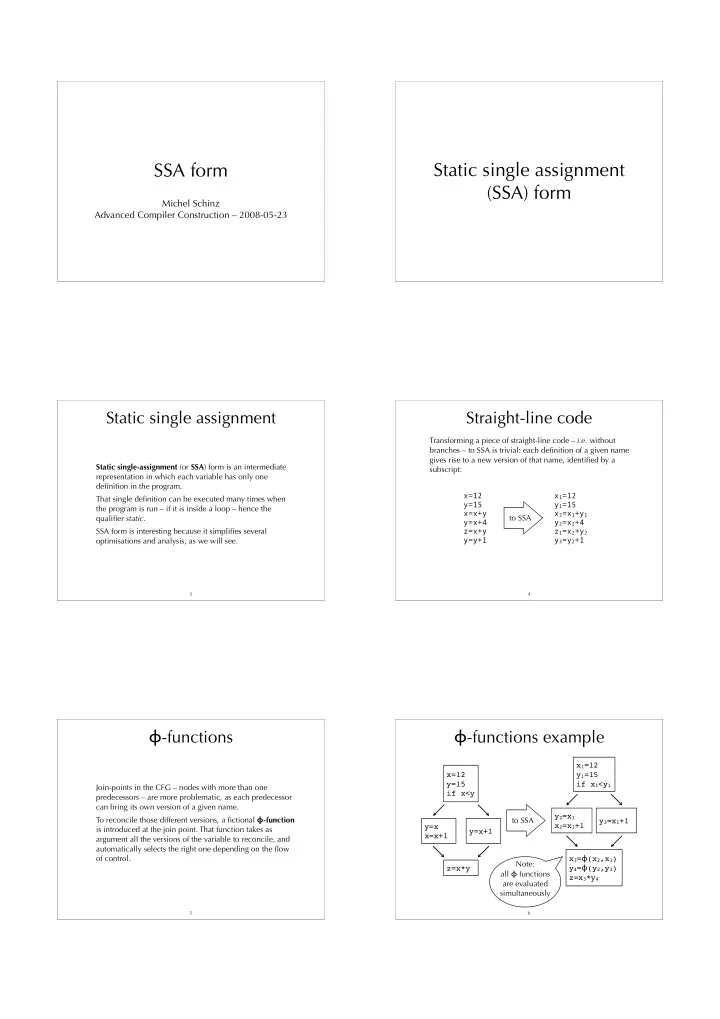
Transforming a piece of straight-line code – i.e. without branches – to SSA is trivial: each definition of a given name gives rise to a new version of that name, identified by a subscript:
4
x=12 y=15 x=x+y y=x+4 z=x+y y=y+1 x1=12 y1=15 x2=x1+y1 y2=x2+4 z1=x2+y2 y3=y2+1 to SSA
- functions
Join-points in the CFG – nodes with more than one predecessors – are more problematic, as each predecessor can bring its own version of a given name. To reconcile those different versions, a fictional -function is introduced at the join point. That function takes as argument all the versions of the variable to reconcile, and automatically selects the right one depending on the flow
- f control.
5
- functions example
6
x=12 y=15 if x<y y=x x=x+1 y=x+1 z=x*y x1=12 y1=15 if x1<y1 y2=x1 x2=x1+1 y3=x1+1 x3=(x2,x1) y4=(y2,y3) z=x3*y4 to SSA Note: all functions are evaluated simultaneously