Building SSA Form Each use refers to exactly one name x 17 - 4 - - PDF document

building ssa form
SMART_READER_LITE
LIVE PREVIEW

Building SSA Form Each use refers to exactly one name x 17 - 4 - - PDF document

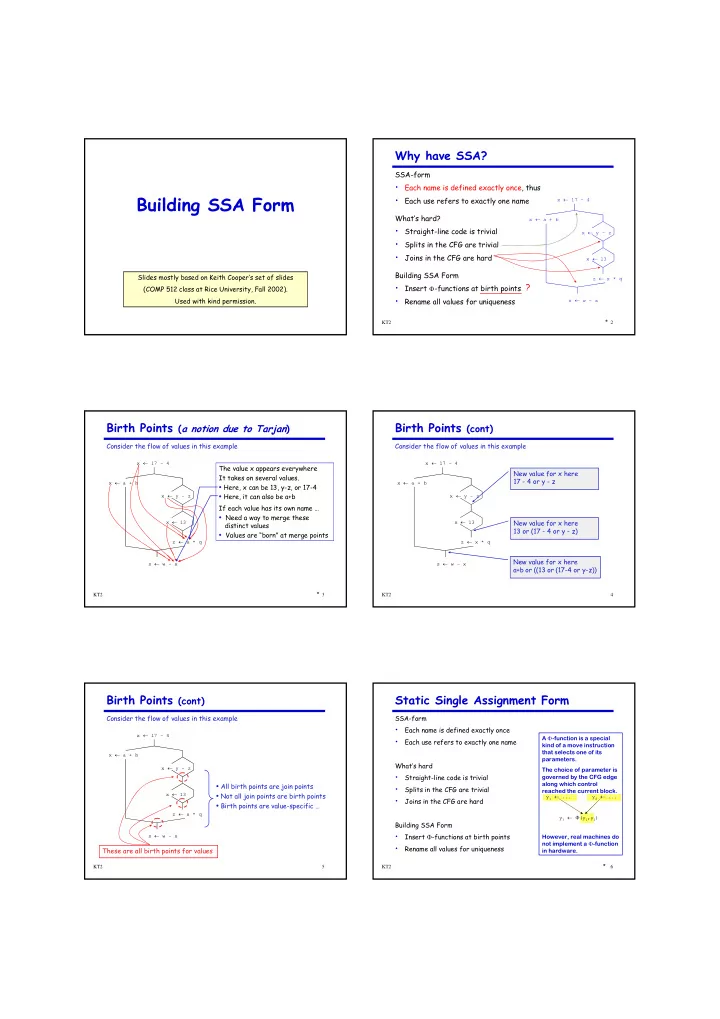
Why have SSA? SSA-form Each name is defined exactly once, thus Building SSA Form Each use refers to exactly one name x 17 - 4 Whats hard? x a + b Straight-line code is trivial x y - z Splits in the CFG are


slide-1
SLIDE 1

Building SSA Form

Slides mostly based on Keith Cooper’s set of slides (COMP 512 class at Rice University, Fall 2002). Used with kind permission.

KT2 2

Why have SSA?

SSA-form

  • Each name is defined exactly once, thus
  • Each use refers to exactly one name

What’s hard?

  • Straight-line code is trivial
  • Splits in the CFG are trivial
  • Joins in the CFG are hard

Building SSA Form

  • Insert Φ-functions at birth points
  • Rename all values for uniqueness

*

x ← 17 - 4 x ← a + b x ← y - z x ← 13 z ← x * q s ← w - x

?

3

Birth Points (a notion due to Tarjan)

Consider the flow of values in this example

x ← 17 - 4 x ← a + b x ← y - z x ← 13 z ← x * q s ← w - x

The value x appears everywhere It takes on several values.

  • Here, x can be 13, y-z, or 17-4
  • Here, it can also be a+b

If each value has its own name …

  • Need a way to merge these

distinct values

  • Values are “born” at merge points

*

KT2 4

Consider the flow of values in this example

x ← 17 - 4 x ← a + b x ← y - z x ← 13 z ← x * q s ← w - x

New value for x here 17 - 4 or y - z New value for x here 13 or (17 - 4 or y - z) New value for x here a+b or ((13 or (17-4 or y-z))

Birth Points (cont)

KT2 5

Consider the flow of values in this example

x ← 17 - 4 x ← a + b x ← y - z x ← 13 z ← x * q s ← w - x

These are all birth points for values

  • All birth points are join points
  • Not all join points are birth points
  • Birth points are value-specific …

Birth Points (cont)

KT2 6

Static Single Assignment Form

SSA-form

  • Each name is defined exactly once
  • Each use refers to exactly one name

What’s hard

  • Straight-line code is trivial
  • Splits in the CFG are trivial
  • Joins in the CFG are hard

Building SSA Form

  • Insert Φ-functions at birth points
  • Rename all values for uniqueness

A Φ-function is a special kind of a move instruction that selects one of its parameters. The choice of parameter is governed by the CFG edge along which control reached the current block. However, real machines do not implement a Φ-function in hardware.

y1 ← ... y2 ← ... y3 ← Φ(y1,y2)

*

KT2

slide-2
SLIDE 2

7

SSA Construction Algorithm (High-level sketch)

  • 1. Insert Φ-functions
  • 2. Rename values

… that’s all ... … of course, there is some bookkeeping to be done ...

*

KT2 8

SSA Construction Algorithm (Less high-level)

  • 1. Insert Φ-functions at every join for every name
  • 2. Solve reaching definitions
  • 3. Rename each use to the def that reaches it

(will be unique)

KT2 9

Reaching Definitions

The equations REACHES(n0 ) = Ø REACHES(n ) = ∪p∈preds(n) DEFOUT(p ) ∪ (REACHES(p ) ∩ SURVIVED(p))

  • REACHES(n) is the set of definitions that reach block n
  • DEFOUT(n) is the set of definitions in n that reach the end of n
  • SURVIVED(n) is the set of defs not obscured by a new def in n

Computing REACHES(n)

  • Use any data-flow method

(i.e., the iterative method)

  • This particular problem has a very-fast solution (Zadeck)

F.K. Zadeck, “Incremental data-flow analysis in a structured program editor,” Proceedings of the SIGPLAN 84 Conf. on Compiler Construction, June, 1984, pages 132-143.

* Domain is |DE

DEFI FINI NITI TIONS ONS|, same

as number of operations

KT2 10

SSA Construction Algorithm (Less high-level)

  • 1. Insert Φ-functions at every join for every name
  • 2. Solve reaching definitions
  • 3. Rename each use to the def that reaches it

(will be unique) What’s wrong with this approach

  • Too many Φ-functions

(precision)

  • Too many Φ-functions

(space)

  • Too many Φ-functions

(time)

  • Need to relate edges to Φ-functions parameters (bookkeeping)

To do better, we need a more complex approach

Builds maximal SSA

KT2 11

SSA Construction Algorithm (Less high-level)

  • 1. Insert Φ-functions

a.) calculate dominance frontiers b.) find global names for each name, build a list of blocks that define it c.) insert Φ-functions ∀ global name n ∀ block b in which n is defined ∀ block d in b’s dominance frontier insert a Φ-function for n in d add d to n’s list of defining blocks

{

Creates the iterated dominance frontier This adds to the worklist ! Use a checklist to avoid putting blocks on the worklist twice; keep another checklist to avoid inserting the same Φ-function twice. Compute list of blocks where each name is assigned. Use this list as the worklist. Moderately complex *

KT2 12

SSA Construction Algorithm (Less high-level)

  • 2. Rename variables in a pre-order walk over dominator tree

(use an array of stacks, one stack per global name) Staring with the root block, b a.) generate unique names for each Φ-function and push them on the appropriate stacks b.) rewrite each operation in the block i. Rewrite uses of global names with the current version (from the stack)

  • ii. Rewrite definition by inventing & pushing new name

c.) fill in Φ-function parameters of successor blocks d.) recurse on b’s children in the dominator tree e.) <on exit from block b > pop names generated in b from stacks

1 counter per name for subscripts Need the end-of-block name for this path Reset the state *

KT2

slide-3
SLIDE 3

13

Aside on Terminology: Dominators

Definitions x dominates y if and only if every path from the entry of the control-flow graph to the node for y includes x

  • By definition, x dominates x
  • We associate a Dom set with each node
  • |Dom(x )| ≥ 1

Immediate dominators

  • For any node x, there must be a y in Dom(x) such that y is closest

to x

  • We call this y the immediate dominator of x
  • As a matter of notation, we write this as IDom(x)
  • By convention, IDom(x0) is not defined for the entry node x0

KT2 14

Dominators (cont)

Dominators have many uses in program analysis & transformation

  • Finding loops
  • Building SSA form
  • Making code motion decisions

Let’s look at how to compute dominators…

A B C G F E D Dominator tree Block Dom IDom A A – B A,B A C A,C A D A,C,D C E A,C,E C F A,C,F C G A,G A Dominator sets *

m0 ← a + b n0 ← a + b A p0 ← c + d r0 ← c + d B r2 ← φ(r0,r1) y0 ← a + b z0 ← c + d G q0 ← a + b r1 ← c + d C e0 ← b + 18 s0 ← a + b u0 ← e + f D e1 ← a + 17 t0 ← c + d u1 ← e + f E e3 ← φ(e0,e1) u2 ← φ(u0,u1) v0 ← a + b w0 ← c + d x0 ← e + f F

KT2 15

SSA Construction Algorithm (Low-level detail)

Computing Dominance

  • First step in Φ-function insertion computes dominance.
  • A node n dominates m iff n is on every path from n0 to m.

>

Every node dominates itself

>

n ’s immediate dominator is its closest dominator, IDOM(n)† DOM(n0 ) = { n0 } DOM(n) = { n } ∪ (∩p∈preds(n) DOM(p)) Computing DOM

  • These equations form a rapid data-flow framework.
  • Iterative algorithm will solve them in d(G) + 3 passes

>

Each pass does N unions & E intersections,

>

E is O(N 2) ⇒ O(N 2) work

†IDOM(n) ≠ n, unless n is n0, by convention.

Initially, DOM(n) = N, ∀ n≠n0 KT2 16

Example

B1 B2 B3 B4 B5 B6 B7 B0 Flow Graph Progress of iterative solution for DOM Results of iterative solution for DOM *

Iter- ation 1 2 3 4 5 6 7 N N N N N N N 1 0,1 0,1,2 0,1,3 0,1,3,4 0,1,3,5 0,1,3,6 0,1,7 2 0,1 0,1,2 0,1,3 0,1,3,4 0,1,3,5 0,1,3,6 0,1,7 DOM(n )

1 2 3 4 5 6 7 DOM 0,1 0,1,2 0,1,3 0,1,3,4 0,1,3,5 0,1,3,6 0,1,7 IDOM 1 1 3 3 3 1 KT2 17

Example

Dominance Tree Progress of iterative solution for DOM

Iter- ation 1 2 3 4 5 6 7 N N N N N N N 1 0,1 0,1,2 0,1,3 0,1,3,4 0,1,3,5 0,1,3,6 0,1,7 2 0,1 0,1,2 0,1,3 0,1,3,4 0,1,3,5 0,1,3,6 0,1,7 DOM(n )

Results of iterative solution for DOM B1 B2 B3 B4 B5 B6 B7 B0

1 2 3 4 5 6 7 DOM 0,1 0,1,2 0,1,3 0,1,3,4 0,1,3,5 0,1,3,6 0,1,7 IDOM 1 1 3 3 3 1

There are asymptotically faster algorithms. With the right data structures, the iterative algorithm can be made faster.

See Cooper, Harvey, and Kennedy. KT2 18

Example

Dominance Frontiers

Dominance Frontiers & Φ-Function Insertion

  • A definition at n forces a Φ-function at m iff

n ∉ DOM(m) but n ∈ DOM(p) for some p ∈ preds(m)

  • DF(n) is fringe just beyond region n dominates

B1 B2 B3 B4 B5 B6 B7 B0

1 2 3 4 5 6 7 DOM 0,1 0,1,2 0,1,3 0,1,3,4 0,1,3,5 0,1,3,6 0,1,7 DF – – 7 7 6 6 7 1

*

  • ← in 1 forces a Φ-function in DF(1) = Ø

(halt) x← ...

x← Φ(...)

  • DF(4) is {6}, so ← in 4 forces a Φ-function in 6

x← Φ(...)

  • ← in 6 forces a Φ-function in DF(6) = {7}

x← Φ(...)

  • ← in 7 forces a Φ-function in DF(7) = {1}

For each assignment, we insert the Φ-functions

KT2

slide-4
SLIDE 4

19

Example

Dominance Frontiers

Computing Dominance Frontiers

  • Only join points are in DF(n) for some n
  • Leads to a simple, intuitive algorithm for computing

dominance frontiers For each join point x (i.e., |preds(x)| > 1) For each CFG predecessor of x Run up to IDOM(x) in the dominator tree, adding x to DF(n) for each n between x and IDOM(x) B1 B2 B3 B4 B5 B6 B7 B0 *

  • For some applications, we need post-dominance,

the post-dominator tree, and reverse dominance frontiers, RDF(n)

> Just dominance on the reverse CFG > Reverse the edges & add unique exit node

  • We will use these in dead code elimination using

SSA

1 2 3 4 5 6 7 DOM 0,1 0,1,2 0,1,3 0,1,3,4 0,1,3,5 0,1,3,6 0,1,7 DF – 1 7 7 6 6 7 1 KT2 20

SSA Construction Algorithm (Reminder)

  • 1. Insert Φ-functions at some join points

a.) calculate dominance frontiers b.) find global names for each name, build a list of blocks that define it c.) insert Φ-functions ∀ global name n ∀ block b in which n is defined ∀ block d in b’s dominance frontier insert a Φ-function for n in d add d to n’s list of defining blocks

* Needs a little more detail

KT2 21

SSA Construction Algorithm

Finding global names

  • Different between two forms of SSA
  • Minimal uses all names
  • Semi-pruned SSA uses names that are live on entry to some block

>

Shrinks name space & number of Φ-functions

>

Pays for itself in compile-time speed

  • For each “global name”, need a list of blocks where it is defined

>

Drives Φ-function insertion

>

b defines x implies a Φ-function for x in every c ∈ DF(b) Pruned SSA adds a test to see if x is live at insertion point

Otherwise, we do not need a Φ-function

KT2

a ← Φ(a,a) b ← Φ(b,b) c ← Φ(c,c) d ← Φ(d,d) y ← a+b z ← c+d i ← i+1 B7 i > 100 i ← ••• B0 b ← ••• c ← ••• d ← ••• B2 a ← Φ(a,a) b ← Φ(b,b) c ← Φ(c,c) d ← Φ(d,d) i ← Φ(i,i) a ← ••• c ← ••• B1 a ← ••• d ← ••• B3 d ← ••• B4 c ← ••• B5 d ← Φ(d,d) c ← Φ(c,c) b ← ••• B6 i > 100

With all the Φ-functions

  • Lots of new ops
  • Renaming is next

Assume a, b, c, & d defined before B0

Example

Excluding local names avoids Φ’s for y & z

23

SSA Construction Algorithm (Less high-level)

  • 2. Rename variables in a pre-order walk over dominator tree

(use an array of stacks, one stack per global name) Staring with the root block, b a.) generate unique names for each Φ-function and push them on the appropriate stacks b.) rewrite each operation in the block i. Rewrite uses of global names with the current version (from the stack)

  • ii. Rewrite definition by inventing & pushing new name

c.) fill in Φ-function parameters of successor blocks d.) recurse on b’s children in the dominator tree e.) <on exit from block b > pop names generated in b from stacks

1 counter per name for subscripts Need the end-of-block name for this path Reset the state

KT2 24

SSA Construction Algorithm (Less high-level)

NewName(n) i ← counter[n] counter[n] ← counter[n] + 1 push ni onto stack[n] return ni Rename(b) for each Φ-function in b, x ← Φ(…) rename x as NewName(x) for each operation “x ← y op z” in b rewrite y as top(stack[y]) rewrite z as top(stack[z]) rewrite x as NewName(x) for each successor of b in the CFG rewrite appropriate Φ parameters for each successor s of b in dom. tree Rename(s) for each operation “x ← y op z” in b pop(stack[x])

Adding all the details ...

for each global name i counter[i] ← 0 stack[i] ← Ø call Rename(n0)

KT2

slide-5
SLIDE 5

a ← Φ(a,a) b ← Φ(b,b) c ← Φ(c,c) d ← Φ(d,d) y ← a+b z ← c+d i ← i+1 B7 i > 100 i ← ••• B0 b ← ••• c ← ••• d ← ••• B2 a ← Φ(a,a) b ← Φ(b,b) c ← Φ(c,c) d ← Φ(d,d) i ← Φ(i,i) a ← ••• c ← ••• B1 a ← ••• d ← ••• B3 d ← ••• B4 c ← ••• B5 d ← Φ(d,d) c ← Φ(c,c) b ← ••• B6 i > 100

Counters Stacks 1 1 1 1 a

a0 b0 c0 d0

Before processing B0

b c d i Assume a, b, c, & d defined before B0 i has not been defined *

Example

a ← Φ(a,a) b ← Φ(b,b) c ← Φ(c,c) d ← Φ(d,d) y ← a+b z ← c+d i ← i+1 B7 i0 > 100 i0 ← ••• B0 b ← ••• c ← ••• d ← ••• B2 a ← Φ(a0,a) b ← Φ(b0,b) c ← Φ(c0,c) d ← Φ(d0,d) i ← Φ(i0,i) a ← ••• c ← ••• B1 a ← ••• d ← ••• B3 d ← ••• B4 c ← ••• B5 d ← Φ(d,d) c ← Φ(c,c) b ← ••• B6 i > 100

Counters Stacks 1 1 1 1 1 a b c d i

a0 b0 c0 d0

End of B0

i0

*

Example

a ← Φ(a,a) b ← Φ(b,b) c ← Φ(c,c) d ← Φ(d,d) y ← a+b z ← c+d i ← i+1 B7 i0 ← ••• B0 b ← ••• c ← ••• d ← ••• B2 a1 ← Φ(a0,a) b1 ← Φ(b0,b) c1 ← Φ(c0,c) d1 ← Φ(d0,d) i1 ← Φ(i0,i) a2 ← ••• c2 ← ••• B1 a ← ••• d ← ••• B3 d ← ••• B4 c ← ••• B5 d ← Φ(d,d) c ← Φ(c,c) b ← ••• B6 i > 100

Counters Stacks 3 2 3 2 2 a b c d i

a0 b0 c0 d0

End of B1

i0 a1 b1 c1 d1 i1 a2 c2

*

Example

i0 > 100 a ← Φ(a2,a) b ← Φ(b2,b) c ← Φ(c3,c) d ← Φ(d2,d) y ← a+b z ← c+d i ← i+1 B7 i0 ← ••• B0 b2 ← ••• c3 ← ••• d2 ← ••• B2 a1 ← Φ(a0,a) b1 ← Φ(b0,b) c1 ← Φ(c0,c) d1 ← Φ(d0,d) i1 ← Φ(i0,i) a2 ← ••• c2 ← ••• B1 a ← ••• d ← ••• B3 d ← ••• B4 c ← ••• B5 d ← Φ(d,d) c ← Φ(c,c) b ← ••• B6 i > 100

Counters Stacks 3 3 4 3 2 a b c d i

a0 b0 c0 d0

End of B2

i0 a1 b1 c1 d1 i1 a2 c2 b2 d2 c3

*

Example

i0 > 100 a ← Φ(a2,a) b ← Φ(b2,b) c ← Φ(c3,c) d ← Φ(d2,d) y ← a+b z ← c+d i ← i+1 B7 i0 ← ••• B0 b2 ← ••• c3 ← ••• d2 ← ••• B2 a1 ← Φ(a0,a) b1 ← Φ(b0,b) c1 ← Φ(c0,c) d1 ← Φ(d0,d) i1 ← Φ(i0,i) a2 ← ••• c2 ← ••• B1 a ← ••• d ← ••• B3 d ← ••• B4 c ← ••• B5 d ← Φ(d,d) c ← Φ(c,c) b ← ••• B6 i > 100

Counters Stacks 3 3 4 3 2 a b c d i

a0 b0 c0 d0

Before starting B3

i0 a1 b1 c1 d1 i1 a2 c2

*

Example

i0 > 100 a ← Φ(a2,a) b ← Φ(b2,b) c ← Φ(c3,c) d ← Φ(d2,d) y ← a+b z ← c+d i ← i+1 B7 i0 ← ••• B0 b2 ← ••• c3 ← ••• d2 ← ••• B2 a1 ← Φ(a0,a) b1 ← Φ(b0,b) c1 ← Φ(c0,c) d1 ← Φ(d0,d) i1 ← Φ(i0,i) a2 ← ••• c2 ← ••• B1 a3 ← ••• d3 ← ••• B3 d ← ••• B4 c ← ••• B5 d ← Φ(d,d) c ← Φ(c,c) b ← ••• B6 i > 100

Counters Stacks 4 3 4 4 2 a b c d i

a0 b0 c0 d0

End of B3

i0 a1 b1 c1 d1 i1 a2 c2 a3 d3

*

Example

i0 > 100

slide-6
SLIDE 6

a ← Φ(a2,a) b ← Φ(b2,b) c ← Φ(c3,c) d ← Φ(d2,d) y ← a+b z ← c+d i ← i+1 B7 i0 ← ••• B0 b2 ← ••• c3 ← ••• d2 ← ••• B2 a1 ← Φ(a0,a) b1 ← Φ(b0,b) c1 ← Φ(c0,c) d1 ← Φ(d0,d) i1 ← Φ(i0,i) a2 ← ••• c2 ← ••• B1 a3 ← ••• d3 ← ••• B3 d4 ← ••• B4 c ← ••• B5 d ← Φ(d4,d) c ← Φ(c2,c) b ← ••• B6 i > 100

Counters Stacks 4 3 4 5 2 a b c d i

a0 b0 c0 d0

End of B4

i0 a1 b1 c1 d1 i1 a2 c2 a3 d3 d4

*

Example

i0 > 100 a ← Φ(a2,a) b ← Φ(b2,b) c ← Φ(c3,c) d ← Φ(d2,d) y ← a+b z ← c+d i ← i+1 B7 i0 ← ••• B0 b2 ← ••• c3 ← ••• d2 ← ••• B2 a1 ← Φ(a0,a) b1 ← Φ(b0,b) c1 ← Φ(c0,c) d1 ← Φ(d0,d) i1 ← Φ(i0,i) a2 ← ••• c2 ← ••• B1 a3 ← ••• d3 ← ••• B3 d4 ← ••• B4 c4 ← ••• B5 d ← Φ(d4,d3) c ← Φ(c2,c4) b ← ••• B6 i > 100

Counters Stacks 4 3 5 5 2 a b c d i

a0 b0 c0 d0

End of B5

i0 a1 b1 c1 d1 i1 a2 c2 a3 d3 c4

*

Example

i0 > 100 a ← Φ(a2,a3) b ← Φ(b2,b3) c ← Φ(c3,c5) d ← Φ(d2,d5) y ← a+b z ← c+d i ← i+1 B7 i0 ← ••• B0 b2 ← ••• c3 ← ••• d2 ← ••• B2 a1 ← Φ(a0,a) b1 ← Φ(b0,b) c1 ← Φ(c0,c) d1 ← Φ(d0,d) i1 ← Φ(i0,i) a2 ← ••• c2 ← ••• B1 a3 ← ••• d3 ← ••• B3 d4 ← ••• B4 c4 ← ••• B5 d5 ← Φ(d4,d3) c5 ← Φ(c2,c4) b3 ← ••• B6 i > 100

Counters Stacks 4 4 6 6 2 a b c d i

a0 b0 c0 d0

End of B6

i0 a1 b1 c1 d1 i1 a2 c2 a3 d3 c5 d5 b3

*

Example

i0 > 100 a ← Φ(a2,a3) b ← Φ(b2,b3) c ← Φ(c3,c5) d ← Φ(d2,d5) y ← a+b z ← c+d i ← i+1 B7 i0 ← ••• B0 b2 ← ••• c3 ← ••• d2 ← ••• B2 a1 ← Φ(a0,a) b1 ← Φ(b0,b) c1 ← Φ(c0,c) d1 ← Φ(d0,d) i1 ← Φ(i0,i) a2 ← ••• c2 ← ••• B1 a3 ← ••• d3 ← ••• B3 d4 ← ••• B4 c4 ← ••• B5 d5 ← Φ(d4,d3) c5 ← Φ(c2,c4) b3 ← ••• B6 i > 100

Counters Stacks 4 4 6 6 2 a b c d i

a0 b0 c0 d0

Before B7

i0 a1 b1 c1 d1 i1 a2 c2

*

Example

i0 > 100 a4 ← Φ(a2,a3) b4 ← Φ(b2,b3) c6 ← Φ(c3,c5) d6 ← Φ(d2,d5) y ← a4+b4 z ← c6+d6 i2 ← i1+1 B7 i0 ← ••• B0 b2 ← ••• c3 ← ••• d2 ← ••• B2 a1 ← Φ(a0,a4) b1 ← Φ(b0,b4) c1 ← Φ(c0,c6) d1 ← Φ(d0,d6) i1 ← Φ(i0,i2) a2 ← ••• c2 ← ••• B1 a3 ← ••• d3 ← ••• B3 d4 ← ••• B4 c4 ← ••• B5 d5 ← Φ(d4,d3) c5 ← Φ(c2,c4) b3 ← ••• B6 i2 > 100

Counters Stacks 5 5 7 7 3 a b c d i

a0 b0 c0 d0

End of B7

i0 a1 b1 c1 d1 i1 a2 c2 a4 b4 c6 d6 i2

*

Example

i0 > 100 a4 ← Φ(a2,a3) b4 ← Φ(b2,b3) c6 ← Φ(c3,c5) d6 ← Φ(d2,d5) y ← a4+b4 z ← c6+d6 i2 ← i1+1 B7 i0 ← ••• B0 b2 ← ••• c3 ← ••• d2 ← ••• B2 a1 ← Φ(a0,a4) b1 ← Φ(b0,b4) c1 ← Φ(c0,c6) d1 ← Φ(d0,d6) i1 ← Φ(i0,i2) a2 ← ••• c2 ← ••• B1 a3 ← ••• d3 ← ••• B3 d4 ← ••• B4 c4 ← ••• B5 d5 ← Φ(d4,d3) c5 ← Φ(c2,c4) b3 ← ••• B6 i2 > 100

Counters Stacks

After renaming

  • Semi-pruned SSA form
  • We’re done …

Semi-pruned ⇒ only names live in 2 or more blocks are “global names”.

Example

i0 > 100

slide-7
SLIDE 7

37

SSA Construction Algorithm (Pruned SSA)

What’s this “pruned SSA” stuff?

  • Minimal SSA still contains extraneous Φ-functions
  • Inserts some Φ-functions where they are dead
  • Would like to avoid inserting them

Two ideas

  • Semi-pruned SSA: discard names used in only one block

>

Significant reduction in total number of Φ-functions

>

Needs only local liveness information (cheap to compute)

  • Pruned SSA: only insert Φ-functions where their value is live

>

Inserts even fewer Φ-functions, but costs more to do

>

Requires global live variable analysis (more expensive) In practice, both are simple modifications to step 1.

KT2 38

SSA Construction Algorithm

We can improve the stack management

  • Push at most one name per stack per block (save push & pop)
  • Thread names together by block
  • To pop names for block b, use b’s thread

This is another good use for a scoped hash table

  • Significant reductions in pops and pushes
  • Makes a minor difference in SSA construction time
  • Scoped table is a clean, clear way to handle the problem

KT2 39

SSA Deconstruction

At some point, we need executable code

  • Real machines do not implement Φ

functions

  • Need to fix up the flow of values

Basic idea

  • Insert copies Φ-function pred’s
  • Simple algorithm

> Works in most cases

  • Adds lots of copies

> Most of them coalesce away

X17 ← Φ(x10,x11) ... ← x17 ... ... ... ← x17 X17 ← x10 X17 ← x11

*

KT2