
SLIDE 1
A QUANTUM PHASE TRANSITION FROM BOUNDED TO EXTENSIVE ENTANGLEMENT
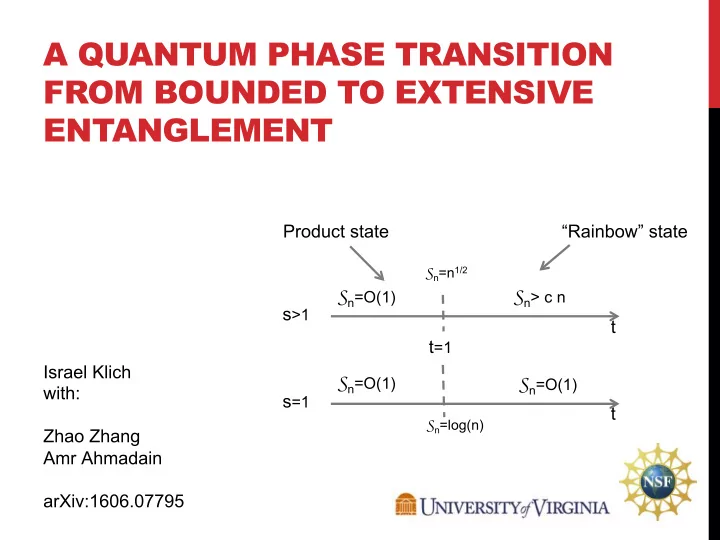
Israel Klich with: Zhao Zhang Amr Ahmadain arXiv:1606.07795 s=1 s>1 t t t=1 Sn=O(1) Sn> c n Sn=O(1) Sn=O(1)
Sn=log(n) Sn=n1/2
“Rainbow” state Product state
A QUANTUM PHASE TRANSITION FROM BOUNDED TO EXTENSIVE ENTANGLEMENT - - PowerPoint PPT Presentation
A QUANTUM PHASE TRANSITION FROM BOUNDED TO EXTENSIVE ENTANGLEMENT Product state Rainbow state S n =n 1/2 S n =O(1) S n > c n s >1 t t =1 Israel Klich S n =O(1) S n =O(1) with: s =1 t S n =log(n) Zhao Zhang Amr Ahmadain
Israel Klich with: Zhao Zhang Amr Ahmadain arXiv:1606.07795 s=1 s>1 t t t=1 Sn=O(1) Sn> c n Sn=O(1) Sn=O(1)
Sn=log(n) Sn=n1/2
“Rainbow” state Product state
Entanglement entropy: Generic states in Hilbert space have extensive entanglement
(page prl 93,foong prl 94,sen prl 96)
SA = −TrρA logρA where ρA = Tr Bρ
(Page prl 93) (Hastings 07,1d) (Gioev IK 06,M Wolf 06) (Holzhey Larsen Wilczek 96, Calabrese Cardy…)
First local Hamiltonian with volume scaling: Irani 2010.
local Hilbert space dimension is 21
Simpler models but without translational invariance, and with exponentially varying couplings:
Gottesman Hastings 2010 Rainbow ground states:Vitagliano Riera Latorre 2010, Ramirez Rodriguez-Laguna Sierra 2014 Translationally invariant but with a square root scaling: Movassagh Shor (2014), Salberger Korepin (2016)
s=1 s>1 t t t=1 Sn=O(1) Sn> c n Sn=O(1) Sn=O(1)
Sn=log(n) Sn=n1/2
Here: a simple spin chain with remarkable phase transition:
1 2 n n+1 n+2 2n
EPR: electron-positron pair generation in an electric field as a source
Basic intuition: How to create a highly entangled state? “Rainbow” state
Pfister et al, 2004 Chen Meniccuci Pfister PRL2014, 60 mode cluster state Incoming laser Nonlinear cavity
ωin →ωn +ω−n =ωin
1 n
Optical frequency comb Cavity eigenmodes
Ψ =
Motzkin paths
Ψ =
colored Motzkin paths
Bravyi et al. 2012 “Criticality without frustration” Movassagh Shor 2014 “Power law violation of the area law in quantum spin chains”
Sn ∝ 1 2 log(n) Sn ∝ n
|1 , 0, -1 , 2 , 1 ,-1 , 1 , 0, 2 , -2, -1 , 0, 0, -1> 1 2n n n-1 m
( - ) ( ( ) ( - ( ) ) - - )
|1 , 0 , -1 , 1 , 1 , -1 , 1 , 0 , 1 , -1 , -1 , 0 , 0 , -1 > 1 2n n n-1 m
( - ) [ ( ) ( - [ ] ) - - ] Motzkin paths: Colored Motzkin paths:
Enforce a g.s. superposition made of Motzkin paths by using projectors like:
Φ = Ψ = Θ = H =∑ Θ Θ + Ψ Ψ + Φ Φ + h1 +h2n +(penalty unmatched colors)
Height after n steps = # of unmatched up steps For n >>1, typical Motzkin walk is like a Brownian walk. ⇒ Typical height after n steps ∝ n ⇒ # of colorings of unmatched up steps ∝ s n allcoloringschemes of unmatched equally likely ⇒ Sn ∝ n
Main idea – up moves are like electrons and down moves are like positrons. They should go in different directions! Can try:
Choice of angles must satisfy a consistency condition:
(a) (b)
h
h + 1
h
h + 1
h0 = h + 2 h0 = h + 2
1
Area colored Motzkin paths
Schmidt decomposition
Ψ = pn,m
m=0 n
coloring scheme
t Area
paths from 0 to height m
⎛ ⎝ ⎜ ⎜ ⎜ ⎞ ⎠ ⎟ ⎟ ⎟ ⊗ t Area
paths from height m to 0
⎛ ⎝ ⎜ ⎜ ⎜ ⎞ ⎠ ⎟ ⎟ ⎟
pn,m = Mn,m
2
Nn Mn,m = si
i=0 (n−m)/2
t Areaunder path
path from0to height mwith iunpaired colors
Nn = sm
m=0 n
Mn,m
2
Ψ = t Area
colored Motzkin paths
We need the asymptotics of Mn,m Mn,m = si
i=0 (n−m)/2
t Areaunder path
path from0to height mwith iunpaired colors
path from0to height mwith
X(0)=0 X(n)=m
−
n
ds )2−log(t)X(s)ds
Charged particle in a field, Brownian particle with a drift
(0, 0) (k, 0)(k + 1, 0) (k + 1, m)
(k, m − 1)
(k, m + 1)
(k, m)
For precise estimates use recursion relations:
Mk+1,k+1=tk+1/2Mk,k Mk+1,k=tkMk,k + tk−1/2Mk,k−1 Mk+1,m=stm+1/2Mk,m+1 + tmMk,m + tm−1/2Mk,m−1, 0 < m < k Mk+1,0=st1/2Mk,1 + Mk,0
Define Mn =
m=0 ∞
ˆ S m = m −1 Then : Mn = ! K st−(k−1/2) ˆ S +1+t(k−1/2) ˆ S+
k=1 n
For large n, Mn ~ ! K st−(k−1/2) ˆ S +1+t(k−1/2) ˆ S+
k=1 k0−1
t(k−1/2) ˆ S+
k=k0 n
0 +corrections
Ballistic propagation of distribution
∝ n − k0
Transient
s=1 s>1 t t t=1 Sn=O(1) Sn> c n Sn=O(1) Sn=O(1)
Sn=log(n) Sn=n1/2
Here: a simple spin chain with remarkable phase transition:
1 2 n n+1 n+2 2n
Fredkin model Salberger/Korepin 2016 has as ground state superposition
Entropy scales linearly with n log(s)! Same phase diagram. Need 3 neighbor interactions. To appear shortly! IK with Z Zhang, O Salberger, T Udagawa, H Katsura, V Korepin
Ψ =
colored Dyck paths
We can deform it into:
Ψ = qArea under
colored Dyck paths
1. Gap decays exponentially for t>1. Gapped for t<1? 2. Thermodynamics is unknown (Shape of transition region?) 3. Stability? 4. Periodic boundary conditions? 5. Can build a tensor network. 6. Holography: Can get linear entanglement scaling by choosing a metric that would give entanglement using Ryu Takayangi formula. Relation to hyperscaling violations (Huijse, Sachdev and Swingle 2012)?