
SLIDE 1
Quantum Information Processing and Quantum Error Correction and - - PowerPoint PPT Presentation
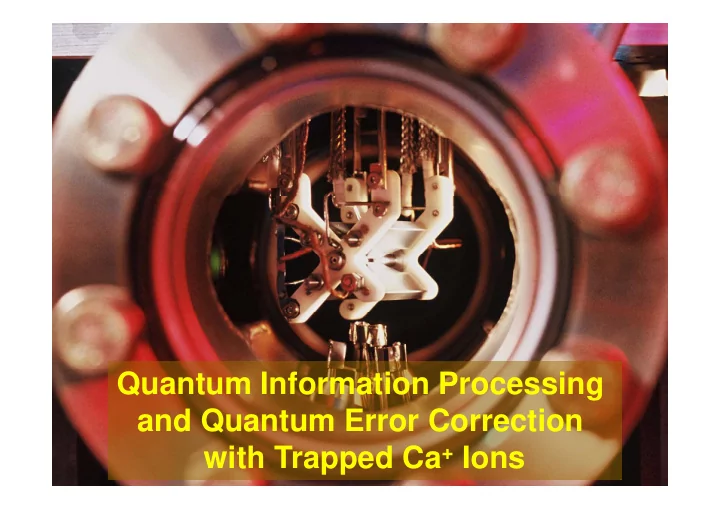
Quantum Information Processing and Quantum Error Correction and Quantum Error Correction with Trapped Ca + Ions Quantum Information Processing and Quantum Information Processing and Quantum Error Correction with Trapped Ca + Ions Quantum Error
Rainer Blatt
Institute of Experimental Physics, University of Innsbruck, Institute of Quantum Optics and Quantum Information, p , Austrian Academy of Sciences
Trapped Ca+ for quantum information processing Coherence of multi‐particle entangled states Quantum error correction with trapped ions Undoing a measurement by quantum error correction Quantum simulations with trapped ions
IQI GmbH
MICROTRAP AQUTE
Industrie Tirol
FWF SFB G b Tirol
SFB
qubit on narrow S - D quadrupole transition Level scheme of Ca+
854 nm
P3/2 P1/2
866 nm
D3/2
397 nm 866 nm
D5/2
393 nm
40C +
3/2
729 nm
40Ca+ S1/2
2-level-system: 2-level-system: 2-level-system:
P1/2 D5/2 P1/2 D5/2
2 level system: 2 level system: 2 level system:
S
Fluorescence detection
S
Fluorescence detection Zeeman structure in non zero magnetic field: 5/2
S1/2 S1/2
non-zero magnetic field:
D
5/2
1/2 3/2
3/2 + vibrational degrees of sideband cooling quantum state
S
1/2
freedom processing
S
1/2
1/2
P D
absorption and emission cause fluorescence steps monitor spectroscopy cause fluorescence steps (digital quantum jump signal)
S
8
detection efficiency: 99.85% S tensity
6 7 8
D-Zustand besetzt S-Zustand besetzt ungen
ents
D state occupied S state occupied
scence in
3 4 5
der Messu
measureme
D Fluores
1 2 3
Anzahl
# of m
D
time (s)
20 40 60 80 100 120
Zählrate pro 9 ms
counts per 9 ms
n n-1 n+1
entangling operation with bichromatic excitation
n 1 n+1 n 1 n+1
+ + +
n n+1 n-1 n-1 n-1
MS‐gate generates GHZ states Realizes a two‐body Hamiltonian where every ion interacts with every other, e.g., for 3 ions
collective local operations with resonant excitation
D5/2
40Ca+
resonant manipulation
+ + + S1/2 Generate rotations about x/y axis Examples: Examples:
D5/2
40Ca+
Single‐qubit rotations:
manipulation
+ + +
Single‐qubit rotations: ‐ far detuned laser AC stark shift S1/2 ‐ AC‐stark shift Generate rotations about z axis Examples: p
+ + + + +
collective local operations, F = 99% single‐qubit z‐rotations, F = 99% Mølmer‐Sørensen entangling operations, F = 98%
Two‐body interaction by off‐resonant spin‐motion coupling
Effective spin‐spin interaction
Many ions:
Creation of GHZ states
A Sørensen K Mølmer
PRL 82, 1971 (1999) …
1
…
1 1
… …
1 1 1
…
DDDD DDDD SDDD DSDD DDSD DDDS SDDS DSSD DSDS DDSS SSDD SDSD SSSD SSDS SDSS DSSS
n = 1 n = 0
SSSD SSDS SDSS DSSS |0,SSSS>
DDDDDDDD SSSSSSSS
Fidelity (%) P it i l 1 99.5(7) Parity signal single ion Ramsey fringe 2 3 98.6(2) 3 4 97.0(3) 95 7(3) 4 6 95.7(3) 89 2(4) 6 8 89.2(4) 81.7(4)
Phase of analysing pulse ()
genuine N‐particle Entanglement P it i l 8 96 by Parity signal 10 40 12 18 12 18 14 17
W Dü I Ci W Dü I Ci
6837, (2001)
6837, (2001)
single‐ion Ramsey contrast s g e o a sey co as
Assumption: Assumption:
2 ions
p magnetic field fluctuations cause collective dephasing p magnetic field fluctuations cause collective dephasing
4 ions 8 i
3 ions
6 ions 8 ions Waiting time (µs)
1/2 ‐1/2 ‐3/2 3/2 5/2 / 3/2 ‐5/2 ‐1/2 1/2
Hamiltonian with Fidelity Fidelity with (GHZ state) and denotes an ensemble average over the random fluctions For stationary noise of the magnetic field, characterized by a decay we obtain:
relative error probability
correlated noise correlated noise
two qubits
‐> superdecoherence ‐> superdecoherence
two qubits three qubits four qubits six qubits
BUT BUT application of a MS gate operation to the initial state yields the symmetric GHZ state the symmetric GHZ state insensitive to global dephasing by magnetic field noise insensitive to global dephasing by magnetic field noise measured coherence time consistent with expectation from lifetime limit:
D5/2
5/2
S1/2 consistent with expectation from lifetime (D5/2) limit:
5/2
prepare qubits i S t t
1/2 3/2 5/2
Hiding states in S, S‘ states avoids decoherence from spontaneous emission
D
in S states
D
5/2
spontaneous emission
S‘ S
1/2
1/2
S‘ S
Idea: use long-lived Bell states as logical qubits
Idea: use long-lived Bell states as logical qubits Gate operations by Gate operations by
Trade off more ions (2x) for much extended coherence times (100-1000x)
Idea: use long-lived Bell states as logical qubits
Idea: use long-lived Bell states as logical qubits Gate operations by 1st experiment: Gate operations by
Analysis by state and process tomography
experiment mean gate fidelity
+ + + + +
collective local operations, F = 99% single‐qubit z‐rotations, F = 99% Mølmer‐Sørensen entangling operations, F = 98%
Basic set of operations: N ions
Mølmer-Sørensen gate collective spin flips individual light shift gates
+ + + + +
no interferometric stability between beams required
Arbitrary unitary operations can be achieved ! Arbitrary unitary operations can be achieved ! ...but what is an optimal way to do this ?
Quantum optimal control:
012312 (2009) Find such that 012312 (2009) Find such that Gradient ascent algorithm:
g j , g , ( ) Modification of search algorithm:
Example: quantum Toffoli gate
=
1
Example: quantum Toffoli gate
=
2 3
Scalable quantum computation requires error correction
Optimal control : Quantum Error Correction
Quantum Error Correction: 3 qubits encode logical qubit (protection against spin flips)
spin flip errors spin flip errors spin flip errors spin flip errors error syndrome correction encoding reset ancillas y detection step
Implementation : 34 laser pulses (11 entangling pulses)
012312 (2009)
encoding error decoding corr. reset
i l h i d f fi bi requires only three instead of five qubits repetition requires re‐encoding
►correct for phase errors instead of bit flips -> add Hadamards reset ► add a dummy operation D, D-1 that simplifies encoding ► operation U does not matter since ancillas are reset ► operation U does not matter since ancillas are reset (but gives an additional degree of freedom for optimisation)
reset
reset the ancillas: reset the ancillas: shelve population of ancillas l
heating: 0.014 phonons/reset
d encode error repeat correct correct
Innsbruck (2010)
process tomography after each step F = 97% identity process F = 97% identity process F = 90% w/ errors F = 90% w/o errors F = 90% w/ errors F = 90% w/o errors F = 80% w/ errors F = 80% w/o errors F = 80% w/ errors F = 80% w/o errors step 1 step 2 step 3F = 70% w/ errors F = 72% w/o errors F = 70% w/ errors F = 72% w/o errors
pulse sequence
Science 332 , 1059‐1061 (2011)
Goal
Simulate the physics of a quantum system of interest by another system that is easier to control and to measure
Experimental requirements
another system that is easier to control and to measure.
Experimental requirements
Trapped ions
Goal
Simulate the physics of a quantum system of interest by another system that is easier to control and to measure. Engineer a Hamiltonian Hsim exactly matching the H il i H
Approach
system Hamiltonian Hsys
pp Examples:
Ult ld t i
(MIT, Harvard, MPQ, NIST,…)
(JQI MPQ IQOQI ) (JQI, MPQ, IQOQI …)
Goal
Simulate the physics of a quantum system of interest by another system that is easier to control and to measure.
Approach
Use a quantum computer as a quantum simulator Decompose dynamics induced by system Hamiltonian q p q into sequence of quantum gates
Example:
… with a single trapped ion
The Dirac equation can be cast in a 1+1 dimensional form (1 spatial + 1 spinor degree of freedom) can be cast in a 1+1 dimensional form (1 spatial + 1 spinor degree of freedom) resonant bichromatic excitation Stark shift with the replacements
For the 1d Dirac equation we trace over the spin degrees of freedom and the remaining spinor represents the matter and anti‐matter components Zitt b “ „Zitterbewegung“ due to interference between positive and negative energy parts of spinor
Apply the Hamiltonian and measure the expectation value of the position
massless particle massless particle Zitterbewegung with increasing mass term
For : Klein tunneling Klein tunneling Realization of a linear potential with trapped ions: A second ion driven by bichromatic light field and prepared in an eigenstate of A second ion driven by bichromatic light field and prepared in an eigenstate of x
steep
Linear potential
shallow
No potential
steep shallow ime Ti
Free propagation Reflection Reflection and tunneling positive and negative energy parts
Decompose dynamics induced by system Hamiltonian p y y y into sequence of quantum gates
System: qubit register Quantum gate toolbox:
g q g
E i i f di i i
Decompose dynamics induced by system Hamiltonian p y y y into sequence of quantum gates
System: qubit register Quantum gate toolbox:
g q g
E i i f di i i
model of some local system to be simulated for a time t
0. have a universal set on ‘encoding’ degrees of freedom 1 b ild h l l l i l 1. build each local evolution operator separately, for small time steps, using operation set 2 approximate global evolution operator 2. approximate global evolution operator using the Trotter approximation
… …
“Efficient for local quantum systems“
“Efficient for local quantum systems“
1 Trotter (digital) time step
y , Science 273, 1073 (1996) y , Science 273, 1073 (1996)
2‐spin Ising system 69%
Mølmer‐Sørensen gate 85% AC‐Stark gate dynamics to simulate: 91%
y
bability
pro
91%
Ising Ising XY XY XYZ XYZ 2‐spin simulations Ising type 1 Ising type 1 Ising type 2 Ising type 2 n‐body n‐body 3‐spin simulations >3‐spin simulations 4 spins 4 spins 6 spins 6 spins
Science 334, 6052 (2011)
Science 334, 6052 (2011)
Simulated phase evolution with 6 spins t l t b d d ith entanglement bounds measured with the procedure according to
J=2B
ground state properties and quantum phase changes
Fourier transform the data and get the energy gaps in the simulated Hamiltonian
Energy eigenvalues could be extracted by embedding into phase estimation algorithm
thought to be laser intensity fluctuations limiting possible simulation size and complexity g y g p p y
Gate ops and coherence of multi‐partite entanglement Q t i f ti t lb Quantum information toolbox Quantum error correction with trapped ions Undoing a quantum measurement Quantum Simulation of the Dirac equation and Klein‐tunneling Universal quantum simulator with ion traps (Trotter)
Future: Future:
further optimization of logic operations further optimization of logic operations error correction protocols with five qubits, different encoding implementation of logical qubits scalability issues implementation of logical qubits, scalability issues miniaturize traps, interface quantum information
… …
Future goals and developments
more qubits (~20 – 50) b tt fid liti better fidelities faster gate operations cryogenic trap, micro‐structured traps faster detection development of 2‐d trap arrays, onboard addressing, electronics etc. entangling of large(r) systems: characterization ? implementation of error correction, keep „qubit qubit alive alive“ “ applications ‐ small scale QIP (e.g. repeaters) ‐ quantum metrology, enhanced S/N, tailored atoms and states ‐ quantum simulations (Majorana equation, spin Hamiltonians, incl. QEC) ‐ quantum computation (period finding, quantum Fourier transform, factoring)
AQUTE
Industrie Tirol IQI GmbH
FWF SFB
J Barreiro
D Nigg N Röck
M Niedermair
B Lanyon
B Brandstätter
K Schüppert
B Ames
Theory collaboration: P. Zoller, M. Müller
AQUTE
Industrie Tirol IQI GmbH
FWF SFB