
Srinidhi Varadarajan 02/14/2000 Title goes here 1
Error Detection
■ Two types
◆ Error Detection Codes (e.g. CRC,
Parity, Checksums)
◆ Error Correction Codes (e.g.
Hamming, Reed Solomon)
■ Basic Idea
◆ Add redundant information to
determine if errors have been introduced
✦ Why redundant?
Error Detection Codes
■ Naïve scheme
◆ Send a duplicate copy of the
message
■ Problems
◆ Takes up too much space ◆ Poor performance.
✦ Can’t even detect 2 bit errors ■ Cyclic Redundancy Codes are
common
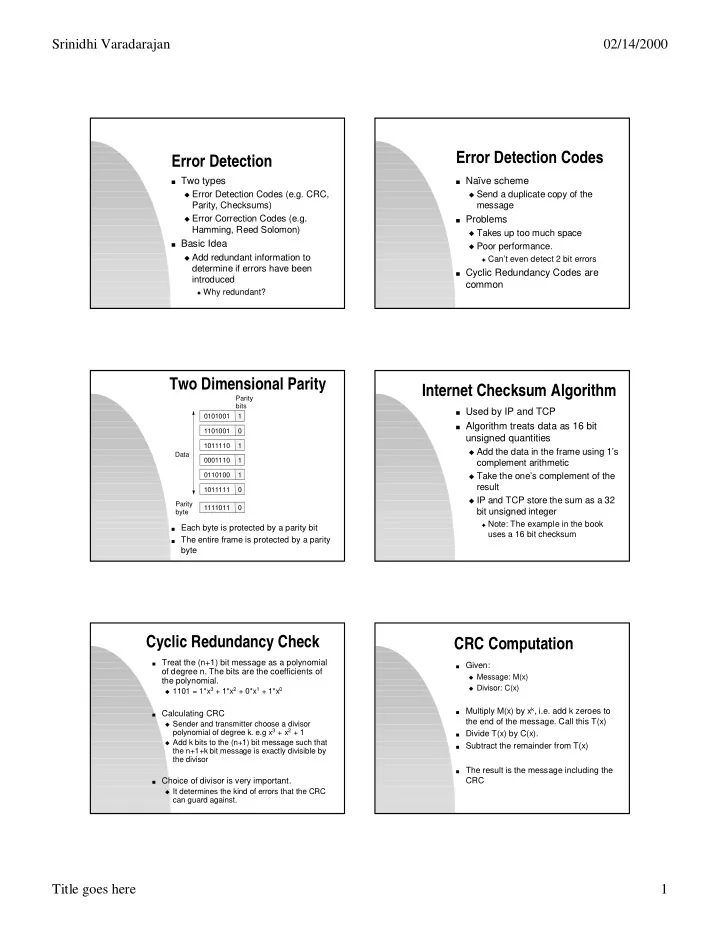
Two Dimensional Parity
■ Each byte is protected by a parity bit ■ The entire frame is protected by a parity
byte
1011110 1 1101001 0101001 1 1011111 0110100 1 0001110 1 1111011 Parity bits Parity byte Data
Internet Checksum Algorithm
■ Used by IP and TCP ■ Algorithm treats data as 16 bit
unsigned quantities
◆ Add the data in the frame using 1’s
complement arithmetic
◆ Take the one’s complement of the
result
◆ IP and TCP store the sum as a 32
bit unsigned integer
✦ Note: The example in the book
uses a 16 bit checksum
Cyclic Redundancy Check
■ Treat the (n+1) bit message as a polynomial
- f degree n. The bits are the coefficients of
the polynomial.
◆ 1101 = 1*x3 + 1*x2 + 0*x1 + 1*x0
■ Calculating CRC
◆ Sender and transmitter choose a divisor
polynomial of degree k. e.g x3 + x2 + 1
◆ Add k bits to the (n+1) bit message such that
the n+1+k bit message is exactly divisible by the divisor
■ Choice of divisor is very important.
◆ It determines the kind of errors that the CRC
can guard against.
CRC Computation
■ Given:
◆ Message: M(x) ◆ Divisor: C(x)
■ Multiply M(x) by xk, i.e. add k zeroes to
the end of the message. Call this T(x)
■ Divide T(x) by C(x). ■ Subtract the remainder from T(x) ■ The result is the message including the