SLIDE 1
1 Systems Design & Programming CMPE 310
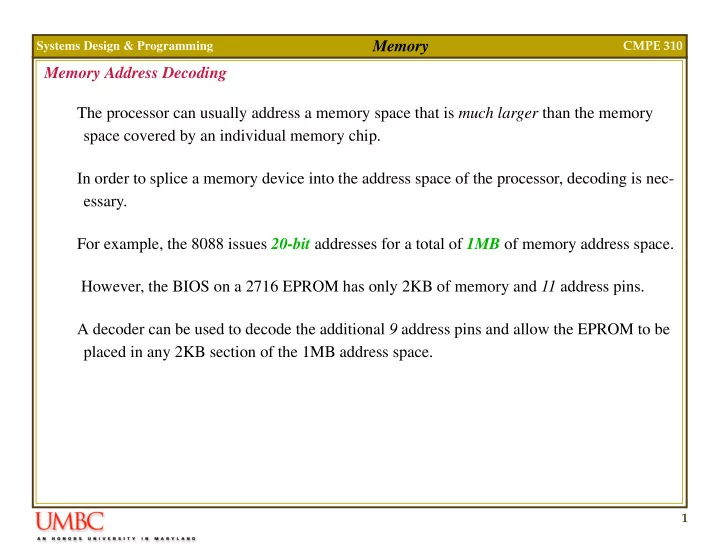
Memory Memory Address Decoding The processor can usually address a memory space that is much larger than the memory space covered by an individual memory chip. In order to splice a memory device into the address space of the processor, decoding is nec- essary. For example, the 8088 issues 20-bit addresses for a total of 1MB of memory address space. However, the BIOS on a 2716 EPROM has only 2KB of memory and 11 address pins. A decoder can be used to decode the additional 9 address pins and allow the EPROM to be placed in any 2KB section of the 1MB address space.
SLIDE 2
2 Systems Design & Programming CMPE 310
Memory Memory Address Decoding A0 A1 A10 O0 O1 O7 ... ... CS RD of 8088/86 Or MRDC bus signal.
2716
IO/M A19 A18 A17 A16 A15 A14 A13 A12 A11 Address Bus Data Bus Logic 0 when A11 through A19 are all 1. (2K X 8) (Book shows OE connection for RD but chip definition does NOT have this pin) EPROM
SLIDE 3
3 Systems Design & Programming CMPE 310
Memory Memory Address Decoding To determine the address range that a device is mapped into: This 2KB memory segment maps into the reset location of the 8086/8088 (FFFF0H). NAND gate decoders are not often used Large fan-in NAND gates are not efficient Multiple NAND gate IC's might be required to perform such decoding Rather the 3-to-8 Line Decoder (74LS138) is more common. 1111 1111 1XXX XXXX XXXX A19 - A11 A10 - A0 1111 1111 1000 0000 0000 (FF800H) To 1111 1111 1111 1111 1111 (FFFFFH)
SLIDE 4
4 Systems Design & Programming CMPE 310
Memory Memory Address Decoding The 3-to-8 Line Decoder (74LS138) Note that all three Enables (G2A, G2B, and G1) must be active, e.g. low, low and high, respectively. Each output of the decoder can be attached to an 2764 EPROM (8K X 8). G2A G2B G1 A B C 1 2 3 4 5 6 7 Enable Select Inputs Outputs Inputs Output Enable Select
G2A G2B G1
C B A 0 1 2 3 4 5 6 7
1 X X X X X 1 1 1 1 1 1 1 1 X 1 X X X X 1 1 1 1 1 1 1 1 X X X X X 1 1 1 1 1 1 1 1 1 0 0 1 1 1 1 1 1 1 1 1 1 0 1 1 1 1 1 1 1 1 0 1 1 0 1 1 1 1 1 1 1 1 1 1 1 0 1 1 1 1 1 1 0 1 1 1 1 0 1 1 1 1 1 1 1 1 1 1 1 0 1 1 1 1 1 0 1 1 1 1 1 1 0 1 1 1 1 1 1 1 1 1 1 1 1 0
SLIDE 5
5 Systems Design & Programming CMPE 310
Memory Memory Address Decoding The EPROMs cover a 64KB section of memory. G2A G2B G1 A B C 1 2 3 4 5 6 7 A0 A12 O0 O7 ... ... CS
2764
A16 A17 A18 A19 A13 A14 A15 CS CS CS CS CS CS CS RD of 8088/86 Data Bus Address Bus
F2000-F3FFF F0000-F1FFF F4000-F5FFF F6000-F7FFF F8000-F9FFF FA000-FBFFF FC000-FDFFF FE000-FFFFF
Address space F0000H-FFFFFH A13 through A15 select a 2764 A16 through A19 enable the decoder (8K X 8)
74LS138
EPROM
SLIDE 6
6 Systems Design & Programming CMPE 310
Memory Memory Address Decoding Yet a third possibility is a PLD (Programmable Logic Device). PLDs come in three varieties: PLA (Programmable Logic Array) PAL (Programmable Array Logic) GAL (Gated Array Logic) PLDs have been around since the mid-1970s but have only recently appeared in memory systems (PALs have replaced PROM address decoders). PALs and PLAs are fuse-programmed (like the PROM). Some are erasable (like the EPROM). A PAL example (16L8) is shown in the text and is commonly used to decode the memory address, particularly for 32-bit addresses generated by the 80386DX and above.
SLIDE 7
7 Systems Design & Programming CMPE 310
Memory Memory Address Decoding AMD 16L8 PAL decoder. It has 10 fixed inputs (Pins 1-9, 11), two fixed outputs (Pins 12 and 19) and 6 pins that can be either (Pins 13-18). AND/NOR device with logic expressions (outputs) with up to 16 ANDed inputs and 7 ORed product terms. O3 1 2 3 4 5 6 7 15 11 20 19 16
16L8
17 18 I4 I5 I6 I7 VCC I3 I2 O6 O8 I1 O4 O5 O7 9 8 10 12 13 14 I8 I9 GND O2 O1 I10 ;pins 1 2 3 4 5 6 7 8 9 10 A19 A18 A17 A16 A15 A14 A13 NC NC GND ;pins 11 12 13 14 15 16 17 18 19 20 NC O8 O7 O6 O5 O4 O3 O2 O1 VCC Equations: /O1 = A19 * A18 * A17 * A16 * /A15 * /A14 * /A13 /O2 = A19 * A18 * A17 * A16 * /A15 * /A14 * A13 /O3 = A19 * A18 * A17 * A16 * /A15 * A14 * /A13 /O4 = A19 * A18 * A17 * A16 * /A15 * A14 * A13 /O5 = A19 * A18 * A17 * A16 * A15 * /A14 * /A13 /O6 = A19 * A18 * A17 * A16 * A15 * /A14 * A13 /O7 = A19 * A18 * A17 * A16 * A15 * A14 * /A13 /O8 = A19 * A18 * A17 * A16 * A15 * A14 * A13 Programmed to decode address lines A19 - A13 onto 8 outputs.
SLIDE 8
8 Systems Design & Programming CMPE 310
Memory 8088 and 80188 (8-bit) Memory Interface The memory systems sees the 8088 as a device with: 20 address connections (A19 to A0). 8 data bus connections (AD7 to AD0). 3 control signals, IO/M, RD, and WR. We'll look at interfacing the 8088 with: 32K of EPROM (at addresses F8000H through FFFFFH). 512K of SRAM (at addresses 00000H through 7FFFFH). The EPROM interface uses a 74LS138 (3-to-8 line decoder) plus 8 2732 (4K X 8) EPROMs. The EPROM will also require the generation of a wait state. The EPROM has an access time of 450ns. The 74LS138 requires 12ns to decode. The 8088 runs at 5MHz and only allows 460ns for memory to access data. A wait state adds 200ns of additional time.
SLIDE 9
9 Systems Design & Programming CMPE 310
Memory 8088 and 80188 (8-bit) EPROM Memory Interface The 8088 cold starts execution at FFFF0H. JMP to F8000H occurs here. G2A G2B G1 A B C 1 2 3 4 5 6 7 A0 A11 O0 O7 ... ... CS 2732 A15 A17 A18 A19 A12 A13 A14 CS CS CS CS CS CS CS RD Data Bus Address Bus Address space F8000H-FFFFFH (4K X 8) 74LS138 OE A16 WAIT IO/M 5V 1K To wait state generator
SLIDE 10
10 Systems Design & Programming CMPE 310
Memory 8088 and 80188 (8-bit) RAM Memory Interface A0 A14 O0 O7 ... ... CS A18 A19 CS CS CS CS CS CS CS OE IO/M WE CS CS CS CS CS CS CS A0 A14 O0 O7 ... ... CS OE WE Data Bus (32K X 8) WR A15 A16 A17 1G2G 74LS244 Buffer RD G Dir 74LS245 BD Buffer G2A G2B G1 A B C 1 2 3 4 5 6 7 G2A G2B G1 A B C 1 2 3 4 5 6 7 Address Bus 74LS138 A14 A9 A10 A11 A12 A13 1G2G 74LS244 Buffer A8 G2A G2B G1 A B C 1 2 3 4 5 6 7 A6 A7 A0 A1 A2 A3 A4 A5 1G2G 74LS244 Buffer 62256 (32K X 8) 62256 3 2 74LS138 74LS138 4
SLIDE 11
11 Systems Design & Programming CMPE 310
Memory 8088 and 80188 (8-bit) RAM Memory Interface The 16 62256s on the previous slide are actually SRAMs. Access times are on order of 10ns. Flash memory can also be interfaced to the 8088 (see text). However, the write time (400ms!) is too slow to be used as RAM (as shown in the text). Parity Checking Parity checking is used to detect single bit errors in the memory. The current trend is away from parity checking. Parity checking adds 1 bit for every 8 data bits. For EVEN parity, the 9th bit is set to yield an even number of 1's in all 9 bits. For ODD parity, the 9th bit is set to make this number odd. For 72-pin SIMMs, the number of data bits is 32 + 4 = 36 (4 parity bits).
SLIDE 12
12 Systems Design & Programming CMPE 310
Memory Parity for Memory Error Detection 74AS280 Parity Generator/Checker This circuit generates EVEN or ODD parity for the 9-bit number placed on its inputs. Typically, for generation, the 9th input bit is set to 0. This circuit also checks EVEN or ODD parity for the 9-bit number. In this case, the 9th input bit is connected to the 9th bit of memory. For example, if the original byte has an even # of 1's (with 9th bit at GND), the parity bit is set to 1 (from the EVEN output). If the EVEN output goes high during the check, then an error occurred. A 1 2 3 4 5 6 7 9 8 14 13 10
74AS280
11 12 I EVEN ODD GND VCC NC H D F G B C E 9-bit parity generator/checker Number of inputs A thru I that are HIGH Outputs EVEN ODD 0, 2, 4, 6, 8 1, 3, 5, 7, 9 H L L H
SLIDE 13
13 Systems Design & Programming CMPE 310
Memory Parity for Memory Error Detection A0 A14 O0 O7 ... ... CS A18 OE RESET WE WR A15 A16 A17 RD G2A G2B G1 A B C 1 2 3 4 5 6 7 74LS138 (32K X 8) 62256 A0 A14 O0 O7 ... ... CS OE WE (32K X 8) 62256 6287 (64K X 1) A0 A15 ... CE WE A B C D E F G H I A B C D E F G H I 74LS280 74LS280 EVEN ODD EVEN ODD 74LS74 Q Q D CLK DO DI Generator Checker IO/M A19 Data Bus Clear NMI Address Bus
SLIDE 14
14 Systems Design & Programming CMPE 310
Memory Error Detection This parity scheme can only detect a single bit error. Block-Check Character (BCC) or Checksum. Can detect multiple bit errors. This is simply the two's complement sum (the negative of the sum) of the sequence of bytes. No error occurred if adding the data values and the checksum produces a 0. For example: This is not fool proof. If 45 changes to 44 AND 04 changes to 05, the error is missed. Compute the sum: Given 4 hex data bytes: 10, 23, 45, 04 10 23 45 04 7C Invert and add 1 0111 1100 + 1 1000 0011 + 1 1000 0100 = 84H to get checksum byte: 10 23 45 04 1 00 Check is made by adding and 84 checking for 00 (discard the carry):
SLIDE 15
15 Systems Design & Programming CMPE 310
Memory Error Detection Cyclic Redundancy Check (CRC) Commonly used to check data transfers in hardware such as harddrives. Treats data as a stream of serial data n-bits long. The bits are treated as coefficients of a characteristic polynomial, M(X) of the form: M X ( ) bn bn
1 − X
bn
2 − X2
... b1Xn
1 −
b0Xn + + + + + = M X ( ) 0X1 1X2 0X3 0X4 1X5 1X6 0X7 1X8 + + + + + + + + + = where b0 is the least significant bit while bn is the most significant bit. For the 16-bit data stream: 26F0H = 0010 0110 1111 0000 1X9 1X10 1X11 0X12 0X13 0X14 0X15 + + + + + + M X ( ) 1X2 1X5 1X6 1X8 1X9 1X10 1X11 + + + + + + =
SLIDE 16 16 Systems Design & Programming CMPE 310
Memory Error Detection Cyclic Redundancy Check (CRC) (cont.) The CRC is found by applying the following equation. G(X) is the called the generator polynomial and has special properties. A commonly used polynomial is: The remainder R(X) is appended to the data block. When the CRC and R(X) is computed by the receiver, R(X) should be zero. Since G(X) is of power 16, the remainder, R(X), cannot be of order higher than 15. Therefore, no more than 2 bytes are needed independent of the data block size. CRC M X ( )Xn G X ( )
( ) R X ( ) + = = Q(X) is the quotient R(X) is the remainder G X ( ) X16 X15 X2 1 + + + =
SLIDE 17 17 Systems Design & Programming CMPE 310
Memory Error Detection Cyclic Redundancy Check (CRC) (cont.)
M X ( )X16 G X ( )
X26 X25 X24 X22 X21 X18 + + + + + + X16 X15 X2 1 + + +
X16 X15 X2 1 + + + X27 X26 X25 X24 X22 X21 X18 + + + + + + X27 X26 + X13 X11 + + X25 X24 X22 X21 X18 + + + + X25 X24 + X11 X9 + X22 X21 X18 + + X9 + + X22 X21 + X8 X6 + + X18 X9 X8 X6 + + + X13 + + X13 X18 X17 + X4 X2 + X17 X13 + + X17 X16 + X3 X +
...
X11 X9 X6 X2 X 1 + + + + + X13 X11 + + X9 X8 X6 X4 X2 + + + + +
R X ( ) X15 X13 X9 X8 X6 X4 X3 X 1 + + + + + + + + = Final Solution is: Value appended is the reverse coefficient value 1101 1010 1100 0101 = DAC5H
SLIDE 18
18 Systems Design & Programming CMPE 310
Memory Error Correction Parity, BCC and CRC are only mechanisms for error detection. The system is halted if an error is found in memory. Error correction is starting to show up in new systems. SDRAM has ECC (Error Correction Code). Correction will allow the system can continue operating. If two errors occur, they can be detected but not corrected. Error correction will of course cost more in terms of extra bits. Error correction is based on Hamming Codes. There is lots of theory here but our focus will be on implementation. The objective is to correct any single bit errors in an 8-bit data byte. In other words, we need 4 parity bits to correct single bit errors. Note that the parity bits are at bit positions that are powers of 2. The data bits of the byte are labeled X3, X5, X6, X7, X9, X10, X11 and X12. The parity bits are labeled P1, P2, P4 and P8.
SLIDE 19
19 Systems Design & Programming CMPE 310
Memory Error Correction Hamming Codes (cont). P1 is generated by computing the parity of X3, X5, X7, X9, X11, X13, X15. These numbers have a 1 in bit position 1 of the subscript in binary. 0 0 0 0 0 0 0 1 0 0 1 0 0 0 1 1 0 1 0 0 0 1 0 1 0 1 1 0 0 1 1 1 1 0 0 0 1 0 0 1 1 0 1 0 1 0 1 1 1 1 0 0 1 1 0 1 1 1 1 0 1 1 1 1 P1 P2 P3 P4 3 4 2 1 5 6 7 8 9 10 11 12 13 14 15 1 2 3 4 P1 is assigned even parity using X3, X5, X7, X9, X11, X13, X15 P2 is assigned even parity using X3, X6, X7, X10, X11, X14, X15 P3 is assigned even parity using X5, X6, X7, X12, X13, X14, X15 P4 is assigned even parity using X9, X10, X11, X12, X13, X14, X15 Note that each data bit is used in the parity computation of at least 2 P bits. Given data byte:
11010010
P1 uses blue bits: Not used since we are correcting byte data. 1 1 0 1 0 0 1 0 3 5 6 7 9 10 11 12 P1 even parity is 1. P2 uses brown bits: 1 1 0 1 0 0 1 0 3 5 6 7 9 10 11 12 P2 even parity is 1. 1 1 0 1 0 0 1 0 1 1 0 1 0 0 1 0 P3 uses cyan bits: P3 even parity is 0. P4 uses purple bits: P4 even parity is 1. 3 5 6 7 9 10 11 12 3 5 6 7 9 10 11 12
SLIDE 20
20 Systems Design & Programming CMPE 310
Memory Error Correction Hamming Codes (cont).
110110010011
Parity encoded data: If X10 flips from 0 -> 1, then the check gives the location of the bit error as: 1 1 1 1 1 0 0 1 0 3 5 6 7 9 10 11 12 P1 even parity is 0. 1 1 1 1 1 0 0 1 0 P2 even parity is now 1. 0 1 1 1 1 0 0 1 0 1 1 1 1 1 0 0 1 0 P3 even parity is 0. P4 even parity is now 1. Flipped P The position of the bit flip is given by: Since these are NOT 0, there was an error. P4P3P2P1 ,which is 1010 or 10 decimal.
SLIDE 21
21 Systems Design & Programming CMPE 310
Memory Parity for Memory Error Correction The 74LS636 corrects errors by storing 5 parity bits with each byte of data. The pinout consists of: 8 data I/O pins 5 check bit I/O pins 2 control pins 2 error outputs Single error flag (SEF) Double error flag (DEF). CB2 1 2 3 4 5 6 7 15 11 20 19 16
74LS636
17 18 DB2 DB3 DB4 DB5 VCC DB1 DB0 S0 SEF DEF CB1 CB0 S1 9 8 10 12 13 14 DB6 DB7 GND CB3 NC CB4 See the text for an example of its use in a circuit.