SLIDE 1 6/22/2015 1 New medicines for type 2 diabetes – when do you use them
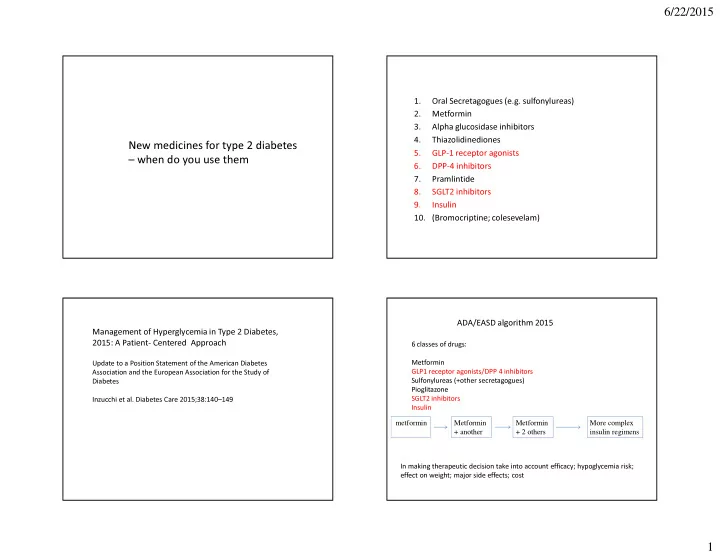
1. Oral Secretagogues (e.g. sulfonylureas) 2. Metformin 3. Alpha glucosidase inhibitors 4. Thiazolidinediones 5. GLP-1 receptor agonists 6. DPP-4 inhibitors 7. Pramlintide 8. SGLT2 inhibitors 9. Insulin
- 10. (Bromocriptine; colesevelam)
Management of Hyperglycemia in Type 2 Diabetes, 2015: A Patient- Centered Approach
Update to a Position Statement of the American Diabetes Association and the European Association for the Study of Diabetes Inzucchi et al. Diabetes Care 2015;38:140–149
ADA/EASD algorithm 2015
6 classes of drugs: Metformin GLP1 receptor agonists/DPP 4 inhibitors Sulfonylureas (+other secretagogues) Pioglitazone SGLT2 inhibitors Insulin metformin Metformin + another Metformin + 2 others More complex insulin regimens In making therapeutic decision take into account efficacy; hypoglycemia risk; effect on weight; major side effects; cost
SLIDE 2 6/22/2015 2 Glycemic targets
- Younger patients with short duration of diabetes - aiming
for an HbA1c of < 7% will reduce the risk of both microvascular and macrovascular complications (aim for 6% if it can be done safely)
- T2D patients who can easily achieve an HbA1c of < 7%
with lifestyle +/- pharmacotherapy do not need to “raise” their HbA1c
- Patients with history of severe hypoglycemia & advanced
atherosclerosis should not aim for < 7%
ages 0-6 <8.5% 6-12 <8% 13-19 <7.5%
- Elderly with limited life expectancy <8%
- Pregnancy 6 % (NICE <6.1%)
GLP-1 receptor agonists Exenatide (Byetta) (2005) Pens – 5 & 10mcg Inject SC twice daily. Do not use for GFR < 30 Exenatide LAR (Bydureon) 2mg powder Resuspend in diluent and inject SC weekly Liraglutide (Victoza) (2010) Pen – 0.6, 1.2 and 1.8 mg Usually 1.2 mg SC daily Albiglutide (Tanzeum) (2014) Pen - 30 mg Inject SC weekly Dulaglutide (Trulicity) (2014) Pen – 0.75, 1.5 mg Usually inject 0.75 mg SC weekly
SLIDE 3
6/22/2015 3
DPP 4 inhibitors Sitagliptin (Januvia) (2006) 25, 50, 100 mg 100 mg daily usual dose. Use 50 mg for GFR 30-50; 25 mg for < 30 Saxagliptin (Onglyza) (2009) 2.5, 5 mg 5 mg daily usual dose. Use 2.5 mg if GFR< 50 or if taking strong CYP/3A4 inhibitors Linagliptin (Tradjenta) (2011) 5 mg 5 mg daily Alogliptin (Nesina) (2013) 6.25,12.5,25 mg 25 mg daily usual dose. Use 12.5 mg for GFR 30-60; 6.25 mg for < 30 SGLT2 inhibitors Canagliflozin (Invokana) (2013) 100 mg, 300 mg 100 mg daily usual dose. Can use 300 for additional glucose lowering Dapagliflozin (Farxiga) (2014) 5, 10 mg 10 mg daily usual dose. Use 5 mg if liver disease Empagliflozin (Jardiance) (2014) 10,25 mg 10 mg daily usual dose. Can use 25 for additional glucose lowering Insulins U300 insulin glargine (Toujeo) (2015) 1.5 ml Pen Duration of action at least 24 hrs Technosphere insulin (Afrezza) (2014) 4 and 8 unit cartridges Peak levels in 12 to 15 minutes; duration 3 hours
GLP1 receptor agonists and DPP4 inhibitors
SLIDE 4 6/22/2015 4
- 0.9
- 0.8
- 0.7
- 0.6
- 0.5
- 0.4
- 0.3
- 0.2
- 0.1
0.1 0.2
Placebo 5 mcg 10 mcg
% HbA1c lowering
Effect of exenatide therapy for 30 wks on glycemic control and weight loss in metformin treated type 2 patients
DeFronzo et al. Diabetes 28:1092; 2005
Weight loss (kg)
Exenatide promotes weight loss when added to diet and exercise in obese nondiabetic subjects
Exenatide Placebo
Total (73)
Nausea (18) No Nausea (55)
Rosenstock et al. Diabetes Care 33: 1173 (2010)
Kg * Liraglutide 3 mg daily approved for weight loss
SLIDE 5 6/22/2015 5
GLP-1 receptor agonists DPP-4 inhibitors HbA1c lowering with monotherapy 0.5 to 1.5 % 0.4 to 0.8% Weight Decreased Neutral
These drugs have glucose dependent insulin release and have low risk for hypoglycemia
GLP-1 receptor agonists : adverse events
Placebo Exenatide (n= 483) (963) Nausea 18 % 44 % Vomiting 4 13 Diarrhea 6 13 Feeling jittery 4 9 Dizziness 6 9 Headache 6 9 Dyspepsia 3 6 Hypoglycemia risk increased if on sulfonylurea
Caution using GLP-1 receptor agonists in patients with renal impairment
FDA: 16 cases of renal kidney impairment and 62 cases of acute kidney injury in patients taking exenatide
- preexisting kidney disease
- ne or more risk factors for kidney disease.
- nausea, vomiting, and diarrhea - possible that these side
effects caused volume depletion and renal injury.
DPP4 inhibitors: adverse events
- Nasopharyngitis; upper respiratory infections
- Allergic reactions – angioedema, anaphylaxis,
exfoliative dermatologic reactions
SLIDE 6 6/22/2015 6
Cases of pancreatitis during clinical trials with GLP-1 receptor agonists Experimental drug Comparator group (placebo;
insulin) Exenatide 8 2 Liraglutide 13 1 Albiglutide 6 2 Dulaglutide 5 1
1.4-2.2 vs 0.6-0.9 cases of pancreatitis per 1000 patient years FDA reporting mechanism 30 cases of acute pancreatitis with exenatide
No cases of pancreatitis reported during clinical trials with sitagliptin and saxagliptin. FDA adverse reporting mechanism 2009 – 88 cases
- f acute pancreatitis in patients on sitagliptin
In one study with linagliptin, 8 cases of pancreatitis in 4687 patients exposed to drug (4311 patient yrs) & no cases in 1183 patients on placebo (433 patient yrs). With alogliptin there were 11 cases in 5902 patients exposed to drug (0.2%) and 5 cases in 5183 on comparator drugs (<0.1%)
Used 10ug of exenatide in rats ~ 70 times the clinical dose for 75 days * Pancreatic acinar inflammation and pyknosis The rats had 30% reduction in weight In human islet amyloid polypeptide transgenic rats, sitagliptin (200 mg/kg ~ 140 times clinical dose) increased pancreatic ductal turnover, metaplasia and induced pancreatitis in one rat **
*Nachnani et al. Diabetologia 53: 153 (2010)
**Matveyenko et al. Diabetes 58: 1604 (2009)
Acinar cells Dedifferentiated cells Pancreatic adenocarcinoma Endocrine cells Cellular plasticity within the pancreas – the potential for fully differentiated cells to change fate
Puri & Hebrok Dev Cell 18:342 (2010)
Acinar injury
SLIDE 7 6/22/2015 7
Rats given GLP1 receptor agonists developed C- cell tumors Avoid if family or personal history of MTC; MEN 2 Differences between the GLP1 receptor agonists
- GI symptoms less with weekly treatment
- Weight loss slightly greater with liraglutide
- ~ 6% of patients on exenatide develop antibodies that
attenuate glycemic response
- Albiglutide has less weight loss than exenatide and
liraglutide
Differences between the DPP4 Inhibitors
- Linagliptin- no dose adjustment for renal or liver disease
- Sitagliptin/saxagliptin/alogliptin adjust dose if renal disease
- Adjust saxgliptin dose if a strong CYP3A4/5 inhibitor is
prescribed Postmarketing study with Saxagliptin – 16, 492 T2D randomized to Saxagliptin or Placebo. Mean followup 2.1 years 289, 3.5% on Saxagliptin vs 228, 2.8% on placebo admitted to hospital for heart failure (P=0.007)
Scirica et al Circ. 130:1579 (2014) Alogliptin 106 admission for heart failu (3.1%) vs Placebo 89 (2.9%) NS (5380 patients, median followup 18 months)
SLIDE 8
6/22/2015 8 SGLT2 inhibitors
SGLT 2 inhibitors lower threshold for glycosuria to 70 to 90 mg/dl 100 mg canagliflozin lowers fasting and postprandial glucose
SLIDE 9 6/22/2015 9
Reduces threshold for glycosuria to 70 to 90 mg/dl Improves fasting and postprandial glucose levels Lowers HbA1c by 0.6 to 1 % Give 100 mg daily and if necessary 300 mg daily Weight lost ~ 5 to 10lbs; decreases systolic BP; raises HDL and LDL chol Side effects – Vaginal yeast infection (~10.4%); UTI (~ 6%); dehydration Do not use if GFR < 45 mL/min; lower dose if < 60 mL/min
Canagliflozin (Invokana)
Differences between the SGLT2 inhibitors
- Inducers of UDP-glucuronosyltransferase enzymes (e.g. rifampin,
phenytoin, phenobarbital, ritonavir) increase metabolism of canagliflozin
- Dapagliflozin- higher rates of breast cancer and bladder cancer in
clinical trials
- Canaglifozin & empagliflozin – do not use if eGFR < 45
- Dapagliflozin- do no use if eGFR < 60
Insulins
36 hr euglycemic clamp in T1D patients after 8 days of daily injections
- f insulin glargine – U100 or U300
Becker et al. Diabetes Care 38: 637 (2015)
SLIDE 10 6/22/2015 10
T1D – 0.2 units/Kg (from FDA.gov)
Results from open label clinical trials with U300 insulin glargine
In the two type 1 studies – control was the same and no difference in overall hypoglycemia rates In the six type 2 studies – control was the same; 2 of 6 studies had less hypoglycemia (glucose 70 or less; or needed help to treat low) Higher doses of U300 were required compared to U100 to achieve glycemic targets (~ 11 to 18% more insulin units) Rosselli et al J Pharm Tech 2015 Fumaryl diketopiperazine is an excipient that forms 2-2.5µm crystal (technosphere particle) that provide a large surface area for adsorption of regular insulin
Angelo et al J Diab Sci Tech 3:545 (2009)
Insulin levels after inhaled insulin vs SC insulin analog
Time to maximal glucose infusion rate : 53 mins inhaled insulin; 108 mins SC analog (back to baseline 3 hr with inhaled insulin; 4 hr with SC analog)
SLIDE 11 6/22/2015 11
Technosphere insulin - Afrezza
From: Sanofi Afrezza prescribing insert
4 unit cartridge – 0.35 mg insulin ~ 39% of dose distributed to lungs; t ½ clearance from lung epithelium ~ 1hr [1 unit SC insulin ~0.04 mg insulin]
In clinical trials, inhaled insulin boluses + SC basal insulin as effective as SC insulin analogs + SC basal insulin (or a little worse) Inhaled insulin use was associated with less symptomatic & severe hypoglycemia (e.g. severe events 8.05 vs 14.45 per 100 subject-months in T1D) FDA briefing document ~ 40 mL decline in FEV1 in first 3 months which persisted for 2 years of follow-up FDA briefing document Spirometry before prescribing, at 6 months and then annually Cough most common side effect (~27%) Bronchospasm in patients with asthma, COPD Not recommended for active smokers or recent ex-smokers
SLIDE 12 6/22/2015 12
Inhaled insulin Comparator Exubera clinical trial data * 6/4740 patients 1/4292 patients FUSE (followup study
subjects ) 2536 subjects (34%) ** 18 primary lung cancers (6 deaths) 5 primary lung cancers (2 deaths) Technosphere insulin *** 2/2750 patient yrs 0/2169 patient yrs
* All in previous cigarette smokers ** Primary lung cancer rates with Exubera 1.07/1000 patient years; Comparator 0.29/1000 patient years *** both ex smokers; and 2 cases of squamous cell lung cancers in nonsmokers after completion of trials Lung cancer and inhaled insulin
Clinical cases
ADA/EASD algorithm 2015 6 classes of drugs: Metformin GLP1 receptor agonists/DPP 4 inhibitors Sulfonylureas (+other secretagogues) Pioglitazone SGLT2 inhibitors Insulin metformin Metformin + another Metformin + 2 others More complex insulin regimens In making therapeutic decision take into account efficacy; hypoglycemia risk; effect on weight; major side effects; cost Decisions based on Efficacy – DPP4 moderate; others high Hypoglycemia risk – oral secretagogues and insulin have high risk Effect on weight – metformin, DPP4 neutral; GLP1 receptor agonists, SGLT2 inhibitors promote weight loss; oral secretagogues, insulin, pioglitazone cause weight gain Major side effects – metformin lactic acidosis pioglitazone fractures; fluid retention, possib. bladder CA GLP1 receptor agonists nausea, vomiting, possibly pancreatitis DPP4 may cause pancreatitis SGLT inhibitors – UTI; genital mycotic infections; dehydration Cost – all except metformin and oral secretagogues are expensive
SLIDE 13 6/22/2015 13
Randomized controlled study of gastric banding vs lifestyle weight loss in 60 obese patients (BMI 30 to 40) with DM < 2 years
Dixon et al. JAMA 299: 316 (2008)
Case 1 UCSF 2013 – 66 yr old Caucasian man with DM 10 yrs. BMI 39.5 (290lb). On metformin for 5yrs. Stopped and on insulin. 50 units of glargine; 20 to 30 units insulin aspart premeals (total insulin ~ 125 units daily). Peripheral neuropathy; nephropathy with urine albumin 3.1 g/g creatinine . Normal creatinine. HbA1c 8.1 % Started metformin + 40 insulin glargine; 15 to 20 insulin aspart premeals. HbA1c ~ 6.7%. Weight loss ~ 4 lbs. Exenatide initiated 6 months ago I month ago – taking 60 units of insulin a day; exenatide 10 mcg twice a day; Metformin XR 1000 daily. HbA1c 6.2 %. Weight 280 lbs. Urine albumin 1.4 g/g creatinine Suggested stop insulin and start glimepiride Case 2 UCSF 2013. 63 yr old Caucasian man with DM since his late 40s. Oral agents until age 60 when placed on insulin pump. Has proliferative retinopathy; peripheral neuropathy with toe amputation; PVD with fem-pop bypass; MI history; left nephrectomy for renal CA – creatinine 2.0. Admitted to UCSF with MRSA bacteremia with septic shock; epidural abscess. Patient before acute illness weighed 220 lbs – after hospitalization weighed 175 lbs. Excellent control
- n insulin – HbA1c 7.1%
- Oct. 2014 -- regained weight – 218 lbs; quite sedentary. HbA1c 10%. Creat 1.78
Negative antibodies for type 1 diabetes. Quite insulin resistant. Started sitagliptin 25 mg daily Jan 2015 – HbA1c 8.9%. Add glipizide 5 mg BID April 2015 – HbA1c 8 %
SLIDE 14 6/22/2015 14
Case 3 54 yr old Caucasian man with DM for 10 years. No complications. BMI 27.5 On metformin, glimepiride, insulin detemir (40 Units). Intolerant of GLP-1 receptor
Started on Canagliflozin 300 mg daily 2 months later – BG low 100’s; HbA1c 6.7 %; insulin detemir dose reduced. No polyuria. No infections Case 4 84 year old woman with DM for 12 yrs. BMI 41 On metformin 1000 bid, glimepiride 4 mg/day HbA1c 8.5 %. Fingerstix glucose high 100’s to low 200’s Would prefer pills to injections Canagliflozin 100 mg daily 1 week later called complain of vulvar itching and rash Canagliflozin stopped; yeast infection treated A cautionary case: SGLT2 inhibitor use in type 1 diabetes 23 year old Caucasian woman with T1D since age 8 – on injections HbA1c around 8 % Started on Canagliflozin Sept 2014 Glucose levels dropped and so insulin doses were gradually decreased Insulin glargine dose reduced 30 to 10 to 8 to 2; also significant decrease in bolus insulin doses Admitted to hospital with nausea, vomiting, dehydration and ketoacidosis A case of needle phobia Diabetes clinic 2012. 53 yr old Vietnamese woman with diabetes since age 37. BMI 18. Initially treated as type 2 diabetes. HbA1c 8-12 GAD antibody +ve Refused to inject insulin even though she agreed that the needles were almost painless (refused to use syringes or pens)
SLIDE 15
6/22/2015 15
Given Novofine autocover needles Now on basal bolus insulin regimen (4 injections a day) HbA1c 6.9 to 7.4 % Dulaglutide pen – you cannot see the needle Wolpert Diab Care 2008 Stacking can be an issue for T1D patients who are on pumps and sensors and inhaled insulin would reduce the risk of hypoglycemia Costs for 1 month supply (standard doses; Walgreens, Costco) Metformin (4 ); glipizide (5); repaglinide (50) Pioglitazone (12) Acarbose (48) DPP4 inhibitors ( ~ 330 ) SGLT2 inhibitors ( ~ 370) GLP1 receptor agonists (~500) Analog insulins ( ~ 400) Old insulins ( ~ 150) Make your own toolkit Metformin Oral secretagogues – glipizide, glimepiride, nateglinide, repaglinide DPP4 inhibitors – sitagliptin GLP-1 receptor agonists – exenatide, liraglutide Insulins – glargine U100, aspart, lispro, some premixed; NPH, Regular ( an SGLT2 inhibitor in the future?)