Disclosure I have served as an expert in litigation Tony Mazzocchi - - PDF document

disclosure i have served as an expert in litigation tony
SMART_READER_LITE
LIVE PREVIEW

Disclosure I have served as an expert in litigation Tony Mazzocchi - - PDF document

Taking t ng the o occupati pational a onal and e envir vironment onmental h l histor ory y Center for Surveillance, Epidemiology, and Laboratory Services wh why it y it matter matters Robert Harrison, MD, MPH University of


slide-1
SLIDE 1

Center for Surveillance, Epidemiology, and Laboratory Services

Robert Harrison, MD, MPH

University of California, San Francisco & California Department of Public Health

Taking t ng the o

  • ccupati

pational a

  • nal and e

envir vironment

  • nmental h

l histor

  • ry –

y – wh why it y it matter matters

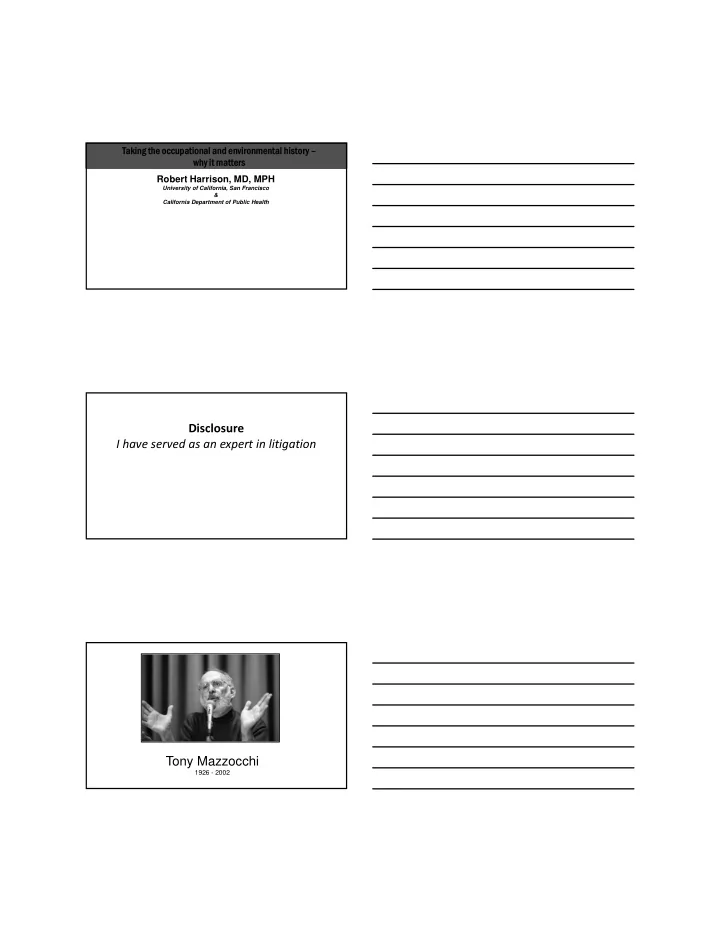
Disclosure I have served as an expert in litigation Tony Mazzocchi

1926 - 2002

slide-2
SLIDE 2
  • Take an occupational history
  • Inform workers
  • Connect the dots

Take an occupational history

  • 24 y.o. male with 8 months numbness and

tingling of extremities, poor concentration, decreased memory. Treated with high dose steroids x 3 months.

  • PE: decreased vibration, pin, light touch.

Broad based gait.

slide-3
SLIDE 3
  • 1. What is your job (what kind of work do you do)?
  • 2. Tell me (exactly) what you do at work.
  • 3. Do you work around any chemicals, dusts, or fumes?

The basic occupational health history

  • 1. Prior work history
  • 2. Names of products, Safety Data Sheets
  • 3. Air monitoring results
  • 4. Duration and intensity of exposure
  • 5. Temporality of symptoms
  • 6. Hierarchy of controls
  • 7. Toxicology and epidemiology research

The advanced occupational health history*

*Probably needs referral to OH provider

slide-4
SLIDE 4

No search on Google images shows use of brake cleaner

slide-5
SLIDE 5
  • Cleaned brake linings and wheel wells

with n-hexane x 18 months

  • Nerve conduction: decreased velocity and

prolonged distal latencies

  • Removed from exposure with slow

improvement

Peripheral neuropathy due to n-hexane

slide-6
SLIDE 6
  • N‐hexane removed from brake cleaners
  • No exposure to workers (UCB study)
  • “Green chemistry” law in California

Inform workers

slide-7
SLIDE 7

Irma Ortiz

  • 40 y.o. woman
  • Mixed dry powder with

diacetyl x 5 years

  • Symptoms of shortness
  • f breath and cough.

Treated for asthma.

  • FEV1 = 0.55 L (18%

predicted). HRCT with ground glass opacities.

California Department of Health Services http://www.dhs.ca.gov/ohb/flavorings.htm Baltimore Sun - April 23, 2006 Sacramento Bee - July 30, 2006

Nov November 23, 23, 19 1992, Terri Bonar-Stewart received a letter dated November 17, 1992 from the Montgomery County Ohio Coroner's Office regarding investigating the death of Ms. I, a former employee of Fries & Fries.: Ms. I had been on disability leave since 1987, and the coroner requested any reports and health records related to that disability. De December 4.

  • 4. 199

1992: Jim Steinke reported that during a casual conversation with his neighbor, Joseph Thorpe, M.D., Dr. Thorpe expressed a concern that he had been treating one current and one former Tastemaker employee for a condition which he defined as bronchiolitis obliterans. According to Dr. Steinke, Dr. Thorpe noted that bronchiolitis obliterans is an unusual disease, and having two cases of the disease at one site was cause for concern. He noted that the former employee, Ms. JMI was deceased and that he had listed the cause of death as bronchiolitis obliterans. He also identified the other employee as Mr. JW. Mr. W was currently on medical disability leave. Mr. Mike Davis scheduled a meeting for December 8, 1992 to discuss Dr. Thorpe's concern and to establish an action plan.” Egilman 2007 IJOEH; internal company memos
slide-8
SLIDE 8

1995: 995: Pulmonary consultant #1: “what we -- what I had was several -- I think five or six, somewhere around that, cases of individuals who had been employed in the company who developed asthma and who had a clinical picture of bronchiolitis obliterans and who had in some cases biopsies, lung biopsies, which substantiated that diagnosis.” 1995: 995: Pulmonary consultant #2: “diacetyl – this would be added to the butter. It would reach a certain temperature and flash. He subsequently would awaken at night with chest tightness and cough and difficulty breathing… This occurred two to three times per week until the butter operation was transferred to the spray dry area approximately two years prior to this evaluation.” [Diagnosis: bronchiolitis obliterans]

Both consultants had signed non‐disclosure agreements

Source: deposition testimony, various cases

NIOSH was not notified and never did an investigation at Givaudan

Gilster‐Mary Lee Corporation Jasper, MO

slide-9
SLIDE 9
  • NIOSH study at “sentinel”

microwave popcorn plant

  • 4 of 8 workers on lung

transplant list

  • One recent death
  • Airways obstruction in

popcorn workers related to cumulative diacetyl exposure levels (dose-response relationship)

5 10 15 20 25 30 35 40 Lowest quartile Second Third Highest quartile

% affected

Cumulative diacetyl exposure quartiles Abnormal Spirometry by Diacetyl Exposure

Kreiss K et al. Clinical bronchiolitis obliterans in workers at a microwave popcorn plant. NEJM 347:330 (2002).

Petition for emergency standard CalOSHA

  • AFL/CIO petition for

emergency standard granted by Standards Board 1/18/07

  • Advisory meetings held

9/28/06, 2/13/07, 3/21/07, and 5/18/07

  • Public hearing 11/19/09
  • Final standard passed

September 16, 2010

slide-10
SLIDE 10

Connect the dots

Ph Photo –

  • – Mike Sorag

e Soraghan

January January 7, 7, 2012 2012 Mar Maratho athon Oi n Oil well l well si site te Di Dickinson, ND ND

slide-11
SLIDE 11

Ph Photo –

  • – Mike Sorag

e Soraghan

Ju July 9, ly 9, 2010 2010 XTO XTO En Energy ergy o

  • il w

l well ll s site te Lamber Lambert, MT MT

slide-12
SLIDE 12

Jul July 9, 9, 201 2010 EMS ru EMS run n n notes tes Jul July 9, 9, 201 2010 Sidney ey Health th C Center er E Emerge gency ncy D Department Sidn Sidney, MT , MT

July 9 ly 9, 2 2010 10 Sidney H dney Health C th Center E nter Emergency ergency Department rtment Sid Sidney ey, MT MT

slide-13
SLIDE 13
slide-14
SLIDE 14

Sep September 9, 9, 20 2013 Sep September 29, 29, 20 2011

slide-15
SLIDE 15

Si Silicos licosis is c case se s summa mmary, Ca Californi lifornia (J a (Janua anuary 2 2019 - 19 - Feb ebruary 2 y 2020) 0) N N = = 10 conf 10 confirmed ( (6 ali alive and and 4 4 dea deaths)

Data Data sour source Out Outcom

  • me

Comme

  • mments

Cas Case #1 #1 “Se “Sentinel” Hospital discharge Confirmed, died 2018 Contact tracing of relative Cas Case #2 #2 Relative of Case #1 Confirmed, died 2018 Lung tissue from coroner Case ses # s #3-6 Worksite case investigation Confirmed Collaboration with CalOSHA Case ses # s #7- 12 12 Silica medical examinations

  • f sentinel worksite

Possible, pending pulmonary evaluation F/u with company, Concentra and pulmonary specialist Cas Case #13 #13 Hospital discharge Confirmed, died 2014 Outpatient records, telephone interview with friend Cas Case #14 #14 Kaiser OM department Confirmed Worksite visit Cas Case #15 #15 WC attorney to UCSF Confirmed Information to QME for claim approval Cas Case #16 #16 Hospital discharge Confirmed, died 2017 Interview with family

  • Warning signal to improve care and/or prevention
  • Lead to epidemiologic or IH study
  • Assist the HCP in diagnosis and treatment

AJPH 1983 AJPH 1983

slide-16
SLIDE 16

Asbestosis Byssinosis Chronic beryllium disease Coal Workers Pneumoconiosis Extrinsic Allergic Alveolitis Mesothelioma Scrotal Cancer Silicosis Silicotuberculosis Talcosis

Inher Inherently occupational ntly occupational

Center for Surveillance, Epidemiology, and Laboratory Services

Taking t ng the o

  • ccupati

pational a

  • nal and e

envir vironment

  • nmental h

l histor

  • ry –

y – wh why it y it matter matters

slide-17
SLIDE 17

Pedro Alarcon 1969‐2017

Which of these questions are part of a comprehensive occupational history?

  • A. Prior jobs and exposures
  • B. Use of personal protective equipment
  • C. Names of chemicals or products
  • D. All of the above

You diagnose a serious occupational disease among five cases at one company. What is the most effective preventive action to take?

  • A. Sign a non‐disclosure agreement as a consultant to

the company

  • B. Report the cases to OSHA or the State public

health agency

  • C. Continue treatment and not inform anyone
  • D. Check with your malpractice lawyer
slide-18
SLIDE 18

A Sentinel Health Event (Occupational)

  • A. Is a disease, disability or death that is legally

established as caused by work

  • B. Must be proven by epidemiological or industrial

hygiene studies

  • C. Should trigger regulatory or public health

investigations that can prevent more disease

  • D. Requires the employer to implement engineering

controls or personal protective equipment