#5: More Coulombs Law Electric force : one of the fundamental forces - - PowerPoint PPT Presentation

5 more coulomb s law
SMART_READER_LITE
LIVE PREVIEW

#5: More Coulombs Law Electric force : one of the fundamental forces - - PowerPoint PPT Presentation

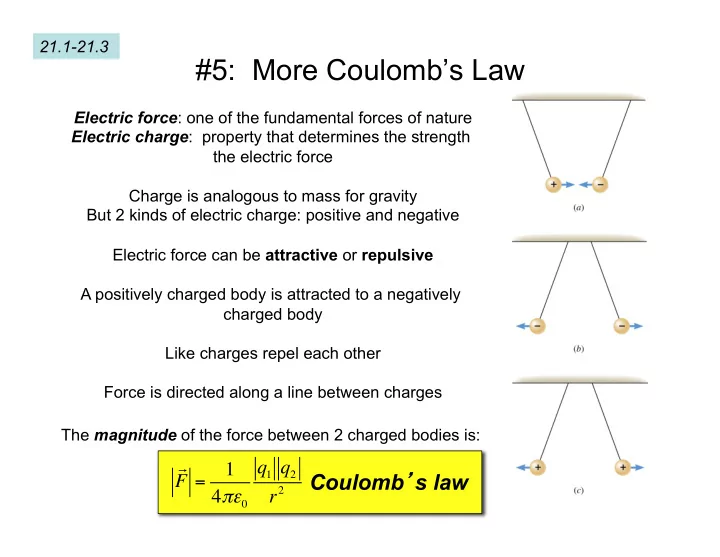
21.1-21.3 #5: More Coulombs Law Electric force : one of the fundamental forces of nature Electric charge : property that determines the strength the electric force Charge is analogous to mass for gravity But 2 kinds of electric charge:


slide-1
SLIDE 1

#5: More Coulomb’s Law

Electric force: one of the fundamental forces of nature Electric charge: property that determines the strength the electric force Charge is analogous to mass for gravity But 2 kinds of electric charge: positive and negative Electric force can be attractive or repulsive A positively charged body is attracted to a negatively charged body Like charges repel each other Force is directed along a line between charges

 F = 1 4πε0 q1 q2 r2

The magnitude of the force between 2 charged bodies is:

Coulomb’s law

21.1-21.3

slide-2
SLIDE 2

Constants and units

  • Charge on an electron exactly equals that of a proton (1.602x10⁻¹⁹ Coulombs)

Not to scale 10-13 cm

1 4πε0 = k = 9×10⁹ N ⋅m2 C2

ε0

Vacuum permittivity or “permittivity of free space” Current (SI unit = Ampere) is the amount of charge that moves through a point or region in a given time

i = dq dt

Coulomb is the SI unit for charge

A = C s

ε0 = 8.85×10⁻¹² C2 N ⋅m2

 F = 1 4πε0 q1 q2 r2

slide-3
SLIDE 3

Charles Coulomb

(1736-1806) Born: Angoulême, Fr 1764-1772 Military assignment in Martinique Theory of retaining walls (1776) Favorite invention: Used a torsion balance to show:

F = k q1 q2 r2

The SI unit of charge is named for him One of 72 French scientists commemorated by Gustave Eiffel

slide-4
SLIDE 4

Conservation of Charge

Electric charge is a fundamental property of particles, but is it really conserved? Particles can be created and destroyed. Neutrons are unstable! They “live” for about 816 seconds

n

A neutron spontaneously changes itself into 3 particles: proton, electron and antineutrino

p e

ν

But the charge on an electron and the charge on a proton are equal and opposite so charge is conserved in the process. β decay This process is called beta (β) decay The conservation of electric charge is one of the most fundamental laws and results directly from inherent symmetries in quantum electrodynamics. In nuclei, beta decay can also convert protons into neutrons: p → n + e+ + ν

slide-5
SLIDE 5

Antimatter & PET

All particles have a corresponding antiparticle - which differs only by its charge. A particle and its antiparticle can annihilate, producing only EM waves - γ rays!

e- + e+ → γ + γ

Is the basis for PET (Positron-Emission Tomography) For example, you might inject a liquid that contains glucose manufactured with an isotope that decays by β+ emission The positron travels only a short distance before annihilating. Two gamma rays leave in

  • pposite directions and are

detected by a ring of detectors. A full 3D image can be constructed

  • f metabolic processes!
slide-6
SLIDE 6

Coulomb’s Law - Vector Form

Force is directed along a line between charges

 r

12

Vector is location of particle 1 relative to particle 2

q1 ¡ q2 ¡

 r

12

ˆ r

12

 F

12

 F

21

q1 ¡ q2 ¡

 r

12

ˆ r

12

 F

12

 F

21

Like charges → force in direction of unit vector

ˆ r

12

 F

12 =

1 4πε0 q1q2 r

12 2

ˆ r

12

Opposite charges → force in opposite direction of unit vector

ˆ r

12

In either case, we can write the force as The force on particle 2 is equal in magnitude but

  • pposite in direction from the force on particle 1

More than 2 particles? Add vectors!!

 F

1 = 

F

12 +

 F

13 +

 F

14 +

slide-7
SLIDE 7

Concept question Three positive charges are arranged in a line as shown. Which particle feels the greatest force? A. Left B. Middle C. Right D. All feel the same force. E. The two 1C charges feel the same (larger) force.

1C 2C 1C 1m 2m

slide-8
SLIDE 8

Concept question Same situation, but the left charge is negative. Which particle feels the greatest force? A. Left B. Middle C. Right D. All feel the same force. E. The +1C and -1C charges feel the same (larger) force.

  • 1C

2C 1C 1m 2m

slide-9
SLIDE 9

y x

Four charges are arranged at the corners of a rectangle as shown in the figure. If q1 and q2 are alpha particles (helium nuclei with charge +2e), then (a) What is the magnitude and direction of the force on q2? (b) Write the force on q2 in unit vector notation. (c) What is the magnitude and direction of the net force on the electron that lies on the x-axis?

4cm

q1 q2

  • e
  • e

3cm

slide-10
SLIDE 10

How neutral are atoms?

Suppose that two objects weighing one gram are separated by 10 m. If we remove an electron from 1 out of every million atoms in each

  • bject, what is the force between the two objects?

If the objects are made out of carbon, then they contain

1g⋅ mole 12g = 1 12 mole = 1 12 6.0 ×10²³atoms = 0.5 ×10²³atoms

The charge q on each object is then:

q = 1 106 0.5 ×10²³atoms

( ) 1.6 ×10⁻¹⁹C ( ) = 0.8 ×10⁻²C = 8mC

We can then calculate the force using Coulomb’s Law

F = 9 ×10⁹ N ⋅ m2 C2 $ % & ' ( ) q1 q2 r2

= 9 ×10⁹ N ⋅ m2 C2 $ % & ' ( ) 8 ×10⁻³C

( ) 8 ×10⁻³C ( )

10m

( )

2

5760 N

slide-11
SLIDE 11

(a) Two tiny conducting spheres are identical and carry charges of -20.0 µC and +53.0 µC. They are separated by a distance of 2.50 cm. What is the magnitude

  • f the force each sphere experiences, and is it attractive or repulsive?

F = k q1 q2 r2

k = 9 ×10⁹ N ⋅ m2 C2 q1 = −20µC 10−6C µC # $ % & ' ( = −2.0 ×10⁻⁵C

q2 = 53µC 10−6C µC # $ % & ' ( = 5.3×10⁻⁵C

r = 2.5cm 1m 100cm " # $ % & ' = 0.025m

F = 9 ×10⁹ N ⋅ m2 C2 $ % & ' ( ) 2.0 ×10⁻⁵C

( ) 5.3×10⁻⁵C ( )

0.025m

( )

2

=15,000N

(b) If we touch the two spheres to each

  • ther and then place them back 2.50 cm

apart, what is the force between them?

Qtot = −20µC + 53µC = 33µC

When we touch the two spheres the total charge becomes shared equally between the two:

q1 = q2 = 1 2 ⋅ 33µC 10−6C µC $ % & ' ( ) =1.65 ×10⁻⁵C

Attractive

F = 9 ×10⁹ N ⋅ m2 C2 $ % & ' ( ) 1.65 ×10⁻⁵C

( ) 1.65 ×10⁻⁵C ( )

0.025m

( )

2

= 3900N

Respulsive