3/9/2017 STUDENT ASSESSMENT EXPERIENCES THE RELATED TO PRACTICE - - PDF document

3 9 2017
SMART_READER_LITE
LIVE PREVIEW

3/9/2017 STUDENT ASSESSMENT EXPERIENCES THE RELATED TO PRACTICE - - PDF document

3/9/2017 STUDENT ASSESSMENT EXPERIENCES THE RELATED TO PRACTICE EDUCATION RESEARCH INTEREST: A qualitative interview study underpinned by phenomenology and hermeneutics Student assessment experiences Dr Jane Morris & Dr Pirjo


slide-1
SLIDE 1

3/9/2017 1

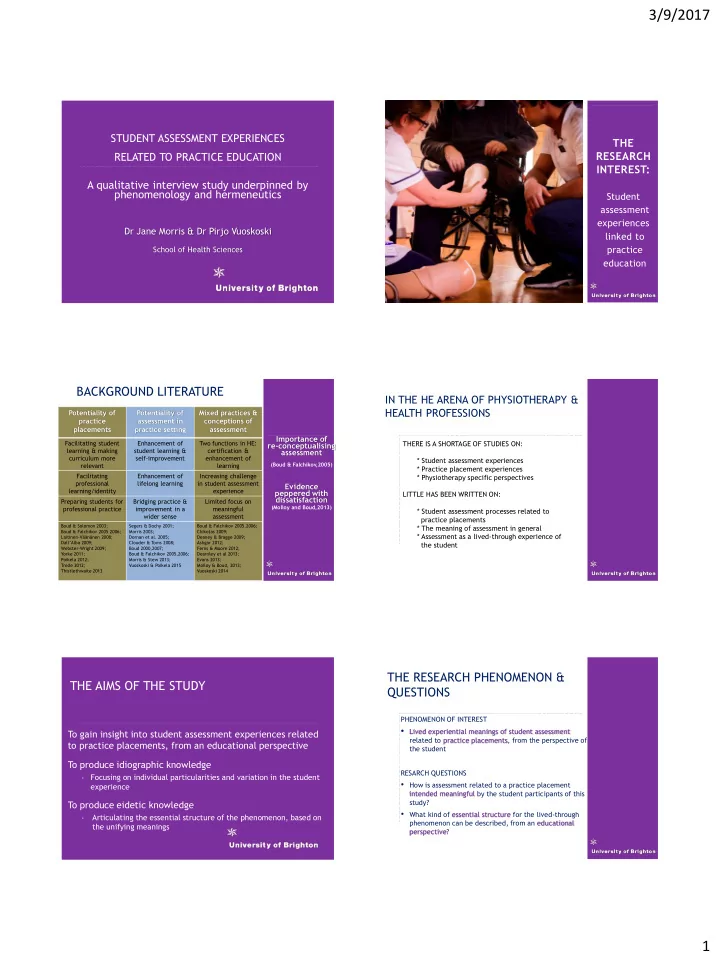
STUDENT ASSESSMENT EXPERIENCES RELATED TO PRACTICE EDUCATION A qualitative interview study underpinned by phenomenology and hermeneutics

Dr Jane Morris & Dr Pirjo Vuoskoski

School of Health Sciences

THE RESEARCH INTEREST:

Student assessment experiences linked to practice education

Potentiality of practice placements Potentiality of assessment in practice setting Mixed practices & conceptions of assessment

Facilitating student learning & making curriculum more relevant Enhancement of student learning & self-improvement Two functions in HE: certification & enhancement of learning Facilitating professional learning/identity Enhancement of lifelong learning Increasing challenge in student assessment experience Preparing students for professional practice Bridging practice & improvement in a wider sense Limited focus on meaningful assessment

Boud & Solomon 2003; Boud & Falchikov 2005 2006; Laitinen-Väänänen 2008; Dall’Alba 2009; Webster-Wright 2009; Yorke 2011; Poikela 2012; Trede 2012; Thistlethwaite 2013 Segers & Dochy 2001; Morris 2003; Dornan et al. 2005; Clouder & Toms 2008; Boud 2000,2007; Boud & Falchikov 2005,2006; Morris & Stew 2013; Vuoskoski & Poikela 2015 Boud & Falchikov 2005,2006; Chikotas 2009; Deaney & Bragge 2009; Ashgar 2012; Ferns & Moore 2012; Dearnley et al 2013; Evans 2013; Molloy & Boud, 2013; Vuoskoski 2014

BACKGROUND LITERATURE

Importance of re-conceptualising assessment

(Boud & Falchikov,2005)

Evidence peppered with dissatisfaction

(Molloy and Boud,2013)

IN THE HE ARENA OF PHYSIOTHERAPY & HEALTH PROFESSIONS

THERE IS A SHORTAGE OF STUDIES ON: * Student assessment experiences * Practice placement experiences * Physiotherapy specific perspectives LITTLE HAS BEEN WRITTEN ON: * Student assessment processes related to practice placements * The meaning of assessment in general * Assessment as a lived-through experience of the student

To gain insight into student assessment experiences related to practice placements, from an educational perspective To produce idiographic knowledge

  • Focusing on individual particularities and variation in the student

experience

To produce eidetic knowledge

  • Articulating the essential structure of the phenomenon, based on

the unifying meanings

THE AIMS OF THE STUDY THE RESEARCH PHENOMENON & QUESTIONS

PHENOMENON OF INTEREST

  • Lived experiential meanings of student assessment

related to practice placements, from the perspective of the student RESARCH QUESTIONS

  • How is assessment related to a practice placement

intended meaningful by the student participants of this study?

  • What kind of essential structure for the lived-through

phenomenon can be described, from an educational perspective?

slide-2
SLIDE 2

3/9/2017 2

RESEARCH CONTEXT

The practice learning environment

  • Complex learning environments

challenge assessment strategies

  • Current challenges of Health and

Social Care

  • Discontent with feedback and

assessment

  • National Student Survey

(NSS,2016)

RESEARCH CONTEXT (cont.)

T wo pre-registration courses (BSc & MSc) at University of Brighton

  • The notion of student assessment

refers to

  • Student assessment process
  • Professional practice setting
  • Integral & mandatory part of the

HE process and course curriculum

  • 6-week period
  • Mandatory total of 1000 hours

RESEARCH CONTEXT (cont.)

Assessment in practice

  • A mark contributing towards the

degree classification

  • The placement is marked/graded

based on specific criteria within the assessment tool

  • Senior physiotherapists in their role

as practice educators facilitate and assess student learning

  • A qualitative phenomenological approach
  • Both descriptive and interpretive phenomenological

strategies will be implemented

  • Therefore, a combination of phenomenological and

hermeneutic design has been chosen to the study

METHODOLOGICAL BACKGROUND

PHENOMENOLOGY & HERMENEUTICS

Shared interest in the human lifeworld, as the world of lived experiences

  • Primacy of this subjective lifeworld and its

relatedness to specific situations and contexts

  • This world is directly given in our experience,

fundamentally characterised by meaning

  • The two positions also differ - in how these

experiences in terms of lived experiential meanings are understood, accessed & analysed

  • Individual interviews of 3-6 student volunteers

(audiorecorded, transcribed verbatim, same interviewer)

  • In-depth interview techniques to seek as complete a

description as possible of the assessment experience

  • Phenomenological descriptive and interpretive

strategies implemented in analysing the data

RESEARCH METHODS

slide-3
SLIDE 3

3/9/2017 3

EMERGING THOUGHTS BASED ON THE DATA

  • Sense of dissonance between ‘learning‘

and ‘marks’

“Because my first one [placement] I didn’t do too well mark-wise, but I got to see a lot and experience a lot, and learn a lot, but marking wise it wasn’t too great” (P1) “That’s very clear on how to get good grades…..it’s just that consistency part you need…so I could tick all the boxes in there, but whether I can actually show them to my educator …it’s not clear how to….it is proving it” (P3)

  • Sense of dissonance between ‘learning‘

and ‘marks’

“we agreed on certain… certain things that I could do in my practice that would mean I would be in a certain grade boundary, and that was really helpful to begin with, knowing that I could go on for the rest of the placement thinking that actually if I do this I know I’m going to be roughly there, so… that was good for my practice so that I had something to aim towards really” (P2)

  • Sense of variation in the educator’s

approach

Example of the 1st educator: “But I felt kind of more pressurised as they were there kind of looking at you, and seeing how you where doing it.. and it felt more.. like an exam” (P1) Example of the 2nd educator: “The educator was really relaxed… she would also step back a little bit… and be a little bit off the side.. I was used to feeling more comfortable.. and just allowing you to do as much as you can..” (P1)

  • Sense of being empowered

“I was given the options of either recollecting of all my thoughts, or, if I felt ready, then we could discuss it.. and find out more of things that I ought to have looked

  • ver more, or that I’d done really well, and that would

help me kind of reflect for the next time… on what I’ve done good” (P1)

  • Sense of being disempowered
  • “and sometimes it’s hard for them (the educators) to

keep their mouth shut as well…. ‘they say oh it was good you did that because of this’ but you don’t get a chance to say ‘well that’s what I was thinking’, they kind of say it for you”(P3)

  • “ but I think when your on placement it’s hard for

you to .. if your educator is saying something, you don’t want to say something and come across as being rude or undermining them, because they are the ones that are going to be grading you” (P 3)

  • Sense of reflection for learning

“ the first week it was more spent watching her with the patients…asking questions….and after seeing a patient I would go everything with her which was good, so I was not just watching I was learning” (P3) “and as the weeks went on…then it was ok we want you to do a subjective assessment, so they would watch me to do that and then she would go over it with me….so it wasn’t like I was left on my own” (P3) “the beginning of week three I started doing all the

  • bjectives and the treatment plans again with her there,

and a few times I was on my own, but they were always within reach, so I could go and say I wasn’t sure about this” (P3)

slide-4
SLIDE 4

3/9/2017 4

EMERGING THEMES

  • Sense of dissonance between ‘learning‘ and ‘marks’
  • Sense of variation in the educator’s approach
  • Sense of being empowered
  • Sense of being disempowered
  • Sense of reflection for learning

How do these themes resonate with your own experience?