3/27/2015 Mitigation of Exposure to False Claims on Cost or Pricing - - PDF document

3 27 2015
SMART_READER_LITE
LIVE PREVIEW

3/27/2015 Mitigation of Exposure to False Claims on Cost or Pricing - - PDF document

3/27/2015 Mitigation of Exposure to False Claims on Cost or Pricing Issues Presented by Matthew R. Krafft Senior Managing Director Construction, Environmental and Government Contracts Group March 13, 2015 FTI Consulting, Inc. Who We


slide-1
SLIDE 1

3/27/2015 1

Mitigation of Exposure to False Claims on Cost or Pricing Issues

Presented by Matthew R. Krafft Senior Managing Director – Construction, Environmental and Government Contracts Group

March 13, 2015

FTI Consulting, Inc. – Who We Are

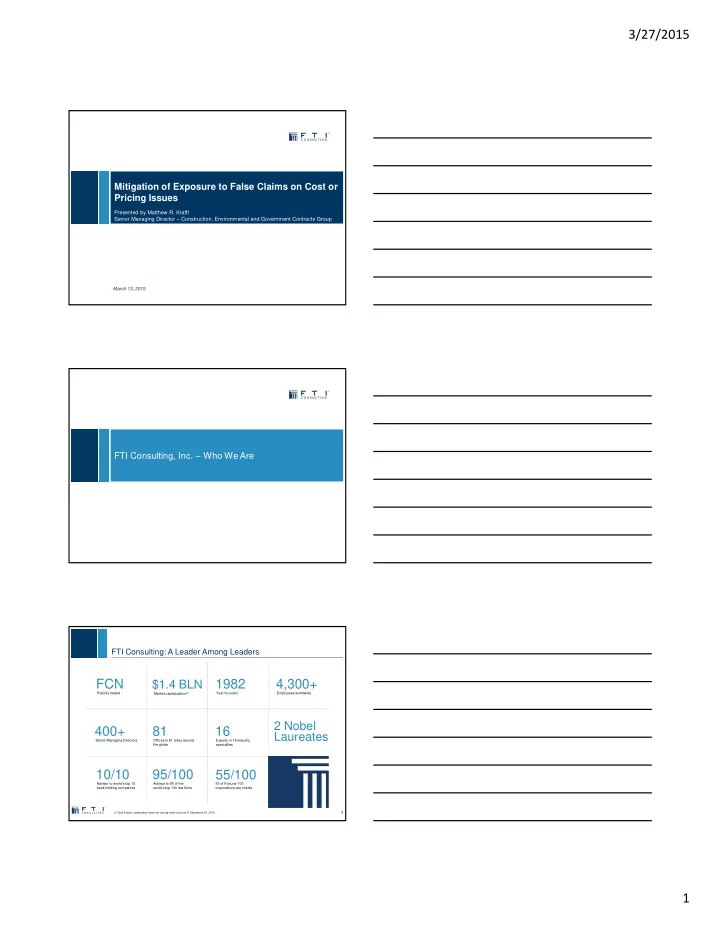
FTI Consulting: A Leader Among Leaders

3

FCN

Publicly traded

$1.4 BLN

1982

Year founded

4,300+

Employees worldwide

400+

Senior Managing Directors

16

Experts in 16 industry specialties

2 Nobel Laureates

10/10

Advisor to world’s top 10 bank holding companies

95/100

Advisor to 95 of the world’s top 100 law firms

55/100

55 of Fortune 100 corporations are clients

81

Offices in 81 cities around the globe Market capitalization(1)

(1)Total Shares outstanding times the closing share price as of September 30, 2014.

slide-2
SLIDE 2

3/27/2015 2

Three Pillars of Strength

4

Industry Expertise Geographic Coverage

Asia Pacific Beijing Hong Kong Singapore Sydney Tokyo Europe, Middle East, Africa Abu Dhabi Brussels Cape Town London Paris Latin America Bogotá Buenos Aires Mexico City Panama City São Paulo North America Boston Chicago Los Angeles New York City San Francisco

Specialist Skills

Bankruptcy Process Computer Forensics Corporate Communications e-discovery Financial Communications Forensic Accounting Global Risk and Investigations International Arbitration Transaction Advisory Valuation Aerospace & Defense Agriculture Automotive Construction & Environmental Energy, Power & Products Financial Institutions Government & Public Contracts Healthcare & Life Sciences Hospitality, Gaming & Leisure Information Technology Insurance Mining Real Estate Retail & Consumer Products Telecom, Media & Technology Transportation

FTI Consulting Segments and Practices

5

Corporate Finance/ Restructuring Economic Consulting Forensic & Litigation Consulting Strategic Communications Technology

Bankruptcy Support Services Interim Management Investment Banking Litigation Support Office of the CFO Performance Improvement Private Equity Advisory Restructuring/Turnaround Services Transaction Advisory Services Valuation & Financial Advisory Services Antitrust & Competition Economics Business Valuation Center for Healthcare Economics and Policy Intellectual Property International Arbitration Labor & Employment Public Policy Regulated Industries Securities Litigation & Risk Management Business Insurance Claims Compliance, Monitoring & Receivership Construction,& Environmental and Government Contract Solutions Dispute Advisory Services Financial & Data Enterprise Analytics Financial Services Forensic Accounting & Advisory Services Global Risk & Investigations Practice Health Solutions Insurance Intellectual Property Trial Services Corporate Communications Creative Engagement and Digital Communications Crisis Communications Employee Engagement and Change Communications Financial Communications Litigation Communications M&A Communications Public Affairs Restructuring and Financial Issues Shareholder Activism and Proxy Advisory Strategy Consulting & Research Computer Forensics & Investigations Discovery Consulting e-discovery Software & Services

FTI Construction, Environmental and Government Contracts (CEGC)

Introduction

Clients ■ Public and Private ■ Owners and Contractors ■ Construction Attorneys ■ Government Agencies Geography ■ North and South America ■ Europe ■ Asia ■ Middle East Industries ■ Infrastructure ■ Transportation ■ Oil and Gas, Pipelines ■ Power Generation ■ Healthcare ■ Hospitality and Gaming ■ Environmental ■ Mining and Metals ■ Industrial ■ Institutional ■ Education Facilities Services ■ Construction Advisory ■ Risk Management Strategies ■ Program Management and Project Monitoring ■ Labor and Productivity Analysis ■ CPM Scheduling and Schedule Analysis ■ Accounting and Cost Analysis ■ Project Auditing ■ Damages Qualification ■ Claims Preparation and Analysis ■ Dispute Resolution ■ Expert Testimony ■ Government Contracts ■ Fraud Investigations and Forensic Accounting

FTI CEGC has the capability to mobilize globally to analyze, evaluate and advise

  • n every

phase of design and construction , for both public and private entities.

6
slide-3
SLIDE 3

3/27/2015 3

United States Atlanta, GA Denver, CO Great Neck, NY Houston, TX Los Angeles, CA Miami, FL New York, NY Rockville, MD San Francisco, CA Seattle, WA Washington, DC

FTI Consulting, Inc. – Construction Solutions - Offices

International Abu Dhabi, UAE Doha, Qatar Dubai, UAE Hong Kong London, United Kingdom Northampton, United Kingdom Perth, Australia Rio de Janeiro, Brazil Sao Paulo, Brazil Singapore Stirling, Scotland

7

False Claims Act

  • The American Civil War (1861–1865) was marked by fraud on all

levels, both in the Union north and the Confederate south. During the war, unscrupulous contractors sold the Union Army decrepit horses and mules in ill health, faulty rifles and ammunition, and rancid rations and provisions, among other unscrupulous actions.[1] In response, Congress passed the False Claims Act on March 2, 1863.

  • The law includes a "qui tam" provision that allows people

who are not affiliated with the government to file actions on behalf of the government (informally called "whistleblowing"). Persons filing under the Act stand to receive a portion (usually about 15–25 percent) of any recovered damages.

  • 1. From Wikipedia, the free encyclopedia

False Claims Act Overview – Historical Context

9

slide-4
SLIDE 4

3/27/2015 4

Substantive Violations of the FCA

■ Submitting a false or fraudulent claim for payment or approval. ■ Making or using a false record or statement material to a false or fraudulent claim. ■ Conspiracy to violate the FCA. ■ Keeping government money or avoiding an obligation owed to the government (reverse false claim) – Overpayments are “obligations” to the government

10

Truth in Negotiations Act (TINA) “TINA”, was enacted on September 10, 1962. Federal Law whose purpose is to protect the Government from defective pricing when negotiating Contracts with an award value of $700,000 or more. Requires the contractor to submit cost or pricing data that is certified to be Accurate, Complete and Current as of the date of agreement on price. Provides for flowdowns to subcontractors. Truth In Negotiations Act Overview – Historical Context

12

slide-5
SLIDE 5

3/27/2015 5

Certification Language – FAR Part 15

13

“This is to certify that, to the best of my knowledge and belief, the cost

  • r pricing data (as Defined in Section 15.401 of the Federal Acquisition

Regulation (FAR) and required under FAR Subsection15.403-4) submitted, either actually or by specific identification in writing, to the contracting officer or to the contracting officer‘s representative in support of [THIS PROPOSAL] are accurate, complete, and current as of [THE DATE OF AGREEMENT UPON PRICE]. This certification includes the cost or pricing data supporting any advance agreements and forward pricing rate agreements between the offeror and the government that are part of the proposal.”

False Claims Act Compared to Truth in Negotiations Act (TINA) False Claims Compared to Defective Pricing

  • The concept of Defective Pricing and False Claims closely related;
  • Do not need to have a certification to have a False Claim allegation;
  • Not necessary for claim to have been paid.
  • Concept of ‘reckless disregard’ can be used as the basis for a False

Claim allegation;

  • FCA provides for treble damages plus civil penalty of $5,500 -

$11,000 per violation.

  • Permits whistle-blowers (qui tam relators) to bring action in return for

a share of the recovery.

15

slide-6
SLIDE 6

3/27/2015 6

False Claims Compared to Defective Pricing (Cont’d)

Price Reduction Clause (FAR 52.215-10) for “defective pricing” when: ■ The Contractor does not submit accurate, complete or current cost or price data. ■ The Government has relied on the defective data in determining the contract price. The Government is entitled to interest and penalties

16

FAR Part 15 Contracting by Negotiation Codifies the Truth in Negotiations Act Requires submission of “cost or pricing data” Data must be “accurate, complete and current” Must be “as of the date of agreement on price” (the handshake date) FAR Part 15 – Contracting by Negotiation

18

slide-7
SLIDE 7

3/27/2015 7

Cost or pricing data is more than historical accounting data. Cost or pricing data consists of:

  • All facts that can be reasonably expected to contribute to

the soundness of estimates of future costs and to the validity of determinations of costs already incurred.

  • All facts which prudent buyers and sellers would

reasonably expect to affect price negotiations significantly.

(See FAR 2.1.1 Cost or pricing data.)

FAR Part 15 – Contracting by Negotiation

19

Certification applies to all negotiated pricing actions of $700,000 or more, including: prime contracts subcontracts change orders modifications Even if not certified, cost or pricing data can be the basis of a false claim allegation. FAR Part 15 Requirements

20

  • FAR 15.408 Solicitation Provisions and Contract Clauses
  • Table 15-2 Instructions for Submitting Cost/Price Proposals

When Certified Cost or Pricing Data Are Required – Prescribed Format. – Indicate proposed cost, profit/fee, and total. – Indicate CAS Applicability. – Identify Departures from: – Disclosed Accounting Principles, – Established Accounting Practices, – FAR Part 31.

FAR Part 15 Requirements (Cont’d)

21

slide-8
SLIDE 8

3/27/2015 8

Table 15-2 Instructions (continued)

■ Provide an index with references and supplement as appropriate. ■ Identify judgmental factors, mathematical methods, projections. ■ Identify the nature and amount of contingencies. ■ Show relationships between line item prices and total price. ■ Attach cost element breakdowns for each line item. ■ Identify incurred costs. ■ Include forward pricing rate agreements.

FAR Part 15 Requirements (Cont’d)

22

Table 15-2 Instructions (Cont’d)

■ Agree to submit to audit. ■ Provide updated data promptly, show how related to proposal. ■ After agreement on price, but before award, submit Certificate of Current Cost or Pricing Data. ■ Conduct cost/price analyses of all subcontractor proposals. ■ Subcontract REAs/Claims – Prime reviews (does not audit) sub’s proposal and includes results of review in proposal to Government.

FAR Part 15 Requirements (Cont’d)

23

Table 15-2 Instructions (Cont’d) ■Include the following statement: –This proposal reflects our estimates and/or actual costs as of this date and conforms with the instructions in FAR 15.403-5(b)(1) and Table 15-2. By submitting this proposal, we grant the Contracting Officer and authorized representative(s) the right to examine, at any time before award, those records, which include books, documents, accounting procedures and practices, and

  • ther data, regardless of type and form or whether such

supporting information is specifically referenced or included in the proposal as the basis for pricing, that will permit an adequate evaluation of the proposed price. ■(See also, FAR 52.215-2 Audits and Records – Negotiation.)

FAR Part 15 Requirements (Cont’d.)

24

slide-9
SLIDE 9

3/27/2015 9

Price Reduction Clause (FAR 52.215-10) for “defective pricing” when: – the Contractor does not submit accurate, complete or current cost or price data. – the Government has relied on the defective data in determining the contract price. The Government is entitled to interest and penalties. Defective Pricing – Price Reduction Clause

25

State False Claim Statutes

  • California
  • Cal. Gov’t Code 12650-56
  • Delaware
  • Del. Code Ann. Tit. 6, 1201-09
  • District of Columbia

DC Code 2-308.03 to 308.21

  • Florida
  • Fla. Stat. 68.081 to 68.09
  • Hawaii
  • Haw. Rev. Stat. 661-21 to 29
  • Illinois

740 Ill. Comp. Stat. 175/1 to 175/8

  • Indiana
  • Ind. Code 5-11-5.5-1 to 55-11-5.5-18
  • Massachusetts
  • Mass. Gen. Laws ch. 12, 5A(A) – (O)
  • Minnesota
  • Minn. Stat. 15C.01 et. seq.

State False Claim Statutes

27

slide-10
SLIDE 10

3/27/2015 10

  • Montana
  • Mont. Code Ann. 17-8-401 to 412
  • Nevada
  • Nev. Rev. Stat. 357.010 to 357.250
  • New Jersey

NJ Stat. 2A:32C1 to 15, 17 and 18

  • New Mexico

NM Stat. 44-9-1 to 44-9-14

  • New York

NY State Fin. Law 187-94

  • North Carolina

NC Gen. Stat. 1-605 to 618

  • Oklahoma
  • Okla. Stat. tit. 63 5053.1 to 5053.7
  • Rhode Island

RI Gen. Laws 9.1.1-1 to 9.1.1-8

  • Tennessee
  • Tenn. Code 4-18.101 to 108
  • Virginia
  • Va. Code Ann. 8.01-216.1 to 216.19

State False Claim Statutes (Cont’d)

28

Examples of Defective Pricing/False Claim Issues

BID & BILL

Journeyman rates Full vendor quotes Full materials cost Overstated indirect rates Accelerated depreciation Old production methods Equipment as if rented Bond at full rates Full airfare rates

Examples of Defective Pricing/False Claims

INCUR

Apprentice rates Reduced vendor amounts Discounted materials cost or rebates Actual indirect rates Straight line depreciation New, more cost-effective production methods Actual costs on owned equipment Discounted bond rates based on rebates Discounted airfare rates based on rebates

30

slide-11
SLIDE 11

3/27/2015 11

  • G&A - Including FAR Part 31 unallowable costs in Eichleay

Formula calculations or home office overhead mark-ups.

  • Equipment - Claiming the cost of equipment that is not on site

during a delay (e.g. scrapped or being repaired).

  • Insurance - Billing General Liability, Workman’s Compensation or
  • ther insurances at rates that include a markup and do not

represent actual costs.

Examples (Cont’d)

31

  • Double Dipping - Duplicating indirect costs in both a daily rate and

markup percentage for field office overhead.

  • Improper Estimates - Including one-time charge costs in a daily

field office overhead rate.

  • Unallowable Costs - Including FAR Part 31 unallowable costs in a

field office overhead rate

  • Hidden Profit – Including any non-cost-based charges that include

intercompany profits, commissions, fees, etc. as proposed ‘costs’ without disclosure.

Examples (Cont’d)

32

  • Labor – Claim for “Guaranteed (unworked) Overtime.
  • Failure to Disclose –
  • Using a lower subcontractor quote during performance without

having disclosed that quote to the government during negotiations.

  • Failure to update for changes in the bill of materials.
  • Failure to include discounts from suppliers and subcontractors.

Examples (Cont’d)

33

slide-12
SLIDE 12

3/27/2015 12

Audit Exposure to Defective Pricing/False Claims “You will therefore do well to bring with you (back to Washington) any papers or documents which may relate to your expenditures on the expedition… (most prominently) receipts for the rations (and) clothing account for the men.” From Letter of William Simmons, War Department Auditor to Meriwether Lewis, June 17, 1807, regarding expense accounting for Lewis and Clark Expedition. (Undaunted Courage, Stephen E. Ambrose, p. 425.) Audit Exposure to False Claims Actions

35

DCAA has two opportunities to identify “defective pricing”:

  • Pre award proposal audit
  • Post award audit (incurred cost audits – high profit rate as an

indicator) Claims (and claim audits) may be based on projected costs, incurred costs or both. Contractor is always subject to whistle-blower exposure.

Audit Exposure to False Claims Actions

36

slide-13
SLIDE 13

3/27/2015 13

Steps to Avoid Defective Pricing/False Claims

  • Know what defective pricing is.
  • Err on the side of disclosure.
  • Understand and follow your estimating system procedures.
  • Document and retain data provided in support of your price.
  • Perform thorough “sweeps” prior to the date of final price

agreement.

Steps to Avoid False Claims

38

  • Sweeps for Defective Pricing
  • Determine if the most current, accurate and complete data exists.
  • Requirement to be disclosed to government.
  • Sweep occurs:
  • After the date on price agreement but before signing the

certificate of current cost or pricing.

  • Submit additional cost data with executed certificate of current

cost or price data.

Best Practices/Recommendations

39

slide-14
SLIDE 14

3/27/2015 14

Prepare Adequate Proposals

  • Always use current labor rates and burden rates. Obtain such data

from your finance department.

  • Have someone, independent of the proposal, review the submission

before it is submitted to the Government.

  • Cost estimates or proposals that have not been negotiated in over

30 days should be revised before negotiations begin.

Best Practices/Recommendations (Cont’d)

40

Adequate Proposal Preparation (Cont’d)

  • Ensure that labor and material quantities and classifications

between the cost and technical proposals correlate with each other.

  • All notices, forms, and certifications should be complete and
  • accurate. Internal systems should be established to comply with

any of the aforementioned notices.

  • Ensure that no unallowable costs are included in the proposal.

Best Practices/Recommendations (Cont’d)

41

Maintain properly organized and current project documentation. 1. Maintain audit trail from claim calculations to contemporaneous project documents, specifically noting and explaining any adjustments to contemporaneous information (hours, rates, etc.). 2. Keep copies of all materials given to auditor or claims consultant hired by the owner.

Best Practice Recommendations – Documentation

42

slide-15
SLIDE 15

3/27/2015 15

4. Fully disclose the necessary explanatory information of contract interpretations and costing methodologies used to prepare claims and payment requisitions. 5. Clearly disclose any issues that are estimated or which are more aggressive than some bid assumptions. 6. Use appropriate certification language. 7. Disclose, disclose, disclose!!!

Best Practice Recommendations – Documentation (Cont’d)

43

REAs/Claims

1. Read and understand the contract pricing provisions before preparing and submitting the claim. 2. Use actual costs whenever possible in claim submissions. 3. Use approaches to claims that are consistent with construction industry-accepted methodologies (e.g., measured mile analyses, actual costs, time related costs in daily rates, etc.).

Calculation of Damages in REAs/Claims

45

slide-16
SLIDE 16

3/27/2015 16

4. Communicate with experts instead of thinking that by engaging them you can “walk away” from the claim process. 5. Use reasonable estimates in submissions. 6. If some costs are being claimed under alternate approaches, clearly identify them and calculate some type of credit in the submission. 7. Scrub the claim for duplication.

Calculation of Damages in REAs/Claims (Cont’d)

46

1. Don’t submit hasty claims – not a defense to false claims issues. 2. Have non-project review of claim submissions BEFORE they go in. 3. Compare rates and assumptions being made in a claim to those found in the bid documents.

Claim Review and Certification

47

4. Review subcontractor claims in sufficient detail and request back- up or inquire as to various elements of the subcontractor claim to allow for your certification of the subcontractor claim (consider use of written questionnaires). 5. Make sure subcontractor payments are consistent with certification of requisitions to the owner.

Claim Review and Certification (Cont’d)

48

slide-17
SLIDE 17

3/27/2015 17

Case Experience

Accounting firm travel rebate cases. Korean contractor constructing roads on a remote island (unallowable costs, unusual claim approaches, equipment rates,

  • ne-time charges in a daily rate applied to claim).

WC and GL rates ‘marked-up’ beyond actual amounts billed by insurance companies. Representing laborers as journeymen when in fact they were apprentices. Unallowable sale and leaseback costs in an overhead pool.

Personal Case Experience and False Claims Examples

50

Contractor defrauded by sub; Government takes position that the contractor is liable for a false claim. Including non-time-related costs in daily rates for field office

  • verhead delay claims:

> Bond costs > Construction of man camp at remote site > Shipping costs for job material to foreign country > Concrete formwork

Personal Case Experience and False Claims Examples (Cont’d)

51

slide-18
SLIDE 18

3/27/2015 18

Company billing for bond as if it was a third party cost when, in fact, the insurance company was owned by the parent of the contractor, and this relationship was not disclosed. Company billed for bond under the terms of the contract that allowed for early billing of 100% of the bond when the contractor paid it. In this case, the bond had not been paid by the contractor, but merely invoiced from a related party. Company billing for costs during acceleration which were base contract requirements.

Personal Case Experience and False Claims Examples (Cont’d)

52

The Way Forward

1. Develop, support and “live by” a company wide Ethics Program. 2. Develop a due diligence/compliance program for the development and review of claims. 3. Conduct periodic seminars and training programs for employees to educate them on claim preparation and development issues. 4. Maintain a good working relationship with Government Authorities and Contracting Officers.

Company Policies and Procedures Including Code of Ethics (FAR Clause 52.203-13)

54

slide-19
SLIDE 19

3/27/2015 19

Matthew R. Krafft ■ Senior Managing Director - Construction, Environmental and Government Contracts Group ■ FTI Consulting, Inc. ■ 301-873-9696 ■ matt.krafft@fticonsulting.com ■ http://www.fticonsulting.com/global2/professionals/matthew-r- krafft.aspx

Questions?

55

Critical Thinking at the Critical Time ™