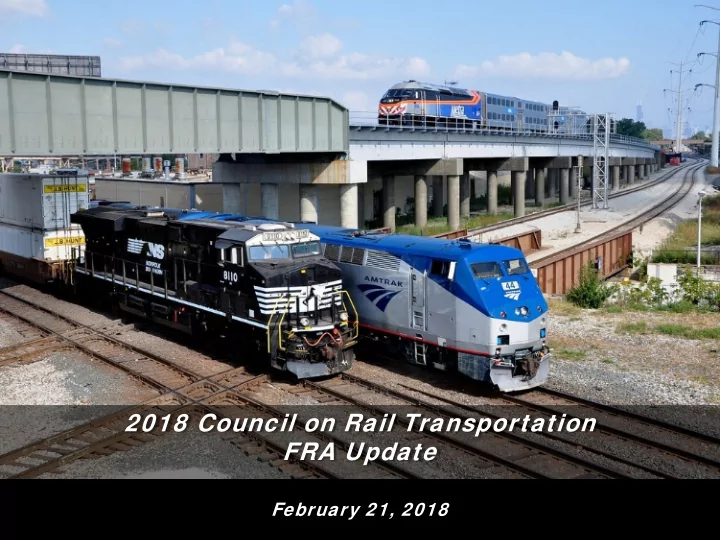
2018 Council on Rail Transportation FRA Update February 21, 2018 - - PowerPoint PPT Presentation

2018 council on rail transportation fra update
SMART_READER_LITE
LIVE PREVIEW

2018 Council on Rail Transportation FRA Update February 21, 2018 - - PowerPoint PPT Presentation

2018 Council on Rail Transportation FRA Update February 21, 2018 Agenda FRAS Focus Areas for FY18/19 Program Delivery Updates Completing New Grant Applications FAST Act Implementation and Rail Performance Update FAST Act


slide-1
SLIDE 1

2018 Council on Rail Transportation FRA Update

February 21, 2018

slide-2
SLIDE 2

2/26/2018

Agenda

 FRA’S Focus Areas for FY18/19  Program Delivery Updates  Completing New Grant Applications  FAST Act Implementation and Rail Performance Update  FAST Act – Management and Reporting  Grade Crossing Safety and Trespasser Prevention  Q&A Session

2

slide-3
SLIDE 3

2/26/2018

FRA’s Focus Areas for FY18/19

Paul Nissenbaum Associate Administrator for Railroad Policy and Development

slide-4
SLIDE 4

2/26/2018

Administration’s FY19 Budget

4

U.S. Department of Transportation Priorities Federal Railroad Administration’s Mission

SAFETY INFRASTRUCTURE INNOVATION ACCOUNTABILITY

“To enable the safe, reliable, and efficient movement of people and goods for a strong America, now and in the future.” Office of Railroad Policy and Development’s Focus Areas Safety Innovation Infrastructure Modernization Amtrak Reform Project Delivery

slide-5
SLIDE 5

2/26/2018

FRA’s Budget ($ millions)

Account/Program FY17 Enacted FY18 TBD FY19 Request

Safety & Operations $218 $202 Railroad Research & Development $40 $19 Amtrak NEC $328 $200 Amtrak National Network $1,167 $538 Competitive Rail Grants (FAST Act Authorized) $98 — Rail Safety User Fee — ($50) Rescissions — ($55) Total $1,851 $854

5

slide-6
SLIDE 6

2/26/2018

President’s Infrastructure Initiative

 Spur $1.5T of investment with $200B of federal funds over 10 years  Funding and coordination across multiple agencies  Focuses on ways to finance, manage, and utilize our current and future transportation assets

6

PROGRAM AMOUNT ($ billions) Incentives $100 Rural $50 Transformative Projects $20 Financing Programs $20 Federal Capital Revolving Fund $10

slide-7
SLIDE 7

2/26/2018

FY17: $500M FY17: $25M FY17: $68M FY17: $787M FY17: $199M FY17: $5M

Federal- State Partnership for State of Good Repair Restoration & Enhancement National Infrastructure Investments (TIGER) Consolidated Rail Infrastructure & Safety Improvements INFRA PTC Implementation

Overview of Current DOT Funding Sources

FY17 Appropriations for Investment in High Performance Rail

FTA Program FRA Program OST Program

7

slide-8
SLIDE 8

2/26/2018

PTC Implementation

  • 41 Railroads are currently

implementing PTC: – 7 Class I Freight Railroads – 30 Passenger/Commuter Railroads (including Amtrak) – 4 Short Line and Terminal Railroads

  • December 31, 2018 – Deadline for PTC system implementation, unless a railroad
  • btains an extension to a date no later than December 31, 2020.
  • Since FY 2008 – DOT has provided over $2.2 billion to support PTC implementation

– $925 million in grant funding – $1,349 million in RRIF and TIFIA loans

8

slide-9
SLIDE 9

2/26/2018

Purpose of Program

  • To fund projects that improve safety, efficiency, and reliability of

intercity passenger and freight rail systems

Eligible Applicants

  • State Entities
  • Transportation Research Board (TRB)
  • Local Governments
  • University Transportation Centers
  • Amtrak
  • Certain Non-profit Organizations
  • Class II/III Railroads

Eligible Projects

  • Wide range of capital projects, such as track, station and equipment

improvements, PTC, congestion mitigation, grade crossings, rail line relocation, environmental analyses and planning, safety programs and institutes

FY17 Authorized FY17 Enacted

$190 M $68 M

Consolidated Rail Infrastructure & Safety Improvements

9

slide-10
SLIDE 10

2/26/2018

Restoration & Enhancement

Purpose of Program

  • Operating assistance to initiate, restore, or enhance intercity

passenger rail service

Eligible Applicants

  • State Entities
  • Amtrak
  • Local Governments • Rail Carriers

Eligible Projects

  • Financial assistance to cover expenses associated with operation of

passenger rail service, such as train engineer staffing, fuel, and costs related to train dispatching, station management, and overhead

FY17 Authorized FY17 Enacted

$20 M $5 M

10

slide-11
SLIDE 11

2/26/2018

Purpose of Program

  • To fund rail intercity passenger and freight rail projects in states that

either do not have intercity passenger rail or are not connected to the national rail system

Eligible Applicants

  • Alaska
  • South Dakota
  • Wyoming
  • Hawaii*

Eligible Projects

  • Wide range of capital projects, such as track, station and equipment

improvements, PTC, congestion mitigation, grade crossings, rail line relocation, environmental analyses and planning

FY17 Directed Grants – Special Transportation Circumstances, $2.24 M

*Despite being an eligible applicant, funding is not allocated to Hawaii.

11

slide-12
SLIDE 12

2/26/2018

Federal-State Partnership for State of Good Repair

Purpose of Program

  • To fund capital projects to reduce the state of good repair backlog on

certain publicly-owned or Amtrak-owned railroad assets

Eligible Applicants

  • State Entities
  • Amtrak
  • Local Governments

Eligible Projects

  • Capital projects to repair, replace, rehabilitate, or improve publicly-
  • wned or Amtrak-owned infrastructure, equipment, and facilities

FY17 Authorized FY17 Enacted

$140 M $25 M

12

slide-13
SLIDE 13

2/26/2018

Evaluation Criteria

  • Technical Merit
  • Project Benefits

Selection Criteria

Key Departmental Objectives: Economic Vitality Leveraged Funding Innovation Accountability

FY17 Competitive Rail Development Grants – Common Evaluation & Selection Criteria

13

slide-14
SLIDE 14

2/26/2018

Program Delivery Updates

Jamie Rennert Director, Office of Program Delivery

slide-15
SLIDE 15

2/26/2018

FRA’s Grant Portfolio

Rail Program Number of Grants Federal Funding ($M) % Outlaid % Closed HSIPR 152 $9,732 86% 64%

Amtrak Programs

Amtrak Annual 22 $14,649 97% 73% Amtrak Other 7 $456 98% 29% Amtrak Sandy 5 $307 86% 20% Amtrak FEMA 11 $158 84% 73%

OST Programs

TIGER 51 $631 67% 43% FASTLANE/INFRA 8 $152 0% 0%

Safety/ Research Programs

Safety Tech (PTC) 25 $86 60% 28% Safety Infrastructure 23 $25 0% 0% R&D 31 $23 87% 45% STEP 2016 9 $10 1% 0%

Legacy/ Modal Transfer Programs

RR Development 33 $211 70% 76% CMAQ 6 $141 54% 17% Legacy Moynihan 5 $131 89% 60% Rail Line Relocation 68 $80 87% 85% Maglev 2 $28 12% 50% Capital Assistance 13 $22 100% 92% Railroad Rehab 24 $20 100% 100% Next Gen HSR 11 $10 53% 73% R&D Rail Corridor 3 $4 15% 0% TOTAL 509 $26,873,734,282 91% 59%

15

slide-16
SLIDE 16

2/26/2018

Ongoing Technical Assistance to Build America Bureau

16

slide-17
SLIDE 17

2/26/2018

Railroad Rehabilitation & Improvement Financing (RRIF) Loan Program

  • $35 billion loan capacity
  • $7 billion set-aside for other than Class I railroads (Short Line

and Regional RRs)

  • Undersubscribed by Short Line/Regional

Rail:

  • 29 loans in past 15 years totaling < $1

billion

  • The Bureau’s goal is to make RRIF more accessible to Short Line

and Regional RRs.

17

slide-18
SLIDE 18

2/26/2018

Environmental Streamlining – FAST Act

FAST Act of 2015 – mandated project delivery reforms:

  • Exempt historic railroad or rail

transit lines from Section 4(f) reviews

  • Align FRA’s NEPA and 4(f)

procedures with FHWA and FTA’s

  • Revise CEs
  • Establish Section 106 exemption

18

slide-19
SLIDE 19

2/26/2018

Environmental Streamlining – Administration’s Initiatives

  • Executive Order (Jan. 2017)
  • Two-year EIS Target for Major Infrastructure Projects
  • For Projects w/ “Reasonable Availability of Funds”
  • One Federal Decision – Synchronizing

NEPA with Other Permitting Reviews

  • One Federal Decision MOU
  • CEQ and OMB Implementing Guidance
  • Emphasized in the President’s Infrastructure Principles

(Feb. 2018)

19

slide-20
SLIDE 20

2/26/2018

Completing New Grant Applications

Mariam Ouhamou FRA Grants Management Division

slide-21
SLIDE 21

2/26/2018

What is a NOFO?

  • NOFO = Notice of Funding Opportunity
  • Announces a Grant Opportunity to the Public
  • Federal Register
  • Grants.gov
  • GrantSolutions.gov
  • FRA Website: Discretionary Competitive

Grant Programs at https://www.fra.dot.gov/Page/P0997

  • Consists of Several Parts:
  • Program Summary
  • Key Dates
  • Addresses
  • FRA Contact Info
  • Table of Contents: Program Description, Federal Award Information,

Eligibility Information, Application and Submission Information, Application Review Information, Federal Award Administration Information, Federal Awarding Agency Contacts

21

slide-22
SLIDE 22

2/26/2018

Eligibility Information

*Authorizing statues and appropriations often drive the eligibility information contained in a NOFO.

  • Type of Applicant
  • Allowable entities identified
  • Joint applicants must all be eligible
  • Type of Project
  • Project requirements listed
  • Project examples are provided
  • Cost Sharing/Matching
  • May or may not be required, parameters will be stated

22

slide-23
SLIDE 23

2/26/2018

Eligibility Information – FAQ

Does FRA prefer applications that include additional matching funds?

  • It will depend on the grant program. Check the

language within the NOFO, but often times, yes. What is the difference between a joint applicant and a project partner?

  • A joint applicant refers to one or more Eligible

Applicants (as described in the NOFO) who submit a single application.

  • A project partner refers to one or more stakeholders
  • r collaborators that support the project.

23

slide-24
SLIDE 24

2/26/2018

Eligibility Information – Best Practice Best Practice – Ensure matching funds meet minimum requirements *For questions about eligibility, contact Amy Houser, Program Analyst, at amy.houser@dot.gov

24

slide-25
SLIDE 25

2/26/2018

Application Content

Required Documents will be specified in the NOFO and may include the following:

  • Project Narrative
  • Statement of Work
  • SF424 (Application for Federal Assistance)
  • SF 424A or 424C – Budget Info for Non-Construction OR

Construction

  • SF 424B or 424D – Assurances for Non-Construction OR

for Construction

  • FRA’s Additional Assurances and Certifications
  • SF LLL: Disclosure of Lobbying Activities
  • Project Development Supporting Documentation
  • Benefit-Cost Analysis
  • Other Required Documents: e.g., NEPA documentation,

planning documents

25

slide-26
SLIDE 26

2/26/2018

Application Content – Project Narrative

  • Critical Part of Application
  • Should Include:
  • Cover Page
  • Brief Summary of Project
  • Project Funding Information
  • Applicant Eligibility
  • Project Eligibility
  • Detailed Project Description
  • Project Location/Map
  • Project Implementation and Management
  • Evaluation and Selection Criteria
  • Project Readiness, such as NEPA completion

26

slide-27
SLIDE 27

2/26/2018

Project Narrative – Best Practices

  • Be sure to organize the Project Narrative headings

and corresponding information exactly as specified in the NOFO.

  • The Project Narrative must sufficiently address the

evaluation and selection criteria to be considered a competitive application.

27

slide-28
SLIDE 28

2/26/2018

Application Content – Statement of Work (SOW)

  • Addresses the scope, schedule, and budget for the

proposed project as if it were selected for award

  • A Sample SOW template is located at:

https://www.fra.dot.gov/eLib/Details/L18661.

  • Includes:
  • Background
  • Objective
  • Project Location
  • Description of Work
  • Project Schedule and Deliverables
  • Project Estimate/Budget

28

slide-29
SLIDE 29

2/26/2018

Statement of Work (SOW) – Best Practice Best Practice – Use the FRA Standard Cost Categories as a way to organize a SOW and Budget

*The FRA Standard Cost Categories are located here: https://www.fra.dot.gov/Elib/Document/16647

29

slide-30
SLIDE 30

2/26/2018

Application Review

Each application is reviewed for completeness and eligibility to determine which applications move to the evaluation stage. Each complete and eligible application is evaluated by a panel

  • f DOT subject matter experts

using criteria outlined in the NOFO. Final funding decisions are made by taking into account the evaluation and selection criteria

  • utlined in the NOFO.
  • 1. Intake and Eligibility
  • 2. Evaluation
  • 3. Selection

30

slide-31
SLIDE 31

2/26/2018

Application Review – Best Practices

  • Think like a reviewer!
  • Make a strong case for the overall significance of the proposed

project

  • Provide statistics, when possible
  • Include project timeline information
  • Describe the results/outcomes to be achieved by the end of the

funding period

  • In all responses, be brief, direct, and clear
  • Do not exceed page limits

31

slide-32
SLIDE 32

2/26/2018

How to Apply?

  • Obtain a Dun and Bradstreet Number (DUNS)
  • Register in the federal government's System for

Award Management (SAM.gov)

  • For Grants.gov, complete an Authorized

Organization Representative profile and create a username and password

  • Submit an application addressing all

requirements outlined in the NOFO

32

slide-33
SLIDE 33

2/26/2018

Key Takeaw ays

  • Follow the directions.
  • Read the NOFO carefully and use a checklist.
  • Indicate what "success" will look like.
  • Name key partners, indicate in-place agreements, and

include letters of support.

  • Register and send in the application early.
  • If applying through Grants.gov, use the “Track My

Application” function.

  • NOFOs identify a point of contact who can address

questions.

  • That said, FRA staff cannot give hints, tips, or a

competitive advantage to one applicant over others.

33

slide-34
SLIDE 34

2/26/2018

Final Check

  • Are you on schedule to meet the application deadline?
  • Does the project align well with the evaluation and

selection criteria?

  • Does the application demonstrate strong collaboration

and partnerships?

  • Do the project benefits exceed the costs?
  • Do all budget figures match corresponding figures on

the Cover Page and in the Project Narrative?

  • Do numbers in columns and rows all add up properly in

budget tables?

  • Have you addressed all of the criteria on which you will

be rated?

  • Are your strategies, activities, staffing, and other

application content in alignment?

34

slide-35
SLIDE 35

2/26/2018

FAST Act Implementation and Rail Performance Update

Michael Lestingi Director, Office of Policy and Planning

slide-36
SLIDE 36

2/26/2018

FAST Act Implementation Status

  • FRA is the lead entity or

supporting other agencies in the implementation of 80 requirements.

  • 48 requirements

implemented to-date.

  • FRA is also monitoring

another 50 actions directed at other entities.

Requirement # of Requirements # Completed Rulemakings 13 9 Reports 26 16 Studies 10 5 Guidance 2 1 Other 29 17 Total 80 48

FRA FAST Act Requirements

36

slide-37
SLIDE 37

2/26/2018

Safety FAST Act Updates

7311 – Study and Testing of Electronically Controlled Pneumatic Brakes; Regulatory Impact Analysis Submitted 11/16/17 7310 – Hazardous Materials by Rail Study; PHMSA Issued Report to Congress 11/30/17

37

slide-38
SLIDE 38

2/26/2018

Additional FAST Act Updates

11201 – Amtrak Account Structure; Amtrak Submitted Report to USDOT on 12/4/17 11204 – State-Supported Route Committee Goals and Objectives; Submitted to Congress 12/8/17

38

slide-39
SLIDE 39

2/26/2018

Long-Distance Pilot Program

  • Allows for non-Amtrak operation of no more than 3 long-distance routes
  • For a period of 4 years, plus one additional 4-year extension

39

slide-40
SLIDE 40

2/26/2018

200 250 300 350 400 JAN FEB MAR APR MAYJUN JUL AUG SEP OCT NOV DEC 40 60 80 100 120 140 160 JAN FEB MAR APR MAYJUN JUL AUG SEP OCT NOV DEC 15 30 45 JAN FEB MAR APR MAYJUN JUL AUG SEP OCT NOV DEC

Freight Performance Update

Grain Coal Intermodal

500 600 700 800 900 1000 1100 1200 JAN FEB MAR APR MAY JUN JUL AUG SEP OCT NOV DEC

Number of Carload and Intermodal Units Thousands Month

Total Traffic on the U.S. Rail Network (Carloads and Intermodal Units)

2018 2017 2016 2006

2006 2008 2018 2018 2018 2018

40

slide-41
SLIDE 41

2/26/2018

Amtrak Service Update FY2017 Amtrak Ridership

Business Line Growth Northeast Corridor +1% State Supported +2.1% Long Distance +.9%

System Ridership 31.7 Million +1.5%

41

slide-42
SLIDE 42

2/26/2018

Amtrak Service Update

76% 81% 47%

30% 40% 50% 60% 70% 80% 90% 100%

FY 2013 FY 2014 FY 2015 FY 2016 FY 2017

Amtrak All Stations OTP by Service Line

.Northeast Corridor. ..State Supported Services… ...Long Distance…

42

slide-43
SLIDE 43

2/26/2018

FAST Act – Management and Reporting

Beth Nachreiner Chief, Passenger Rail Policy

slide-44
SLIDE 44

2/26/2018

FAST Act required:

  • FRA and Amtrak to define an

account structure and accounting methodologies

  • FRA to reform Amtrak’s grant

process and Amtrak to update internal controls

  • Amtrak to develop 5-Year Service

Line and Asset Line Plans

FAST Act – Management and Reporting

Account Structure Grant Process 5-Year Plans

44

slide-45
SLIDE 45

2/26/2018

Based on a matrix organization where Service Lines use the resources from the Asset Lines to deliver transportation and related services to customers

Amtrak’s Account Structure

NEC National Network Service Lines

Transportation Equipment Infrastructure Stations National Assets

Asset Lines

NEC

Infrastructure Access Ancillary State Supported Long Distance Infrastructure Access Ancillary

45

slide-46
SLIDE 46

2/26/2018

Amtrak’s Account Structure

NEC National Network Service Lines

Transportation Equipment Infrastructure Stations National Assets

Asset Lines

NEC

Infrastructure Access Ancillary State Supported Long Distance Infrastructure Access Ancillary

46

Sources (Revenue) Uses (Expenses)

slide-47
SLIDE 47

2/26/2018

NEC National Network Service Lines

Transportation Equipment Infrastructure Stations National Assets

Asset Lines

NEC

Infrastructure Access Ancillary State Supported Long Distance Infrastructure Access Ancillary

Example: Operating – Costs for T&E Crew on Long-Distance Routes

Amtrak’s Account Structure

47

slide-48
SLIDE 48

2/26/2018

NEC National Network Service Lines

Transportation Equipment Infrastructure Stations National Assets

Asset Lines

NEC

Infrastructure Access Ancillary State Supported Long Distance Infrastructure Access Ancillary

Example: Operating – Station Personnel Costs at Chicago Union Station

Amtrak’s Account Structure

48

  

slide-49
SLIDE 49

2/26/2018

NEC National Network Service Lines

Transportation Equipment Infrastructure Stations National Assets

Asset Lines

NEC

Infrastructure Access Ancillary State Supported Long Distance Infrastructure Access Ancillary

Example: Capital – Upgrades to State-Supported Equipment

Amtrak’s Account Structure

49

slide-50
SLIDE 50

2/26/2018

  • Provide a whole picture
  • f Amtrak’s business
  • Must reflect Amtrak’s
  • rganization to be

effective

  • New methodology

developed for capital allocations

Amtrak-Wide Operating Sources and Uses

Amtrak’s Account Structure – Lessons Learned

50

slide-51
SLIDE 51

2/26/2018 Account Structure Grant Process 5-year Plans

Amtrak’s Account Structure – What’s Next?

51

YTD September FY 2017 Financial Sources: Passenger Related Revenue Ticket Revenue (Adjusted) Charter/Special Trains Food and Beverage Contractual Contribution (Operating) PRIIA 209 Operating Payments Reimbursable Contracts Access Revenue Commercial Revenue (incl. Pipe/Wire, Real Estate, Parking) All Other Revenue (incl. Insurance Revenue, Cobranded Commissions, etc.) Operating Sources Subtotal Contractual Contribution (Capital) PRIIA 209 Capital Payments Other State/Local Mutual Benefit Financing Proceeds Applied Capital Sources Subtotal Federal Grants to Amtrak Prior Year Carryover Capital Grant Funds Current Year FAST Sec 11101 Grants Operating Capital Other Federal Grants (incl., FRA/OST, FTA, DHS) Federal Grants to Amtrak Subtotal Total Financial Sources Financial Uses (Operating): Service Line Management Train Operations Equipment Infrastructure Stations National Assets and Corporate Services Total Operating Uses Financial Uses (Capital): Service Line Management Train Operations Equipment Infrastructure Stations National Assets and Corporate Services Capital Expenditures Legacy Debt Repayments Total Capital Uses National Network Account Total NEC Account Total

slide-52
SLIDE 52

2/26/2018

Grade Crossing Safety and Trespasser Prevention

Starr Kidda, Ph.D. FRA Office of Research Development & Technology Human Factors Division

slide-53
SLIDE 53

2/26/2018

53

slide-54
SLIDE 54

2/26/2018

2017 Research Needs Workshop

  • 4th Workshop to collaborate,

identify and prioritize specific research needs

  • 150+ attendees: Federal, state and

local governments; railroad, academia, and consultants

  • Five hot button topic areas:
  • Engineering/Technologies,
  • Human Factors,
  • Community

Outreach/Education,

  • Enforcement, and
  • Hazard Management

54

slide-55
SLIDE 55

2/26/2018

100 200 300 400 500 600 700 1986 1990 1994 1998 2002 2006 2010 2014 FATALITIES YEAR

All Rail GRX/Trespass/Suicide Fatalities

GRX Trespass Suicide 55

slide-56
SLIDE 56

2/26/2018

Problem

 2016 Accident/Incident Data

  • 2,041 incidents – 1,100 casualties (260 fatal, up 10% from 2015)
  • Rail Trespassing (excl. suicides) – 959 casualties (476 fatal, up 6.0% from 2015)

260, 34% 476, 61% 38, 5%

CY 2016 Rail Fatalities

Grade Crossing Trespass Other

56

slide-57
SLIDE 57

2/26/2018

Law Enforcement Grant Pilot Study

Project Description:

  • Determine if funding directed at

law enforcement agencies for rail trespass prevention activities is an effective safety program

  • Implement FRA grant program

to fund rail trespass prevention activities for law enforcement agencies

  • $150,000 available
  • 6 month period of

performance

57

slide-58
SLIDE 58

2/26/2018

Photo-Based Education at Crossings

Project Description:

  • Study the effectiveness of cameras at crossings to detect

grade crossing violations

  • City installed photo enforcement system and initiated

warning letter mailings in August 2016

58

slide-59
SLIDE 59

2/26/2018

Vehicle ROW Incursion Prevention

Project Description:

  • Study interventions to prevent vehicle

incursions into railroad rights-of-way

  • Select strategy, location(s), install, and

evaluate Status:

  • Analyzed potential locations; developed

strategies and implementation plan

  • Supported implementation at 2 locations
  • Currently collecting post data

59

slide-60
SLIDE 60

2/26/2018

Vehicle ROW Incursion Prevention

60

slide-61
SLIDE 61

2/26/2018

Vehicle ROW Incursion Prevention

61

slide-62
SLIDE 62

2/26/2018

Vehicle ROW Incursion Prevention

62

slide-63
SLIDE 63

2/26/2018

Questions?

63

slide-64
SLIDE 64

2/26/2018

RAIL–Moving America Forward

www.fra.dot.gov

64