Draft Statewide Rail Plan www.drpt.virginia.gov Overview Virginia - - PDF document

draft statewide rail plan
SMART_READER_LITE
LIVE PREVIEW

Draft Statewide Rail Plan www.drpt.virginia.gov Overview Virginia - - PDF document

Draft Statewide Rail Plan www.drpt.virginia.gov Overview Virginia Rail System Port Projects Setting the Stage Passenger Rail Initiatives Rail Benefits High Speed Rail Proposed Improvements Total Project Benefits


slide-1
SLIDE 1

www.drpt.virginia.gov
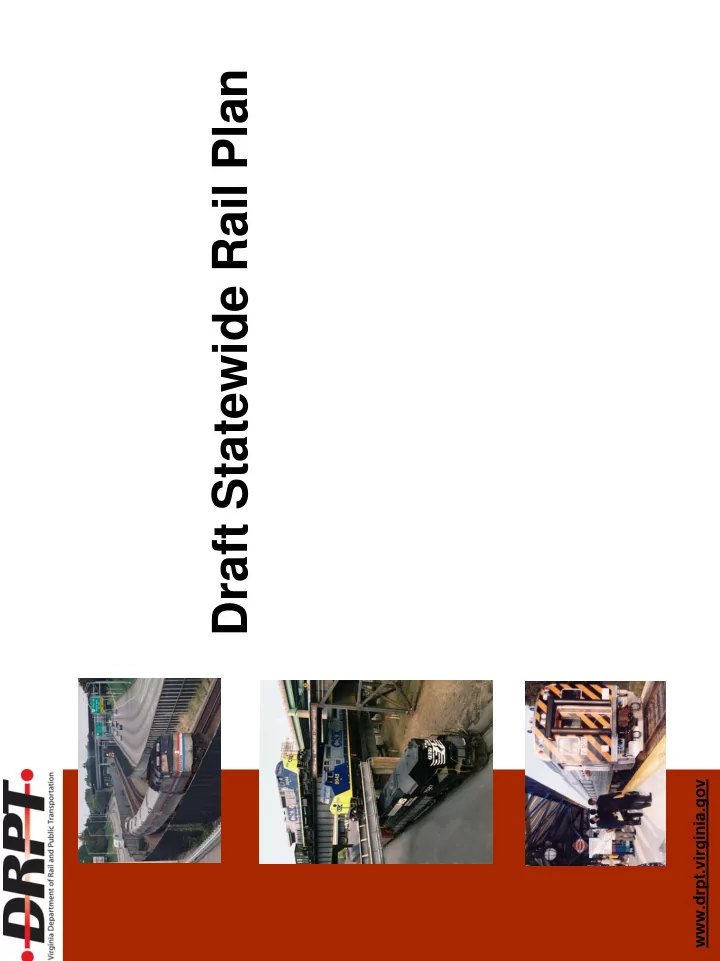
Draft Statewide Rail Plan

slide-2
SLIDE 2

7-14-08

2

Draft Statewide Rail Plan

Overview

Virginia Rail System Setting the Stage Rail Benefits Proposed Improvements Cost Assumptions Class I and Shortline

Railroads

Port Projects Passenger Rail

Initiatives

High Speed Rail Total Project Benefits Funding Next Steps

slide-3
SLIDE 3

7-14-08

3

Draft Statewide Rail Plan

Virginia Rail System

– Two passenger rail operators – Amtrak and Virginia Railway Express – Twelve freight railroads –

  • Two national Class I Railroads: Norfolk Southern and CSX
  • Ten local shortline railroads
slide-4
SLIDE 4

7-14-08

4

Draft Statewide Rail Plan

Virginia's Current Rail System

Privately-Owned by Freight Railroads

60% 26% 15% Norfolk Southern CSX Bay Coast Virginia Southern Norfolk & Portsmouth Winchester & Western Shenandoah Valley Commonwealth Railway Buckingham Branch Chesapeake Western Chesapeake & Albemarle North Carolina & Virginia

slide-5
SLIDE 5

7-14-08

5

Draft Statewide Rail Plan

Virginia Highway and Rail Miles

4,395 3,929 3,365 57,865 69,114 7,191

10,000 20,000 30,000 40,000 50,000 60,000 70,000 80,000 1930 1970 2007 System Mileage Rail Miles Highway Miles

Forecast Year:

slide-6
SLIDE 6

7-14-08

6

Draft Statewide Rail Plan

Virginia Freight Tonnage by Mode and Direction (2004)

slide-7
SLIDE 7

7-14-08

7

Draft Statewide Rail Plan

Projected Virginia Freight by Mode (2035)

slide-8
SLIDE 8

7-14-08

8

Draft Statewide Rail Plan

Average Total AADT and Truck Percentages All count Segments – top 30 Routes (2005)

  • 20,000

40,000 60,000 80,000 100,000 120,000 140,000 160,000 180,000 200,000

I-495 I-395 I-264 I-95 I-66 Dulles Toll I-64 I-195 VA 27 VA 28 I-664 I-581 VA 110 I-295 VA 150 I-464 GW Parkway VA 7 US 50 VA 225 VA 76 VA 241 VA 143 VA 73 VA 168 US 258 VA 171 US 58 I-81 Dulles Access

Average AADT, All Count Segments 0% 5% 10% 15% 20% 25% 30% Average Truck %, All Count Segments

slide-9
SLIDE 9

7-14-08

9

Draft Statewide Rail Plan

Increase of Containerized Cargo (TEUs) Virginia Ports

Forecast Year: 2006

slide-10
SLIDE 10

7-14-08

10

Draft Statewide Rail Plan

Virginia Rail Tonnage (2004)

slide-11
SLIDE 11

7-14-08

11

Draft Statewide Rail Plan

Rail Tonnage Passing Through Virginia (2004)

slide-12
SLIDE 12

7-14-08

12

Draft Statewide Rail Plan

Percentage of Freight Rail Tonnage (2005)

Unit Train 60% Long trains of a single railcar type and product, like coal -- mostly east-west Carload 24% Mixed trains with different railcar types and products -- mostly north- south Intermodal/Auto 16% Containers, autos,

  • ther on railcars -- a

future north-south

  • pportunity
slide-13
SLIDE 13

7-14-08

13

Draft Statewide Rail Plan

Annual Passenger Traffic (FY 1993-2007)

500,000 1,000,000 1,500,000 2,000,000 2,500,000 3,000,000 3,500,000 4,000,000 1 9 9 3 1 9 9 5 1 9 9 7 1 9 9 9 2 1 2 3 2 5 2 7 Amtrak VRE

slide-14
SLIDE 14

7-14-08

14

Draft Statewide Rail Plan

Setting the Stage

The draft statewide rail plan builds on past successes to develop

multimodal transportation corridors

It is consistent with Commonwealth Transportation Policy Goals:

– Providing a safe transportation system for Virginians – Maintaining existing transportation assets – Efficient and cost effective movement of people and goods – Stewardship of the environment

It also supports the VTrans 2035 statewide transportation plan

update

slide-15
SLIDE 15

7-14-08

15

Draft Statewide Rail Plan

Setting the Stage

Virginia rail funding

– The Rail Enhancement Fund provides approximately $24 million for rail capital improvements annually – Rail Enhancement funding was supplemented in 2007 by a 10-year, $124.7 million bond program – Rail Preservation funding for shortline railroads is available at approximately $3 million annually – Rail Industrial Access funding is available for businesses to connect to freight rail shipping through a shared fund at approximately $5 million annually – One-time funding for the I-95 and I-81 rail corridors has provided more than $130 million to improve rail capacity and service reliability

slide-16
SLIDE 16

7-14-08

16

Draft Statewide Rail Plan

Virginia has participated in the Heartland Corridor Project, a project of national significance that will support and enhance domestic and international trade, and remove 150,000 trucks from Virginia highways. Four tunnels in Virginia are being cleared to accommodate double-stack rail traffic.

slide-17
SLIDE 17

7-14-08

17

Draft Statewide Rail Plan

Virginia has allocated over $151.55 million to help increase rail capacity and divert trucks to rail in the I-95 and I-81 corridors. The new two-track Quantico Creek Bridge opened on Feb. 17, 2007 in the I-95 corridor.

slide-18
SLIDE 18

7-14-08

18

Draft Statewide Rail Plan

Virginia has participated in the construction of an on-dock rail yard to support the first privately developed marine terminal in North America, APM Terminals Virginia, to move 128,500 containers annually in 2010. A train carries double-stack rail containers from the port.

slide-19
SLIDE 19

7-14-08

19

Draft Statewide Rail Plan

Setting the Stage

Virginia faces a number of challenges:

– Population growth

  • Outpacing the national average

– Highway congestion

  • Northern Virginia is part of the second worst region in the country

– Airline industry limitations

  • No direct connections between Virginia regions and cities
  • Cost prohibitive for travel within the state

– Passenger and freight rail capacity/demand

  • Rail transportation is approaching the limits of capacity
  • Demand continues to rise

– Port growth

  • One of the most significant economic engines of Virginia
  • More access to freight rail shipping is needed to accommodate

the demand for imports and exports

slide-20
SLIDE 20

7-14-08

20

Draft Statewide Rail Plan

Setting the Stage

Understanding the freight rail business:

– The US is an international leader in freight rail, but lags behind in passenger rail. – Freight rail is a very capital intensive industry. From 1995-2004, rail capital expenditures represented 18% of rail revenue compared to 4% for the average manufacturing company. – Rail tracks in Virginia are privately owned by freight companies with a responsibility to return shareholder value. – Freight rail is at least five times more profitable than passenger rail. – Capacity is a commodity for private railroads, and railroads typically focus on capacity replacement (additional tracks) in exchange for access by commuter rail. – Private railroads have the power to condemn property for necessary right of way.

slide-21
SLIDE 21

7-14-08

21

Draft Statewide Rail Plan

Setting the Stage

Understanding the passenger rail business:

– Passenger rail typically requires a subsidy. – Amtrak, through federal statute, has the right to operate on freight rail lines. – Commuter rail operators like VRE do not have that right, and must negotiate with private railroads. – The cost of right of way is expensive. – VDOT estimates that the cost of acquiring right of way between Washington, DC and Richmond in the I-95 corridor would cost at least $2 billion – Passenger rail operators have consistently chosen to access private rail lines rather than building dedicated passenger tracks.

slide-22
SLIDE 22

7-14-08

22

Draft Statewide Rail Plan

Rail Benefits

VRE service provides the equivalent capacity of one

highway lane on I-95 and I-66 during peak periods.

One intermodal train can carry up to 280 truck trailers. Train travel is 17% more energy efficient than

domestic airline travel and 21% more energy efficient than auto travel.

Traveling by rail contributes fewer greenhouse gas

emissions than either cars or airplanes. Passenger rail emits only 0.2% of the travel industry’s total greenhouse gases.

slide-23
SLIDE 23

7-14-08

23

Draft Statewide Rail Plan

Proposed Improvements

Projects identified in the draft Statewide Rail Plan will:

– Focus on corridor management to support diverse needs – Provide improvements throughout the state – Position Virginia for future growth – Support growth at the Ports of Hampton Roads

slide-24
SLIDE 24

7-14-08

24

Draft Statewide Rail Plan

Cost Assumptions

Project cost estimates include capital costs only All costs are stated in 2008 dollars, without

escalation to potential year of expenditure

No operating or equipment costs are included-

these will be identified in the Rail Action Plan

The Rail Action Plan will include all costs and

will have costs escalated based on year of expenditure

slide-25
SLIDE 25

7-14-08

25

Draft Statewide Rail Plan

Rail Needs by Major Corridor

35% 47% 10% 3% 5% I-81 I-95/I-64 Route 460 Port I-66

More than $4.9 billion in needs statewide

slide-26
SLIDE 26

7-14-08

26

Draft Statewide Rail Plan

Class I and Shortline Railroad Projects

Class I and Shortline Railroad Project Costs Project Costs National Gateway $48 million Coal Corridor $12.1 million Crescent Corridor $1.6 billion Heartland Corridor $66.01 million Shortline Railroads $68 million Total Costs $ 1.8 billion

slide-27
SLIDE 27

7-14-08

27

Draft Statewide Rail Plan

Class I and Shortline Project Results

Improves freight rail shipping and diverts truck traffic to

rail along Virginia highways: I-81, I-95, I-64, I-66, I-85, I- 295, I-495 and Route 460, and outside Virginia along major routes such as I-20, I-40 and I-75

Multistate agreements needed to maximize truck

diversion

Includes construction of rail yards and increases

capacity

Improves shortline rail systems in Virginia to

accommodate heavier freight shipments and faster passenger rail service

slide-28
SLIDE 28

7-14-08

28

Draft Statewide Rail Plan

CSX National Gateway Corridor (I-95, I-295, I-495)

Parallels I-95 through Virginia Improves efficiency of freight rail shipping

from ports of MD, VA and NC and to markets in PA, WV and OH

Freight benefit: expands capacity,

provides double-stack train clearances

Passenger benefit: improves

  • n-time performance

Total project cost: $48 million

Removes 130,000 trucks from I-95 Corridor Saves over 31.9 million gallons of fuel Saves 61,705 tons of CO2 emissions

slide-29
SLIDE 29

7-14-08

29

Draft Statewide Rail Plan

Norfolk Southern Crescent Corridor (I-81)

Improves freight rail shipping along I-20,

I-40, I-75, I-85 and I-81

Freight benefit: expands capacity,

diverting trucks from congested highways

Passenger benefit: Could support

expanded Amtrak service to Charlottesville, Lynchburg, Roanoke and Bristol, and expanded VRE service from Manassas to Haymarket

Total project cost: $1.6 billion

Removes 1.6 million trucks (base estimate) from I-81 Corridor by 2035 Saves over 227 million gallons of fuel Saves 674,000 tons of CO2 emissions

slide-30
SLIDE 30

7-14-08

30

Draft Statewide Rail Plan

Norfolk Southern Heartland Corridor (US460) (Phase 1)

Doubles freight capacity parallel

to Route 460

Freight benefit: cuts 1.5 days of

shipping time between Hampton Roads and Chicago

Passenger benefit: Could support

expanded Amtrak service between Washington, DC and Bristol

Planning has begun on Phase 2 Total project cost: $66.01 million

Removes 150,000 trucks from Virginia highways Saves over 20.06 million gallons of fuel Saves 55,804 tons

  • f CO2 emissions
slide-31
SLIDE 31

7-14-08

31

Draft Statewide Rail Plan

Norfolk Southern Coal Corridor (US460)

Adds additional track capacity parallel to Route 460 between

Andover and Green Bay to support projected increases in coal shipments

Freight benefit: Improves capacity to move coal from coal fields

to Hampton Roads and to generating stations in TN, NC, SC and GA

Passenger benefit: Could support expanded Amtrak service

between Washington, DC and Bristol

As most coal is already carried by rail, no calculations of truck

diversion, fuel savings or reduced emissions have been conducted

Total project cost: $12.1 million

slide-32
SLIDE 32

7-14-08

32

Draft Statewide Rail Plan

Shortline Railroad Preservation (statewide)

Brings all shortline rail systems in Virginia

up to Federal freight and passenger standards

Freight benefit: Improves capacity to handle larger

shipments, providing critical business-to-business link

Passenger benefit: Improves Amtrak service

between Orange and Clifton Forge

Total project cost: $68 million

slide-33
SLIDE 33

7-14-08

33

Draft Statewide Rail Plan

Port Projects

NIT Central Rail Yard

Expansion

Craney Island Rail

Connection

Norfolk/Portsmouth

Beltline Railroad Improvements

Ports of Hampton Roads Project Costs Project Costs NIT Central Rail Yard Expansion $40.15 million Craney Island Rail Connection $130 million Norfolk Portsmouth Belt Line Railroad $8.75 million Total Costs $178.9 million

slide-34
SLIDE 34

7-14-08

34

Draft Statewide Rail Plan

Port Project Results

Increases rail capacity and provides competitive port

shipping services

Diverts more port shipments from truck to rail to help

manage highway congestion

Supports the transport of up to 50% of projected

containers at Craney Island

Nearly doubles today’s on-terminal rail handling

capacity at Norfolk International Terminal

Improves rail crossing safety

slide-35
SLIDE 35

7-14-08

35

Draft Statewide Rail Plan

Norfolk International Terminal (NIT) Central Rail Yard Expansion

Diverts port shipments

from truck to rail

Nearly doubles today’s

  • n-terminal rail handling capacity

Total project cost: $40.15 million

Removes 180,310 trucks from Virginia highways Saves over 24.3 million gallons of fuel Saves 47,072 tons of CO2 emissions

slide-36
SLIDE 36

7-14-08

36

Draft Statewide Rail Plan

Craney Island Rail Connection

Three-phase project that builds

  • n I-664/Route 164 Median Rail

Safety Relocation Project

Adds rail capacity to major

new port facility

Supports transport of

approximately 50 percent

  • f projected 1.43 million

containers through this facility

Total project cost: $130 million

Removes 848,571 trucks from Virginia highways Saves over 114 million gallons of fuel Saves 221,528 tons

  • f CO2 emissions
slide-37
SLIDE 37

7-14-08

37

Draft Statewide Rail Plan

Norfolk Portsmouth Belt Line Railroad Improvement

Complementary to the NIT Central

Rail Yard Expansion

Adds off-site marshalling yard,

separating highway traffic from train movements

Improves operating efficiency

  • f trains traveling to and from the
  • n-terminal rail yard

Total project cost: $8.75 million

Eliminates 12.852 hours per year of delays (based on 18 train crossings per day) at an existing at-grade crossing at NIT and Hampton Boulevard

slide-38
SLIDE 38

7-14-08

38

Draft Statewide Rail Plan

Passenger Rail Projects

Commuter Rail Improvements

(I-66 and I-95):

– VRE Alexandria to Manassas (I-66) – VRE Manassas to Gainesville/ Haymarket Expansion (I-66) – VRE Fredericksburg to Washington, DC (third track) Intercity Rail: – Urban Crescent Express (I-64 and I-95) – TransDominion Express (TDX) (I-81 and Routes 29/460)

Passenger Rail Project Costs Project Costs Commuter Rail Alexandria to Manassas $8.25 million Commuter Rail Gainesville to Haymarket $281 million Commuter Rail Fredericksburg to Washington, DC $470 million Intercity Rail Urban Crescent $757 million Intercity Rail TransDominion Express $206 million Total Costs $ 1.7 billion

slide-39
SLIDE 39

7-14-08

39

Draft Statewide Rail Plan

Passenger Rail Project Results

Supports more frequent service in the Urban Crescent between

Washington, DC, Richmond and Newport News

Supports more frequent service in the Route 29 corridor between

Lynchburg and Washington, DC, and implementation of Phase 1

  • f the TransDominion Express

Supports expansion of VRE service between Manassas and

Gainesville/Haymarket

Supports new service, station improvements, travel time

improvements and more frequent service along existing routes

Upgrades track and other facilities/infrastructure for higher speed

service

slide-40
SLIDE 40

7-14-08

40

Draft Statewide Rail Plan

VRE Alexandria to Manassas (I-66)

Upgrades track and improves the

reliability of VRE operations by enabling increased train speed

Total project cost: $8.25 million

Removes 53,091 cars from Virginia roadways Saves over 24.3 million gallons of fuel Saves 47,072 tons of CO2 emissions

slide-41
SLIDE 41

7-14-08

41

Draft Statewide Rail Plan

VRE Manassas to Gainesville/Haymarket Expansion (I-66)

Studies viability and potential

locations of future passenger rail stations between Manassas and Gainesville/Haymarket

Requires extensive upgrading

  • f existing freight line for

passenger rail service

Next steps are additional

environmental review and preliminary design

Total project cost: $281 million

Removes 430,556 cars from Virginia highways Saves 1.7 million gallons of fuel Saves 7,756 tons of CO2 emissions

slide-42
SLIDE 42

7-14-08

42

Draft Statewide Rail Plan

VRE Fredericksburg to Washington, DC Improvements (I-95, I-395, I-495)

Expands rail service and improves

existing service through signalization, station and rail infrastructure improvements, including:

– Automatic train control cab signalization – VRE second platforms at Woodbridge, Lorton and Rippon Stations – Arkendale to Powell’s Creek third track and station – Capacity improvements between Franconia/Springfield and Fredericksburg, excluding major bridges Total project cost $470 million

Removes over 1.4 million cars from the I-95 corridor Saves over 7.9 million gallons of fuel Saves 46,877 tons

  • f CO2 emissions
slide-43
SLIDE 43

7-14-08

43

Draft Statewide Rail Plan

Urban Crescent Express (I-64, I-95, I-295, Route 460)

Freight and passenger rail improvements

between Fredericksburg, Richmond and Newport News

Station improvements, including the

facilitation of transit-oriented development near stations

Best passenger rail ridership increase

  • pportunity in Commonwealth, potentially

doubling Amtrak corridor ridership by 2015

Total project cost: $757 million

Removes over 1.3 million cars from Virginia highways Saves over 9.5 million gallons of fuel Saves 62,072 tons

  • f CO2 emissions
slide-44
SLIDE 44

7-14-08

44

Draft Statewide Rail Plan

TransDominion Express (TDX) (I-81 and Routes 29/460)

Enhances mobility along the Route 29, I-81

and Route 460 corridors by improving infrastructure to support higher speeds for passenger rail

Phase I: Washington, DC to Lynchburg Phase II: Lynchburg to Roanoke Phase III: Roanoke to Bristol Phase IV: Lynchburg to Richmond Total project cost: $206 million

Removes 53,091 cars from I-81 and Route 29 corridors Saves over 164,637 gallons of fuel Saves 983 tons

  • f CO2 emissions
slide-45
SLIDE 45

7-14-08

45

Draft Statewide Rail Plan

High Speed Rail Project (I-95, I-295, I-495, I-85, I-64, Route 460)

High speed rail service

between Washington, DC and Raleigh, NC

Total cost does not include the

cost of major river and stream crossings

Total cost does not include the

cost of electrification and improvements between Richmond and Washington, DC

High Speed Rail Project Costs Project Costs Southeast High Speed Rail Project $1.2 billion Total Costs $1.2 billion

slide-46
SLIDE 46

7-14-08

46

Draft Statewide Rail Plan

Southeast High Speed Rail Project (I-95, I-295, I-495, I-85, I-64, Route 460)

Studies higher speed rail

connections between Hampton Roads and Richmond’s Main Street Station to Washington, DC

Also studies creating a high speed

rail corridor between Washington, DC and Raleigh, NC

Pending legislation in

U.S. Congress could impact feasibility of program

Total project cost: $1.2 billion

Removes over 1.1 million cars from Virginia and North Carolina highways Saves over 5.6 million gallons of fuel Saves 33,713 tons

  • f CO2 emissions
slide-47
SLIDE 47

7-14-08

47

Draft Statewide Rail Plan

Total Project Benefits

Total public benefits of the potential projects are as

follows:

– 7.3 million cars and trucks removed from highways

  • Approximately 108% of the total vehicle ownership in

Virginia, based on vehicles registered in 2006

– 445 million gallons of fuel saved

  • Approximately 32 million barrels of oil imported to the US

– 1.2 million tons of carbon emissions saved

  • Equal to the emissions of approximately 7,000 automobiles

per year

slide-48
SLIDE 48

7-14-08

48

Draft Statewide Rail Plan

Project Funding

Cost of all proposed projects is approximately $5 billion, and

current estimated revenue between 2009 and 2035 is $1.3 billion

Commonwealth’s rail programs foster the sharing of costs

and benefits

Potential sources of funds: – Railroads – Commonwealth of Virginia, from dedicated funding sources as well as special allocations – Local jurisdictions, including current Northern Virginia contribution of 13 percent of VRE operating costs – Federal funding, including potential Amtrak bills that include state grants for intercity rail improvements – Passenger fares

slide-49
SLIDE 49

7-14-08

49

Draft Statewide Rail Plan

Next Steps

Key Actions – Draft Plan released for public comment in July 2008

  • Five public meetings statewide
  • Available online:

http://www.drpt.virginia.gov

– Rail Action Plan issued in September 2008

  • Includes funding strategies,

proposed allocation of resources and project implementation schedules

  • Public comments accepted

– Statewide Rail Plan finalized in November 2008 Future Rail Plan Updates: – Six Year Improvement Program yearly update – Comprehensive update on a five-year basis as a part of VTrans