2017/09/19 XENOPHOBIA CRISIS: A Comple x Soc ia l Disa ste r: SAL - - PDF document

2017 09 19
SMART_READER_LITE
LIVE PREVIEW

2017/09/19 XENOPHOBIA CRISIS: A Comple x Soc ia l Disa ste r: SAL - - PDF document

2017/09/19 XENOPHOBIA CRISIS: A Comple x Soc ia l Disa ste r: SAL GA E NGAGE ME NT WORKSHOP: 14 SE PT E MBE R 2017 Gre g Pilla y Disa ste r Risk Ma na g e me nt Ce ntr e BACKGROUND Xe no pho bic Vio le nc e e rupte d in the We


slide-1
SLIDE 1

2017/09/19 1

XENOPHOBIA CRISIS:

A Comple x Soc ia l Disa ste r: SAL GA E NGAGE ME NT WORKSHOP: 14 SE PT E MBE R 2017

Gre g Pilla y Disa ste r Risk Ma na g e me nt Ce ntr e

BACKGROUND

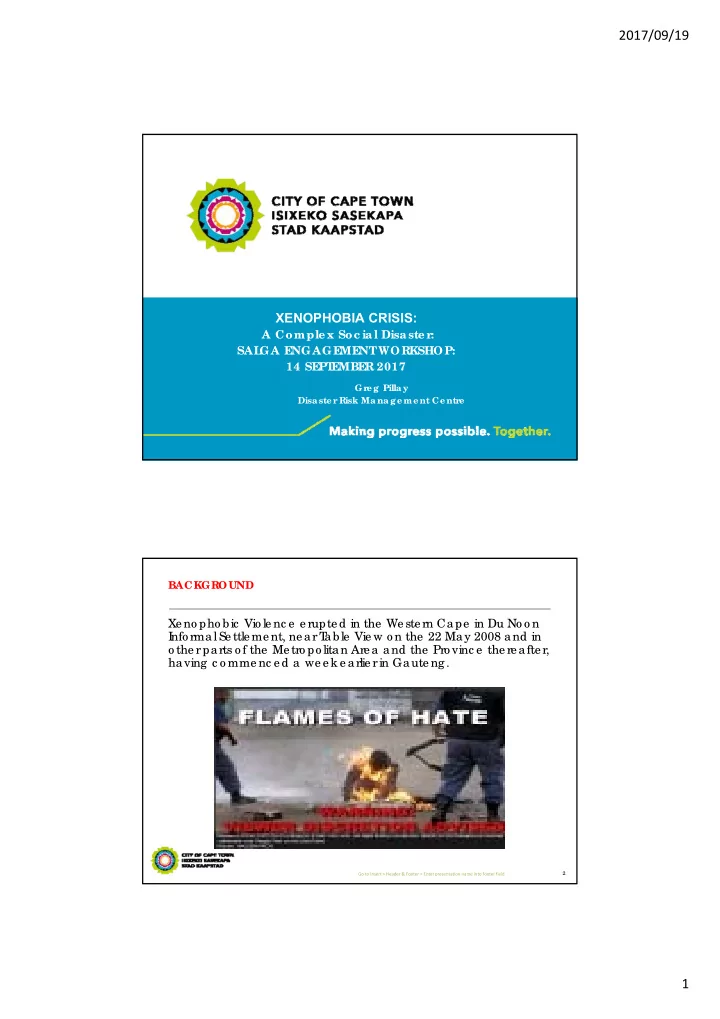
Xe no pho bic Vio le nc e e rupte d in the We ste rn Cape in Du No o n I nfo rmal Se ttle me nt, ne ar T able Vie w o n the 22 May 2008 and in

  • the r parts o f the Me tro po litan Are a and the Pro vinc e the re afte r,

having c o mme nc e d a we e k e arlie r in Gaute ng.

Go to Insert > Header & Footer > Enter presentation name into footer field 2

slide-2
SLIDE 2

2017/09/19 2

Disaster Management as we know it today, had its origins in Civil Defence organizations. Concept of Civil Defence established during Second World War (1939 -1945). London Air Bombardments by Germany during May 1940 prompted authorities to implement certain measures to counteract this. Civil Defence measures included early warning (air raid sirens), underground protection (bomb shelters, bunkers), evacuation, etc.

Go to Insert > Header & Footer > Enter presentation name into footer field 3

Emphasis was placed on self-sufficiency where community leaders were trained to assume command in conflict situations. Organizational arrangements included civilians trained in fire fighting and first-aid to alleviate serious injury and damage to property. Since South Africa at the time was part of the so- called Allied Forces, these concepts were transferred to it, as an attack on this country was quite possible then.

Go to Insert > Header & Footer > Enter presentation name into footer field 4

slide-3
SLIDE 3

2017/09/19 3

ACT IVAT ION OF DISAST E R CO- ORDINAT ING T E AM

On 23 May 2008, the Disaster Co-ordinating Team (DCT) was activated in order to effectively manage the emergency that

  • ccurred. The Team assembled at the Disaster Operations

Centre (DOC) in Goodwood. Disciplines from all emergency services, security services and essential services as well as Civil Society partners such as NGO’s and the Trauma Centre formed part of this multi- disciplinary team. The Disaster Operations Centre was managed on a 24 Hour basis and all role-players were present.

Go to Insert > Header & Footer > Enter presentation name into footer field 5

2001 : Public Hearings 2002 : Disaster Management Act 57 of 2002 promulgated 2005 : National Disaster Risk Management Framework Published

Go to Insert > Header & Footer > Enter presentation name into footer field 6

slide-4
SLIDE 4

2017/09/19 4

SAF E T Y SIT E S

Around 20 000 refugees were quickly sheltered in various locations across the Metropole:-

  • Soetwater Campsite Resort,
  • Youngsfield Military Base,
  • Harmony Park Campsite Resort in Strand,
  • Silverstroom Campsite Resort on the West Coast and
  • Bluewaters Campsite Resort
  • Various community halls (14),
  • Various religious and civil society premises

Go to Insert > Header & Footer > Enter presentation name into footer field 7

The refugees were housed at these relatively remote locations for their own safety.

Go to Insert > Header & Footer > Enter presentation name into footer field 8

slide-5
SLIDE 5

2017/09/19 5

SAFETY SITES

Go to Insert > Header & Footer > Enter presentation name into footer field 9

The safety sites were managed on a 24 hour

  • basis. Site managers were appointed to each

safety site. Disaster Risk Management field staff together with Law Enforcement agencies,

  • ther City Officials, Civil Society, volunteers

from various communities and NGO’s worked together in managing these safety sites.

A HAZARD: is any set of conditions that places people or an area at

  • risk. Examples of hazards include - floods, earthquakes, fire,

drought, blizzards, tornadoes, epidemics, nuclear material, pollution, utility failures, transportation accidents, terrorism, riots, warfare, etc (World Disasters Report, 2002: 9). VULNERABILITY: simply put is the degree of loss that could result from a potentially damaging phenomenon (Republic of South Africa 2002: 10). ELEMENTS AT RISK : Includes a wide range of things that make up

  • ur society – people’s lives, their health, economic opportunities,

equipment, livelihoods, crops, livestock, houses, roads, schools, natural environment, etc (Coburn, Spence, Pomonis, 1991: 19).

Go to Insert > Header & Footer > Enter presentation name into footer field 10

slide-6
SLIDE 6

2017/09/19 6 Types of Disasters

FOUR (4) MAIN CATEGORIES: Natural Disasters Human-Caused or Man-Made Disasters Rapid Onset Disasters Slow Onset Disasters

Go to Insert > Header & Footer > Enter presentation name into footer field 11 12 Go to Insert > Header & Footer > Enter presentation name into footer field

slide-7
SLIDE 7

2017/09/19 7

INVOLVEMENT OF UNITED NATIONS

  • First time Republic of South Africa has dealt with a crisis of

this nature.

  • Appeal was made by South African Government for United

Nations assistance since foreign nationals were involved.

  • The UN inter-agency task team was committed to mobilising

assistance and support on behalf of the UN.

Go to Insert > Header & Footer > Enter presentation name into footer field 13

  • The United Nations offered their assistance to the Province with regards to site

management.

  • A co-ordinating structure of UN agencies (including OCHA, IOM, UNICEF, Red Cross

and OXFAM) and the Province met at the Provincial Disaster Management Centre in

  • rder to provide their technical assistance regarding the ongoing humanitarian

support. UNOCHA - United Nations Office for the Co-ordination of Humanitarian Affairs Mission is to mobilise and co-ordinate effective and principled humanitarian action in partnership with national and international actors. IOM

  • International Organisation for Migration

The leading inter-governmental organisation in the field of migration. UNICEF

  • United Nations International Children's Emergency Fund

Provide long term humanitarian and development assistance to children and mothers in developing countries. OXFAM

  • Oxford Committee for Famine Relief

Focus on humanitarian work, assisting those immediately affected by conflict and natural disasters.

14 Go to Insert > Header & Footer > Enter presentation name into footer field
slide-8
SLIDE 8

2017/09/19 8

RELIEF TO FOREIGN NATIONALS

The City of Cape Town together with NGO’s had to provide these persons with shelter, basic municipal services, food and medical care.

15 Go to Insert > Header & Footer > Enter presentation name into footer field

THE NGO’S THAT WERE IDENTIFIED:

  • Mustadafin Foundation
  • Historically Disadvantaged Individuals (HDI) support
  • South African National Zakah Fund (SANZAF)
  • Red Cross Society
  • Salvation Army

16 Go to Insert > Header & Footer > Enter presentation name into footer field

slide-9
SLIDE 9

2017/09/19 9

RELIEF TO FOREIGN NATIONALS

  • In helping the victims of Xenophobic violence, the City of

Cape Town was in the unusual position of having to deal directly with a international crisis that is not really within the City’s constitutional mandate as a local authority.

  • Dealing with attacks against foreign nationals by SA Citizens

and provide relief and assistance to the victims is a National issue and nowhere in the world is a local government expected to manage complex issues such as repatriation of foreign nationals. This is more appropriately the responsibility

  • f National Government and international organisations such

as the United Nations High Commission of Refugees (UNHCR).

17 Go to Insert > Header & Footer > Enter presentation name into footer field 18 Go to Insert > Header & Footer > Enter presentation name into footer field

  • The Dept of Social Development of PG:WC with various NGO’s

continued to provide nutritional meals for the displaced persons.

  • During the recent months the Department of Social Services

provided meals for approximately 11 000 persons twice daily and continued to provide extra relief for mothers and babies.

slide-10
SLIDE 10

2017/09/19 10

The City spent R 206 million for its contribution in the management of the disaster. The Dept of Social Development of PG:WC was supported by the Red Cross (amongst other NGO’s) that assisted with the provision of blankets and clothing.

19 Go to Insert > Header & Footer > Enter presentation name into footer field 20 Go to Insert > Header & Footer > Enter presentation name into footer field

Water and sanitation, primary health services were provided at all safety sites by the City.

slide-11
SLIDE 11

2017/09/19 11

  • DECLARATION OF A DISASTER

A Provincial disaster was declared on 29 May 2008, giving the Provincial Government the primary responsibility for handling the disaster. After initial estimates of up to 20 000 people that were displaced, it decreased to 11 000, as at 17 June 2008.

21 Go to Insert > Header & Footer > Enter presentation name into footer field

  • A joint Provincial/ City of Task Team was established on 13

June 2008, together with representatives from the Department

  • f Home Affairs, United Nations High Commission for

Refugees (UNHCR) and the South African Police Services to further manage the crisis.

  • The task team agreed to establish specific Working Groups

for Accommodation and Health, Re-integration, Safety and Security, Repatriation, and to compile an Integrated database.

22 Go to Insert > Header & Footer > Enter presentation name into footer field

slide-12
SLIDE 12

2017/09/19 12

  • RE – INTEGRATION
  • The mediation process began on the 26 May 2008. Based on

feedback from the mediation teams deployed, there were groups at safety sites who strongly wanted to be re- integrated.

  • In some instances such as at Masiphumulele, re-integration

into previous occupied communities, was successful.

  • Generally, foreign nationals feared being re-integrated into

local areas where they previously stayed.

23 Go to Insert > Header & Footer > Enter presentation name into footer field

COMPARISON SAFETY SITES 26 MAY 08 31 AUGUST 08 Soetwater 2705 200 Harmony Park 3317 700 Silverstroom 1930 71 Youngsfield 1200 618 Blue Waters 730 433 Community Halls 11245 509 TOTALS 21127 2531

24 Go to Insert > Header & Footer > Enter presentation name into footer field

slide-13
SLIDE 13

2017/09/19 13

  • About 2 531 displaced foreign nationals in 33 sites remained

in Western Cape after 3 months

  • The large majority of displaced persons in Metropolitan Cape

Town continued to reside in the five mega camps, whose total population remained stable.

  • The City of Cape Town, the Department of Local Government

and Housing, the Department of Social Development and the Department of Home Affairs came to an agreement on how to support the re-integration of the displaced.

25 Go to Insert > Header & Footer > Enter presentation name into footer field

  • An agreement was reached that the 37 existing sites would be

consolidated into three sites. Blue Waters, Harmony Park and

  • Youngsfield. All existing sites closed on 31 August 2008.
  • A consolidated movement plan was formulated for the

movement of foreign nationals to those 3 sites.

26 Go to Insert > Header & Footer > Enter presentation name into footer field

slide-14
SLIDE 14

2017/09/19 14

CHALLENGES

REPATRIATION The National Dept of Home Affairs in collaboration with the Department of Foreign Affairs and the United Nations continued to work on this process. NATIONALITIES : FOREIGN NATIONALS Burandi, Rwanda, Zimbabwe, Angola, Mozambique, Zambia, Kenya, Tanzania, Somali, Ethiopia, Bangladesh, Malawi, Ghana, Democratic Republic of Congo.

27 Go to Insert > Header & Footer > Enter presentation name into footer field

SHELTER

Shelter in tents in all sites was considered to be inadequate and below minimum standards for privacy, dignity, protection and safety issues. It was recommended by the (UNHRC) that larger tents be removed and rather provide smaller family size tents.

slide-15
SLIDE 15

2017/09/19 15

29 Go to Insert > Header & Footer > Enter presentation name into footer field

COMMUNICATION

The lack of communication from government to displaced persons cause psychological distress and hinder re‐

  • integration. It was recommended that site

visits composed of key stakeholders should regular visit the camps to meet with displaced persons and share information.

E DUCAT ION

T he De partme nt o f E duc atio n : We ste rn Cape was re que ste d to e nsure that the sc ho o l go ing c hildre n in the se site s c o ntinue to re c e ive o ngo ing e duc atio n.

30 Go to Insert > Header & Footer > Enter presentation name into footer field

slide-16
SLIDE 16

2017/09/19 16

WATER AND SANITATION

  • In all sites water supply exceeded minimum requirements, however, in some sites

access to hot water for bathing was limited. Toilet and bathing facilities in all sites posed protection concerns for women and girls.

31 Go to Insert > Header & Footer > Enter presentation name into footer field

F OOD AND NUT RIT ION

A comprehensive nutritional analysis of food provided was undertaken to ensure a balanced diet.

32 Go to Insert > Header & Footer > Enter presentation name into footer field

slide-17
SLIDE 17

2017/09/19 17

HEALTH

33 Go to Insert > Header & Footer > Enter presentation name into footer field

In case of medical emergencies ambulances were dispatched to the camps. Provision was made to ensure regular mobile clinics visits by primary health practitioners.

  • Poor weather conditions in the form of gale force winds and

cold fronts causing storms had adverse effects on many of the mega camp sites.

34 Go to Insert > Header & Footer > Enter presentation name into footer field

slide-18
SLIDE 18

2017/09/19 18

Bad weather caused tents to be blown over which had to be reconstructed overnight, thus threatening shelter of many of the displaced persons.

35 Go to Insert > Header & Footer > Enter presentation name into footer field 36 Go to Insert > Header & Footer > Enter presentation name into footer field

slide-19
SLIDE 19

2017/09/19 19

T ha nk You

F

  • r que rie s c onta c t (inse rt na me .surna me @c a pe town.g ov.za )