Xenophobic Violence in South Africa: Critical Reflections on Current - - PowerPoint PPT Presentation

xenophobic violence in south africa
SMART_READER_LITE
LIVE PREVIEW

Xenophobic Violence in South Africa: Critical Reflections on Current - - PowerPoint PPT Presentation

Xenophobic Violence in South Africa: Critical Reflections on Current explanations Jean Pierre Misago ACMS-University of the Witwatersrand Jean.Misago@wits.ac.za HSRC Seminar www.migration.org.za Pretoria, 30 June 2015 The African Centre for


slide-1
SLIDE 1

www.migration.org.za

Jean Pierre Misago ACMS-University of the Witwatersrand Jean.Misago@wits.ac.za

HSRC Seminar Pretoria, 30 June 2015
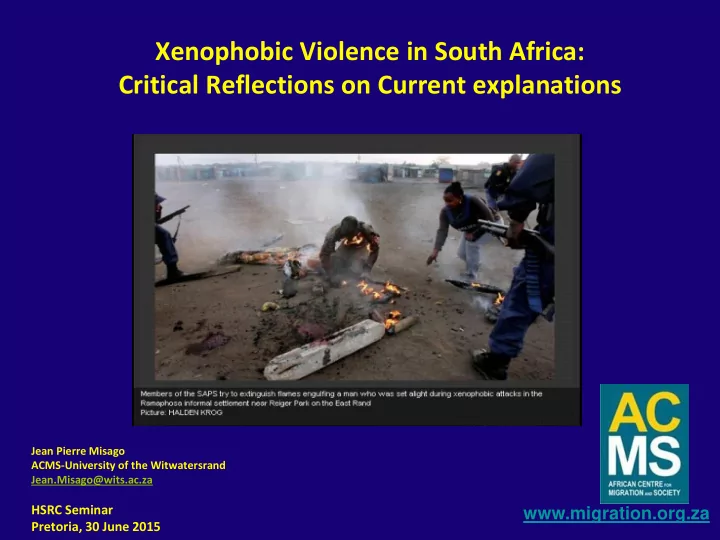
Xenophobic Violence in South Africa: Critical Reflections on Current explanations

slide-2
SLIDE 2

www.migration.org.za

  • Graduate degree programmes (Hons, MA, PhD) with students from

across Africa, North America, and Europe;

  • Research in 12 African countries on issues related to migration,

urbanisation, human rights, development, governance, and social change;

  • Partnerships in 4 continents;
  • Provides research services and support to government, international
  • rganizations, local NGOs, and rights advocates.

The African Centre for Migration & Society at Wits

An internationally engaged; Africa-oriented; and African-based research and teaching centre dedicated to shaping academic and policy debates

  • n migration, development and social transformation
slide-3
SLIDE 3

www.migration.org.za

Main Arguments

  • Most current explanations are valuable in describing the socio-economic and

political context but they fall short as scientific explanations for the occurrence

  • f the violence
  • Only a multivariate explanatory model can account for all the determinants of

the violence

slide-4
SLIDE 4

www.migration.org.za

Methods

  • A decade of ACMS quantitative and qualitative research; on-going
  • PhD work
  • All together, more than 30 case studies across the country (latest Soweto)
  • Focus on explaining violence and not attitudes
  • ‘Most similar systems’ approach to understand why violence in some areas and not in
  • thers
slide-5
SLIDE 5

www.migration.org.za

Conceptual clarifications

  • Xenophobia =/= Xenophobic violence: Violence is

not a quantitative degree of conflict (Blubaker et al. 1999)

  • This discussion about causal explanations of xenophobic

violence and not of xenophobia.

  • Xenophobia or just criminality? Not mutually

exclusive

slide-6
SLIDE 6

www.migration.org.za

Current Causal Explanations: Not these….

slide-7
SLIDE 7

www.migration.org.za

Current Causal Explanations: These rather….

  • Can be grouped into 3 main categories:
  • Economic and material: Competition for scarce resources and opportunities;

poverty, inequality, unemployment; Service Delivery Failures; Mass Influx and Inadequate Border Control (invoking The ‘threshold of tolerance’ hypothesis: the greater the numbers

  • f migrants in a context of deep dislike , the more violent the reaction (Relative deprivation

theory).

  • Historical, political and institutional: the legacy of apartheid (segregation,

isolation policies, etc.), the impact of post-apartheid nation-building efforts and the failure to meet socio-economic expectations.

  • Psycho-social: cultural stereotyping, repressed historical trauma, culture of violence.
  • Shortcomings:
slide-8
SLIDE 8

www.migration.org.za

Current Causal Explanations: Shortcomings

  • Common and long standing: cannot explain violence in some areas and not in
  • thers with similar socio-economic conditions
  • Reductionist, one-factor, mono-causal explanations: can be at best partial or

incomplete.

  • Biggest problem: they do not seem to recognise their limitations. They claim to be all

encompassing i.e. to account for all the elements of the causal chain.

  • What these explanations really do is to describe the conditions prevailing in affected

areas; they do not explain how these conditions exactly lead to mass violence targeting foreign nationals.

slide-9
SLIDE 9

www.migration.org.za

Determinants of Xeno violence (or elements of the violence causal chain)

  • Deprivation: real or relative
  • Belief: that foreigners are the cause of the

deprivation

  • Collective discontent towards foreigners
  • Micro-politics

& political economy: instrumental motives of instigators

  • Mobilization of the discontent: the trigger
  • Governance and social controls: favorable
  • pportunity structure for violence
slide-10
SLIDE 10

www.migration.org.za

Conclusion: Towards a Multivariate Model of Xeno Violence

slide-11
SLIDE 11

www.migration.org.za

Multivariate Model of Xenophobic Violence

Determinants Micro

  • politics and

Governance Political economy (intervening variable) ( intervening variable) Deprivation_______ ___ Belief__________Discontent__________________________ ____ Mobilization__________________________ ____ Xenophobic violence Explanations Real or perceived socio

  • economic and

political deprivation Xenophobic attitudes and belief attributing deprivation to foreign nationals Belief leads to collective discontent and strong resentment towards foreign nationals Instrumental motives

  • f violence

entrepreneur s i.e. i nstigators’ political and economic incentives Trigger: violence entrepreneurs mobilize discontented members

  • f the community for

violence Favourable governance factors and social controls provide a political opportunity structure for mobilizat ion to succeed in triggering violence Outbreak of violence as a result of value - added process : each determinant playing its specific and indispensable role Associated theories  Relative deprivation  Scapegoating model  Real conflict theory  Framing theory  Elite manipulation theory  Rational choice  Greed and grievance theory  Mobilization of discontent model (my innovation )  Political

  • pportunity

structure model  A multivariate model (my suggestion)

slide-12
SLIDE 12

www.migration.org.za

Jean Pierre Misago ACMS-University of the Witwatersrand Jean.Misago@wits.ac.za

HSRC Seminar Pretoria, 30 June 2015

Xenophobic Violence in South Africa: Critical Reflections on Current explanations