2015 (4) Child (5) Maternal Mortality Health 193 Member States - - PDF document

2015
SMART_READER_LITE
LIVE PREVIEW

2015 (4) Child (5) Maternal Mortality Health 193 Member States - - PDF document

19-Feb-18 Achievement of MDGs and Adaptation of SDGs: Bangladesh Context Presented by Shimul Sen Assistant Chief General Economics Division (GED) ( Making g Growth Work for the Poor) Bangladesh Planning Commission 15 th February, 2018 1


slide-1
SLIDE 1

19-Feb-18 1

General Economics Division (GED)

(Making g Growth Work for the Poor)

Bangladesh Planning Commission

15th February, 2018

Presented by Shimul Sen Assistant Chief

1

Achievement of MDGs and Adaptation of SDGs: Bangladesh Context

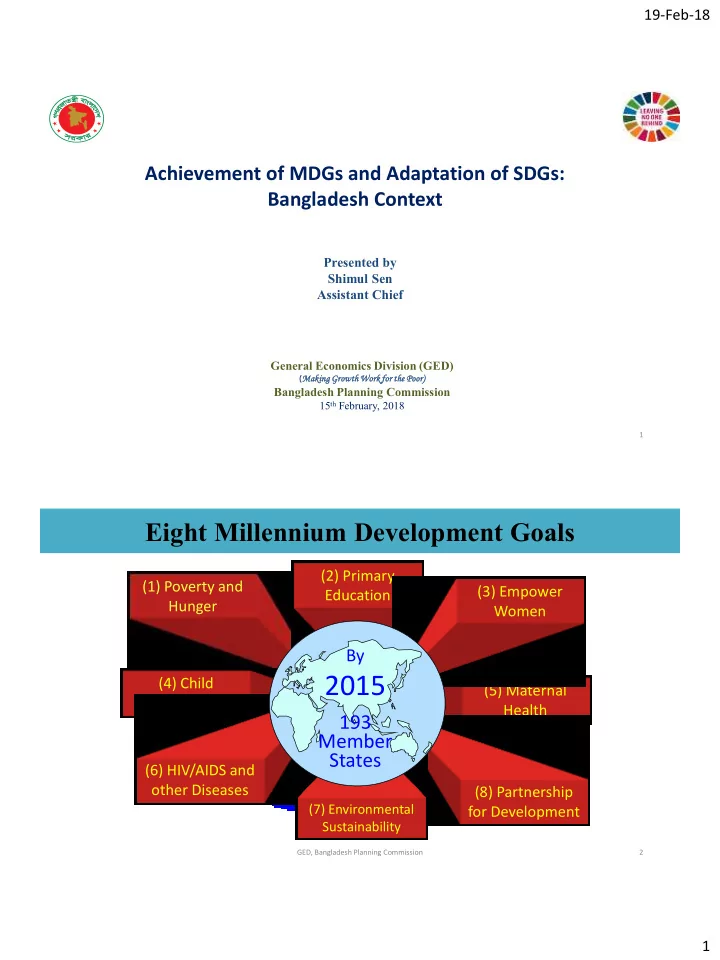
Eight Millennium Development Goals

GED, Bangladesh Planning Commission 2

(1) Poverty and Hunger (2) Primary Education (4) Child Mortality (5) Maternal Health (8) Partnership for Development (6) HIV/AIDS and

  • ther Diseases

(3) Empower Women

(7) Environmental Sustainability

By

2015

193 Member States

slide-2
SLIDE 2

19-Feb-18 2

Bangladesh MDGs achievements: International recognition

  • Hon‟ble Prime Minister of Bangladesh was awarded with ‘UN MDG Awards 2010’ for reducing under five child

mortality rate (MDG-4).

  • Bangladesh received South-South Award 'Digital Health For Digital Development' for success on attainment of

MDG- 4 & MDG-5.

  • Bangladesh received ‘Diploma Award’ from Food and Agriculture Organization (FAO) for achieving the MDG-1.
  • Bangladesh was honoured with the ‘special recognition’ for outstanding progress in fighting hunger and poverty.
  • Bangladesh was awarded ‘South-South Award’ for achievements in alleviating poverty.
  • Hon‟ble Prime Minister was awarded ‘UNESCO Peace Tree Award’ for her commitment to women‟s

empowerment and girls‟ education.

  • Bangladesh received „Women in Parliaments Global Forum Award’, as Bangladesh ranked 10th out of 142

countries in the political sphere.

  • Hon‟ble Prime Minister was awarded “Champions of the Earth” by UNEP for Policy Leadership.
  • The UN-Women recognised our Hon‟ble Prime Minister as "Planet 50-50 Champion"
  • The Global Partnership Forum awarded Hon‟ble Prime Minister "Agent of Change Award" for her outstanding

contributions to women empowerment.

GED, Bangladesh Planning Commission 3 GED, Bangladesh Planning Commission 4

slide-3
SLIDE 3

19-Feb-18 3

GED, Bangladesh Planning Commission 5

Goal 1: Eradicate Extreme Poverty & Hunger

Targets Achieved

Base Year 1990-91 Current Status Target 2015 Status

Proportion of people below national upper poverty line (%) (Cost of Basic Need=CBN method) 56.7 24.8

(GED 2015)

29.0 Goal met Poverty gap ratio (%) 17.0 6.5

(HIES 2010)

8.0 Goal met Prevalence of underweight children under –five years of age (6-59 months), (%) 66.0 32.6

(BDHS 2014)

33.0 Goal met % of people below minimum level

  • f dietary energy consumption (1805

kcal/day) (Direct Calorie Intake = DCI) 28.0 16.4

(Estimate for 2015 by UNSD)

14.0 On Track

  • With sustained GDP growth rate of
  • ver 6%, the MDG target of halving

the population living under the poverty line (from 56.7% to 29%) was achieved by 2012, three years ahead of the target date.

  • The social protection allocation was

increased from 1.98% of GDP in FY 09 to 2.30% in FY 15.

  • Half of the total budget expenditure

has been related to poverty reduction for the last seven years.

GED, Bangladesh Planning Commission 6

Goal 2: Achieve Universal Primary Education

Targets Achieved Base Year Current Status Target 2015 Status

Net Enrolment Ratio in Primary Education (%) 60.5

98 (2015, DPE)

100.0

Goal met

Proportion of pupils starting grade 1 who reach grade 5 (%) 43.0

81.3 (2015, DPE)

100.0

Substant ial Achieve ment

Literacy rate of 15-24 year olds, women and men, %

  • 75.4 (Pop.

Cens., BBS 2011)

100.0

On Track

  • Net Enrolment Ratio: Bangladesh

was well ahead than the regional neighbors, except India and Nepal

  • Literacy rate: Bangladesh is better

than India and Pakistan along with

  • ther South Asian counterparts

except Maldives and Sri Lanka.

  • A major milestone in the education

sector is the adoption of National Education Policy 2010, which the government is implementing.

slide-4
SLIDE 4

19-Feb-18 4

GED, Bangladesh Planning Commission 7

Goal 3: Promote Gender Equality and Empower Women

Targets Achieved Base Year Current Status Target 2015 Status Ratio of girls to boys in Primary education (Gender Parity Index, GPI=Girls/Boys) 0.83 1.04

(DPE 2015)

1.0 Goal met Ratio of girls to boys in Secondary education (Gender Parity Index, GPI=Girls/Boys) 0.52 1.14

(BANBEIS 2015)

1.0 Goal met Ratio of girls to boys in Tertiary education (Gender Parity Index, GPI=Girls/Boys) 0.37 0.65

(BANBEIS 2015)

1.0 Substanti al Achievem ent

  • Bangladesh has been maintaining

gender parity at secondary education level during the last 15 years.

  • Gender parity at the secondary level is

highest in Bangladesh, followed by Maldives, Bhutan, Sri Lanka and Nepal.

  • With respect to share of women in

wage employment in the non- agriculture sector, Bangladesh

  • utperformed India, Pakistan, Nepal,

Afghanistan and Bhutan.

GED, Bangladesh Planning Commission 8

Goal 4: Reduce Child Mortality

Targets Achieved Base Year Current Status Target 2015 Status Under-five (6-59 months) Mortality Rate (per 1000 live births) 146

36

(SVRS 2015) 48 Goal met Infant (0-1 year) Mortality Rate (per 1000 live births) 92

29

(SVRS 2015) 31 Goal met Proportion of 1 year-old children immunized against measles (%) 54

80

(BDHS 2014) 100

Substantial Achievement

  • In order to strengthen primary

healthcare facilities, the government has launched 13,126 community clinics during the 6th FYP period.

  • The under-five mortality rate per

1000 live births in Bangladesh is lower than that of India and Pakistan.

  • Bangladesh also performed better

than India and Pakistan in case of infant mortality and children 1 year

  • ld immunized against measles.
slide-5
SLIDE 5

19-Feb-18 5

GED, Bangladesh Planning Commission 9

Goal 5: Improve Maternal Health

Targets Achieved Base Year Current Status Target 2015 Status

Maternal Mortality Ratio ( per 100,000 live births) 574

176

(MMEIG 2015)

143

Substanti al Progress

Proportion of births attended by Skill Health Personnel (%) 5.0

42.1

(BDHS 2014)

50.0

Ditto

Contraceptive Prevalence Rate (%) 39.7

62.1

(SVRS 2015)

72

On Track

Antenatal Care coverage (at least 1 visit) % 27.5

75

(SVRS 2015)

100

Substanti al Progress

Antenatal Care coverage (at least 4 visits) % 5.5

31.2

(BDHS 2014)

50

Ditto

  • Contraceptive

Prevalence Rate & Maternal Mortality Ratio: Other than Maldives and Sri Lanka, Bangladesh’s achievement is impressive than other South Asian countries.

  • Health and Population Sector Programme

(HPSP), followed by Health Population and Nutrition Sector Development Program (HPNSDP) sought to improve the state of health of the people of the country with focus on women, child and the poor.

GED, Bangladesh Planning Commission 10

Goal 6: Combat HIV/AIDS, Malaria and Other Diseases

Targets Achieved

Base Year Current Status Target 2015 Status

HIV prevalence among population (%) 0.005

<0.1 (UNAIDS

2013)

Halting On Track

Prevalence of Malaria per 100,000 Population 776.9 434

(NMCP 2014)

310.8

Substantial Progress

Deaths of Malaria per 100,000 Population 1.4

0.34

(NMCP 2014)

0.6

Goal met

Proportion of children U5 sleeping under insecticide treated bed nets (%) 81 92.2 (NMCP

2014)

90

Goal met

TB Case Notification rate (all forms) per 100,000 population per year 59 53

(WHO 2014)

120

Goal met

Cure Rate of TB under DOTS (%) 73 92

(WHO 2014)

> 90

Goal met

  • Bangladesh’s performance in

Halting HIV/AIDS is inspiring compared to the South Asian neighbors.

  • Notwithstanding the success in

containing Tuberculosis, TB prevalence rate is still highest in Bangladesh among the regional countries
slide-6
SLIDE 6

19-Feb-18 6

GED, Bangladesh Planning Commission 11

Goal 7: Ensure Environmental Sustainability

  • In case of Using Improved Drinking

Water Sources Bangladesh’s performance is impressive comparing to India and Pakistan.

  • In case of access to improved

sanitation, Bangladesh has been doing better than Afghanistan, India, Nepal, Bhutan and Cambodia.

  • Despite positive picture in

afforestation, extensive clearing of forests for agriculture, homestead and other non-forest purpose thwart attaining of the target

Targets Achieved Base Year Current Status Target 2015 Status

Proportion of land area covered by forest (%) 9.0 13.40 (TD>=30%) (DoF) 20.0 (TD>=70 %) Substantial Progress Consumption of ozone – depleting substance in Ozone Depletion Potential (ODP) tonnes 72.6 64.9 (DoE, 2013) 65.39 Goal met Proportion of people using an improved Drinking Water Sources 78 97.9 (SVRS 2015) 100 Goal met 7.9: Proportion of population using an improved sanitation facility 34 73.5 (SVRS, 2015) 100 Substantial Progress

GED, Bangladesh Planning Commission 12

Goal 8: Develop a Global Partnership for Development

Indicators Base Year Current Status Status Net ODA received by BD in billion US$ 1.73 1.79 (Ave. FY91 to FY15; GED, 2015)

  • Net ODA received by BD as % of

OECD/DAC donors‟ GNI (FY: 14)

  • 0.002

(ERD, FY14)

  • Average tariff imposed by developed

countries on agricultural products, textile & clothing (%) 12 0-9 (BTC,2011)

  • Debt Service as % of exports of

goods & services (%) 20.9 5.1 (ERD, FY15) Highly Impressive Cellular subscribers per 100 population

  • 80

(BTRC, June 2015) Highly Impressive

  • Between 1990-91 and 2014-15, the

disbursement of ODA as a proportion of Bangladesh’s GDP has fallen from 5.59 per cent to 1.56 per cent.

  • Developing and least developed

countries did not get promised financial assistance from most of the OECD/DAC countries.

slide-7
SLIDE 7

19-Feb-18 7

Area of Attention Required for Fulfilling the unfinished MDGs

  • Unemployment and underemployment is still persistent especially among the young people

between 15 to 24 years of age.

  • Addressing stunting and wasting will be a major concern to improve nutritional wellbeing.
  • Reducing income inequality and the low economic participation of women remain as matter of

concerns.

  • Primary education completion rate and the adult literacy rate are yet to obtain.
  • Quality of education is a challenge at the primary and higher secondary levels.
  • Inequalities remain in maternal health.
  • Prevalence of malaria is still high even though death incidences are reduced.
  • Prevalence of TB and TB mortality targets are yet to be achieved.
  • Tree coverage and proportion of protected terrestrial and marine areas is much less.
  • Access to safe water for all is still a challenge.
  • One-third population are not using improved sanitation.
  • Capacity to raise public resources domestically is limited.

GED, Bangladesh Planning Commission 13

70th UNGA Adopted SDG as Post-2015 Agenda

GED, Planning Commission

slide-8
SLIDE 8

19-Feb-18 8

Chronology of Agenda 2030: Sustainable Development

  • Rio+20 UN Conference on Sustainable Development, held in Rio de Janeiro, Brazil in June 2012 was the international

forum where Sustainable Development Issue has been focused for preparing Post 2015 Development Agenda.

  • The Brundtland Report, published in 1987, coined the term "sustainable development" and defined it as

"development that meets the needs of the present without compromising the ability of future generations to meet their own needs."

GED: Making growth work for the Poor 15

The SDGs are …

  • A set of 17 goals for the world‟s future,

through 2030

  • Backed up by a set of 169 detailed Targets
  • Emerged from the most inclusive process in

the UN‟s history, with the involvement of approximately 8.5 million people

  • r
  • rganizations (GOB proposed: 11 Goals, 58

Targets & 241 Indicators)

  • Negotiated over a two-year period at the

United Nations (March 2013 to August 2015)

  • 136 Heads of State or Government was

present (25th September 2015).

GED, Bangladesh Planning Commission 16

232 indicators

169 targets 17 goals SDGs

slide-9
SLIDE 9

19-Feb-18 9

MDGs versus SDGs

  • MDGs was based on UN Millennium Declaration (2000) and SDGs are based on UNCSD

(Rio+20 declaration, 2012).

  • In the SDGs, unfinished agenda of MDGs are carried forward along with inclusion of human

rights, peace, access to justice, energy, growth & employment, innovation & industrialization, urbanization & climate change issues.

  • The MDG period was 2001-2015 and the SDG period is 2016 to 2030.
  • MDG started with 8 goals, 18 targets and 48 indicators (later 20 targets & 60 indicators).

SDGs starts with 17 goals, 169 targets and 232 indicators. (6 indicators used twice; 3 indicators thrice)

  • MDGs were built on top down approach, but SDGs are built on bottom up approach.

GED, Bangladesh Planning Commission 17

MDGs versus SDGs (Contd.)

  • MDGs were mainly focused for the LDCs but SDGs are universal. UNIVERSALITY
  • Goal to goal linkages were missing in MDGs but well inter-linkages among the goals are

there is SDGs. INTEGRATION

  • MDGs focused on National level only quantitative data. But SDGs focuses on quantitative

and qualitative disaggregated data. TRANSFORMATION

  • Means of Implementation (MoI) were absent in MDGs but well-coordinated MoIs are

present in SDGs. (MoI Target=> 43; MoI Indicators =>48)

  • Hunger was treated as part of poverty in MDGs but hunger is now treated as part of food

security and nutrition in the SDGs.

  • Private sector was not involved in the MDGs implementation, but in SDGs they are treated

as important players.

GED, Bangladesh Planning Commission 18

slide-10
SLIDE 10

19-Feb-18 10

GED, Bangladesh Planning Commission 19

SDG # 1: End poverty in all its forms everywhere

GED, Bangladesh Planning Commission 20

slide-11
SLIDE 11

19-Feb-18 11

SDG # 2: End hunger, achieve food security and improved nutrition and promote sustainable agriculture

GED, Bangladesh Planning Commission 21

SDG # 3: Ensure healthy lives and promote well-being for all at all ages

GED, Bangladesh Planning Commission 22

slide-12
SLIDE 12

19-Feb-18 12

SDG # 4: Ensure inclusive and equitable quality education and promote lifelong learning opportunities for all

GED, Bangladesh Planning Commission 23

SDG # 5: Achieve gender equality and empower all women and girls

GED, Bangladesh Planning Commission 24

slide-13
SLIDE 13

19-Feb-18 13

SDG # 6: Ensure availability and Sustainable management of water and sanitation for all

GED, Bangladesh Planning Commission 25

SDG # 7: Ensure access to affordable, reliable, sustainable and modern energy for all

GED, Bangladesh Planning Commission 26

slide-14
SLIDE 14

19-Feb-18 14

SDG # 8: Promote sustained, inclusive and sustainable economic growth, full and productive employment and decent work for all

GED, Bangladesh Planning Commission 27

SDG # 9: Build resilient infrastructure, promote inclusive and sustainable industrialization and foster innovation

GED, Bangladesh Planning Commission 28

slide-15
SLIDE 15

19-Feb-18 15

SDG # 10: Reduce inequality within and among countries

GED, Bangladesh Planning Commission 29

SDG # 11: Make cities and human settlements inclusive, safe, resilient and sustainable

GED, Bangladesh Planning Commission 30

slide-16
SLIDE 16

19-Feb-18 16

SDG # 12: Ensure sustainable consumption and production patterns

GED, Bangladesh Planning Commission 31

SDG # 13: Take urgent action to combat climate change and its impacts

GED, Bangladesh Planning Commission 32

slide-17
SLIDE 17

19-Feb-18 17

SDG # 14: Conserve and sustainably use the

  • ceans, seas and marine resources for

sustainable development

GED, Bangladesh Planning Commission 33

SDG # 15: Protect, restore and promote sustainable use of terrestrial ecosystems, sustainably manage forests, combat desertification, and halt and reverse land degradation, and halt biodiversity loss

GED, Bangladesh Planning Commission 34

slide-18
SLIDE 18

19-Feb-18 18

SDG # 16: Promote peaceful and inclusive societies for sustainable development, provide access to justice for all and build effective, accountable and inclusive institutions at all levels

GED, Bangladesh Planning Commission 35

SDG # 17: Strengthen the means of implementation and revitalize the global partnership for sustainable development

GED, Bangladesh Planning Commission 36

slide-19
SLIDE 19

19-Feb-18 19

Each goal is important in itself …

GED, Bangladesh Planning Commission 37

Each goal is important in itself … And they are all connected

GED, Bangladesh Planning Commission 38

slide-20
SLIDE 20

19-Feb-18 20

SDGs as a Network of Targets

GED, Bangladesh Planning Commission 39

Social = People Economic = Prosperity Environmental = Planet Sustainable Development Goals Peace Partnership

17 Goals in 5Ps

“The new agenda is a promise by leaders to all people

  • everywhere. It is an agenda for people, to end poverty in all its

forms—an agenda for the planet,” Ban Ki-moon, UN Secretary- General in 70th UNGA

GED, Bangladesh Planning Commission 40

slide-21
SLIDE 21

19-Feb-18 21

Initiatives of GOB in mainstreaming the Agenda 2030 (SDGs) Implementation

GED, Bangladesh Planning Commission 41

  • A total of 14 goals (82%) are

found to be thematically fully aligned with the plan document

  • 3 Goals -Goal 14, Goal 16

and Goal 17 (18%) are partially aligned.

Alignment of SDGs (Goals only) with the 7th Five Year Plan

Alignment of SDGs with 7th FYP

GED, Bangladesh Planning Commission 42

  • As an ‘early starter’ country to implement Agenda 2030, Bangladesh emphasized SDGs while setting up

the priority areas for 7th Five Year Plan (2016-20).

slide-22
SLIDE 22

19-Feb-18 22

  • A total of 58 (34.3%)

SDGs targets are found to be aligned with 7th FYP

  • 38 (22.5%) targets are

partially aligned

  • 73 (43.2%) targets are not

aligned.

Alignment of SDGs (Targets) with the 7th Five Year Plan

Alignment of SDGs with 7th FYP (contd)

GED, Bangladesh Planning Commission 43

Challenges remain in Indicators as around 20% Indicators

  • f

SDGs are incorporated in the 7th FYP

Sustainable Development Goals (SDGs): Roadmap for Bangladesh for Implementing Agenda 2030

GED, Bangladesh Planning Commission 44

  • PMO has created an inter-ministerial committee, “SDGs Implementation and Monitoring Committee” which

includes 20 Senior Secretaries/ Secretaries from different ministries/ divisions.

  • GED is the secretariat for the committee to coordinate the implementation at policy level along with monitoring

and reporting SDG attainment status of Bangladesh.

  • On top an office of Principal Coordinator for SDGs Affairs has been established in PMO to coordinate and

facilitate overall implementation and monitoring of SDGs.

  • SDGs are aligned in the 7th FYP, the National Developmental Plan of Bangladesh.
  • SDGs Mapping among the Ministries/Divisions have been finalized and published.
  • SDG Data Gap Analysis has been finalized and published.
  • National Monitoring and Evaluation (M&E) Framework for SDGs is in the process of finalization.
  • SDGs Action Plan are in the process of preparation.
  • A study on SDGs Need Assessment and Financing is being done.
  • An on-line SDGs Data Repository system is in the process preparation.
  • Instruction has been given to include SDGs issues in the APA of all Ministries/Divisions/Agencies.
  • Instruction has been given to include SDGs issues in the different training institutions.
slide-23
SLIDE 23

19-Feb-18 23

Whole Society Approach of SDGs implementation

  • The government has adopted a “whole of society” approach for implementation and attainment of

the SDGs.

  • GED in collaboration with UNRC in Bangladesh has organized a Consultation on Stakeholders’

Engagement on the SDG Implementation in Bangladesh held on 30th March 2016. Representatives from the NGOs, CSOs, DPs and Media participated and opined different stakeholders‟ involvement in SDGs implementation.

  • A consultation meeting between the GoB, Private Sector and the UN System on the Role of the

Private Sector in Facilitating the SDGs was held on 23rd November 2016 held in Radisson Blu Hotel, Dhaka. GED presented a trigger paper on the role of Private sector in implementing SDGs in Bangladesh. From the private sector, FBCCI also presented a paper on the topics.

  • A seminar on Role of Media in SDGs Implementation in Bangladesh was held on 25th January

2017 at the NEC Conference Room. Effective and coherent role of media on creating SDGs awareness and branding of success was sought. It was proposed that print media might publish a page/supplementary on SDGs and Electronic media could broadcast program on SDGs issues in a regular basis to create awareness among the stakeholders to create social demand for implementation.

GED, Bangladesh Planning Commission 45

Mapping of Ministries/Divisions by SDG Targets

GED, Bangladesh Planning Commission 46

slide-24
SLIDE 24

19-Feb-18 24

SDG Mapping (Who to do what)

10 20 30 40 50 60 70

40 34 61

Lead Co-lead Associate

GED, Bangladesh Planning Commission 47

Lead Ministries/Divisions for Implementing SDGs

26 22 16 16 15 11

10

10 9 8 7 7 6 5 5 5 5 5 5 5 5

4

4 3 3 3 3 2 2 2 2 2 1 1 1 1 1 1 1 1 5 10 15 20 25 30

40_Lead Ministry/Division for SDG Implementation

GED, Bangladesh Planning Commission 48

slide-25
SLIDE 25

19-Feb-18 25

Co-Lead Ministries/Divisions for Implementing SDGs

3 1 1 2 1

1

2 8 1 3 6 2 1 2 2 6 6 1 12 1 2 2 1 5 2 1 2 1 2 1 1 1 2 1

2 4 6 8 10 12 14 34_Co-lead Ministries/Divisions

GED, Bangladesh Planning Commission 49

Associate Ministries/Divisions/Institutions for Implementing SDGs

84 82 65 57 48 43 42 42 42 41 40 40 34 31 29 28 28 25 23 22 21 20 20 19 19 19 19 19 19 18 17 17 16 16 15 15 15 14 14 13 12 12 9 9 9 8 8 8 7 6 6 6 5 5 5 5 4 4 3 3 2

10 20 30 40 50 60 70 80 90

MoFA SID LGD MoInd MoInf MoWCA MoE BFID MoFL MoEF FD MoHA MoA MoHFW ERD MoEWOE MoSW GED MoPA MoPME ICTD MoYS MoCHTA MoC MoWR MoF LPAD IRD MoRA MoLE MoS PD MoST LJD CD MoDMR MoL PMO MoD MoTJ EMRD MoLE MoHPW PTD MoR MoCAT BD InfCom PID RTHD MoLWA NHRC MoCA RDCD SEID AWRRID PoD EC IED ACC C&AG

61_Associate Ministries/Divisions/Institutions

GED, Bangladesh Planning Commission 50

slide-26
SLIDE 26

19-Feb-18 26

Data Gap Analysis for SDGs Monitoring

GED, Bangladesh Planning Commission 51

Data availability against Goals (number)

5 5 12 2 8 2 1 5 5 7 2 1 1 3 4 7 6 9 10 6 4 4 4 9 6 1 8 4 2 3 6 10 16 1 4 3 2 5 1 3 1 3 5 9 4 6 5 9 2

5 10 15 20 25 30

1 2 3 4 5 6 7 8 9 10 11 12 13 14 15 16 17

Readily Available Partially Available Not Available

GED, Bangladesh Planning Commission 52

slide-27
SLIDE 27

19-Feb-18 27

Data Availability Against Goals (%)

42 36 46 18 57 18 17 29 42 64 13 14 10 21 17 28 29 50 64 38 55 29 36 67 53 50 9 53 31 29 30 43 43 64 45 8 15 27 14 45 17 18 8 27 33 69 57 60 36 39 8 26

10 20 30 40 50 60 70 80 90 100

1 2 3 4 5 6 7 8 9 10 11 12 13 14 15 16 17 Total % of availability of data against goals Readily Available Partially Available Not Available

GED, Bangladesh Planning Commission 53

Ministries/Divisions responsible for data source

93 52 46 26

20 16

12 11 11 10 10 9 9 8 7 6 6 6 5 5 5 5 5 5 5 4 4

4 3 3 3 3 2 2 2 2 2 2 2 1 1 1 1 1

10 20 30 40 50 60 70 80 90 100

SID MoHFW MoEF ERD FD LGD MoDMR MoHA MoA BFID MoSW MoC MoE MoFL MoFA GED MoPME MoWR PoD MoWCA MoEWOE LPAD PMO MoLE MoS MoST PTD RTHD MoL MoD MoHPW EMRD MoCHTA MoPA MoCAT MoCA IRD MoR NHRC IMED MoYS MoInd LJD R,SC

GED, Bangladesh Planning Commission 54

slide-28
SLIDE 28

19-Feb-18 28

Departments responsible for SDG Data Source

89 24 22 21 14 8 8 7 7 6 5 4 4 4 4 4 3 3 3

3 2 2 2 2 2 2 2 2 2 2 1 1 1 1 1 1 1 1 1 1 1 1 1 1 1 1 1 1

10 20 30 40 50 60 70 80 90 BBS NIPORT DGHS DoE BFD BB DSS DDM BP DoF BANBEIS Tariff com DPE BTRC SREDA BIDA DAE DPHE WDB BRTA BADC NBR HEU WTOC WARPO BMET BERC BR BIWTC BIWTA MRA IFE NNS BARI DNC MIS, DGFP MIS, DYS NGOAB CPTU BGB DoLab BOESL DoP BMDA HCU CAAB BRTC UGC Data source by departments (48)

GED, Bangladesh Planning Commission 55

  • Following the SDGs mapping, preparation of “Action Plan to Implement SDGs through 7th FYP” is already

initiated by GED through training and consultation with Ministries in a phased manner.

  • Subsequently, the responsible lead ministries/divisions, as identified in the SDG Mapping, will prepare their own

action plans for attaining the SDGs‟ target.

  • The LEAD ministry will initiate working for each target of the SDGs in consultation with the associate ministries

to prepare action plan as formatted by GED

  • Ministries/Divisions will prepare their action plan to achieve the SDG targets in accordance with 7th FYP for the

next five years and beyond

  • The draft action plan from LEAD ministry will be sent to GED, Planning Commission
  • GED will compile and edit the action plans for the targets of SDGs received from each LEAD ministry in

consultation with the respective ministries.

  • Several inter-ministerial consultation workshops will be arranged for finalisation of the DRAFT “Action Plan to

Implement SDGs through Five Year Plans”

Action Plan to Implement SDGs through 7th FYP

GED, Bangladesh Planning Commission 56

slide-29
SLIDE 29

19-Feb-18 29

SDG Action Plan through National Mid-Term and Long-Term Development Plans

GED, Bangladesh Planning Commission 57

SDG Targets Global Indicators for SDG Targets Lead/ Co-Lead Ministries/D ivision Associate Ministries/Di visions 7th FYP Goals/ Targets related to SDG Targets and Indicators On-going Project/Programme to achieve 7th FYP Goals/ Targets Requirement of New Project/ Programme up to 2020 Actions/ Projects beyond 7th FYP Period (2021- 2030) Policy/ Strategy if needed (in relation with Column 8) Remarks Project Title and Period Cost in BDT (million) Project Title and Period Cost in BDT (million) 1 2 3 4 5 6.1 6.2 7.1 7.2 8 9 10

  • GED has prepared ‘SDGs Needs Assessment and Financing Strategy’

for Bangladesh to estimate the resources needed for achieving SDGs in Bangladesh by 2030.

  • Global estimate shows that US$ 3-5 trillion would be required annually

throughout the world.

  • In Bangladesh, around 928.48 Billion US$ additional funding would be

required from 2017 to 2030 to fully implement the SDGs (2015-16 constant prices). Annual average cost would be 66.32 billion US$

  • It would be 19.75% of the accumulated GDP under 7th FYP extended

scenario during the period FY2017-FY2030.

  • Of the additional required costs, domestic financing: 85.1% (US$ 796.09

billion); External financing: 14.9% (US$ 132.39 Billion).

  • Of the domestic financing, Govt: 33.5%, Private: 42%, PPP: 5.6%, NGOs:

4%. Of the external, FDI: 9.95%, Aid & Grants: 4.94%

  • Annual average: US$ 56.86 Billion from domestic, US$ 9.46 Billion from

external sources (FDI: US$ 6.91 Bn/year; Grants & Aid: 2.55 Bn/year)

Study on SDGs Needs Assessment and Financing for Implementing Agenda 2030

GED, Bangladesh Planning Commission 58

slide-30
SLIDE 30

19-Feb-18 30

Global Goals: Sustainable Development Goals (SDGs) National Development Plan (7th Five Year Plan)

Macroeconomic Stability and Economic Growth Poverty Reduction Employment Growth Agriculture Education Health Water & Sanitation Transport and Communication Power, Energy and Mineral Resources Gender and inequality Environment, CC and DM Information & Communication Technology Urban Development International Cooperation and Partnership

Sectoral Policies/Strategies

Annual Performance Agreement (APA) of Line Ministries/Divisions SDGs M&E Framework (232 Indicators)

Development Results Frameworks (DRF) of 7th Five Year Plan (88 indicators under 15 priority areas)

Key Performance Indicators (KPI) Governance Annual Development Programme (ADP) or the Development Budget Project level M&E

National M&E System of Bangladesh

GED, Bangladesh Planning Commission 59

National Monitoring & Evaluation Framework for SDGs

  • On the basis of the findings of SDGs Data Gap Analysis, the SDG Monitoring and Evaluation

Framework is being prepared.

  • The GED has initiated a process of M&E Framework formulation process through inter-

ministerial workshop.

  • The framework has been finalized after a series of consultations with all government and non-

government stakeholders.

  • Means of implementation will need to be clearly formulated and gaps identified.
  • Private Sector‟s roles and partnership needs to be delineated/ figured out.

GED, Bangladesh Planning Commission 60

60

slide-31
SLIDE 31

19-Feb-18 31

National M&E Framework for SDGs (Cont)

Goals, Targets and Indicators

Status of Data Availability with Indicator Priorities [1] (1/2/3)

Data Sources (Relevant Agency with Ministry/ Division to generate/ provide data)

Baseline data (Year[2])

Milestone by 2020 Milestone by 2025 Target by 2030 Lead Ministry/ Divisions

Remarks[3]

1 2 3 4 5 6 7 8 9

GED, Bangladesh Planning Commission 61

  • 1. 1 = if data is Readily Available now;

2 = if data is partially available at present; 3 = if data is not presently available

  • 2. Baseline data should

not be before 2010, closer to 2015 is preferable

  • 3. Whether the indicator is not relevant to

Bangladesh; whether the metadata is not available; if disaggregated data is not available to Bangladesh as required by the indicator itself.

  • To facilitate the results based

monitoring system within Government, a macro-level data repository system is being prepared by a2i of PMO to facilitate GED.

Establishment of Macro-level Data Repository System for Tracking Agenda 2030 Implementation

Authentication by BBS

Online sources Data from NDPs Admin data

  • An SDG Tracker has been established

with the help of a2i of PMO to analyze the data for tracking and evaluating SDG attainment.

GED, Bangladesh Planning Commission 62

slide-32
SLIDE 32

19-Feb-18 32

  • Bangladesh has participated in the Voluntary National Review (VNR) of

SDGs in 2017.

  • The focus of the report is where we are in implementing Agenda 2030.
  • 7 Goals: Goal 1 (Poverty); Goal 2 (Hunger); Goal 3 (Health); Goal 5

(Gender); Goal 9 (Infrastructure); Goal 14 (Life under water); Goal 17 (Means of implementation)-have been reviewed.

  • In 2017 Bangladesh has submitted VNR of SDGs along with 42 other

countries.

  • 74 targets and 115 indicators related to 7 goals have been used for

reviewing the SDGs.

  • GED has drafted VNR Report of SDGs taking inputs from different

Ministries/Divisions.

  • The draft report was shared with different stakeholders including

government, NGOs, CSOs, Academia and Development Partners.

  • After consultations, the VNR was finalized and sent to the HLPF of

Sustainable Development.

  • On 17th July 2017, Hon‟ble Planning Minister led delegation of

Bangladesh presented the VNR to HLPF at the UNHQ, NY.

Voluntary National Review (VNR) of SDGs

GED, Bangladesh Planning Commission 63

"Let us together create a world that can eradicate poverty, hunger, war and human sufferings and achieve global peace and security for the well being of humanity." Bangabandhu Sheikh Mujibur Rahman, Founding Father of Bangladesh

GED, Bangladesh Planning Commission 64

THANK YOU ALL