2/2/2015 FUNDAMENTAL LEGAL PRINCIPLES Principle of Indemnity - - PDF document

2 2 2015
SMART_READER_LITE
LIVE PREVIEW

2/2/2015 FUNDAMENTAL LEGAL PRINCIPLES Principle of Indemnity - - PDF document

2/2/2015 FUNDAMENTAL LEGAL PRINCIPLES Principle of Indemnity Principle of Insurable Interest Principle of Subrogation Principle of Utmost Good Faith Requirements of an Insurance Contract Distinct Legal Characteristics of


slide-1
SLIDE 1

2/2/2015 1

FUNDAMENTAL LEGAL PRINCIPLES

  • Principle of Indemnity
  • Principle of Insurable Interest
  • Principle of Subrogation
  • Principle of Utmost Good Faith
  • Requirements of an Insurance Contract
  • Distinct Legal Characteristics of Insurance

Contracts

  • Law and the Insurance Agent

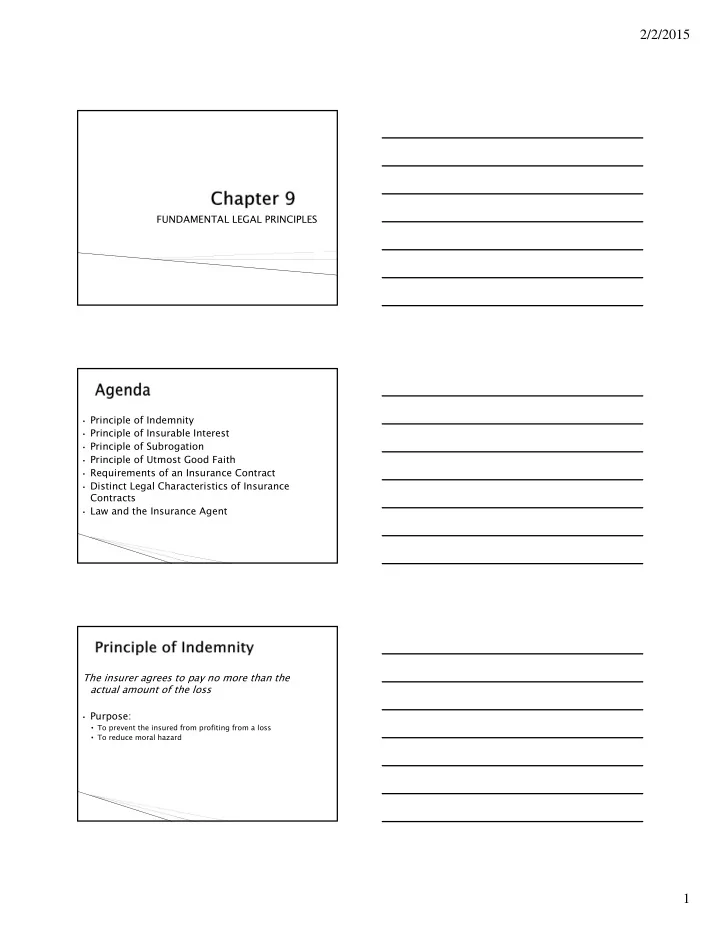
The insurer agrees to pay no more than the actual amount of the loss

  • Purpose:
  • To prevent the insured from profiting from a loss
  • To reduce moral hazard
slide-2
SLIDE 2

2/2/2015 2

  • In property insurance, indemnification is based
  • n the actual cash value of the property at the

time of loss

  • There are three main methods to determine

actual cash value:

  • Replacement cost less depreciation
  • Fair market value is the price a willing buyer would pay a willing

seller in a free market

  • Broad evidence rule means that the determination of ACV should

include all relevant factors an expert would use to determine the value of the property

  • Exceptions to the principle of indemnity:
  • A valued policy pays the face amount of insurance if a total loss
  • ccurs
  • Some states have a valued policy law that requires payment of

the face amount of insurance to the insured if a total loss to real property occurs from a peril specified in the law

  • Replacement cost insurance means there is no deduction for

depreciation in determining the amount paid for a loss

  • A life insurance contract is a valued policy that pays a stated

sum to the beneficiary upon the insured’s death

The insured must stand to lose financially if a loss

  • ccurs
  • Purpose:
  • To prevent gambling
  • To reduce moral hazard
  • To measure the amount of loss
  • When must insurable interest exist?
  • Property insurance: at the time of the loss
  • Life insurance: only at inception of the policy
slide-3
SLIDE 3

2/2/2015 3

Substitution of the insurer in place of the insured for the purpose of claiming indemnity from a third person for a loss covered by insurance.

  • Purpose:
  • To prevent the insured from collecting twice for the same loss
  • To hold the negligent person responsible for the loss
  • To hold down insurance rates
  • The insurer is entitled only to the amount it

has paid under the policy

  • The insured cannot impair the insurer’s

subrogation rights

  • Subrogation does not apply to life insurance

and to most individual health insurance contracts

  • The insurer cannot subrogate against its
  • wn insureds

A higher degree of honesty is imposed on both parties to an insurance contract than is imposed on parties to other contracts

slide-4
SLIDE 4

2/2/2015 4

  • Supported by three legal doctrines:
  • Representations are statements made by the applicant for

insurance

  • A contract is voidable if the representation is material,

false, and relied on by the insurer

  • An innocent misrepresentation of a material fact, if

relied on by the insurer, makes the contract voidable

  • Concealment is intentional failure of the applicant for

insurance to reveal a material fact to the insurer

  • Warranty is a statement that becomes part of the

insurance contract and is guaranteed by the maker to be true in all respects

  • Statements made by applicants are considered

representations, not warranties

  • To be legally enforceable, an insurance

contract must meet four requirements:

  • Offer and acceptance of the terms of the contract
  • Consideration – the values that each party exchange
  • Legally competent parties, with legal capacity to enter

into a binding contract

  • The contract must exist for a legal purpose
  • Aleatory: values exchanged are not equal
  • Unilateral: only the insurer makes a legally enforceable

promise

  • Conditional: policyowner must comply with all policy

provisions to collect for a covered loss

  • Personal: property insurance policy cannot be validly assigned

to another party without the insurer's consent

  • Contract of adhesion: since the insured must accept the entire

contract as it is written, any ambiguities are construed against the insurer

slide-5
SLIDE 5

2/2/2015 5

  • An agent is someone who has the authority to

act on behalf of a principal (the insurer)

  • Several laws govern the actions of agents and

their relationship to insureds

  • There is no presumption of an agency relationship
  • An agent must be authorized to represent the principal
  • Authority is either express, implied, or apparent
  • Knowledge of the agent is presumed to be knowledge of the

principal with respect to matters within the scope of the agency relationship

  • Insurers can place limitations on the power of agents by

adding a nonwaiver clause to the application or policy

  • Waiver is defined as the voluntary

relinquishment of a known legal right

  • Estoppel occurs when a representation of fact

made by one person to another person is reasonably relied on by that person to such an extent that it would be inequitable to allow the first person to deny the truth of the representation