14/05/2015 The UKs exemption from duty for cider makers producing - - PDF document

14 05 2015
SMART_READER_LITE
LIVE PREVIEW

14/05/2015 The UKs exemption from duty for cider makers producing - - PDF document

14/05/2015 The UKs exemption from duty for cider makers producing 70hl or The UK s exemption from duty for cider makers producing 70hl or less in any 12 months Cider Duty imposed from 9 September 1976 Exemption came into operation


slide-1
SLIDE 1

14/05/2015 1

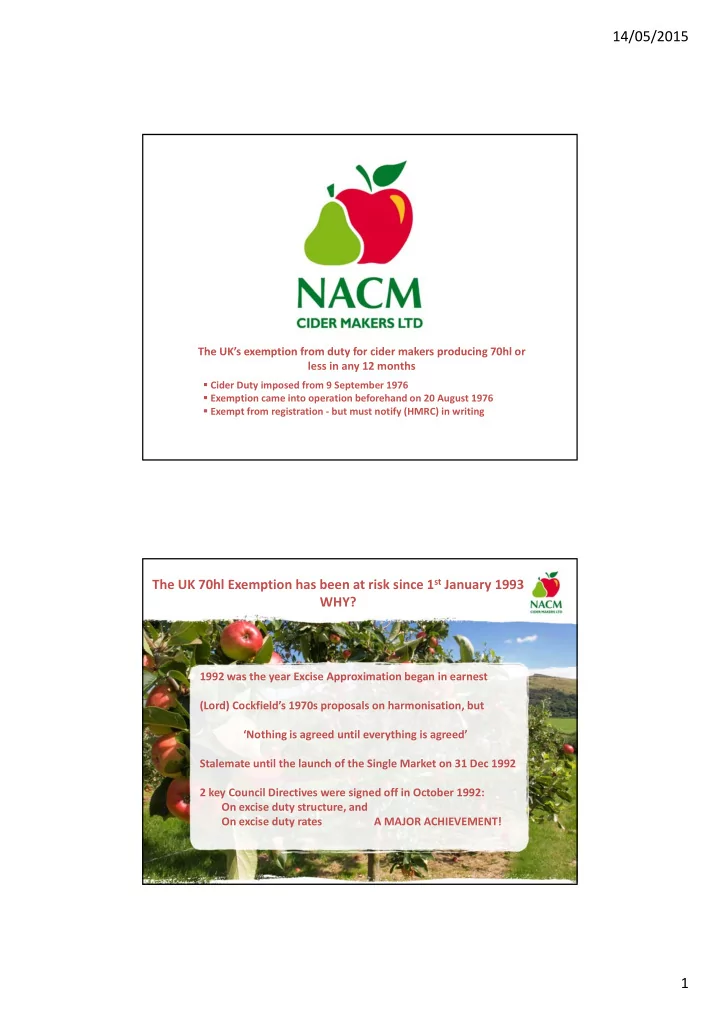
The UK’s exemption from duty for cider makers producing 70hl or The UK s exemption from duty for cider makers producing 70hl or less in any 12 months

  • Cider Duty imposed from 9 September 1976
  • Exemption came into operation beforehand on 20 August 1976
  • Exempt from registration ‐ but must notify (HMRC) in writing

The UK 70hl Exemption has been at risk since 1st January 1993 WHY?

1992 was the year Excise Approximation began in earnest (Lord) Cockfield’s 1970s proposals on harmonisation, but ‘Nothing is agreed until everything is agreed’ Stalemate until the launch of the Single Market on 31 Dec 1992 2 key Council Directives were signed off in October 1992: On excise duty structure, and On excise duty rates A MAJOR ACHIEVEMENT!

slide-2
SLIDE 2

14/05/2015 2

THE 70HL EXEMPTION AT RISK ‐ because attitudes to Wine taxation vary across the EU..

Of the 28 shown: Of the 28 shown: 12 EU MS tax wine at noticeable levels. 16 do not. Cider taxation must be related to wine taxation ‐ and under strict conditions.

Source: EU excise_duties‐part_i_alcohol_en Jan2015 DG Taxud

THE STRUCTURES DIRECTIVE SETS THE RULES: ‐ Cider is a ‘Fermented Beverage other than Wine and Beer’

Council Directive 92/83/EEC of 19/10/92 on the harmonization of the structures..... Condition set:

  • 1. Beer
  • 2. Wine
  • 3. F.B.

(otWB)

  • 4. Intermed.

Products

  • 5. Ethyl

Alcohol

Scope All beer All wine All O.F.B. * All Int. Prods. All E.A. Definition, CN 2203 2204/05 2206 if not 1/2/3 2207/08 ABV range >0.5% ABV >1.2% ‐ ≤15% (≤18%) >1.2% ‐ ≤10% (≤15%) >1.2% ‐ ≤22% >1.2% Duty on Hl/degrees Hl Hl Hl HlPA Nature Per ° alc Bands Bands Bands Per ° alc Reduced ≤50% of N R if If ≤8 5% ABV ≤40% of N R if Reduced rates? ≤50% of N.R. if ≤0.2mHl If ≤8.5% ABV If ≤8.5% ABV (Art. 13.3) ≤40% of N.R. if ≤15% ABV ≤50% of N.R. Conditional on Annual Vol. 1 set per type 1 set per type 1 rate only ≤10Hl p.a. Product exemptions? UK ‐ Conc. Malt Beverage NONE UK ‐ Aromatic bitters (?) Special cond’n * Under Art 15, wine rules/rates apply

slide-3
SLIDE 3

14/05/2015 3

SO – WHAT DOES THE DIRECTIVE DEMAND?

Cider must follow wine rules – and, but for Art.13.3, so also wine duty. The exemption should have been withdrawn on 01 January 1993. What has complicated the situation since 1993? To take appro imation f rther the Commission has been tr in To take approximation further, the Commission has been trying several times to update/amend the Directive, but to no avail. Amendment is likely only to bring other troubles. ‘Nothing is agreed until everything is agreed.’ No new condition can be introduced by itself.

SO –WHERE ARE WE NOW?

It seems the exemption was ‘below the radar’ until October 2012. When the Commission became aware officially it had to act. We understand that HMT has been long in discussion with DG Taxud to defend the status quo. The Commission feels that HMT’s arguments must be tested in the

  • ECJ. The case will not get there for at least a year, probably longer.

Source: NACM from HMRC reports

NACM is representing the whole family of UK cider makers with HMT. NACM is putting all its influence into achieving a workable outcome.

slide-4
SLIDE 4

14/05/2015 4

AND WHERE DO WE GO FROM HERE?

NACM has been told:

  • Treasury counsel at HMT is expected to deliver a legal opinion
  • Treasury counsel at HMT is expected to deliver a legal opinion
  • n the Commission’s case shortly.
  • The UK (HMT) must respond to the Commission in 2 months.
  • We should be prepared to see the exemption abolished in its

current form and seek acceptable alternatives. NACM has pledged HMT to:

  • Work closely with them to ensure that the very small sector

does not suffer.

  • Assist them in exploring options for change, not abandonment.
  • Communicate as widely as possible when the process allows.

Let us hope we can arrive at a better position than before.

slide-5
SLIDE 5

14/05/2015 5

AAAAAAAAAAAAAA

bbbbbbbbbbbbbbb

Source: NACM from HMRC reports and Canadean