10/10/2017 This presentation was delivered on 30 th October 2017, not - - PDF document

10 10 2017
SMART_READER_LITE
LIVE PREVIEW

10/10/2017 This presentation was delivered on 30 th October 2017, not - - PDF document

10/10/2017 This presentation was delivered on 30 th October 2017, not for onward distribution Trading places - Is the turnaround in economic fortunes real, and what might it mean? Neil Parker NatWest Markets FX Market Strategist October 2017


slide-1
SLIDE 1

10/10/2017 1

Trading places - Is the turnaround in economic fortunes real, and what might it mean?

Neil Parker – NatWest Markets FX Market Strategist

October 2017 This presentation was delivered on 30th October 2017, not for onward distribution

The views expressed within this presentation are those of Neil Parker, Market Strategist, Desk Strategy, which is a part of the NatWest Markets business. This is not Independent Research, as defined by the Financial Conduct Authority. This material should be regarded as a marketing communication and may have been produced in conjunction with the NatWest Markets trading desks that trade as principal in the instruments mentioned herein. All data is as at 9th October 2017.

Contents

2

  • The global economy – Inflation up, GDP slow, Euroland improving
  • Monetary policy – US tightening leading the way?
  • The UK –a weaker domestic economy in H1 ’17
  • The UK – is the inflation rise temporary?
  • The labour market –tightening conditions
  • Productivity – a puzzle that needs unlocking
  • Brexit – the timelines
  • The Euroland recovery – changing the ECB’s approach?
  • The US – not all about the dot plots
  • FX markets – has GBP troughed?
  • Summary

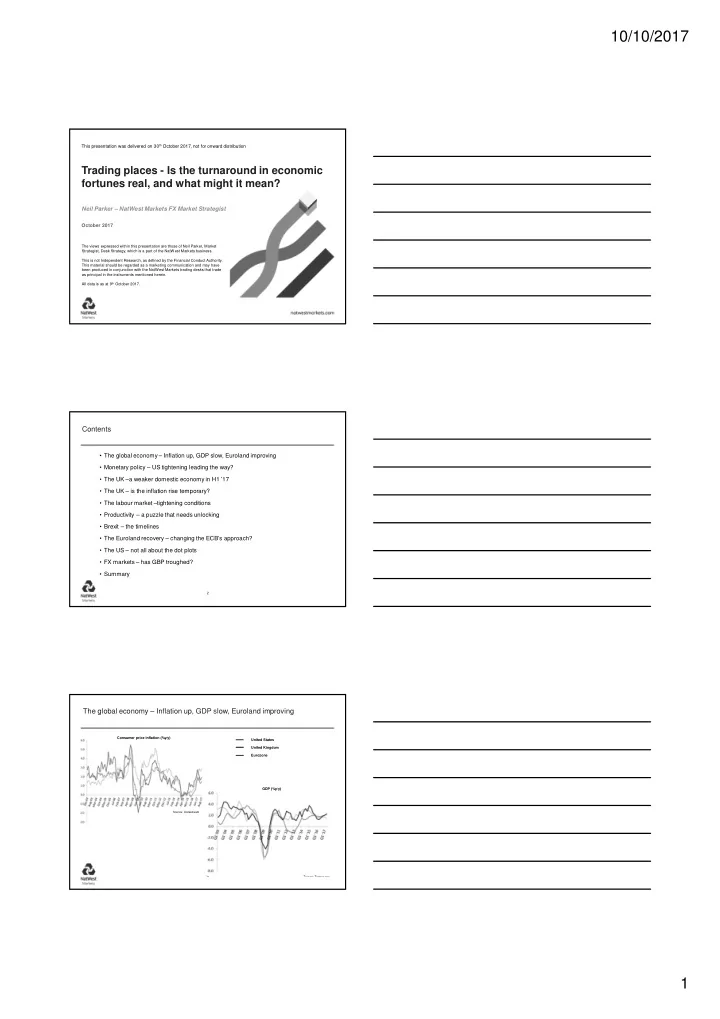
The global economy – Inflation up, GDP slow, Euroland improving

3 United States United Kingdom Eurozone

Source: Datastream Source: Datastream

Consumer price inflation (% y/y) GDP (% y/y)

slide-2
SLIDE 2

10/10/2017 2

4

% Month/year

Source: Datastream US Fed Funds Rate, % UK BoE Bank Rate, % EA ECB Refi Rate, %

Monetary policy – is ultra loose monetary policy still needed? The UK – signs of a weaker domestic economy in H1 ‘17

5

  • The BoE remain willing to accept some overshoot of

inflation, but how much, or is growth still more important than inflation? Source: Datastream % UK consumer spending & retail sales (% y/y) Retail sales Consumer spending UK consumer credit (BoE measure, £bn) Source: Datastream

  • In 2016, consumption expenditure has remained the

solid foundation for growth. H1 & H2 2017 disappointed in the face of higher inflation.

  • UK net trade is expected to help, but the figures have

not yet shown much improvement.

The UK – is the inflation rise temporary?

6

  • Given that the overall GDP deflator (which correlates

closely with CPI inflation) is running around 2.5%, this implies ‘domestic’ inflation is close to 0%.

  • With the effect of the GBP depreciation now working

through the CPI inflation calculation and we could see CPI inflation begin to fall before year end.

  • We estimate that a sustained 15% depreciation

(appreciation) in sterling boosts (lowers) import price inflation by 7.5 percentage points.

  • There is considerable uncertainty about the extent to which

firms will be able to pass on cost increases to consumers and whether this will trigger wage inflation – we are sceptical.

slide-3
SLIDE 3

10/10/2017 3

Productivity – a puzzle that needs unlocking

7 Source: Datastream

  • UK productivity growth was assumed to

trend around 2% prior to the financial crisis, although in reality it was probably a little below this on average.

  • Post the financial crisis we have rarely seen

productivity growth at or close to 2%.

  • A lack of productivity growth would, under

normal circumstances prompt higher levels

  • f inflation.
  • The ONS have recently admitted that UK

unit labour costs are significantly higher in Q2 than originally indicated.

  • Higher unit labour costs could prompt a

change in strategy from the Bank of England, although other areas of the UK economy are underperforming.

%y/y UK unit labour costs - % y/y UK labour productivity - % y/y

Brexit – the timelines

8 The UK/EU Brexit negotiations are set to follow a 3 stage approach: 1) Negotiations on the UK-EU split. 2) Negotiations on the bill for that split, based on the UK’s financial pre-commitments. 3) Negotiations on a future agreement on trade.

The Euroland recovery - changing the ECB’s approach?

9 Euroland manufacturing PMI index

Source: Datastream Source: Datastream

Euroland CPI inflation (%y/y)

  • A recovering Euroland economy has led to higher inflation, but a recovering EUR is

exercising downward pressure on headline rates now.

  • Will the ECB be forced to change their approach given the strength in the data?
slide-4
SLIDE 4

10/10/2017 4

The Euroland recovery - changing the ECB’s approach?

10 Euroland growth & unemployment

Source: Datastream

GDP (LHS %y/y) Unemployment (RHS, %)

The Euroland recovery - changing the ECB’s approach?

11 ECB balance sheet (€bn)

  • A announcement to reduce in the pace of monetary expansion may come in the next few months, but

there seem few signs of a desire to tighten monetary policy over the months and quarters ahead.

  • Perhaps the deposit rate could be made less negative, but given the strength of the EUR, the ECB will

likely be cautious over any such actions.

Source: Bloomberg Source: Bloomberg

ECB refi rate (%)

The US – not all about the dot plots

12

  • The Federal Reserve’s monetary

policy strategy may be switching from just rate increases to balance sheet reduction.

  • Their plan though is likely to be

influenced by the US President’s plans to alter the tax regimes

  • n personal incomes and

corporate profits.

  • His ability to push through this

agenda with the Senate and House will be in part prompted by the debate over the debt ceiling.

  • Tighter US monetary policy and

looser fiscal policy could prompt a significant USD appreciation.

slide-5
SLIDE 5

10/10/2017 5

FX markets – Has GBP troughed?

13 FX forecasts are by NatWest Markets FX Desk Strategy, as contained in the UK Macro Strategy – 6th October 2017

Summary

14

  • Inflation has made a reappearance, and possible US fiscal reforms and GBP depreciation could still prompt

a further rise in UK and US headline inflation rates.

  • The Bank of England are growing increasingly concerned by domestic inflation conditions. The US Federal

Reserve seem set to tighten interest rates again before year end, even after balance sheet reduction, and the ECB could start to rein in loosening.

  • FX rates could make the UK an attractive place to buy from, and buy into, although we are watching for 2nd

round effects of rises from food, clothing and household goods price rises on wages. Will wages be affected by the restrictions in labour supply as net migration rates slow?

  • There are plenty of key events regarding the UK’s decision to leave the EU coming up, and in politics
  • generally. These could be a source of further uncertainty and volatility in the FX/financial markets.
  • Could weak productivity be the source of renewed inflation in the UK as well?

Disclaimer

15