1 PSYC530 wk01 handouts Cognitive Engineering Cognitive Science - - PDF document

1 psyc530 wk01 handouts
SMART_READER_LITE
LIVE PREVIEW

1 PSYC530 wk01 handouts Cognitive Engineering Cognitive Science - - PDF document

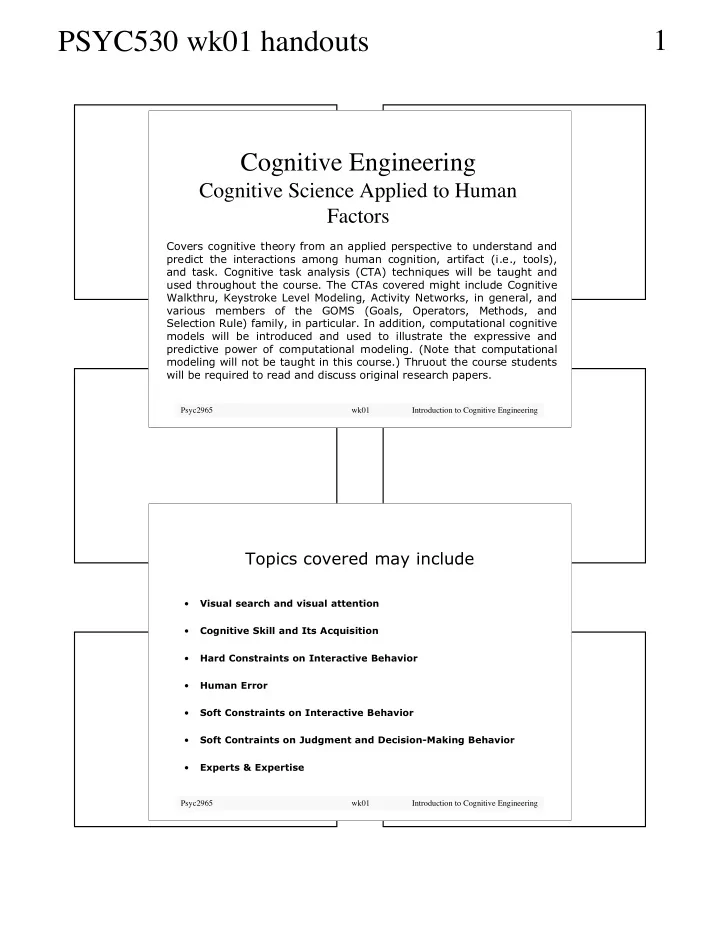
1 PSYC530 wk01 handouts Cognitive Engineering Cognitive Science Applied to Human Factors Covers cognitive theory from an applied perspective to understand and predict the interactions among human cognition, artifact (i.e., tools), and task.


slide-1
SLIDE 1

PSYC530 wk01 handouts 1

Psyc2965 wk01 Introduction to Cognitive Engineering

Cognitive Engineering

Cognitive Science Applied to Human Factors

Covers cognitive theory from an applied perspective to understand and predict the interactions among human cognition, artifact (i.e., tools), and task. Cognitive task analysis (CTA) techniques will be taught and used throughout the course. The CTAs covered might include Cognitive Walkthru, Keystroke Level Modeling, Activity Networks, in general, and various members of the GOMS (Goals, Operators, Methods, and Selection Rule) family, in particular. In addition, computational cognitive models will be introduced and used to illustrate the expressive and predictive power of computational modeling. (Note that computational modeling will not be taught in this course.) Thruout the course students will be required to read and discuss original research papers.

Psyc2965 wk01 Introduction to Cognitive Engineering

Topics covered may include

  • Visual search and visual attention
  • Cognitive Skill and Its Acquisition
  • Hard Constraints on Interactive Behavior
  • Human Error
  • Soft Constraints on Interactive Behavior
  • Soft Contraints on Judgment and Decision-Making Behavior
  • Experts & Expertise
slide-2
SLIDE 2

PSYC530 wk01 handouts 2

Psyc2965 wk01 Introduction to Cognitive Engineering

Techniques covered may include

  • Use of simulated task environments in research
  • Use of eye movement technology
  • Analysis of action log files

Psyc2965 wk01 Introduction to Cognitive Engineering

Cognitive Engineering

Education

HFES

Cognitive Science Artificial Intelligence

IO

slide-3
SLIDE 3

PSYC530 wk01 handouts 3

Psyc2965 wk01 Introduction to Cognitive Engineering

How does Cognitive Engineering Differ from Human Factors?

  • Designing machines that accommodate the limits
  • f the human user is a major concern of the field
  • f human factors.
  • The field of human factors is broader than this

course, and broader than cognitive engineering. Both the course and the program concentrate on designing systems that accommodate the information-processing capabilities of the human mind.

Psyc2965 wk01 Introduction to Cognitive Engineering

Human Factors

  • Goal of Human Factors, to apply knowledge in

designing systems that work, accommodating the limits of human performance and exploiting the advantages of the human operator in the process.

slide-4
SLIDE 4

PSYC530 wk01 handouts 4

Psyc2965 wk01 Introduction to Cognitive Engineering

Cognitive Engineering

  • Is notable for its

– Solid theoretical basis and close relation to theoretical cognitive science – Indeed -- most people who do cognitive engineering research also do basic cognitive research – (Though it is not true that most people who do cognitive engineering also do research.)

Psyc2965 wk01 Introduction to Cognitive Engineering

Theoretical Cognitive Science

  • Unlike cognitive engineering, the Goals of

Theoretical Cognitive Science are

– to uncover laws of behavior through empirical study and cognitive modeling – It is NOT a requirement that cognitive science generate immediately useful knowledge

slide-5
SLIDE 5

PSYC530 wk01 handouts 5

Psyc2965 wk01 Introduction to Cognitive Engineering

Human Factors, Theoretical Cognitive Science, and Cognitive Engineering

  • Cognitive Engineering has its own unique goals

derived from the intersection of these two: Aim of applied cognition is not simply to compare two possible designs for a piece of equipment (role of HF), but to specify the capacities and limitations

  • f the human from which the choice of a better

design should be directly deducible

Adapted from Wickens, 1992

Psyc2965 wk01 Introduction to Cognitive Engineering

Research Credos

  • “There is nothing so useful as a good theory.”

Lewin, K. (1951). Field theory in social science. New York: Harper Row.

  • “Nothing drives basic science better than a

good applied problem.” Newell, A., & Card, S. K. (1985). The

prospects for psychological science in human-computer interaction. Human-Computer Interaction, 1(3), 209-242.

– “The reverse side of the coin is that this practical pressure of technology can also be of benefit to psychological science itself by providing a sustained, concrete set of problems to solve with visibly measurable results.”

slide-6
SLIDE 6

PSYC530 wk01 handouts 6

Psyc2965 wk01 Introduction to Cognitive Engineering

¿Applied Cognition?

  • Subtitle of course is: Cognitive Science

Applied to Human Factors

  • Begs the question of how does cognitive

science inform human factors issue?

Psyc2965 wk01 Introduction to Cognitive Engineering

Simon’s Ant

“A person attempts to achieve his goals by doing those things the task itself requires to be done. Much of the complexity of human behavior derives not from the complexity of the human himself (he is simply trying to achieve his goals), but from the complexity of the task environment in which the goal-seeking takes place” Card, Moran, & Newell, 1983, p. 86.

slide-7
SLIDE 7

PSYC530 wk01 handouts 7

Psyc2965 wk01 Introduction to Cognitive Engineering

The fundamental principle of task analysis

  • Rationality Principle.

A person acts so as to attain his/her goals through rational action, given the structure of the task and the inputs of information, and bounded by limitations on his knowledge and processing ability:

Goals + Task + Operators + Inputs + Knowledge + Process-limits Behavior.. Card, Moran, & Newell, 1983, p. 86.

Psyc2965 wk01 Introduction to Cognitive Engineering

The basic problem for goal-oriented cognition: Task-action mapping

  • From what we want to do:

Saturday 7:00pm 11 8:00pm STARTTIME DOW CHANNEL ENDTIME RECORD StarTrek

DOW = day-of-week

slide-8
SLIDE 8

PSYC530 wk01 handouts 8

Psyc2965 wk01 Introduction to Cognitive Engineering

Task-action mapping

  • To what the artifact requires us to do:

Where “this” involves ≈30 keypresses and the setting and completing of 19 goals and subgoals

EndMode StartMode RECORD StarTrek Program StarTrek SetVCR setMode CS setPROGREC ON STARTTIME Saturday DOW 11 CHANNEL setMode START ENDTIME setMode END SET-HOUR SET-10MIN SET-MIN SET-HOUR SET-10MIN SET-MIN

7 8

Psyc2965 wk01 Introduction to Cognitive Engineering

Newell’s analysis of levels: The Time Scale of Human Action

Activation Conflict Resolution Microstrategies Methods Procedures Subtasks

Activities/ Processes

Parameters 1 ms

0.001

Biological Band (subsymbolic) Architectural Atomic Components 10 ms

0.01

Elements (DME-MA-VA) Production System 100 ms

0.1

Production Rules Embodiment Level 1/3 sec Embodied Cognition Activities 1 sec

1

Cognitive Band (symbolic) Cognitive Task Analysis Unit task 10 sec

10

Unit Task Analysis Subtask min

100

10 min

1000

hours

10000

Bounded Rationality Traditional Task Analysis Task days

100000

Task week

1000000

Education Design months

10000000

Development System years

100000000

Social & Organizational Culture Technology decades

1000000000

World (theory) Analysis System Time Units Scale (sec)

slide-9
SLIDE 9

PSYC530 wk01 handouts 9

Psyc2965 wk01 Introduction to Cognitive Engineering

Why do we need Cognitive Scientists?

  • In Bounded Rationality band?
  • Who cares about the discipline -- as long as

the job gets done?

  • Why not a computer scientist?
  • Why not an experimental psychologist?
  • What do we have to offer that other

disciplines do not?

Psyc2965 wk01 Introduction to Cognitive Engineering

Prospects for Psychological Science

  • Newell & Card (1985)

– Key to this class – Key to Cognitive Engineering as a subdiscipline

  • Hard science drives out soft science
slide-10
SLIDE 10

PSYC530 wk01 handouts 10

Psyc2965 wk01 Introduction to Cognitive Engineering

Hard and Soft Sciences of the Interface

  • Computer Science versus Cognitive Science

and Human Factors

  • Soft and Hard Cognitive Science
  • A Cognitive Science approach to

“hardening” the science of the interface

Psyc2965 wk01 Introduction to Cognitive Engineering

More Problems with Current Approach

  • Build two and I’ll test them
  • So what?
  • Cost-Benefit Tradeoffs?
slide-11
SLIDE 11

PSYC530 wk01 handouts 11

Psyc2965 wk01 Introduction to Cognitive Engineering

Problems of Timing and Form

  • Inputs from Human Factors professionals

are often not effective due to timing and form

– Timing – Form

Psyc2965 wk01 Introduction to Cognitive Engineering

The Vision

  • Get in at the beginning
  • “It’s not just my opinion!”

– Models as the answer! – Answers come from the MODEL not from the MODELER

slide-12
SLIDE 12

PSYC530 wk01 handouts 12

Psyc2965 wk01 Introduction to Cognitive Engineering

Properties of an Engineering- Style Theory of Interactive behavior

  • Task analysis
  • Calculation
  • Approximation

Psyc2965 wk01 Introduction to Cognitive Engineering

Newell’s analysis of levels -- Revisited

Parameters 1 ms 0.001 Biological Band (subsymbolic) Architectural Elements 10 ms 0.01 Elements (DME-MA-VA) Production Rule 100 ms 0.1 Production Rules Embodied Activities (Basic units of embodied cognition) 1/3 sec Microstrategy Analysis Activities 1 sec 1 Cognitive Band (symbolic) Cognitive Task Analysis Unit task 10 sec 10 Unit Task Analysis Subtask min 100 10 min 1000 hours 10000 Bounded Rationality Traditional Task Analysis Task days 100000 Task week 1000000 Education Design months 10000000 Development System years 100000000 Social & Organizational Culture Technology decades 1000000000

World (theory) Analysis System Time Units Scale (sec)

slide-13
SLIDE 13

PSYC530 wk01 handouts 13

Psyc2965 wk01 Introduction to Cognitive Engineering

Cognitive Bounded Rationality How are the cognitive and bounded rationality bands connected?

– Time duration of most activities that HF worries about lies in both the cognitive and bounded-rationality bands – “Psychology delivers to the bounded-rationality band the model that must be used to understand what helps the user and how” (N&C, 85). – Understanding how the task is done, requires understanding the tools available for doing the task. A cognitive task analysis, as opposed to simply a task analysis, takes into consideration the information processing tools that humans bring.

That is, the cognitive band supplies the operators and processing- limits (the ant) called for by the rationality principle. Likewise the

  • nly inputs (the beach) that matter, are those that can be operated

upon at the cognitive level.

Psyc2965 wk01 Introduction to Cognitive Engineering

Tool, device,

  • r interface
slide-14
SLIDE 14

PSYC530 wk01 handouts 14

Psyc2965 wk01 Introduction to Cognitive Engineering

Traditional Research in Cognitive Psychology

Psyc2965 wk01 Introduction to Cognitive Engineering

Traditional Human Factors

slide-15
SLIDE 15

PSYC530 wk01 handouts 15

Psyc2965 wk01 Introduction to Cognitive Engineering

Traditional Engineering

Psyc2965 wk01 Introduction to Cognitive Engineering

The Cognitive Engineering Perspective: Taking the ETA triad seriously

Artifact Interactive Behavior Embodied Cognition Task