SLIDE 1 1
YSU YSU
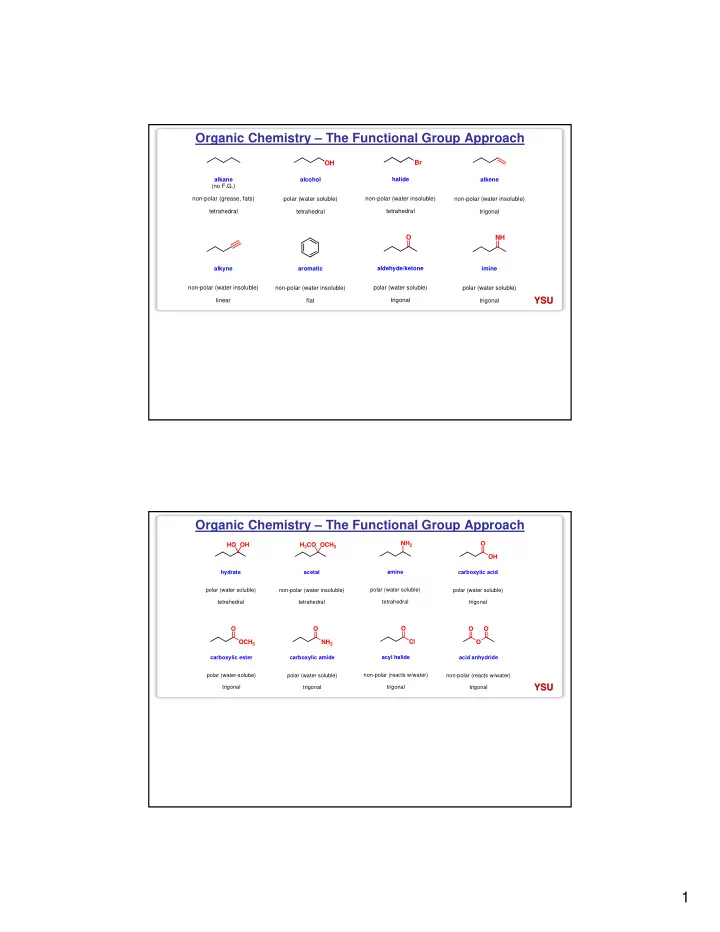
Organic Chemistry – The Functional Group Approach
alkane (no F.G.) non-polar (grease, fats) tetrahedral
OH
alcohol polar (water soluble) tetrahedral
Br
halide non-polar (water insoluble) tetrahedral alkene non-polar (water insoluble) trigonal alkyne non-polar (water insoluble) linear aromatic non-polar (water insoluble) flat aldehyde/ketone polar (water soluble) trigonal imine polar (water soluble) trigonal
O NH
YSU YSU
Organic Chemistry – The Functional Group Approach
OCH3
carboxylic ester polar (water-solube) trigonal
NH2
carboxylic amide polar (water soluble) trigonal
Cl
acyl halide non-polar (reacts w/water) trigonal
O
acid anhydride non-polar (reacts w/water) trigonal
O O O O O
hydrate polar (water soluble) tetrahedral acetal non-polar (water insoluble) tetrahedral amine polar (water soluble) tetrahedral
OH
carboxylic acid polar (water soluble) trigonal
NH2 O HO OH H3CO OCH3
SLIDE 2 2
YSU YSU
Organic Chemistry – The Functional Group Approach
alkane (no F.G.) non-polar (grease, fats) tetrahedral
OH
alcohol polar (water soluble) tetrahedral
Br
halide non-polar (water insoluble) tetrahedral alkene non-polar (water insoluble) trigonal alkyne non-polar (water insoluble) linear aromatic non-polar (water insoluble) flat aldehyde/ketone polar (water soluble) trigonal imine polar (water soluble) trigonal
O NH
YSU YSU
Organic Chemistry – The Functional Group Approach
alkane (no F.G.) non-polar (grease, fats) tetrahedral
OH
alcohol polar (water soluble) tetrahedral
Br
halide non-polar (water insoluble) tetrahedral alkene non-polar (water insoluble) trigonal alkyne non-polar (water insoluble) linear aromatic non-polar (water insoluble) flat aldehyde/ketone polar (water soluble) trigonal imine polar (water soluble) trigonal
O NH
SLIDE 3
3
YSU YSU
Carey Chapter 4 – Alcohols and Alkyl Halides
Figure 4.2 – Electron density maps of CH3OH and CH3Cl
YSU YSU
Alcohols and Halogens in Medicine and Nature
Chloramphenicol Acetaminophen
O2N HN O OH OH Cl Cl
Valium
SLIDE 4 4
YSU YSU
4.2 IUPAC Nomenclature of Alkyl Halides
- Functional class nomenclature
pentyl chloride cyclohexyl bromide 1‐methylethyl iodide
- Substitutive nomenclature
2‐bromopentane 3‐iodopropane 2‐chloro‐5‐methylheptane YSU YSU
4.3 IUPAC Nomenclature for Alcohols
1‐pentanol cyclohexanol 2‐propanol 2‐pentanol 1‐methyl cyclohexanol 5‐methyl‐2‐heptanol
SLIDE 5
5
YSU YSU
4.4 Classes of Alcohols and Alkyl Halides
Cl OH Br OH I Cl Br CH3 (CH3)3COH CH2CH3 Cl Primary (1o) Secondary (2o) Tertiary (3o) YSU YSU
4.5 Bonding in Alcohols and Alkyl Halides
Figure 4.1
SLIDE 6
6
YSU YSU
4.5 Bonding in Alcohols and Alkyl Halides
Figure 4.2 – Electron density maps of CH3OH and CH3Cl
YSU YSU
4.6 Physical Properties – Intermolecular Forces
CH3CH2CH3 CH3CH2F CH3CH2OH
propane fluoroethane ethanol
b.p. ‐42 oC ‐32 oC 78 oC
SLIDE 7
7
YSU YSU
4.6 Physical Properties – Intermolecular Forces
Figure 4.4
YSU YSU
4.6 Physical Properties – Intermolecular Forces
Figure 4.4
SLIDE 8
8
YSU YSU
4.6 Physical Properties – Water Solubility of Alcohols
Alkyl halides are generally insoluble in water (useful in lab)
YSU YSU
4.6 Physical Properties – Water Solubility of Alcohols
Solubility is a balance between polar and non‐polar characteristics
SLIDE 9
9
YSU YSU
4.6 Physical Properties – Water Insolubility
Biochemistry involves a delicate balance of “like dissolves like”
Cholesterol – non‐polar alcohol Limited solubility in water Precipitates when to concentrated Results in gallstones
YSU YSU
4.7 Preparation of Alkyl Halides from Alcohols and H-X
R OH + H X R X + H O H alcohol hydrogen halide alkyl halide water
Lab Conditions
SLIDE 10
10
YSU YSU
4.8 Mechanism of Alkyl Halide Formation
Mechanism – a description of how bonds are formed and/or broken when converting starting materials (left hand side) to products (right hand side)
Usually involves solvents and reagents, sometimes catalysts Curved arrows are used to describe the chemical changes YSU YSU
4.8 Reaction of a Tertiary Alcohol with H-Cl
Look for chemical changes – which bonds are formed or broken?
learn the outcome of reaction in order to get going quickly recognize the nature of the organic substrate (1o, 2o, 3o?) be aware of the reaction conditions (acidic, basic, neutral?)
SLIDE 11
11
YSU YSU
4.8 Reaction of a Tertiary Alcohol with H-Cl
YSU YSU
4.8 Energetic description of mechanism - Step 1 : protonation
Figure 4.6
SLIDE 12
12
YSU YSU
4.8 Energetic description of mechanism - Step 2 : carbocation
Figure 4.7
YSU YSU
4.8 Energetic description of mechanism - Step 3 : trap cation
Figure 4.9
SLIDE 13
13
YSU YSU
4.9 Full mechanism “pushing” curved arrows
H3C C H3C H3C O H H Cl H3C C H3C H3C Cl H3C C H3C H3C O H H C CH3 H3C CH3 Cl Cl (+ H2O) H Cl (- H2O)
YSU YSU
4.9 Full SN1 mechanism showing energy changes
Figure 4.11
SLIDE 14
14
YSU YSU
4.10 Carbocation structure and stability
Figure 4.8
YSU YSU
Hyperconjugation – the donation of electron density from adjacent single bonds
4.10 Carbocation structure and stability
Figure 4.15
SLIDE 15
15
YSU YSU
4.10 Relative carbocation stability
Figure 4.12
YSU YSU
4.11 Relative rates of reaction of R3COH with HX
Related to the stability of the intermediate carbocation:
SLIDE 16
16
YSU YSU
4.11 Relative rates of reaction of R3COH with HX
Rate‐determining step involves formation of carbocation
Figure 4.16
YSU YSU
4.12 Reaction of methyl- and 1o alcohols with HX – SN2
Same bonds are formed and broken as in 3o case, however;
CH3 and 1o carbon cannot generate a stabilized carbocation kinetic studies show the rate‐determining step is bimolecular sequence of bond‐forming/breaking events must be different
SLIDE 17
17
YSU YSU
4.12 Reaction of methyl- and 1o alcohols with HX – SN2
Alternative pathway for alcohols that cannot form a good carbocation
YSU YSU
4.12 Geometry changes during SN2
http://www.bluffton.edu/~bergerd/classes/cem221/sn‐e/SN2.gif
SLIDE 18
18
YSU YSU
4.12 Energy profile for SN2 reaction
YSU YSU
4.13 Other methods for converting ROH to RX
OH PBr3 Br SOCl2 Cl
Convenient way to halogenate a 1o or 2o alcohol Avoids use of strong acids such as HCl or HBr Via SN2 mechanism at 1o and CH3 groups
SLIDE 19
19
YSU YSU
4.14 Free Radical Halogenation of Alkanes
heterolytic homolytic Possible modes of bond cleavage
YSU YSU
4.15 Free Radical Chlorination of Methane
CH4 + Cl2 CH3Cl + Cl2 (~400oC) CH2Cl2 + Cl2 CHCl3 + Cl2 (~400oC) (~400oC) (~400oC) CH3Cl + HCl CH2Cl2 + HCl CHCl3 + HCl CCl4 + HCl
SLIDE 20
20
YSU YSU
4.16 Structure and stability of Free Radicals
Figure 4.17 – Bonding models for methyl radical YSU YSU
4.16 Structure and stability of Free Radicals
Free radical stability mirrors that of carbocations Hyperconjugation is the main factor in stability Experimental evidence that radicals are flat (sp2)
SLIDE 21
21
YSU YSU
4.16 Bond Dissociation Energies (BDE)
YSU YSU
4.16 Bond Dissociation Energies (BDE)
104 58 83.5 103
SLIDE 22
22
YSU YSU
4.17 Mechanism for Free Radical Chlorination of Methane
YSU YSU
4.17 Mechanism for Free Radical Chlorination of Methane
SLIDE 23
23
YSU YSU
4.17 Mechanism for Free Radical Chlorination of Methane
YSU YSU
4.17 Mechanism for Free Radical Chlorination of Methane
SLIDE 24
24
YSU YSU
4.18 Free Radical Halogenation of Higher Alkanes
YSU YSU YSU YSU
4.18 Free Radical Halogenation of Higher Alkanes
Radical abstraction of H is selective since the stability of the ensuing radical is reflected in the transition state achieved during abstraction. Cl H CH2CH2CH2CH3 Cl H CHCH2CH3 CH3 Lower energy radical, formed faster
SLIDE 25
25
YSU YSU
4.18 Free Radical Halogenation of Higher Alkanes
Figure 4.16
YSU YSU
4.18 Bromine radical is more selective than chlorine radical
Consider propagation steps – endothermic with Br∙, exothermic with Cl∙
SLIDE 26
26
YSU YSU
4.18 Bromine radical is more selective than chlorine radical
Bromination – late TS looks a lot like radical Chlorination – early TS looks less like radical